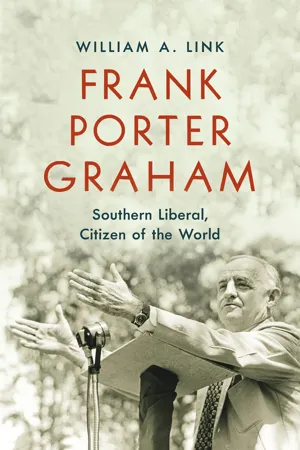
Frank Porter Graham (1886–1972) was one of the most consequential white southerners of the twentieth century. Born in Fayetteville and raised in Charlotte, Graham became an active and popular student leader at the University of North Carolina. After earning a graduate degree from Columbia University and serving as a marine during World War I, he taught history at UNC, and in 1930, he became the university’s fifteenth president. Affectionately known as “Dr. Frank,” Graham spent two decades overseeing UNC’s development into a world-class public institution. But he regularly faced controversy, especially as he was increasingly drawn into national leadership on matters such as intellectual freedom and the rights of workers. As a southern liberal, Graham became a prominent New Dealer and negotiator and briefly a U.S. senator. Graham’s reputation for problem solving through compromise led him into service under several presidents as a United Nations mediator, and he was outspoken as a white southerner regarding civil rights.
Brimming with fresh insights, this definitive biography reveals how a personally modest public servant took his place on the national and world stage and, along the way, helped transform North Carolina.
- 392 pages
- English
- ePUB (mobile friendly)
- Available on iOS & Android
eBook - ePub
About this book
Information
1
Beginnings
One of Frank Porter Graham’s earliest memories, as a five-year-old, was when his father, Alexander, visited with Edwin A. Alderman and Charles D. McIver. Sitting in the Graham household, McIver remembered how, on the night of their graduation from UNC in 1881, he and Alderman were swept up into a new gospel of education. In 1889, Alderman and McIver persuaded the North Carolina legislature to finance three years of teachers’ institutes in order to evangelize the gospel of modern education. Alexander became among the most enthusiastic “conductors” of the teacher institutes.1 The institutes’ conductors, among them Graham, Alderman, and McIver, urged teachers to complete an examination leading to certification as a way of improving the quality of public education. In addition, they became educational evangelists, eventually traveling 3,100 miles to speak before 3,600 teachers and 35,000 people.2 Listening to the men express their bond in education, Frank was entranced. He recalled the conversation as “like the milk from my mother’s breast to me.”3
A decade older than these men, Alexander Graham shared their enthusiasm for public education and common experiences as school superintendents in late nineteenth-century North Carolina towns. McIver, like Alexander, descended from Highland Scots in the Upper Cape Fear region. He also attended UNC, taught school, and led schools in Durham and Winston. In 1891, McIver successfully opened a new publicly supported women’s college in Greensboro, the State Normal and Industrial School. Alderman, originally from Wilmington, studied at UNC and then worked in Goldsboro under the tutelage of reforming school superintendent Edward Pearson Moses and eventually became superintendent of that town’s schools. In 1891, McIver recruited Alderman to join the State Normal faculty. Alderman subsequently became president of UNC in 1895, Tulane University in 1900, and the University of Virginia in 1905.4
Establishing modern public schools was no easy task. In 1880, nearly half of North Carolinians were illiterate, that is, unable to write their names, including two-thirds of African Americans and nearly 29 percent of whites.5 These grim statistics resembled the rest of the South; illiteracy offered visible evidence of backwardness. Other late nineteenth-century North Carolinians believed that the state’s social problems were urgent. Another of Alderman and McIver’s generation, Walter Hines Page, a journalist who fled the state in the late 1880s for the North, became a leading publisher and, after 1900, an advocate of change. While in North Carolina in early 1886, Page concluded that its leaders ill served the state. Enterprising young people left the state in droves, he claimed. The state’s rulers were nothing more than “mummies,” dead in mind and spirit, and living in the past. They feared intellectual inquiry or honest investigation, and those with initiative and who told the “plain truth” were accused of treason, or having become “Yankeeized.” North Carolinians, Page maintained, should “rise up and say plainly . . . that the controlling forces, the spokesmen and the mummies of North Carolina to-day must be rid of power.” In order to achieve real change, the state awaited “a few first-class funerals.”6 With many white and Black illiterates and extensive poverty, there was a consensus that education could serve as a basis for North Carolina’s awakening.
Alexander Graham and many of his contemporaries served in the Confederate military. The Civil War, only two decades past, cast a long shadow over late nineteenth-century North Carolina. The war’s aftermath became a dead weight, with Page’s mummies remaining in control. The war had radically changed the region’s social system, freeing millions of enslaved men and women while reconstructing slavery’s racial hierarchy into a different form. Railroads expanded to such an extent that the new transportation network reached most of North Carolina’s hinterlands, fueling growing towns and an emerging cotton textile industry. Alexander realized the new opportunities during the postwar era, but he also could not ignore the persistent poverty and underdevelopment that characterized what was called the “Rip Van Winkle” state.
Alexander grew up in the Upper Cape Fear valley, an enclave of Scottish culture even in the mid-nineteenth century. Nearly 20,000 Highland Scots arrived in the mid-eighteenth century as part of the rush of immigrants peopling the frontier of the Carolina backcountry. These Scottish Presbyterians, devoted to church, reading and literacy, and community-building, subscribed to a Calvinist conception of Christian calling, the belief that Presbyterians had an obligation to service in professions like the ministry, the law, and teaching. Alexander, who was born on September 12, 1844, to tailor and farmer Archibald Graham and his wife Anne McLean, grew up in rural Cumberland County, about four miles northwest of Fayetteville. His parents were by no means poor; in 1810, Archibald owned eight slaves. Fifty years later, in 1860, he reported to the census taker $6,800 in real estate and $18,870 in personal property, wealth that placed the family in a higher social status. Much of that wealth came from Alexander’s mother, Anne, whose great-grandfather, Alexander McAlister, was a Whig leader during the Revolution. McAlister served as a member of the Wilmington Committee of Safety and the 1775–76 North Carolina provincial congresses. He signed the Halifax Resolves, an early demand for independence from Britain, and served as a colonel in the local militia.
Members of Alexander’s family, like other North Carolinians, were swept up into the Civil War. In July 1862, his older brother Archie enlisted as a private in the Fifth Regiment, North Carolina cavalry. During 1863–64, Archie served as courier for Confederate generals Joseph Gordon, Fitzhugh Lee, Wade Hampton, and J. E. B. Stuart. On April 26, 1865, Archie was at Greensboro when Gen. Joseph Johnston’s 90,000-strong Army of Tennessee surrendered to Union commander William T. Sherman near Durham at Bennett Place.7 Alexander, an adolescent, missed most of the war, and his military career was briefer than Archie’s and most likely did not involve major combat. Privately educated, Alexander began teaching at age sixteen, working two years at the Richmond Academy, near Spring Hill, North Carolina. At twenty years old, only months before the Civil War ended, Alexander joined the Third North Carolina Home Guard, which Confederates raised in Cumberland County. One account reported Alexander’s capture at Bentonville, fought on March 19–21, 1865, between Sherman’s invading armies and Confederate defenders under Joseph Johnston. But the evidence remains slender. Alexander subsequently applied for a Confederate pension in 1926; after his death, his wife continued to receive the pension provided by the North Carolina state government, but there is no other record clearly documenting his service.8
When the war ended, Graham taught school in Bladen County, but, on his own and impoverished, he also ran a peddler’s wagon in South Carolina. In September 1866, Alexander managed to save enough money to enroll at the University of North Carolina, where he joined the Philanthropic Literary Society and in 1867 served as captain of the university’s first baseball team. During Reconstruction, UNC was in a perilous condition after Republicans took control of the university in 1868 and enemies of Reconstruction, opposing Republican influence in state institutions, refused to accept their leadership. In 1871, only two years after Graham and seventeen other students graduated in 1869, an anti-Republican boycott closed UNC for five years.
When Walter Hines Page, in his mummy letters, reported the exodus of enterprising North Carolinians, he listed Franklin Porter, Tarboro native, Alexander’s UNC classmate and Frank Porter Graham’s namesake. Frank later called Porter “one of the best friends my father ever had.” After spending two years at UNC with Alexander, Porter finished his undergraduate degree at Yale and then studied law at Columbia University. After practicing in Fayetteville, Porter eventually moved to St. Joseph, Missouri, where he established a prosperous law practice.9 A UNC classmate of Porter’s and Alexander’s, R. H. Lewis, later a Raleigh physician, recalled how as children Porter had rescued him when he went swimming in the Tar River and almost drowned. Lewis was disabled in one of his legs, and the river current was too strong, forcing him under. Porter dove in and pulled him back to shore. When Frank Graham, as an adult, went to Lewis for medical treatment, he refused to charge a fee. “I will not accept payment for this service,” Lewis said, “to a boy who was named for the boy who saved my life.”10
Perhaps encouraged by Porter, who studied law at Columbia University, Alexander secured a job at the Columbia Grammar School in 1871. Teaching during the day, Alexander also completed a law degree in 1873 at Columbia by finishing many of his classes at night. He returned to Fayetteville in 1875, where he obtained a law license and was for three years a practicing attorney. Soon after his move to Fayetteville, on January 28, 1875, Alexander married nineteen-year-old Katherine “Kate” Sloan. Kate’s ancestors were mostly English, propertied, and established members of the planter class. Henry Sloan lived in southeastern Virginia and served in the House of Burgesses from 1657 to 1661. About a century later, his great-great-grandson, David Sloan, migrated to the Cape Fear region, then a North Carolina frontier. Kate was David’s great-granddaughter, the fifth of seven children. Her father, David Dickson Sloan, was a physician who lived in the Ingold neighborhood of southern Sampson County, east of the Cape Fear River.11
Frank’s familial influences were powerful, shaping his worldview. His parents, according to one account, were “strikingly different in bearing and temperament.”12 He resembled his mother, who was born on March 5, 1855, in Garland, Sampson County. She was five feet tall; Frank was five foot four. Compared to the more reserved Alexander, Kate was warm and outgoing. Nonetheless, the example of his father profoundly influenced the views of his son. Frank internalized his father’s faith in the importance of education, traveling with him and observing his missionary zeal. As a stout Presbyterian, Alexander ensured that all of his children attended college, a rare feat among nineteenth-century southerners.
Alexander’s time in Fayetteville proved formative.13 Created in 1783 by the merger of the smaller towns of Cross Creek and Campbellton, Fayetteville was named in honor of the Marquis de Lafayette, the Revolutionary War hero. Located at the fall line of the Cape Fear River, beyond which rapids became less navigable, Fayetteville during the antebellum era became a transfer point for cargoes arriving from the North Carolina Piedmont on three plank roads terminating in the town. Paddlewheel, flat-bottom steamboats transported people and goods such as tobacco, cotton, turpentine, wheat, and lumber from Fayetteville to Wilmington. By the Civil War, the town, with a population of more than 4,000, had become the largest community in the Upper Cape Fear region and the third largest in the state.
Although Fayetteville served as a transportation and weapons manufacturing hub for the eastern Confederate armies, its postwar recovery was slow, and the town did not regain its antebellum population until the twentieth century. Concerned about the town’s future, Fayetteville leaders turned to schooling, and during the summer of 1878 town leaders organized a new, modern graded school. Graded-school education had become a marker of town development. These modern school systems, popular in urban settings during the Gilded Age, offered professionalized teaching, upgraded and permanent facilities, and improved pedagogy, while they also provided a new approach to socialization and training for citizenship. Schools, according to graded-school advocates, could trigger a social transformation.14 In contrast to rural schools, in which all ages were amalgamated, urban graded schools organized grades and constructed permanent wood or brick facilities. With money from the George Peabody Fund, plus $3,000 raised by public subscription, Fayetteville leaders during the summer of 1878 turned to Alexander Graham to lead the new all-white school.15 Town leaders wanted what other growing late nineteenth-century urban communities already possessed—modern schools. Graham now saw his Christian calling not in the law but in teaching.16
In charge of Fayetteville schools for a decade, Graham constructed a model town school system.17 He participated in the Summer School for Teachers at UNC, an early effort at teacher training, where he met aspiring schoolmen such as Alderman and McIver. Using Peabody support, the state school superintendent also operated summer teacher training, or normals; Alexander taught summer normals in Washington, Wilson, Elizabeth City, Newton, and Franklin.18 The early historian of southern education Edgar Wallace Knight described Alexander’s “simplicity, sincerity, unaffected dignity, engaging humor, fidelity to duty, devotion to the public weal, and a clear conscience in the hour of death.” He had, according to Knight, qualities of “gentleness, sweet reasonableness, potent personal charm, a sensitive intellectuality, and the calm rationality of philosopher and sage.” A person of “extraordinary stamina,” he was a “hard fighter, but always in the open.” Alexander had linguistic ability, according to Knight, who described how he gained a “fair mastery” of Spanish at the age of seventy-five.19
In early 1888, the Charlotte school board was looking for a new graded-school superintendent, and, after a search in which twenty-five people applied—including Alderman—Alexander was elected to the position on February 16, 1888, taking charge two days later.20 His reputation, one newspaper put it in 1891, grew into “one of the best known, brightest and most energetic educators in all North Carolina.”21 In 1895, Alexander took an exhibit of a model graded school to the Cotton States Exposition in Atlanta.22 A year later, the Charlotte Democrat praised his “progressive methods, executive capacity and eminent fitness” as well as the “high state of efficiency” of the Charlotte schools.23 A well-respected community leader, Alexander led local efforts to refashion Charlotte’s history by promoting the subsequently debunked idea that the first Declaration of Independence was signed in Charlotte on May 31, 1775, a year before Thomas Jefferson penned his more famous document.24 On November 2, 1934, Alexander died in his ninetieth year, according to a contemporary, the “most honored and beloved school man in the state.”25
Alexander’s growing family included Frank Porter Graham, the sixth of nine children and the fourth son, who was born in Fayetteville on October 14, 1886, and named for Alexander’s good friend Franklin Porter. When Frank was a child, the Grahams lived in a two-story, four-bedroom house at 1001 South Brevard Street, at the intersection with Liberty Street, near the cen...
Table of contents
- Cover Page
- Title Page
- Copyright Page
- Contents
- Preface
- Introduction
- 1 Beginnings
- 2 University Man
- 3 War and Its Aftermath
- 4 The UNC Presidency
- 5 Angels of Darkness
- 6 The New Deal Comes South
- 7 The Limits of Gradualism
- 8 A Practical Philosopher of Compromise
- 9 Postwar Crises
- 10 The Anti-Communist Attack
- 11 A Tocsin of Democratic Decency
- 12 Peacemaker
- Epilogue: Champion of Peace and Freedom
- Acknowledgments
- Notes
- Bibliography
- Index
- Series Editor’s Note
- Back Cover
Trusted by 375,005 students
Access to over 1.5 million titles for a fair monthly price.
Study more efficiently using our study tools.
Frequently asked questions
Yes, you can cancel anytime from the Subscription tab in your account settings on the Perlego website. Your subscription will stay active until the end of your current billing period. Learn how to cancel your subscription
No, books cannot be downloaded as external files, such as PDFs, for use outside of Perlego. However, you can download books within the Perlego app for offline reading on mobile or tablet. Learn how to download books offline
Perlego offers two plans: Essential and Complete
- Essential is ideal for learners and professionals who enjoy exploring a wide range of subjects. Access the Essential Library with 800,000+ trusted titles and best-sellers across business, personal growth, and the humanities. Includes unlimited reading time and Standard Read Aloud voice.
- Complete: Perfect for advanced learners and researchers needing full, unrestricted access. Unlock 1.5M+ books across hundreds of subjects, including academic and specialized titles. The Complete Plan also includes advanced features like Premium Read Aloud and Research Assistant.
We are an online textbook subscription service, where you can get access to an entire online library for less than the price of a single book per month. With over 1.5 million books across 990+ topics, we’ve got you covered! Learn about our mission
Look out for the read-aloud symbol on your next book to see if you can listen to it. The read-aloud tool reads text aloud for you, highlighting the text as it is being read. You can pause it, speed it up and slow it down. Learn more about Read Aloud
Yes! You can use the Perlego app on both iOS and Android devices to read anytime, anywhere — even offline. Perfect for commutes or when you’re on the go.
Please note we cannot support devices running on iOS 13 and Android 7 or earlier. Learn more about using the app
Please note we cannot support devices running on iOS 13 and Android 7 or earlier. Learn more about using the app
Yes, you can access Frank Porter Graham by William A. Link in PDF and/or ePUB format, as well as other popular books in History & Education Biographies. We have over 1.5 million books available in our catalogue for you to explore.