eBook - ePub
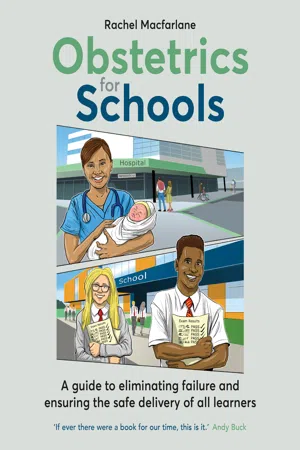
Obstetrics for Schools
Eliminating failure and ensuring the safe delivery of all learners
- 272 pages
- English
- ePUB (mobile friendly)
- Available on iOS & Android
eBook - ePub
Obstetrics for Schools
Eliminating failure and ensuring the safe delivery of all learners
About this book
In
Obstetrics for Schools: A guide to eliminating failure and ensuring the safe delivery of all learners, Rachel Macfarlane presents a powerful manifesto for school leaders and teachers on how they can bridge the advantage gap and deliver positive outcomes for all pupils.
In most parts of the world, the death of a baby in childbirth is now a rare tragedy rather than a common occurrence - and it would be considered shocking for medical staff to accept a significant infant fatality rate. It's also inconceivable that a hospital would have a successful delivery target much below 100%.
How could anything else be acceptable in this day and age?
Yet there is an expectation, and acceptance, of 'baked in' educational failure for around a third of 16-year-olds in UK schools each year. Such outcomes need addressing, and this book does just that.
In
Obstetrics for Schools, Rachel Macfarlane draws on her experience as a head teacher and system leader to share a multitude of practical strategies for overcoming potential barriers to success, presenting case studies and examples of effective practice from schools across the country.
The book illustrates an up-to-date and research-informed picture of the current state of the education system and offers sage guidance on how schools can do more for each and every student. In doing so, Rachel provides a range of fresh approaches to school provision which have been proven to have an impact in a variety of challenging contexts.
Each chapter focuses on a key potential barrier to success and offers school leaders and practitioners a range of strategies to help dismantle them. The book also provides guidance on strategic planning, as well as a variety of ideas and inspiration for staff training.
Suitable for school leaders and teachers in all phases, from early years to sixth form, and in both mainstream and special education.
Information
Topic
EducationSubtopic
Education GeneralChapter 1
The problem laid bare
The best anti-poverty program is a world-class education.
Barack Obama1
We need to remember that societies are strong when they care for the weak. They are rich when they care for the poor. And they are invulnerable when they care for the vulnerable.
Rabbi Sacks2
Let’s jump straight in and take a look at some sobering facts and statistics which illustrate the problem we face:
- ‘By age five, children from low-income backgrounds are, on average, 15 months behind their better-off peers.’ (Gadsby 2017: 12)
- ‘Children from wealthier backgrounds are approximately 20 percentage points more likely to meet the expected standards at 11 than those from low-income families.’ (Gadsby 2017: 14)
- In 2019, only 45% of disadvantaged pupils in England achieved passes at levels 9 to 4 in English and maths, compared with 72% of non-disadvantaged pupils. (Starkey-Midha 2020: 4)
- The disadvantage gap has now begun to widen across all three phases of education – the early years, primary school and secondary school. (Hutchinson et al. 2020: 11)
- ‘The gap for the most persistently disadvantaged pupils, already twice the size of the gap for the least persistently poor pupils, has increased in every year but one since 2014.’ (Hutchinson et al. 2020: 32)
- ‘Since 2011, the gap between pupils from black and White British backgrounds has increased in the order of 60–70 per cent. Meanwhile, the gap for pupils who arrive late into the English state school system with English as an Additional Language (EAL) has widened by 11 per cent.’ (Hutchinson et al. 2020: 32)
- For SEND pupils, progress in closing the gap for both school support and education, health and care plan (EHCP) pupils has slowed since 2015, ‘and reversed for pupils with the greatest needs.’ (Hutchinson et al. 2020: 32)
- ‘By Year 13 (age 17), nearly one in three young people eligible for free school meals are not participating in education, compared to only one in seven not eligible.’ (Gadsby 2017: 20)
- ‘24% of pupils eligible for free school meals attend higher education, compared to 42% of non-free school meal pupils.’ (Gadsby 2017: 24)
- Low-income undergraduates are less likely to stay on a university course. ‘Each year, one in 12 university freshers from a low-income background drops out, some 2,000 students in total.’ (Gadsby 2017: 26)
- ‘Students from higher income families earn around 25% more than those from low-income families. […] three and a half years after graduation […] privately educated graduates earn £4,500 more than their state school counterparts. Their salaries also increase more quickly.’ (Gadsby 2017: 28)
- ‘Without five good GCSEs, a young person loses out on an average of £100,000 in earnings over their lifetime.’ (Starkey-Midha 2020: 3)
- ‘Every graduate Prime Minister since 1945 has been an Oxford alumnus.’ (Gadsby 2017: 34)
- The cost of poor social mobility to the UK economy per year by 2050 is estimated to be 14 billion. (Gadsby 2017: 10)
- ‘If you’re born poor, you will die on average 9 years earlier than others.’ (Prime Minister’s Office and May 2016)
These figures speak for themselves. They convey the moral imperative for educators to take action.
In summary, we know that, compared with ‘other OECD countries, children in the UK are more likely to achieve along socio-economically predictable lines; well-to-do children tend to achieve higher outcomes than children raised in poverty’ (Goodall 2017a: 4). Disadvantaged children are over-represented in the tail of low attainment in our schools. In July 2019, the annual report by the Education Policy Institute (EPI) warned that disadvantaged pupils finish school 18 months behind their more advantaged peers (Hutchinson et al. 2019: 10). A year later, the 2020 report announced the sobering news that the gap had expanded to 18.1 months, and 22.7 months for the persistently disadvantaged (those eligible for FSM for 80% or more of their school life) (Hutchinson et al. 2020: 35). Top-attainers in England perform at a similar standard to high-achievers in some of the most successful developed nations in the world, but what distinguishes the UK is a long tail of low attainment, highly correlated with family income and background.
So, as we have seen from the statistics quoted, young people from disadvantaged backgrounds are less likely to progress into higher education. They have lower average earnings, poorer health and a shorter life expectancy than their more affluent peers. The Social Mobility and Child Poverty Commission’s State of the Nation report (2014: 64) highlighted that children from disadvantaged backgrounds are twice as likely to not be in education, employment or training (NEET) and at higher risk of ending up in poverty as adults.
Why the reference to obstetrics in this book’s title?
You may well have been asking yourself this question. Well, it’s because, although I have opened this book with some rather bleak statistics, if we look at the history of obstetrics and changes in infant mortality rates, we find a story of hope and some important lessons from which we, in education, can learn.
In 1800 the global child mortality rate was 43%. With a combination of the discovery of antiseptics, advances in surgery, vaccines against and cures for infectious diseases, improvements to maternity and infant care and better general health and diet, this had reduced to 22% by 1950. It dropped to just 4.5% by 2015 (Roser et al. 2013). In most parts of the world, the death of a baby during childbirth or as an infant is now a rare tragedy, rather than a commonplace feature of society. There are, of course, still significant variations around the world: infant mortality stands at 11% in Afghanistan at the time of writing, whereas it is just 0.4% in the UK.3 However, the overall advance is both striking and uplifting.
Like infant mortality rates around the globe, educational outcomes vary considerably from region to region and even between schools in the same locality. In some settings in England, including many which are non-selective, almost all students reach the standards of literacy and numeracy required to gain a grade 4 or better at GCSE (or the equivalent), whilst in others the majority of students leave school without the level of maths and English qualification required for progression into higher education or gainful employment. This, of course, reduces their earning potential, their chances of enjoying a rich and rewarding career and life, and even their life expectancy.
This variation is unacceptable, as is the overall approximately 30% ‘failure’ rate. What is more, it is no more an inevitability, I suggest, than the high infant mortality rates witnessed at the start of the 19th century. Barring a few exceptions (for example, students with cognitive impairments and certain learning disabilities), all students educated in UK schools should be capable of attaining the level of skills and competence required to gain a grade 4 in English and maths by the age of 16 in our currently norm-referenced assessment system.
Our job as educators is to strive to create the best conditions for learning – an environment in which all students can, and almost every student does, succeed, safely delivered into the world as a healthy and resilient learner. Like a well-functioning hospital obstetrics ward, our schools should, and can, be environments in which failures are reduced to occasional exceptions. In this book we will explore the conditions required for this to happen.
Why am I writing this book now?
Well, it appears that, far from being on course to incrementally reduce and close the disadvantage gap, we are in danger of leaving it jammed wide open. Whilst there were some encouraging signs of the disadvantage gap closing at the beginning of the 2010s, the EPI’s 2019 report found that the reduction of disadvantage gaps in education seemed to have been slowing down markedly in recent years, with progress in gap-narrowing at Key Stage 4 looking to have ground to a complete halt (Hutchinson et al. 2019: 10–11). In its 2020 report, the EPI brought us the news that:
The disadvantage gap has stopped closing over the last five years and there are several indications that it has begun to widen. […] This is a concerning indication that inequalities have stopped reducing and have started to widen. (Hutchinson et al. 2020: 9, 11)
The report presents stark data regarding increased numbers of learners coming from persistently disadvantaged families, where the attainment gap is greatest (23 months at age 16) (Hutchinson et al. 2020: 17). The data regarding other vulnerable groups is equally concerning. The 2020 EPI report also showed a significant widening of the gap over the last decade for pupils from Black backgrounds and for ‘late arriving EAL pupils’ (Hutchinson et al. 2020: 20). Stubborn inequities persist for vulnerable groups too: the gap between the attainment of looked after children and their peers is 29 months and for those with a child protection plan it is 26 months (Hutchinson et al. 2020: 24).
And then COVID-19 struck in early 2020. England’s schools closed to all but a small number of children as the nation struggled to contain the coronavirus outbreak. It was apparent within days that home learning was going to be a vastly different experience from family to family. Where children from more affluent backgrounds would likely have their own room, desk, stationery, books, computer, internet access, a home printer and an outdoor learning environment, many of the disadvantaged children in England were living in conditions much less conducive to home learning, with limited resources (traditional and digital). Where well-educated parents could assist with learning tasks and middle-class parents could afford a tutor to support their children, those from poorer backgrounds were more likely to have parents who had to go out to work and who were not as able to assist with school tasks. Many schools were not furnished with ‘intelligence’ as to which of their students lacked the necessary resources to learn. In normal times, schools are engineers of social mobility, but in lockdown this was going to be much harder. As Mariella Wilson (2020) predicted in April:
What is clear is that the learning and, therefore, the attainment gap – between those who are disadvantaged and those who are not – that has worried the profession and the government for over a decade, is set to grow exponentially. As our lockdown looks set to be extended, the impact of missed schooling will have long-lasting effects.
On 13 May 2020, Vicki Stewart,...
Table of contents
- Praise
- Title Page
- Dedication
- Foreword
- Acknowledgements
- Contents
- Introduction
- Chapter 1: The problem laid bare
- Chapter 2: The elephant in the room
- Chapter 3: Building strong relationships with students
- Chapter 4: Impactful parental engagement
- Chapter 5: Creating an environment of high-quality teaching and learning
- Chapter 6: Metacognition and self-regulation
- Chapter 7: The importance of oracy
- Chapter 8: Developing cultural capital
- Chapter 9: Poverty-proofing your school
- Chapter 10: Preparing learners for successful transitions
- Chapter 11: Getting to the root of the problem
- Conclusions
- Appendix A:: Sample BRIDGES newsletters
- Appendix B:: INA primary cultural passports
- Bibliography
- Copyright
Trusted by 375,005 students
Access to over 1.5 million titles for a fair monthly price.
Study more efficiently using our study tools.
Frequently asked questions
Yes, you can cancel anytime from the Subscription tab in your account settings on the Perlego website. Your subscription will stay active until the end of your current billing period. Learn how to cancel your subscription
No, books cannot be downloaded as external files, such as PDFs, for use outside of Perlego. However, you can download books within the Perlego app for offline reading on mobile or tablet. Learn how to download books offline
Perlego offers two plans: Essential and Complete
- Essential is ideal for learners and professionals who enjoy exploring a wide range of subjects. Access the Essential Library with 800,000+ trusted titles and best-sellers across business, personal growth, and the humanities. Includes unlimited reading time and Standard Read Aloud voice.
- Complete: Perfect for advanced learners and researchers needing full, unrestricted access. Unlock 1.5M+ books across hundreds of subjects, including academic and specialized titles. The Complete Plan also includes advanced features like Premium Read Aloud and Research Assistant.
We are an online textbook subscription service, where you can get access to an entire online library for less than the price of a single book per month. With over 1.5 million books across 990+ topics, we’ve got you covered! Learn about our mission
Look out for the read-aloud symbol on your next book to see if you can listen to it. The read-aloud tool reads text aloud for you, highlighting the text as it is being read. You can pause it, speed it up and slow it down. Learn more about Read Aloud
Yes! You can use the Perlego app on both iOS and Android devices to read anytime, anywhere — even offline. Perfect for commutes or when you’re on the go.
Please note we cannot support devices running on iOS 13 and Android 7 or earlier. Learn more about using the app
Please note we cannot support devices running on iOS 13 and Android 7 or earlier. Learn more about using the app
Yes, you can access Obstetrics for Schools by Rachel Macfarlane in PDF and/or ePUB format, as well as other popular books in Education & Education General. We have over 1.5 million books available in our catalogue for you to explore.