This book explains and illustrates criminal justice research topics, including ethics in research, research design, causation, operationalization of variables, sampling, methods of data collection (including surveys), reliance on existing data, validity, and reliability. For each approach, the book addresses the procedures and issues involved, the method's strengths and drawbacks, and examples of actual research using that method. Every section begins with a brief summary of the research method. Introductory essays set the stage for students regarding the who, what, when, where, and why of each research example, and relevant discussion questions and exercises direct students to focus on the important concepts.
Research Methods for Criminal Justice and Criminology: A Text and Reader features interesting and relevant articles from leading journals, which have been expertly edited to highlight research design issues. The text offers instructors a well-rounded and convenient collection that eliminates the need to sift through journals to find articles that illustrate important precepts. All articles are recent and address issues relevant to the field today, such as immigration and crime, security post-9/11, racial profiling, and selection bias in media coverage of crime. Ensuring a rich array, additional articles are downloadable at the Support Material tab at www.routledge.com/9780367508890. Instructors can access password-protected PowerPoint slides, test banks, and exercises at the link under Instructor & Student Resources.
The book encourages classroom discussion and critical thinking and is an essential tool for undergraduate and graduate research methods courses in criminal justice, criminology, and related fields.
If you are reading this, you are probably enrolled in a research methods course. You also probably aren’t thrilled about it, but it will be okay. A common knock on academics is that it lacks practical application to real life. After all, how many of us regularly use the trigonometry that we learned in high school or even in college? Don’t get me wrong. I believe that there is value in trigonometry because it challenges us with higher-order thinking. Plus, I like certain types of math, but I can respect those who do not. While it might not seem so now, this class is something that you can use in your life. Knowing about research can truly help you be a better criminal justice professional and be in a stronger position to judge the evidence that people use to support their arguments.
I have had enough experience working with students that I am well aware that many dread research methods and statistics courses, and the only reason they take them is because they are mandatory. I understand the apprehension because of how challenging the classes can be. What I find frustrating is when students fail to appreciate what they stand to gain. While you might not realize it now, this class has tons of practical application to all criminal justice jobs and life outside work. This class will help you sort through what is real and what is pseudoscience, “fake news,” or a fad lacking any evidence of effectiveness. This is of vital importance to your careers. You might start out in a low-level position, such as a police officer on a regular beat or a case worker for a social service agency, but you are going to want to move up in the ranks and become someone who has a hand in making decisions. When that happens, you can either move the field of criminal justice in the right direction, using evidence to inform your decisions, or you can try to use what people think of as “common sense” and advocate for something that is probably ineffective. The “common sense” approach to criminal justice policy has brought us such failures as Scared Straight, DARE, mandatory sentences for drug possession, and correctional boot camps.
Fortunately, our field is moving in the direction of evidence-based practice (EBP). That means that there is a push in criminal justice to learn about what types of interventions work, to implement only programs that work, and to discard those that are ineffective. As implausible as it may seem, this is not how criminal justice has operated for decades. While lamenting misguided efforts in the field of corrections, Latessa, Cullen, and Gendreau (2011) argued that what we have been doing qualifies as “quackery,” meaning the use of interventions that are not based on our knowledge of what causes crime or what we know is effective in changing offender behavior. Our use of ineffective programs based on flawed premises has cost us billions of dollars and has harmed victims, communities, and even offenders.
Evidence-based practice (EBP), according to the National Institute of Corrections (NIC), involves the “objective, balanced, and responsible use of current research and the best available data to guide policy and practice decisions” (NIC, n.d., para 1). EBP specifically focuses on empirical research and prioritizes that over professional experience. Researchers contribute to EBP by producing methodologically rigorous program evaluations. Practitioners and policymakers may then use this information to guide their decisions about which policies and programs to keep, which to modify, and which to jettison. Notice that this is a two-step process that requires work from both researchers and practitioners. Many students approach research methods classes with the attitude of “I am not going to be a researcher, so I don’t need this.” But that is not true. It might have been the case back when your parents or grandparents got jobs in this field, but not anymore. You are probably in this class because you want to be either a researcher (less likely) or a criminal justice practitioner (more likely). Either way, for evidence-based practice to work in our field, you need to be part of it. To do that, you don’t have to be a researcher, but you have to at least have a basic understanding of research and how to distinguish between good and bad information.
This book will also help you with life outside work. We have access to more information than previous generations could have ever imagined. That is a blessing, but it is also a curse. With this proliferation of information comes the creation and dissemination of misinformation. Two of today’s most prominent examples of how damaging misinformation can be are vaccines and climate change. A MIT professor of geochemistry recently reviewed 11,602 scientific articles about climate change and found that, among those articles, there was a 100 percent agreement that global warming is not only real but also a product of human activity (Powell, 2017). And yet, there are people, some in high-ranking positions in government and industry, who deny the science. This has profound implications for policy.
Given the strength of corporations, lobbyists, and politicians who promote certain industries, it is likely that climate change denial would continue to exist, albeit with fewer followers, even without the availability of the internet to spread misinformation. The internet, however, has been vital to the growth of the anti-vaccine movement (Larson, 2018). There is no evidence that links vaccines to autism. None. The only research conducted by an actual scientist that linked vaccines to autism was published in 1998, but the study had to be retracted due to fraud. The lead researcher took numerous steps throughout the study to make sure that the research team would find the exact results that he was seeking in order to benefit himself financially (Sathyanarayana & Andrade, 2011). Since that retraction, there has been no research conducted by any actual professional researcher that supports the anti-vax movement, but there have been plenty of credible articles refuting the vaccine-autism link. Despite the overwhelming lack of evidence of the dangers of vaccines, misinformation continues to spread, largely through the internet. Anyone can make a web-site and post claims that have no basis in fact. Additionally, the internet has empowered all of us to become “researchers,” and those who are unable to differentiate good sources from bad can be easily convinced with incorrect information. The spread of misinformation about vaccines has become so bad that Facebook is using pop-up windows to try to direct people conducting searches to valid sources of vaccine information, such as the World Health Organization (Howard, 2019).
With the help of this book and your professor, you should leave this class having a much better sense of what constitutes actual research. You will also learn that all research is not created equal, and we always have to consider how the research was conducted as we try to make sense of the findings. This will help you as you hear not only about research in criminal justice but also work on all subject matters. Research methods classes for all disciplines are remarkably similar. The ethics precautions that are necessary for each study vary. For example, in your class, you will not be reviewing the necessary steps to ethically care for lab rats or chimpanzees, as you would in biology or even psychology. The research designs and sampling considerations, however, are the same no matter the discipline. So, once you start to feel more comfortable understanding the basics of criminal justice research, you should feel more confident in being able to judge the quality of work elsewhere. That will make you a better consumer of information in all corners of life.
The Scientific Method
I am sure that you have already conducted some research on something. You had to do research to figure out which laptop or car you should buy. You probably did a good amount of research to choose a college. You have also done research to write papers for other classes. All that is good. You are better off knowing that one of your top choices of cars got an excellent crash-test rating while your other choice failed and decapitated the crash-test dummy. Reading consumer magazines and comparing laptops at a store do not involve scientific research though. This book and your class will teach you about a more systematic way of learning.
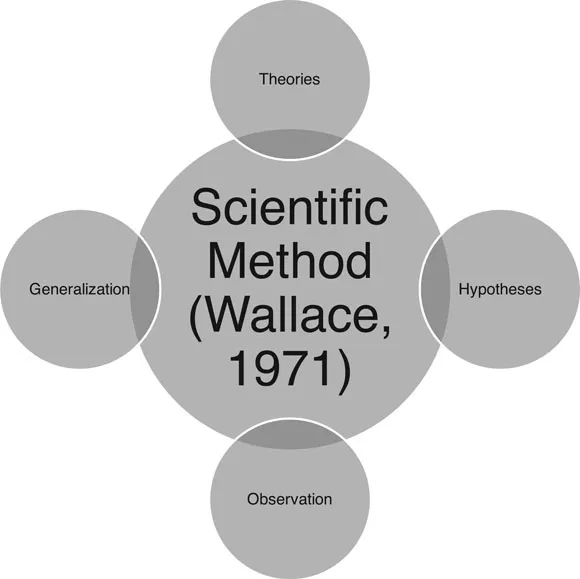
The research that is the subject of this course is based on the scientific method. What sets this apart from the research you did to shop for a computer is that the scientific method requires adherence to a strict set of rules. Just as with your computer, or car-buying research, we make observations, but with the scientific method, we do so in a very systematic way, with the goal of generating an unbiased image of the world rather than an individual’s personal image (Haig, 2018; Wallace, 1971). In his classic work on the scientific method, Wallace (1971) visualized the research process as a wheel, including theory formulation, hypothesis construction, observations, and then generalization of findings (Figure 1.1). The use of a wheel as an illustration is important here, as wheels lack a clear starting point. For research, the start and end points vary depending on the method the researcher adopts. The two most common approaches in criminal justice research are deductive and inductive. The deductive method has been the favored set of steps in the natural sciences for decades, and it is commonly used in criminal justice research. The deductive approach starts with theory. A theory is an attempt to construct a plausible explanation of reality (Hagan, 2007). Researchers then use logical deduction to take theories and write hypotheses, or predictions of relationships between variables based on our understanding of theory (Maxfield & Babbie, 2012; Wallace, 1971). Only after those two steps are completed does the researcher determine how to measure the hypotheses and conduct observations. These observations must follow specific protocol to reduce the potential for bias. Once data have been collected, it is time to test the hypotheses. Based on the rigor of the research design, it may or may not be appropriate to generalize the findings to the wider population. Researchers using deductive reasoning would start at the top of the research wheel in Figure 1.1 and move clockwise.
Figure 1.1 Stages of Research
Source: Wallace, W. (1971). The logic of science in sociology. Chicago: Aldine. P. 81
Research based on inductive reasoning has a different starting point, at the bottom of the wheel and moving clockwise. Rather than beginning with a theory and then moving on to hypothesis testing, researchers taking the inductive approach use observations as their starting point. They seek to observe facts without any particular theory in mind. Those observations can then be used to draw conclusions and generate a theory based on the findings. These theories are known as grounded theories since they are based on the data that have already been collected (Glaser & Strauss, 1967; Maxwell, 1996). Researchers can then take that newly formed theory, generate hypotheses based on it, and go around the wheel again but with the deductive approach this time.
Qualitative and Quantitative Research
The decision of whether to approach research with inductive or deductive reasoning might be related to the kind of study the researcher is planning. Criminal justice as an academic discipline has benefitted from both quantitative and qualitative research. Quantitative research is the more common approach in criminal justice. Quantitative work tends to start with a deductive approach, with researchers using knowledge of theory to write and then test hypotheses. The primary distinguishing characteristics of quantitative research are the use of numerical values to represent concepts and the quantification of results, often involving statistical procedures. Due to the rules governing statistical analysis, quantitative studies rely on large sample sizes, but to get the necessary sample size, researchers often forgo the opportunity to interact much, if at all, with potential research participants. In fact, a popular trend in criminal justice research today is to obtain access to large datasets with information collected by other researchers or practitioners and perform sophisticated statistical analysis without interacting with any of the humans who were the subject of data collection.
Qualitative research largely involves observation and long interviews of smaller groups with the goal of generating a more complete understanding of a group or subculture. Qualitative research in criminal justice draws from the work of urban anthropologists and sociologists who spend extensive amounts of time with and sometimes even live among those they are studying. Qualitative work could start from either the inductive or the deductive approach starting points. Unlike quantitative studies that involve testing a specific hypothesis, some qualitative studies entail collecting data first and then focusing on theory generation based on the conclusions drawn from the observations. While quantitative research follows strict data collection plans with interview schedules or data collection checklists written out and pretested prior to data collection, qualitative researchers might begin their observations while lacking any research questions (Hagan, 2007; Maxfield & Babbie, 2012).
Both qualitative and quantitative research have helped our discipline grow, and both will be necessary to help us continue to learn why people commit crime and what we can do to stop it. There are, unfortunately, professional rivalries that develop, and there are occasionally debates about the merits of both the qualitative and quantitative approaches. As I noted earlier, quantitative methods are more frequently used in criminal justice research. Quantitative approaches, with deductive reasoning, are synonymous with positivism, or the natural sciences approach to research. In the more extreme form of this approach, researchers who identify as positivists can endorse sci...
Table of contents
Cover
Half Title
Title Page
Copyright Page
Dedication Page
Contents
Online Supplements
Preface
Acknowledgments
Credits
1 Introduction
2 Reading and Reviewing Research
3 Ethics in Criminal Justice Research
4 Causation, Experimental, and Quasi-Experimental Designs
5 Pre-Experimental, Longitudinal, and Cross-Sectional Designs
6 Measurement, Validity, and Reliability
7 Measuring Crime: The UCR, NIBRS, and NCVS
8 Sampling
9 Surveys and Interviews
10 Field Research
11 Less Obtrusive Methods
12 Policy Analysis and Program Evaluation
Glossary
Index
Trusted by 375,005 students
Access to over 1.5 million titles for a fair monthly price.
Study more efficiently using our study tools.
Frequently asked questions
Yes, you can cancel anytime from the Subscription tab in your account settings on the Perlego website. Your subscription will stay active until the end of your current billing period. Learn how to cancel your subscription
No, books cannot be downloaded as external files, such as PDFs, for use outside of Perlego. However, you can download books within the Perlego app for offline reading on mobile or tablet. Learn how to download books offline
Perlego offers two plans: Essential and Complete
Essential is ideal for learners and professionals who enjoy exploring a wide range of subjects. Access the Essential Library with 800,000+ trusted titles and best-sellers across business, personal growth, and the humanities. Includes unlimited reading time and Standard Read Aloud voice.
Complete: Perfect for advanced learners and researchers needing full, unrestricted access. Unlock 1.5M+ books across hundreds of subjects, including academic and specialized titles. The Complete Plan also includes advanced features like Premium Read Aloud and Research Assistant.
Both plans are available with monthly, semester, or annual billing cycles.
We are an online textbook subscription service, where you can get access to an entire online library for less than the price of a single book per month. With over 1.5 million books across 990+ topics, we’ve got you covered! Learn about our mission
Look out for the read-aloud symbol on your next book to see if you can listen to it. The read-aloud tool reads text aloud for you, highlighting the text as it is being read. You can pause it, speed it up and slow it down. Learn more about Read Aloud
Yes! You can use the Perlego app on both iOS and Android devices to read anytime, anywhere — even offline. Perfect for commutes or when you’re on the go. Please note we cannot support devices running on iOS 13 and Android 7 or earlier. Learn more about using the app
Yes, you can access Research Methods for Criminal Justice and Criminology by Christine Tartaro in PDF and/or ePUB format, as well as other popular books in Social Sciences & Criminal Law. We have over 1.5 million books available in our catalogue for you to explore.