Museums and Atlantic Slavery explores how slavery, the Atlantic slave trade, and enslaved people are represented through words, visual images, artifacts, and audiovisual materials in museums in Europe and the Americas.
Divided into four chapters, the book addresses four recurrent themes: wealth and luxury; victimhood and victimization; resistance and rebellion; and resilience and achievement. Considering the roles of various social actors who have contributed to the introduction of slavery in the museum in the last thirty years, the analysis draws on selected exhibitions, and institutions entirely dedicated to slavery, as well as national, community, plantation, and house museums in the United States, England, France, and Brazil. Engaging with literature from a range of disciplines, including history, anthropology, sociology, art history, tourism and museum studies, Araujo provides an overview of a topic that has not yet been adequately discussed and analysed within the museum studies field.
Museums and Atlantic Slavery encourages scholars, students, and museum professionals to critically engage with representations of slavery in museums. The book will help readers to recognize how depictions of human bondage in museums and exhibitions often fail to challenge racism and white supremacy inherited from the period of slavery.
In the past thirty years, museums in general and specifically exhibitions in Europe and the Americas have addressed the history of Atlantic slavery by focusing on the material wealth of slave owners and slave traders. Displaying silverware, furniture, and clothing, museum displays in the United States, France, and England show visitors the luxurious lifestyles of men and women who owned enslaved Africans and their descendants. Whereas in some cases this approach has underscored the economic engines of slavery and the Atlantic slave trade, in many cases the emphasis on wealthy slaveholders and slave merchants has contributed to the reproduction of narratives that tend to glorify and reaffirm the supremacy of white elites to the detriment of the crucial role enslaved people played in the construction of societies where slavery existed.
In this chapter, I explore how museums and exhibitions explain the history of slavery and the Atlantic slave trade by emphasizing the wealth of slave owners and slave merchants. I discuss the permanent exhibitions of the International Slavery Museum (Liverpool), the Georgian House Museum (Bristol), and the Museum of London Docklands (London), all three in England; the John Brown House Museum (Providence, Rhode Island) in the United States; and the Nantes History Museum (Musée d’histoire de Nantes, Nantes) in France. I emphasize that each museum and exhibition emerged in a singular context to portray specific national and local realities. Yet, their displays present many similarities. I argue that the use of paintings and artifacts to illustrate the rich lifestyles of slaveholders and slave merchants offer unique opportunities to convey the history of slavery and the Atlantic slave trade. However, most institutions are not successful in using material culture to establish connections between the production and consumption of commodities produced by enslaved people in the Americas and the prosperity of slaveholding elites. Likewise, as most exhibitions fail to associate the wealth generated by the Atlantic slave trade and the present-day legacies of these atrocities, they continue reinforcing white supremacy.
The wealth of the trade
A growing number of museums in cities that functioned as slave-trading seaports or where slavery played an important role started creating exhibition spaces to address this long and painful past. Liverpool was the first British slave port during the era of the Atlantic slave trade. Public debates on the city's slave-trading past emerged in the 1980s as a reaction to the persistence of racism and racial inequalities in the city, which on a number of occasions led to episodes of police brutality against black residents.1 As a response to black protest and enduring public debates on the city's participation in the Atlantic slave trade, in 1991 Liverpool's Merseyside Maritime Museum started preparing the permanent exhibition Transatlantic Slavery: Against Human Dignity, or simply the Transatlantic Slavery Gallery.2 The initiative was sponsored by the Peter Moores Foundation, a charity institution that, among others, supports music, the arts, education, environmental, health, and social projects. Initially, as noted by Stephen Small, the Consortium of Black Organisations and the Liverpool 8 Law Centre denounced the initiative.3 According to these groups, Liverpool museums had historically conveyed racist representations of Africans, rejected black visitors, and failed to employ black staff members. Although sharing these criticisms, other organizations like the Federation of Liverpool Black and the Merseyside Africa Council agreed to participate in the discussions to prepare the creation of the new gallery and pushed the museum's administration to include black scholars and members of the black community in the consultation process. Eventually, Anthony Tibbles, then the maritime history curator of the National Museums and Galleries Merseyside, formed a team of eleven guest curators, seven of whom were black.
Unveiled in 1994, the new gallery consisted of nearly forty panels, as well as video displays, audio recordings, and artifacts telling the history of the Atlantic slave trade and Liverpool's involvement in it. The gallery also established connections with the broader Atlantic world, discussed the legacies of slavery, and briefly addressed the issue of reparations for slavery. Even though most commentators reacted positively to the new initiative, some white residents of Liverpool reacted negatively to the creation of the new gallery, as it emphasized too much the role of the city in the Atlantic slave trade. As concerned black citizens continued to criticize the gallery, the museum developed a program to seeking to engage the local black community. It also created an advisory committee including local and national black leaders who championed anti-racist struggle in Britain, such as Jocelyn Barrow, general secretary and co-founder of the Campaign Against Racial Discrimination in the 1960s.4
In the following years, Liverpool black citizens and their allies, including academics who agreed that the Transatlantic Slave Gallery no longer adequately responded to the need to address the topic of slavery and the slave trade, and especially Liverpool's involvement in the trade, started putting pressure on public authorities to create a slavery museum. The approach of the bicentennial of the Slave Trade Act 1807, which abolished the Atlantic slave trade in the British empire, and also of Liverpool's 800th anniversary intensified these discussions.5 These debates were fruitful. In 2007, the International Slavery Museum was unveiled under the auspices of the National Museums Liverpool. Located on the third floor of the Merseyside Maritime Museum, as put by its own director, Richard Benjamin, the museum “is a campaigning museum and an active supporter of social change and social justice.”6
Visitors of the International Slavery Museum are mainly residents of Liverpool and other British cities, but tourists from around the world are also count among its guests. Unlike other institutions that unveiled exhibitions about the Atlantic slave trade, the museum and its predecessor, the Transatlantic Slavery Gallery, both emerged from consultation processes that largely involved local and national black organizations and citizens as well as black academics and curators. In other words, although most of its visitors are white citizens, the museum's exhibition settings were designed to address black audiences.
Drawing from the previous Transatlantic Slave Gallery, the museum is divided into three main galleries. The first gallery covers Life in West Africa, the second explores Enslavement and the Middle Passage, and the third gallery The Legacy discusses the present-day legacies of slavery. Although the museum adopts a chronological approach, before entering the galleries, an initial section is dedicated to temporary exhibitions that usually feature contemporary issues associated with the history and memory of British black communities. While the second gallery details how Africans were captured and transported to the Americas, it also brings to light the wealth generated by the slave trade, and especially how the elites of Liverpool profited from the inhumane commerce.
In this gallery, two large glass displays discuss the economic profits generated by slavery and the Atlantic slave trade by taking two main approaches. A first display features the painted portrait of Thomas Golightly, who served as mayor (1772–1773) and treasurer (1789–1820) of the city of Liverpool. Golightly, like several other city mayors, actively participated in the Atlantic slave trade. Until 1807, when the British slave trade was prohibited, his name appeared in the list of the Company of Merchants Trading to Africa. Still, the artifacts presented in this panel are manufactured objects and goods used in the commercial exchanges with African rulers and middlemen and are not illustrative of the profits made by British slave merchants. As visitors move forward, a separate panel features a short text underscoring the wealth of Richard Watt I, an affluent merchant who was born in a village northeast of Liverpool. His involvement in the Atlantic slave trade started with his participation in a large-scale slave factorage, a business consisting of selling enslaved people on commission as part of an agreement with the owner of the slave ship's cargo, in which the profits were returned in the same vessel that transported the slaves.7 Later Watt served as attorney for several planters and also acquired a plantation. Back in Liverpool, he created a trading house through which he imported commodities from Jamaica and purchased several properties. In the panel, his fortune is exemplified with a photograph and an engraving of his most well-known property, the Speke Hall, a huge Tudor manor house, and its estate located eight miles from Liverpool. However, because there is no portrait identifying Watt and the wall panel is located in an unnoticed corner, inattentive visitors can certainly miss this connection that could highlight the tangible dimensions of the wealth created by the slave trade that remain visible in the city.
Another large glass display in this same gallery connects the broad context of the Atlantic slave trade to the wealth of Liverpool traders. One panel titled “Economic Benefits of Slavery” discusses the profits generated by the slave trade and slavery in Britain. Yet, the script is introduced by a 1829 decontextualized quote by David Walker, the famous American abolitionist activist, discussing the internal slave trade in the United States during a period when the British slave trade had been prohibited for more than two decades. The panel also highlights the profits that Britain and Western European countries made from slavery and the slave trade, implying that the Atlantic slave trade fueled the Industrial Revolution, making Britain the “first industrial nation.” Also according to the text, “[S]uccessful slave owners were able to amass vast personal fortunes. This wealth was in turn used to build grand houses as an investment in other enterprises such as iron, coal, and banking.” Visitors learn that even those businesses and individuals that at first sight were not directly involved in the Atlantic slave trade and slavery still obtained economic gains from these atrocious activities. Overall, this panel also emphasizes that the increasing demand for goods produced by enslaved people in the Americas led to the intensification of the Atlantic slave trade in the eighteenth century. European traders purchased more enslaved Africans in exchange for guns, textiles, and luxury goods. Addressing a later period, another panel in the same display emphasizes that British people consumed different products produced by a slave workforce in the Americas, including clothes made with American cotton and colored with American dyes. British citizens also smoked tobacco from Virginia and drank coffee and hot chocolate from Cuba and Brazil. Despite this emphasis, there are no efforts to create engaging spaces to explain the importance of these goods and examples of manufactured products whose raw materials were cultivated by enslaved people in American plantations. Overall, the assertions emphasizing the wealth generated by the trade are not supported by visual elements that point out to specific families and institutions that made great profits.
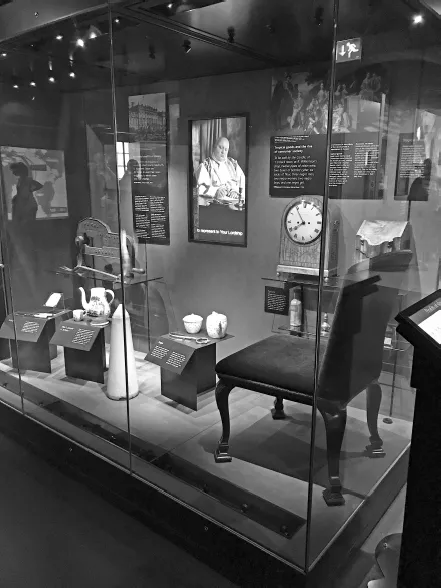
Like several other exhibitions focusing on slavery, sugar is the main example used to explain the wealth generated by the Atlantic slave trade and slavery. Therefore panel texts show how sugar became an important commodity and, as its production expanded, new consumers included members of the British working classes. The display features the rich material culture associated with sugar consumption, including sugarloaves, sugar breakers, teapots, sugar bowls, sugar nippers, coffee cups, and coffeepots found in the households of Liverpool's elites, whose activities were closely associated with the Atlantic slave trade and slavery in the British West Indies (Figure 1.1). Likewise, the glass vitrine showcases various kinds of Jamaican wood samples as well as objects fabricated with these woods, such as a chair and a knife box made of mahogany and a satinwood's bracket clock.8 Along with luxurious china and silver objects from the eighteenth and nineteenth centuries, porcelain plates and bowls featuring the abolitionist representation of the kneeling slave and other abolitionist slogans are also on display. These artifacts emphasize that once the abolitionist movement emerged, activists started incorporating anti-slavery images and symbols into the objects associated with sugar consumption, therefore subverting their original roles to transform them into abolitionist propaganda. The gallery highlights the importance of commodities such as ivory purchased by eighteenth-century European traders, including Liverpool's William Davenport. It also shows how African ivory was used to produce luxury objects such as cutlery handles. Yet, the presentation of small objects such as bowls and cups fails to provide the real dimension of the huge wealth generated by the sugar produced by enslaved people. In the same gallery, there are also other missed opportunities to make this point. For example, another panel highlights that in Liverpool, as in other cities where slavery existed in the Americas, rich citizens owned enslaved servants not only to perform domestic tasks but also to be publicly displayed as evidence of their wealth. But this assertion is not illustrated by any examples of the abundant imagery in portrait paintings and engravings that represent black pages as symbols of the wealth and social distinction of their owners.9 Or perhaps the absence of these images is intended to avoid presenting depictions of objectified black bodies? As we will see in the next chapter, although the museum presents images of physical punishment, overall depictions showing enslaved individuals in submissive positions are very rare in most of the museum's displays. Despite these shortcomings, one section of the second gallery, titled “Reminders of Slavery,” informs visitors that many streets of Liverpool were named after slave merchants. Next to it, a panel with interactive cylindrical plaques lists the names of these streets, including Tarleton Street, Rodney Street, and Earle Street. This display is certainly the most successful in exemplifying how the profits of the trade left important marks in Liverpool, where streets, buildings, and other landmarks were constructed with the wealth created by slavery or named after slave merchants and other individuals involved in the inhuman commerce. As still today Liverpool has no plaques or monuments identifying the slave-trading connections of these sites, the museum is the main agent that fulfills this gap in the city's landscape.
Figure 1.1 Display in the Enslavement and Middle Passage gallery, International Slavery Museum, Liverpool, United Kingdom. Photograph by Ana LuciaAraujo, 2017.
The International Slavery Museum's section discussing how the Atlantic slave trade and slavery contributed to the wealth of European nations and the prosperity of Britain and Liverpool is successful in establishing connections between the local and global contexts. But despite providing a detailed and accurate historical account through texts, images, and artifacts, there are nearly no attempts to associate the fortunes generated by the Atlantic slave with the present-day legacies of slavery. Yet, the presentation of the wealth generated by the trade in enslaved Africans largely draws from text panels and very few artifacts, none of which are significant to convey the magnitude of the profits made by British slave merchants and planters. Actually, few visitors spend sufficient time reading the static panel texts. In this context, the displays are more successful in engaging visitors during the guided tours, in which a docent explains the connections of Liverpool...
Table of contents
Cover
Half Title
Series Page
Title Page
Copyright Page
Advertisement
Dedication
Contents
List of figures
Acknowledgments
Introduction: Representing Atlantic slavery in the museum
1 Wealth and refinement
2 Submission and victimization
3 Resistance and rebellion
4 Achievement and legacies
Conclusion: Persisting legacies
Bibliography
Index
Trusted by 375,005 students
Access to over 1.5 million titles for a fair monthly price.
Study more efficiently using our study tools.
Frequently asked questions
Yes, you can cancel anytime from the Subscription tab in your account settings on the Perlego website. Your subscription will stay active until the end of your current billing period. Learn how to cancel your subscription
No, books cannot be downloaded as external files, such as PDFs, for use outside of Perlego. However, you can download books within the Perlego app for offline reading on mobile or tablet. Learn how to download books offline
Perlego offers two plans: Essential and Complete
Essential is ideal for learners and professionals who enjoy exploring a wide range of subjects. Access the Essential Library with 800,000+ trusted titles and best-sellers across business, personal growth, and the humanities. Includes unlimited reading time and Standard Read Aloud voice.
Complete: Perfect for advanced learners and researchers needing full, unrestricted access. Unlock 1.5M+ books across hundreds of subjects, including academic and specialized titles. The Complete Plan also includes advanced features like Premium Read Aloud and Research Assistant.
Both plans are available with monthly, semester, or annual billing cycles.
We are an online textbook subscription service, where you can get access to an entire online library for less than the price of a single book per month. With over 1.5 million books across 990+ topics, we’ve got you covered! Learn about our mission
Look out for the read-aloud symbol on your next book to see if you can listen to it. The read-aloud tool reads text aloud for you, highlighting the text as it is being read. You can pause it, speed it up and slow it down. Learn more about Read Aloud
Yes! You can use the Perlego app on both iOS and Android devices to read anytime, anywhere — even offline. Perfect for commutes or when you’re on the go. Please note we cannot support devices running on iOS 13 and Android 7 or earlier. Learn more about using the app
Yes, you can access Museums and Atlantic Slavery by Ana Lucia Araujo in PDF and/or ePUB format, as well as other popular books in Art & Museum Studies. We have over 1.5 million books available in our catalogue for you to explore.