The
New York Times–bestselling authors of
Miracle at Midway delve into the surprise attack on Pearl Harbor during WWII in "a superb work of history" (
Albuquerque Journal Magazine).
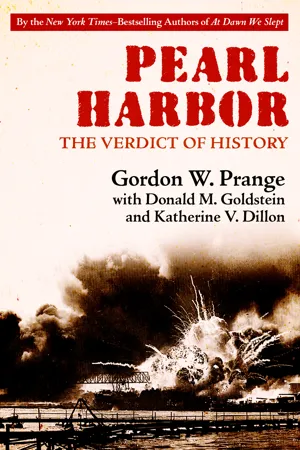
In the predawn hours of December 7, 1941, a Japanese carrier group sailed toward Hawaii. A few minutes before 8:00 a.m., they received the order to rain death on the American base at Pearl Harbor, sinking dozens of ships, destroying hundreds of airplanes, and taking the lives of over two thousand servicemen. The carnage lasted only two hours, but more than seventy years later, terrible questions remain unanswered.
How did the Japanese slip past the American radar? Why were the Hawaiian defense forces so woefully underprepared? What, if anything, did American intelligence know before the first Japanese pilot shouted "Tora! Tora! Tora!"? In this incomparable volume, Pearl Harbor experts Gordon W. Prange, Donald M. Goldstein, and Katherine V. Dillon tackle dozens of thorny issues in an attempt to determine who was at fault for one of the most shocking military disasters in history.
eBook - ePub
Pearl Harbor
The Verdict of History
- 827 pages
- English
- ePUB (mobile friendly)
- Available on iOS & Android
eBook - ePub
About this book
Information
PART I
THE BASE AND THE SUMMIT
CHAPTER 1
“We Were All Out There”
Were the American people primarily responsible?—The role of the press—Post-World War I disillusionment—“Merchants of Death”—Reluctance to increase armed forces—Assurance of U.S. safety—Postevent press charges—Isolationism
Almost before the echoes of Japanese engines had died away, some individuals in the United States declared that the American people must accept a portion of the blame for Pearl Harbor, because of “our blindness, our provincialism, our complacency, even our ignorance as a people.”1 Seldom if ever has the nation indulged its propensity for self-chastisement and breast-beating more thoroughly than in relation to Pearl Harbor. Each investigation, each development, brought a fresh outburst, culminating on August 30, 1945, when President Harry S. Truman pronounced: “… the country as a whole is basically responsible in that the people were unwilling to take adequate measures to defense [sic] until it was too late to repair the consequences of their failure to do so.”2
Was this a valid judgment? Did Truman’s remark spring from a profound search for the root of the matter, or had he spread the responsibility so thinly that no one could carry more than a token share?
Certainly, responsibility for the American aspects of what happened on December 7, 1941, was too widely diffused to pin exclusively on any one man, or even any two men. Newspaper editor William Allen White warned against passing the buck too far, however, although he added courageously, “… the writer of these lines is by no means innocent.”3
This admission made White a rare bird among journalists. Yet the American press had been the prime medium of popularizing and perpetuating myths of Japanese inferiority, of American superiority, of the country’s security from Axis attack. For example, an editorial in the Chicago Tribune on Navy Day, 1941, ridiculed the idea of war with Japan:
She cannot attack us. That is a military impossibility. Even our base at Hawaii is beyond the effective striking power of her Fleet. She may threaten the Philippines but the Philippines are of so little vital interest to this country that we have already arranged to give them their independence within five years.
And what has Japan that we want? Nothing.4
Thus the Tribune bestowed its prestige upon two dangerous fallacies: First, the United States held in its own hands the choice of peace or war; second, Hawaii was out of reach of the Japanese Navy. Moreover, the Tribune callously suggested that the United States should toss the Philippines to the wolves because its “vital interests” were not directly involved, although in 1941 those islands were under American protection.
Possibly the Honolulu Advertiser tacitly included the press when it admitted that the errors in judgment involved at Pearl Harbor “belonged to all America, and, thus all America must share in the national complacency that found us unprepared.”5
The reasoning of those who blamed the people split into two streams. The first took an almost mystical attitude of mea culpa. The people of the United States had sinned, so the Lord punished them with Japanese bombs and torpedoes as the modern equivalent of fire and brimstone. Henry R. Luce spoke for this school of thought: “The disaster … was a sign of all the weakness and wrongness of American life in recent years.”6 Following publication of the report of the tragedy that Secretary of the Navy Frank Knox made shortly after the event, the blunt-penned Dorothy Thompson poured an avalanche of scorn over her countrymen:
And I will tell you where the ultimate responsibilities lies, for Hawaii and for everything else. It lies with us. …
For a whole generation the American idea has been to get as much as it could for as little effort. For a whole generation the American motto has been, “I guess it’s good enough.”
I accuse us. I accuse the twentieth-century American. I accuse me….7
Walter Lippmann carried this reasoning another decimal point or two: “… what happened at Pearl Harbor is the very pattern and image of the deadly illusions and the moral failings which have prevailed among us since the other war…”8
Others took a more practical view of why the American people were culpable. The Meridian (Mississippi) Star crisply expressed this rationale: “For years and years we refused to face facts and demand from our congressmen an army, navy and air corps big enough and strong enough to hold its own against all comers. … The result? A nation that was unprepared. …”9
The Charleston (West Virginia) Gazette attributed this torpor to the fact that some “honestly thought we could build a wall of steel around ourselves and retire within it in complete safety, there to remain isolated until the storm passed.”10
This withdrawal did not result from a heartless disregard for the rest of humanity. No natural disaster could occur in so remote a corner that Americans would not reach into their hearts and pockets to help alleviate suffering. But to involve themselves again in the Old World’s man-made holocausts was something else.
The United States had entered World War I in a spirit of high sacrifice. Uncle Sam and his noble allies would fight the war to end all wars, would make the world safe for democracy, a world fit for heroes to live in. After they came out of the ether, American survivors looked around and what did they see? In Germany an iron-fisted, sadistic regime which made Kaiser Bill’s “huns” look like Boy Scouts by comparison; Benito Mussolini, trying to remodel the genial Italians into scowling Roman warriors, had hooked them ignominiously to Adolf Hitler’s tailboard; Russia was proving that if you scratched a commissar you drew Romanov blood; Japan had run amok.
Instead of war being at an end, the nations of Europe and Asia were arming to the back teeth; the world had never been less safe for democracy; it was not a suitable abode for everyday, peace-loving human beings, let alone heroes. An indignant public concluded that Uncle Sam had been played for a sucker.
Popular imagination seized upon “merchants of death,” a catch-phrase of the 1930s, publicized by a number of books on the manufacture and sale of armaments.11 This concept culminated in the Senate investigations of the munitions industry held between 1934 and 1936, presided over by Senator Gerald P. Nye of North Dakota. Nye’s committee found:
While the evidence … does not show that wars have been started solely because of the activities of munitions makers and their agents, it is also true that wars rarely have one single cause, and the committee finds it to be against the peace of the world for selfishly interested organizations to be left free to goad and frighten nations into military activity.12
It was not a pretty picture that the Nye Committee held up to the eyes of a disgusted nation. Not the least disquieting aspect of the inquiry was the revelation of the close relationship between the armed forces and the munitions industry. Naturally, the Army and Navy wanted the United States to have a strong capacity to produce armament, but in some cases they went over the line. Perhaps most damaging from the standpoint of the American people, testimony concerning the munitions industry’s publicity campaigns cast doubt upon the credibility of the press in crisis reporting. Nye remarked to a witness that he had noted over a period of nine years
that just preceding the advent of each naval appropriation bill we have had a great deal in the papers about trouble with Japan. How much of these annual scares are occasioned by what was strictly propaganda, having your own personal interests at stake? How many of these annual scares of trouble with Japan have you and others interested in the munitions game played up?13
Yet the years of the Nye Committee—1934 to 1936—covered a period of acute need for close, objective reporting and a well-informed public. Japan had given notice that it would abandon the Washington Naval Treaty and had withdrawn from the second London Conference. Germany had repudiated the arms limitations sections of the Versailles Treaty, denounced the Locarno Pact, and sent troops into the Rhineland. All the iniquities of the arms trade could not nullify these iron facts.
There was definite appeal in the naive concept that the basic cause of war was the “merchants of death” drumming up trade: It absolved of war guilt all except an infinitesimal, sinister minority; it relieved the average citizen of the humiliating conviction that he had been a gullible rube; it reduced war to a simple matter of dollars and cents, which most people could understand.
Of course, the theory was entirely too pat, too neat, and ignored the whole sweep of man’s life on earth. War was a long-lived, widespread phenomenon whose roots struck much deeper than a munitions maker’s profit-and-loss statement. This thesis helped drive the United States still further into its self-imposed “ivory tower” mentality. The nation had already achieved something of a record in inconsistency. By standing aloof from the League of Nations it had rejected collective security, yet it had refused to provide for itself an adequate unilateral national defense system.
As a result of the Washington Naval Conference of 1922, the United States scrapped twenty-eight vessels, including eleven capital ships in various stages of completion, and converted two battle cruisers, Lexington and Saratoga, to aircraft carriers, then considered to be instruments of defense rather than offense. Moreover, the United States pledged itself not to increase existing fortifications of Guam, Tutuila, the Aleutians, and the Philippines.14 In effect, this left American outlying possessions in the Pacific at the mercy of Japan and removed the means of enforcing American foreign policy in the Far East.
The Navy did not even build up to treaty limits during the administrations of Calvin Coolidge and Herbert Hoover. Matters began to look up when Roosevelt became President. He took a personal interest in the sea service; nevertheless, he did not press for a big Navy. Always a master of the possible, he tacked to catch the prevailing winds. And the little breezes of public opinion did not yet blow in that direction. But the little scraps Roosevelt gave the Navy were an improvement over the nothing bestowed by the two previous administrations.15
The Army was in no better shape. The Versailles Treaty had limited Germany to an army of 100,000 men, deemed the absolute minimum required to preserve national order while rendering Germany harmless to the rest of the world. Yet when the Preparatory Committee for the Geneva Conference first met on May 18, 1926, the United States had reduced its own land forces to 118,000.16 Considering the relative size of the two countries, the United States had voluntarily denuded itself far beyond what even Germany’s late enemies believed essential to declaw the double eagle.
In 1932 the U.S. Regular Army, with not quite 120,000 active-duty enlisted men, ranked seventeenth among the world’s armies. When General George C. Marshall became Chief of Staff in September 1939, the Army and its Air Corps combined had less than 200,000 men.17 As late as April 1941, in a magazine article urging reorganization of the air forces, one finds this suggestion for financial savings:
The planes which have been built and those to be built can be reduced in productive cost by eliminating the idea that the airplane should be built like the automobile—to last for four or five years. Careful study of the records of this modern air warfare reveals that the average pilot’s life is between thirty and fifty hours in the air. Therefore, why build the airplanes to last longer than the pilots who fly them?18
One would give much to have heard the reaction in General H.H. “Hap” Arnold’s staff to the idea of no-deposit no-return aircraft.
Authority for a 20-percent increase in the Navy finally became law on May 17, 1938, “after strenuous debate.” It called for forty-six combatant ships and twenty-six auxiliaries. “Opponents of the expansion dubbed it ‘monstrous’ and ‘indefensible,’ and tagged it a ‘super-Navy bill.’”19
A peculiar aspect of American thinking in this period was preoccupation with beating the corpse of World War I. Some Americans decried the alleged sins of their former Allies while ignoring the rearming and the frankly expressed aggressive intentions of the Axis. In a radio address on January 28, 1938, Representative Herbert S. Bigelow of Ohio urged against passage of the “super-Navy” bill. He “put no trust in the governments of Europe. They roped us in once, but I say never again. … Let us not be a Nation of old maids looking under the bed every night for Germans or Japs.”20
Representative Thomas O’Malley of Wisconsin spoke like an irreconcilable Irishman: “God grant we may not be led into another [war] by that wily little island in the Atlantic…” If the United States needed to defend itself, why not spend the money on coastal defenses, antiaircraft guns and other protective measures, instead of “$75,000,000 apiece for battleships that can be destroyed by $350,000 bombing planes? …”21
Nye, too, was unhappy about the expanded Navy. He thought it would be too big for defense, not big enough to attack Japan, and too late “to stop Japan in China.” He favored a Navy “strong enough to defend this nation.” But he was dead set against anything that might be “part of an adventurous gamble on a foreign war.”22
The ever eloquent Representative Hamilton Fish of New York announced his readiness “to vote millions for defense” but did not propose “to vote one single dollar for purposes of offenses and aggression.” He laid the whole problem upon the Administration rather than on the Axis, and accused Roosevelt of trying to build a navy “not merely for defense but for aggressio...
Table of contents
- Cover Page
- Title Page
- Contents
- Introduction
- Preface
- List of Major Personnel
- Abbreviations
- Prologue
- Part I: THE BASE AND THE SUMMIT
- Part II: ADVISERS, PLANNERS, AND CHIEFS
- Part III: FIELD COMMANDERS AND OPERATORS
- Part IV: THE VIEW FROM THE CROW’S NEST
- Image Gallery
- Notes
- Appendices
- Selected Bibliography
- Index
- About the Authors
- Copyright Page
Trusted by 375,005 students
Access to over 1.5 million titles for a fair monthly price.
Study more efficiently using our study tools.
Frequently asked questions
Yes, you can cancel anytime from the Subscription tab in your account settings on the Perlego website. Your subscription will stay active until the end of your current billing period. Learn how to cancel your subscription
No, books cannot be downloaded as external files, such as PDFs, for use outside of Perlego. However, you can download books within the Perlego app for offline reading on mobile or tablet. Learn how to download books offline
Perlego offers two plans: Essential and Complete
- Essential is ideal for learners and professionals who enjoy exploring a wide range of subjects. Access the Essential Library with 800,000+ trusted titles and best-sellers across business, personal growth, and the humanities. Includes unlimited reading time and Standard Read Aloud voice.
- Complete: Perfect for advanced learners and researchers needing full, unrestricted access. Unlock 1.5M+ books across hundreds of subjects, including academic and specialized titles. The Complete Plan also includes advanced features like Premium Read Aloud and Research Assistant.
We are an online textbook subscription service, where you can get access to an entire online library for less than the price of a single book per month. With over 1.5 million books across 990+ topics, we’ve got you covered! Learn about our mission
Look out for the read-aloud symbol on your next book to see if you can listen to it. The read-aloud tool reads text aloud for you, highlighting the text as it is being read. You can pause it, speed it up and slow it down. Learn more about Read Aloud
Yes! You can use the Perlego app on both iOS and Android devices to read anytime, anywhere — even offline. Perfect for commutes or when you’re on the go.
Please note we cannot support devices running on iOS 13 and Android 7 or earlier. Learn more about using the app
Please note we cannot support devices running on iOS 13 and Android 7 or earlier. Learn more about using the app
Yes, you can access Pearl Harbor by Gordon W. Prange,Donald M. Goldstein,Katherine V. Dillon in PDF and/or ePUB format, as well as other popular books in History & Military & Maritime History. We have over 1.5 million books available in our catalogue for you to explore.