Uncovering the roots of the U.S. Constitution
The U.S. Constitution influences nearly every aspect of our lives. But for all the fierce disputes about what the Constitution means, the historical foundations of America's legal and political institutions pass almost unnoticed today.
This is a glaring oversight, one that clouds our understanding of the Constitution and American law and politics in general. For the Constitution did not spring up suddenly in 1787. The framers were influenced at every turn by a tradition of constitutional development dating back to ancient times.
Political scientist and legal scholar Matthew A. Pauley fills in the blanks in our understanding by chronicling the three most important influences on the American constitutional experience: ancient Greece, ancient Rome, and England. Pauley's masterful historical survey sheds new light on our system of representative democracy, our court structure, and our traditions of law—civil and criminal, public and private.
No student of law or government can afford to ignore this highly readable, deeply informative work.
Athens, Rome, and England adds immeasurably to our appreciation and understanding of the roots of the American Constitution and our legal and political system.
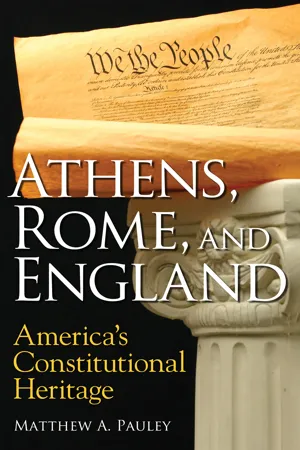
- 256 pages
- English
- ePUB (mobile friendly)
- Available on iOS & Android
eBook - ePub
About this book
Information
PART ONE

The Constitution of Ancient Athens
ONE
Ancient Greece and American Constitutionalism
In their humanism and in their preference for the rule of law, the ancient Greeks were remarkably similar to us and greatly influenced our constitutional tradition. On the other hand, they differed sharply from us in their attitude toward international relations and in the kind of union and level of participation in democratic government they favored. In this respect, they gave our Founding Fathers an example of what they did not want to do. A study of the democratic constitutional development of ancient Athens can do much to show the relevance of the Greek experience to American constitutionalism.
The first three words of the American Constitution—We the People—are unquestionably the most famous and, in some ways, the most significant in our recorded history. Unlike the Codes of Hammurabi and Lipit-Ishtar in ancient times, our fundamental law does not begin with an invocation of the gods and the divine origins of the state. The father of our Constitution, James Madison, was acutely aware, as he puts it in The Federalist Papers, that men are not angels and that angels are not to govern men. The public order for us is made by humans, for humans.
America’s greatest chief justice, John Marshall, recognized this fact in his famous opinion for the Supreme Court in the 1819 case of McCulloch v. Maryland. Rejecting Maryland’s argument that the states retained their sovereignty after entering the union, Marshall reminded his contemporaries that the Constitution had been ratified, not by the state legislatures, but by conventions chosen in each state by the people. In all respects, Marshall went on, the constitutional system draws power from the people: “The government of the Union, then,… is emphatically and truly a government of the people. In form, and in substance, it emanates from them. Its powers are granted by them, and are to be exercised directly on them, and for their benefit.”1
This humanism of American law has its roots in ancient Greece. The Greeks were the world’s first humanists. Theirs was, of course, not the world’s first great civilization. The Egyptians, for example, gave the world fantastic architecture, among much else. From our humanistic point of view today, however, Egyptian art and literature appear superstitious and stultifying. The Sphinx with its lion’s body and man’s head seems a perfect symbol of their fantastic conceptions of gods who were not human but rather monstrous combinations of animals. Egyptian religious and legal customs seemed primitive to the ancient Greeks who later documented them. One example is recorded by the Greek historian Herodotus on his visit to Egypt: “When a cat dies in a house, its inmates shave their eyebrows; When a dog dies, they shave body and head all over.”2
By contrast, Greek gods were designed as “big men”—with human virtues and vices. Moreover, in art, in religion, in philosophy, and especially in politics and law, the focus of the ancient Greeks was on everything pertaining to the welfare and fortunes of man in this world. As one historian puts it, it is hard to imagine “the ‘wily Odyseus’ obeying an order to shave his eyebrows because a cat had died or to fasten golden bracelets on the front paws of a sacred crocodile.”3
That was a new way of looking at the world then, and it is still with us now. We are reminded of it every time we consider what Abraham Lincoln meant when he spoke at Gettysburg of “government of the people, by the people, for the people.”
As Lincoln also understood well, America’s international relations begins with the Declaration of Independence. In the penultimate sentence of that document, Thomas Jefferson made clear the prerogatives of “the separate and equal station” that he was claiming for the new nation. The basic principle of our foreign policy is to be a nation and respect the right of other sovereign nations to a “separate and equal station” among the powers of the earth.
The Greeks of antiquity had a different approach to international relations. Like the ancient Hebrews, who called all non-Hebrews Gentiles (“other people”), they knew that they were different from all other people in the world. They divided the world into two groups—the Hellenes (which they called themselves, for the ancient Greeks never used the Roman word Greek to describe themselves) and the barbarians.
The term Hellene was used to signify the common tie of kinship shared by all the different clans, ethnic groups, and cities of the area known now as Greece, as well as its colonies. Everyone beyond “Hellas” was considered “barbarian.” But the ancient Greeks did not mean barbarian in the modern sense—not someone who ate raw meat or lived in a cave. The word barbarian for them did not carry the same pejorative connotations that it does for us. It only meant people who made a noise like “bar bar” instead of speaking Greek. The Greeks respected other peoples. They even envied some of them sometimes. But they were always conscious of being different from them.
If asked why he was different from barbarians, an ancient Greek would probably say,, “Those peoples are all slaves. We Hellenes are free men.” To anyone acquainted with ancient Greek history, this may seem an exaggeration. Even during the classical age, not all Greeks lived in a democracy. Not all ruled themselves. Nevertheless, they believed strongly in the rule of law, that state business was public business and not the private concern of the ruler. They were hostile to arbitrary rule. They had kings—Sparta, for example, was never a democracy—but in their very souls the idea of an absolute arbitrary monarch was alien to them.
A story from the great Greek historian of the Persian Wars, Herodotus, can help illustrate this. Herodotus tells of how a great Persian king was caught in a storm at sea. When his skipper advised him to lighten the ship, the king ordered his courtiers to jump overboard. Later, on reaching land in safety, he first decorated his skipper for his wisdom, then beheaded him for the crime of causing the death of his courtiers. Herodotus repeats this story as an example of loathsome tyranny. The lesson is not lost on modern ears. As one contemporary historian puts it, “whoever was armed with executive power should always be … answerable for its use, and a Persian king was answerable to no one.”4
In his introduction to Originalism: A Quarter-Century of Debate, a book celebrating the twenty-fifth anniversary of the Federalist Society, Professor Steven Calabresi of Northwestern University Law School reminds us how deeply committed America also is to the rule of law. “We believe,” he writes, “that ours should be a government of laws and not one of men or of judges.” A jurisprudence of “originalism” that relies on the intent of the framers in constitutional interpretation is, in Calabresi’s view, the best way to remain faithful to this commitment.
The emphasis on the rule of law is central to originalism. Originalists believe that the written constitution is our fundamental law and that it binds all of us—even Supreme Court justices. Those justices who abandon the original meaning of the text of the Constitution inevitably end up substituting their own political philosophies for those of the framers. We Americans have to decide whether we want a government of laws or one of judges.5
Attorney General Ed Meese made much the same point in his now famous 1985 speech to the American Bar Association, which is credited, by Calabresi among others, with having introduced the jurisprudence of originalism “into noisy and public view.” Quoting Tom Paine, Meese said that we “Americans … rightly pride ourselves on having produced the greatest political wonder of the world—a government of laws and not of men. Thomas Paine was right: ‘America has no monarch. Here the law is king.’”6
Like the ancient Greeks, we advocate the rule of law, and like them we despise arbitrary government. In this age of terror, that is principally how we distinguish our form of government from that of our enemies. We implicitly recognize the truth of the observation of Aristotle, who summed up the political experience of the Greeks for us when he said that good constitutions are those in which the rulers act in the interest of the people while perverted constitutions are those in which the rulers act only for themselves.
Our Founding Fathers were, of course, acutely aware of the danger that the rulers would, even in a representative democracy, act in their own interest and not for the good of the whole. This concern is what motivates James Madison, in Federalist No. 10, to argue about the dangers of majority factions—groups of people with an interest adverse to the rights of other citizens or to the common good of the society as a whole. Madison’s solution is to control the effects of factions by widening the sphere—enlarging the size of the union so as to make it more difficult for majority factions to form and carry out their schemes of oppression.
By contrast to us, however, the ancient Greeks remained divided and never, at least in the classical period, achieved what our Constitution calls a “more perfect Union” of the Greek people. In ancient times, the mountains and the water divided the Greeks into many different states—each independent of the other. Each guarded its independence fiercely. At times they allied with one another, but on the whole, each retained its independence.
There is nothing in our experience of modern states comparable to the Greek city-states. The total area of the mainland of ancient Hellas was less than that of the state of Maine. And that small area was divided into fiercely independent city-states.
Historian Herbert Newell Couch of Brown University reminds us to keep a proper perspective when studying ancient Greece: “It is important to modify the inevitable modern concept of large political units like the United States and to picture clearly the miniature geographic scale on which the drama of politics, war, trade, and alliance was played in the ancient world.”7
It would, of course, be impossible to understand what it means to say that the United States is the most powerful nation in the world without knowing what is meant by the term nation. The great German philosopher G. W. F. Hegel taught us that the West has, in modern times, produced “a world not of vast despotic states including many nations, and not of single nations divided into many little states. These two opposed principles of antiquity, both based on slavery, are reconciled in the modern world’s ideal of the nation state.”8
Similarly, to understand politics in antiquity, and in ancient Greece in particular, one has to come to terms with what the polis signified. British classicist H. D. F. Kitto insists on this basic premise: “Without a clear conception of what the polis was, and what it meant to the Greeks, it is quite impossible to understand properly Greek history, the Greek mind, or Greek achievement.”9
In his Republic, Plato would later posit a limit of five thousand citizens for his ideal state. Aristotle in his Politics says that each citizen should be able to recognize every other citizen in the polis by sight. We cannot imagine living in a state that is so small that one could walk across it in one day. But we must not confuse small size with triviality. Kitto explains this in a brilliant passage where he tells how to assess the Greek city-state properly in order to grasp its significance:
To think on this scale is difficult for us, who regard a state of ten million as small, and are accustomed to states which, like the U.S.A. and the U.S.S.R., are so big that they have to be referred to by their initials; but when the adjustable reader has become accustomed to the scale, he will not commit the vulgar error of confusing size with significance. The modern writer is sometimes heard to speak with splendid scorn of “those petty Greek states, with their interminable quarrels.” Quite so, [they] … are petty, compared with modern size. The Earth itself is petty, compared with Jupiter—but then, the atmosphere of Jupiter is mainly ammonia, and that makes a difference. We do not like breathing ammonia, and the Greeks would not much have liked breathing the atmosphere of the vast modern State. They knew of one such, the Persian Empire, and thought it very suitable, for barbarians.10
Above all, the ancient Greek polis was a community, and a community in which the affairs of the whole polis were truly the affairs of every citizen. This is the meaning behind Socrates’s analogy, in Plato’s Republic, to a person cutting his finger: the whole body feels the pain of the part. This is why Aristotle says in his Politics that citizenship does not depend on residence but on active participation in the affairs of the city. This is also what Thucydides means in his History, where he recounts Pericles saying in his Funeral Oration that “a man who does not take part in public affairs is good for nothing.”11 The ancient Greeks had a term for such persons—idiotes, from which we, of course, derive our word idiot.
In modern-day London, the monument to Admiral Lord Nelson in Trafalgar Square is inscribed with the famous words Nelson is said to have uttered at the great naval battle in which he gave his life for England’s victory against the navy of Napoleon: “England expects every man to do his duty.” President John F. Kennedy echoed this sentiment in his Inaugural Address when he urged his fellow Americans to “ask not what your country can do for you, ask what you can do for your country.” The ancient Greeks would surely have understood such an idea, although they might have wondered why people had to be reminded of it.
In postclassical Greece, the orator Demonsthenes will later speak with contempt of the man who “avoids the polis.” And Aristotle will say of the man “who is without a city-state” that he is “either a poor specimen or else superhuman.” Indeed, Aristotle quotes Homer to describe such a man without a country: “clanless, lawless, and hearthless is he.”12
This sense of community in the ancient Greek polis bears emphasis precisely because it is so different from our modern, especially American conception. In our search for parallels, we often forget that, in many ways, the Greek experience is alien to ours. As Robert Morkot reminds us in the Penguin Historical Atlas of Ancient Greece, “the Greeks were probably more unlike us than we have ever allowed.”13
One respect in which they were unlike us is surely their strong sense of political community. For an American in the twenty-first century, the “state” is often that entity which takes our money in the form of taxes. We do not relish paying taxes anymore than w...
Table of contents
- Cover Page
- Title Page
- Dedication
- Contents
- Preface
- Introduction
- Part One: The Constitution of Ancient Athens
- Part Two: The Constitution of Ancient Rome
- Part Three: The English Constitution and English Common Law
- Conclusion
- Notes
- Index
- Copyright Page
Trusted by 375,005 students
Access to over 1.5 million titles for a fair monthly price.
Study more efficiently using our study tools.
Frequently asked questions
Yes, you can cancel anytime from the Subscription tab in your account settings on the Perlego website. Your subscription will stay active until the end of your current billing period. Learn how to cancel your subscription
No, books cannot be downloaded as external files, such as PDFs, for use outside of Perlego. However, you can download books within the Perlego app for offline reading on mobile or tablet. Learn how to download books offline
Perlego offers two plans: Essential and Complete
- Essential is ideal for learners and professionals who enjoy exploring a wide range of subjects. Access the Essential Library with 800,000+ trusted titles and best-sellers across business, personal growth, and the humanities. Includes unlimited reading time and Standard Read Aloud voice.
- Complete: Perfect for advanced learners and researchers needing full, unrestricted access. Unlock 1.5M+ books across hundreds of subjects, including academic and specialized titles. The Complete Plan also includes advanced features like Premium Read Aloud and Research Assistant.
We are an online textbook subscription service, where you can get access to an entire online library for less than the price of a single book per month. With over 1.5 million books across 990+ topics, we’ve got you covered! Learn about our mission
Look out for the read-aloud symbol on your next book to see if you can listen to it. The read-aloud tool reads text aloud for you, highlighting the text as it is being read. You can pause it, speed it up and slow it down. Learn more about Read Aloud
Yes! You can use the Perlego app on both iOS and Android devices to read anytime, anywhere — even offline. Perfect for commutes or when you’re on the go.
Please note we cannot support devices running on iOS 13 and Android 7 or earlier. Learn more about using the app
Please note we cannot support devices running on iOS 13 and Android 7 or earlier. Learn more about using the app
Yes, you can access Athens, Rome, and England by Matthew A Pauley in PDF and/or ePUB format, as well as other popular books in Politics & International Relations & American Government. We have over 1.5 million books available in our catalogue for you to explore.