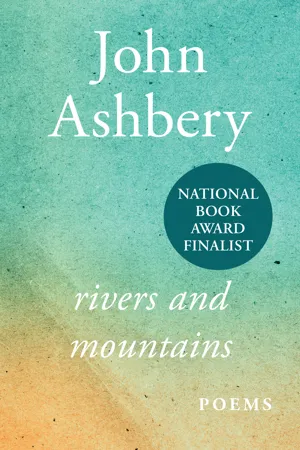
From one of our most important modern poets comes an essential early collection, including the famous long poems "The Skaters" and "Clepsydra"
When
Rivers and Mountains was published in 1966, American poetry was in a state of radical redefinition, with John Ashbery recognized as one of the leading voices in the New York School of poets. Ashbery himself had just returned to America from ten years abroad working as an art critic in France, and
Rivers and Mountains, his third published collection of poems, is now considered by many critics to represent a pivotal transition point in his artistic career. The poet who would gain widespread acclaim with his multiple-award-winning
Self-Portrait in a Convex Mirror (1975) is, in this collection, still very much engaged in the intimate, personal project of taking his poetry apart and putting it back together again, interrogating not just the act of writing but poetry itself—its purpose, its composition, its fundamental parts.
Nominated for a National Book Award by a panel of judges that included W. H. Auden and James Dickey,
Rivers and Mountains includes two of Ashbery's most studied and admired works. "Clepsydra," which takes its name from an ancient device for measuring the passage of time, echoes both the physical form and the philosophical weight of a water clock in its contemplation of the experience of time as it passes. "The Skaters," the long poem that closes the collection, was immediately praised as a masterpiece of modern American poetry, and is the work that perhaps most clearly introduces the voice for which Ashbery is now well known and loved: generous, restless, wide-ranging, and human.
- 192 pages
- English
- ePUB (mobile friendly)
- Available on iOS & Android
eBook - ePub
About this book
Information
The Skaters
I
These decibels
Are a kind of flagellation, an entity of sound
Into which being enters, and is apart.
Their colors on a warm February day
Make for masses of inertia, and hips
Prod out of the violet-seeming into a new kind
Of demand that stumps the absolute because not new
In the sense of the next one in an infinite series
But, as it were, pre-existing or pre-seeming in
Such a way as to contrast funnily with the unexpectedness
And somehow push us all into perdition.
Here a scarf flies, there an excited call is heard.
The answer is that it is novelty
That guides these swift blades o’er the ice
Projects into a finer expression (but at the expense
Of energy) the profile I cannot remember.
Colors slip away from and chide us. The human mind
Cannot retain anything except perhaps the dismal two-note theme
Of some sodden “dump” or lament.
But the water surface ripples, the whole light changes.
We children are ashamed of our bodies
But we laugh and, demanded, talk of sex again
And all is well. The waves of morning harshness
Float away like coal-gas into the sky.
But how much survives? How much of any one of us survives?
The articles we’d collect—stamps of the colonies
With greasy cancellation marks, mauve, magenta and chocolate,
Or funny-looking dogs we’d see in the street, or bright remarks.
One collects bullets. An Indianapolis, Indiana man collects slingshots of all epochs, and so on.
Subtracted from our collections, though, these go on a little while, collecting aimlessly. We still support them.
But so little energy they have! And up the swollen sands
Staggers the darkness fiend, with the storm fiend close behind him!
True, melodious tolling does go on in that awful pandemonium,
Certain resonances are not utterly displeasing to the terrified eardrum.
Some paroxysms are dinning of tambourine, others suggest piano room or organ loft
For the most dissonant night charms us, even after death. This, after all, may be happiness: tuba notes awash on the great flood, ruptures of xylophone, violins, limpets, grace-notes, the musical instrument called serpent, viola da gambas, aeolian harps, clavicles, pinball machines, electric drills, que sais-je encore!
The performance has rapidly reached your ear; silent and tear-stained, in the post-mortem shock, you stand listening, awash
With memories of hair in particular, part of the welling that is you,
The gurgling of harp, cymbal, glockenspiel, triangle, temple block, English horn and metronome! And still no presentiment, no feeling of pain before or after.
The passage sustains, does not give. And you have come far indeed.
Yet to go from “not interesting” to “old and uninteresting,”
To be surrounded by friends, though late in life,
To hear the wings of the spirit, though far. …
Why do I hurriedly undrown myself to cut you down?
“I am yesterday,” and my fault is eternal.
I do not expect constant attendance, knowing myself insufficient for your present demands
And I have a dim intuition that I am that other “I” with which we began.
My cheeks as blank walls to your tears and eagerness
Fondling that other, as though you had let him get away forever.
The evidence of the visual henceforth replaced
By the great shadow of trees falling over life.
A child’s devotion
To this normal, shapeless entity. …
Forgotten as the words fly briskly across, each time
Bringing down meaning as snow from a low sky, or rabbits flushed from a wood.
How strange that the narrow perspective lines
Always seem to meet, although parallel, and that an insane ghost could do this,
Could make the house seem so much farther in the distance, as
It seemed to the horse, dragging the sledge of a perspective line.
Dim banners in the distance, to die. … And nothing put to rights. The pigs in their cages
And so much snow, but it is to be littered with waste and ashes
So that cathedrals may grow. Out of this spring builds a tolerable
Affair of brushwood, the sea is felt behind oak wands, noiselessly pouring.
Spring with its promise of winter, and the black ivy once again
On the porch, its yellow perspective bands in place
And the horse nears them and weeps.
So much has passed through my mind this morning
That I can give you but a dim account of it:
It is already after lunch, the men are returning to their positions around the cement mixer
And I try to sort out what has happened to me. The bundle of Gerard’s letters,
And that awful bit of news buried on the back page of yesterday’s paper.
Then the news of you this morning, in the snow. Sometimes the interval
Of bad news is so brisk that … And the human brain, with its tray of images
Seems a sorcerer’s magic lantern, projecting black and orange cellophane shadows
On the distance of my hand … The very reaction’s puny,
And when we seek to move around, wondering what our position is now, what the arm of that chair.
A great wind lif...
Table of contents
- Cover
- Title Page
- Contents
- Publisher’s Note
- These Lacustrine Cities
- Rivers and Mountains,
- Last Month
- Civilization and Its Discontents
- If the Birds Knew
- Into the Dusk-Charged Air
- The Ecclesiast
- The Recent Past
- The Thousand Islands
- A Blessing in Disguise
- Clepsydra
- The Skaters
- About the Author
- Copyright
Trusted by 375,005 students
Access to over 1.5 million titles for a fair monthly price.
Study more efficiently using our study tools.
Frequently asked questions
Yes, you can cancel anytime from the Subscription tab in your account settings on the Perlego website. Your subscription will stay active until the end of your current billing period. Learn how to cancel your subscription
No, books cannot be downloaded as external files, such as PDFs, for use outside of Perlego. However, you can download books within the Perlego app for offline reading on mobile or tablet. Learn how to download books offline
Perlego offers two plans: Essential and Complete
- Essential is ideal for learners and professionals who enjoy exploring a wide range of subjects. Access the Essential Library with 800,000+ trusted titles and best-sellers across business, personal growth, and the humanities. Includes unlimited reading time and Standard Read Aloud voice.
- Complete: Perfect for advanced learners and researchers needing full, unrestricted access. Unlock 1.5M+ books across hundreds of subjects, including academic and specialized titles. The Complete Plan also includes advanced features like Premium Read Aloud and Research Assistant.
We are an online textbook subscription service, where you can get access to an entire online library for less than the price of a single book per month. With over 1.5 million books across 990+ topics, we’ve got you covered! Learn about our mission
Look out for the read-aloud symbol on your next book to see if you can listen to it. The read-aloud tool reads text aloud for you, highlighting the text as it is being read. You can pause it, speed it up and slow it down. Learn more about Read Aloud
Yes! You can use the Perlego app on both iOS and Android devices to read anytime, anywhere — even offline. Perfect for commutes or when you’re on the go.
Please note we cannot support devices running on iOS 13 and Android 7 or earlier. Learn more about using the app
Please note we cannot support devices running on iOS 13 and Android 7 or earlier. Learn more about using the app
Yes, you can access Rivers and Mountains by John Ashbery in PDF and/or ePUB format, as well as other popular books in Literature & American Poetry. We have over 1.5 million books available in our catalogue for you to explore.