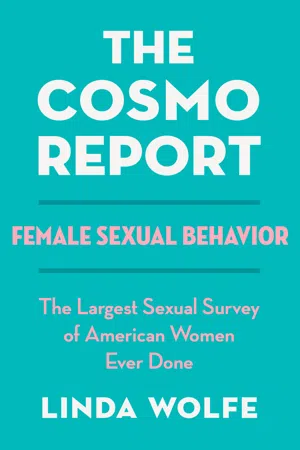
The largest-ever sexual survey of American women Bigger by far than the Kinsey Report or any other sexual study of American women, the Cosmo Report is a landmark work about female behavior. The report is based on the responses of more than one hundred thousand readers of Cosmopolitan magazine to a questionnaire about their sexual habits and preferences. But what makes the book more than a mere set of statistics—however revealing—is that many of the respondents augmented their replies with highly personal letters detailing the sexual practices they engaged in, the ones they most enjoyed, the ones they abhorred, and how they felt about the sexual revolution that transformed the lives of women in the 1970s and 1980s.
- 416 pages
- English
- ePUB (mobile friendly)
- Available on iOS & Android
eBook - ePub
About this book
Information
PART ONE
Sexuality with Partners
Chapter One
The First Time
1. Someday He’ll Come Along, the Man I Love
While not exactly your typical “Cosmo girl,” being 61 years old, I do have this evening free from any frantic sexual activities—or any others, for that matter—and am thus responding to your invitation to send you a letter. The first time? It was all so long ago. I think I was 15, but I might have been 14. It hurt, and I was young enough not quite to understand what was going on. My partner—blond, with silky hair and ears that stuck out and made me laugh—was an older man—of 17. I hadn’t understood until that night why my parents hadn’t wanted me to go out with him. They kept saying he was too old for me. Too old in experience was what they meant. These assignations weren’t as easy as they are now. But as you can see, we managed. And I still remember it.
—a woman from a small city in Michigan
One doubts that there is a woman alive who doesn’t remember the first man with whom she had sexual intercourse. That goes for the woman who has had one lover—just that very first—and stuck with him ever since, as well as for the woman who has since had a hundred lovers. There seems to be something about the first time that makes the event an unforgettable episode in a woman’s development and causes the first man to put an indelible imprint on her consciousness.
It isn’t just because he’s first. Some people claim they can remember all their big “firsts”—first love, first movie, first job, first pair of high heels. But if you prod them, they stumble. Details grow hazy as time unstitches the seams of their reminiscences. This is true even when you question them about first love. But when it comes to the first sexual partner, memory flows. Perhaps the reason this is so is that the first time really isn’t the first time. It is an event that has been previewed over and over in the imagination—worried about, considered, yearned for, fled from—for years, sometimes a decade or more, before it ever occurs. In a sense, it is a culmination rather than a beginning. Few women go to bed with a man for the first time without having long wondered and daydreamed about just what might be involved, how they would feel, and who their first partner would be.
Many women begin their wondering and daydreaming when they are very young, often by the time they are ten or eleven. Girls that age are highly romantic, if not erotic. They are endlessly intrigued by certain male movie and TV stars, collecting their photos, memorizing their histories, knowing their every idiosyncrasy and habit. And it is not uncommon to hear them, their faces intent, their hearts full, humming the lyrics of popular songs with an intensity that suggests that the songs already have profound meaning to them. “Someday he’ll come along, the man I love,” little girls sing, and “Some enchanted evening, I will meet a stranger,” and “Who’s gonna be my love?” By the time she enters her teens, the typical American girl has already been considering for some time, if still in a pre-physical way, the choosing of a sexual partner.
Once she is a teenager, her daydreams about love become sexualized. This is true not just in modern-day America where sexually explicit movies, television shows, books and magazines are all around us, from the time we are tots. In fact, teen-age girls everywhere and in every era have always thought sexual thoughts. Remember Juliet, as Shakespeare imagined her in the sixteenth century, a 14-year-old impatient to go to bed with Romeo:
Come, gentle night; come, loving black-browed night:
Give me my Romeo; and, when he shall die,
Take him and cut him out in little stars,
And he will make the face of heaven so fine
That all the world will be in love with night,
And pay no worship to the garish sun.
O, I have bought the mansion of a love,
But not possessed it; and though I am sold,
Not yet enjoyed. So tedious is this day
As is the night before some festival
To an impatient child that hath new robes
And may not wear them.
One needn’t look only to Shakespeare. Young girls daydreaming about sex during early adolescence exist in literature from all periods and cultures.
By the time a girl actually has her first sexual encounter, she has, generally speaking, been anticipating it and preparing for it for years. So her first full-fledged sexual encounter, unless it occurs as a result of early rape, has been played out in her head, albeit sometimes without the crucial details, a hundred times over.
No wonder, then, it is always so memorable.
But there is a sad fact about first sexual encounters. Historically, most girls have been dismally unprepared for their sexual initiation. A hundred years ago, a mother was expected to offer her daughter at least a little bit of information and guidance concerning her first time—which, of course, usually occurred on her wedding night—but many mothers, inhibited and uncomfortable about sex, reneged. Girls had sex for the first time in ignorance and dismay.
Here is the great American novelist Edith Wharton writing of what happened to her in the 1880s. She begged her mother, shortly before her wedding night, to tell her “what marriage was really like.” Her mother answered disapprovingly, “I never heard such a ridiculous question!” Young Edith persisted. “I’m afraid, Mama,” she said. “I want to know what will happen to me.” But her mother was silent, and a look of disgust crossed her face. “You’ve seen enough pictures and statues in your life,” she managed to explain at last. “Haven’t you noticed that men are … made differently from women?” Then Edith’s mother, too embarrassed to continue, terminated the conversation with a gruff, “Well, then … for heaven’s sake don’t ask me any more silly questions.”
Edith Wharton’s marriage was not consummated for three weeks, and for long afterward sex remained a problematic, distressing experience for her. Years later she was to blame this on the inadequacy of her mother’s advice and to chide the inhibited matrons of her day for failing to provide their daughters with useful information concerning first sex.
Well, one might say, that was in the latter part of the nineteenth century. Girls have easy access to sexual information nowadays.
Yet, oddly enough, in spite of the sexual revolution, there is still an unpleasant air of secrecy and silence regarding first sex. It’s well known that young girls in America today have intercourse at very early ages, that it is the rare one indeed who waits until her wedding night to have sex for the first time. And yet there is precious little information available for girls concerning that initial and crucial sex encounter. Preparation for that first time seems to come after the fact, whether the girl was young a hundred years ago or is young today, and whether she is 14 or 18 or 21.
This is not to say that library and bookstore shelves are not full of books that explain sex explicitly, or that today’s adolescent does not know what the sex act is like, and who does what to whom. But the books do not seem to go to the heart of the matter. Sexual initiation today is still often being conducted in ignorance and with dismay.
This is one of the themes explored in this chapter. The chapter also investigates not just the ages at which the first time most commonly occurs, but who a young girl’s first partner is likely to be, what kinds of first sex are more likely than other kinds to be emotionally and sexually fulfilling, and what effect the first time is likely to have on a woman’s future sexual development. But, above all, the chapter by, delving into the social role of first sex, attempts to explore what is making the experience come about earlier and earlier.
We live in an advanced society, one that has long ceased to honor the importance of commemorating, as our more primitive ancestors did, the transition from youth to maturity. In fact we are in general a society short on celebrations, rituals, the honoring of life’s passages. Sexual initiation seems almost to have been chosen by today’s adolescents themselves to fill a need, to serve as a commemorative rite of passage.
They undertake it with all the fear and unease that, say, Carib youths experienced when they had to prove their adulthood by running through rows of sharp-toothed pineapple fronds. They mostly derive little physical joy from the event. And often it scars them, if only psychically. But wounded as they are, they are ready now to join their elders. And generally the wounds and psychic injuries of first sex seem far less significant to them than the fact that they have, at last, made the passage.
2. How Old Were You?
MAJOR FINDINGS:
Twenty-one percent of the women surveyed first had sexual intercourse by the age of 15.
Sixty-nine percent first had sexual intercourse between the ages of 16 and 20.
Nine percent first had sexual intercourse between the ages of 21 and 25.
It should come as no surprise to anyone that American females are today having their first experiences with sexual intercourse premaritally and at much earlier ages than girls used to have them. Yes, there has been a sexual revolution in America. Compare the results of the Cosmo survey about the ages at which very young girls first have sex with what Kinsey found out back in 1953.
Among Kinsey’s sample of close to 6,000 females, 3 percent had had intercourse by the age of 15. It was a statistic that some conservative Americans did not want to accept. Or at least they wanted to believe that Kinsey had interviewed such a unique sample of women, such an uninhibited group, that his findings could not be said to reflect what was happening with American girls as a whole. Today it is now believed by most scholars and researchers that Kinsey’s sample was indeed representative of American women as a whole and so his findings could be said to have reflected national habits.
It has been nearly thirty years since the Kinsey report. Cosmopolitan discovered that 21 percent of those who responded to its survey had had sex by the age of 15. Does this mean that across the nation, one out of every five women has had sexual intercourse before the age of 15? Perhaps the Cosmopolitan sample was a unique one? A particularly sexually uninhibited one? There are people who would like to believe this is so, sexual puritans who would prefer to assume that while one out of every five of the kinds of women who read Cosmopolitan may have had sex by 15, the figure would be much lower for American women as a whole.
The author is reasonably certain it wouldn’t be—or at least that it wouldn’t be appreciably lower for American women who are today, like most of the Cosmopolitan women, under the age of 34. In fact, if anything, one suspects the figure might be considerably higher. This is because the age of first sex has been shown to be going down and down in numerous surveys of adolescent sex, not just in the Cosmo study.
In 1979, for example, clinical psychologist Aaron Hass published the results of a small but much publicized survey of adolescent sexual behavior, Teenage Sexuality. Hass’ sample was tiny: he studied only 318 girls. But he had, he asserted, drawn them from a variety of American ethnic backgrounds and geographic regions and had avoided choosing only girls whose families were exceedingly liberal about sex. Hass found that in his sample, 41 percent of the girls had had sexual intercourse by the age of 16.
More significantly, in 1973, a more authoritative survey, Adolescent Sexuality in Contemporary America, was published, this one by social psychologist Robert C. Sorenson. Sorenson too studied only a small number of teenagers—411 of them—but he chose them by scrupulous scientific methods in the hope that they would be representative of America’s entire adolescent population. Sorenson found that one out of every two girls in his sample had had sexual intercourse by the age of 15.
It seems reasonable to conclude, in view of the findings of Sorenson and Hass, as well as that of Cosmo, that today at least one out of every four young women in America has had sex before 15.
In any event, without question, the percentage is very far from Kinsey’s 3 percent. And there is no doubt that the trend toward having sex early is deepening. While only 15 percent of the Cosmo women who were over 25 had had sex before 15, among the women who were under 25, a fourth, or 25 percent, had had sex by 15.
Having sex early is, indisputably, increasingly frequent in American society.
Still, most girls do not have sex as young as 15, even today. Most girls first have sex when they are between the ages of 16 and 20. This was the time of sexual initiation for more than two-thirds of all the Cosmo women, and even for more than two-thirds of the women under 25. And according to a major 1980 national survey on adolescent sex conducted by two Johns Hopkins School of Public Health sociologists, the year between 19 and 20 may be the crucial one. The Johns Hopkins team—Melvin Zelnick and John F. Kantner—found that at 19, half of the 1,700 girls they queried had not yet had sex.
Having sex early is more and more frequent in American society, but having it during the last years of high school or the first years of college or employment is the norm.
3. Who Was the First Man?
MAJOR FINDINGS:
The vast majority of the women surveyed—64 percent—had their first sexual experience with a steady boyfriend. Another 16 percent had it with a casual acquaintance. Only ...
Table of contents
- Cover Page
- Title Page
- Dedication
- Foreword
- Contents
- Introduction
- The Cosmo Sex Survey
- Part I: Sexuality with Partners
- Part II: Private Sexuality
- Part III: The Human Arithmetic of Sex
- Part IV: Sexual Abuse
- Part V: The Sexual Revolution
- Appendix: Statistical Results of the Survey
- Acknowledgements
- Index
- Copyright Page
Trusted by 375,005 students
Access to over 1.5 million titles for a fair monthly price.
Study more efficiently using our study tools.
Frequently asked questions
Yes, you can cancel anytime from the Subscription tab in your account settings on the Perlego website. Your subscription will stay active until the end of your current billing period. Learn how to cancel your subscription
No, books cannot be downloaded as external files, such as PDFs, for use outside of Perlego. However, you can download books within the Perlego app for offline reading on mobile or tablet. Learn how to download books offline
Perlego offers two plans: Essential and Complete
- Essential is ideal for learners and professionals who enjoy exploring a wide range of subjects. Access the Essential Library with 800,000+ trusted titles and best-sellers across business, personal growth, and the humanities. Includes unlimited reading time and Standard Read Aloud voice.
- Complete: Perfect for advanced learners and researchers needing full, unrestricted access. Unlock 1.5M+ books across hundreds of subjects, including academic and specialized titles. The Complete Plan also includes advanced features like Premium Read Aloud and Research Assistant.
We are an online textbook subscription service, where you can get access to an entire online library for less than the price of a single book per month. With over 1.5 million books across 990+ topics, we’ve got you covered! Learn about our mission
Look out for the read-aloud symbol on your next book to see if you can listen to it. The read-aloud tool reads text aloud for you, highlighting the text as it is being read. You can pause it, speed it up and slow it down. Learn more about Read Aloud
Yes! You can use the Perlego app on both iOS and Android devices to read anytime, anywhere — even offline. Perfect for commutes or when you’re on the go.
Please note we cannot support devices running on iOS 13 and Android 7 or earlier. Learn more about using the app
Please note we cannot support devices running on iOS 13 and Android 7 or earlier. Learn more about using the app
Yes, you can access The Cosmo Report by Linda Wolfe in PDF and/or ePUB format, as well as other popular books in Social Sciences & Sociology. We have over 1.5 million books available in our catalogue for you to explore.