From the bestselling author of
The Man in the Gray Flannel Suit, a World War II novel that is as thrilling as it is true to life
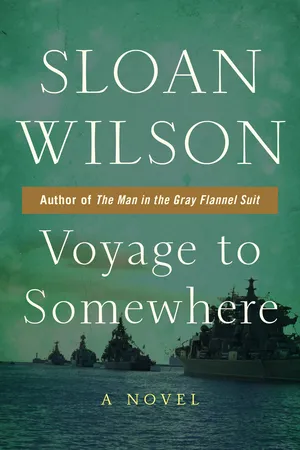
Hoping to draw a nice, lengthy shore duty after two years at sea, Lieutenant Barton is instead told that he is being sent right back out, this time as captain of a supply ship sailing from California to New Guinea and stopping at every small island in between. Homesick for his wife, he has no choice but to accept the assignment and a crew of twenty-six landlubbers whose last names all begin with
W. Their first load of cargo? Pineapples destined for Hawaii.
Life aboard the one-hundred-eighty-foot
SV-126 is never dull. When Barton isn't battling gale-force winds and monstrous waves, he is coping with seasick sailors and budding rivalries that threaten to turn mutinous. Hanging over the ship like a storm cloud is the knowledge that the world is at war and the enemy is never far away.
Whether Lieutenant Barton and his crew are fighting torpedoes and typhoons or writing letters to loved ones,
Voyage to Somewhere offers a unique and page-turning perspective on what the Second World War was really like.
- 253 pages
- English
- ePUB (mobile friendly)
- Available on iOS & Android
eBook - ePub
About this book
Information
Subtopic
Historical FictionIndex
LiteratureCHAPTER ONE
DO YOU want command of a ship?” the personnel officer asked.
“Well,” I said, “I hadn’t thought of it.”
The personnel officer leaned forward and flicked through the pages of a small card index in a green metal box.
“Let me see, Lieutenant,” he said. “Barton is your name. I think I have you down for command of a ship.”
“If you don’t mind,” I interjected, “there are other things I’d rather do. I just came back from two years’ sea duty, you know. I’d been hoping for a job somewhere in the States.”
“If I could only find your name here. I had it somewhere.”
I stood uneasily before the personnel officer’s desk and watched him look through one card index after the other. He was red-faced and fat. I envied him his job. It must be fun to rifle through card indexes to see whom you were going to send out.
“I’d been hoping,” I said again, “that for a while I could be stationed in the States. Some kind of a teaching job, perhaps, or captain of the port.”
“Well,” he said, “I don’t know where your name is. What were you saying?”
“I was saying that I wanted a job here in the States. I’ve just come back from two years overseas.”
He sat back in his chair and placed one of his fat little hands over the other in a gesture of childish dismay.
“Oh,” he said, “that is impossible. We have to man over a hundred ships going out to New Guinea, and we need men of experience. You have had two years’ sea duty, but that’s just what makes you so valuable.”
“How about letting someone else get valuable?” I asked.
He grinned at me as though I had made a wonderful joke and suddenly leaned forward and produced a notebook from a drawer. “I know where your name is,” he said. “That reminds me!”
I watched while he carefully turned the pages.
“Barton,” he said. “Let me see. I know it’s here somewhere.”
The pages made a dry sound.
“Barton,” he said again. “Begins with a B. That would be toward the beginning of the alphabet. Here it is! I knew I had you down somewhere!”
“What,” I asked, “have you got me down for?”
“A wonderful assignment!”
“What assignment?”
“You’re to be commanding officer of a ship.”
“I know,” I said, “and the ship is going to New Guinea. Not just there and back, but there and on. Don’t tell me about it.”
He flipped his notebook shut. “It’s a wonderful assignment,” he said. “I thought I was doing you a favor. It’s a brand-new ship.”
“How long?”
“What?”
“How long is the ship? How big is she?”
“A hundred and eighty feet.”
“No, thanks.”
“What?”
“I don’t want that assignment. Do I have to take it? Tell me now and it will save talk.”
The personnel officer took his glasses off and polished them with his handkerchief. “I’m afraid the Commander is already having your orders written up. If you don’t want the job you might see him, but I’m afraid it won’t do much good. We don’t have many men with enough experience to be commanding officers. You know, to tell you the truth, I can’t understand your attitude.”
I felt tired and pulled up a chair from another desk. Before speaking I lit my pipe. “My attitude,” I said finally, “is easily understood. For the past two years I have been bobbing around in small ships. I’d like a rest. I’ve never been able to understand why it’s necessary to be shoved out the moment I get in. You and I are both lieutenants; why don’t you go to sea for a while and let me have your desk? Let’s divide these honors equally.”
The personnel officer put his glasses on carefully. “There’s nothing I’d like better,” he said, “but I haven’t had the experience. To tell you the truth I’ve never been to sea since my cadet cruise. I couldn’t command a ship now any more than you could really do my job. As a matter of fact, I have twice asked the Commander for a ship, but you know how it is.”
“Yes,” I said, “I know how it is.”
He looked up at me and for a moment I almost felt sorry for him. He looked so small, and so fat, and so sedentary. Perhaps he really did want to go to sea.
“Let me tell you about this assignment,” he said. “The ship is a supply vessel. You’ll run out of convoy to all the small bases. In the Pacific you will call at every small island—the Hawaiians, the Ellice Islands, the Solomons, and maybe more. Once you get to New Guinea you’ll stay away from the big bases almost entirely. It’ll be more an exploring expedition than a war. As captain of the ship you’ll be your own boss; there’ll be no detachment commanders anywhere within miles. It’s a damn rare assignment.”
“What kind of a crew will you give me?”
“Not much, I’m afraid. You know how few experienced hands there are around these days, and the destroyer escorts are getting most of them. I’ll do the best I can for you, though; don’t worry about that.”
“Tell me more about the ship,” I said. “How fast is she? What does she look like?”
“Well, I don’t really know. These are new ships, and I haven’t seen any of them. I understand they’re pretty good, though.”
He opened his notebook again and ran his finger down the line. “Your ship is the SV-126.”
“Thanks,” I said. “That helps a lot. Now I know all about her.”
I got up and started buttoning my coat. “How long have I got in the States?” I asked. “How long before I’ll get my orders?”
“It’s hard to tell. It might be tomorrow, it might be next month.”
“Look,” I said, “I’d like to know. I have to decide whether or not to wire my wife to come out. There’s no use her coming across the continent if I’m only going to be here a few days.”
“You better not have her come out. Your ship will probably be ready sometime this week.”
“Well,” I said, “thanks.”
I turned and walked off. When I had almost reached the door he called after me. “I wouldn’t get too downhearted,” he said. “I hear a rumor that we’re going into the Marianas pretty soon. They say the war’s almost over.”
CHAPTER TWO
NOT HAVING anything else to do, I decided to go down to the shipyard to inspect the SV-126. A yeoman in the office told me that she was building at the Pacific Ship Works. I took a taxi there, and soon stood before the watchman’s gate. Over the fence I could see the towering decks of a battleship on the ways, and moored in a slip was an aircraft carrier. The watchman came out of his box and looked at me as though he wanted to place his hand over my eyes.
“I want to go aboard a ship that’s building here,” I said. “The SV-126.”
The watchman went to a notebook which, by coincidence, had a similar binding to the one in which the personnel officer had found my name.
“SV-126,” he said. “I don’t have no such number here.”
“Look again,” I said. “It must be here. I’m sure the ship is being built in this yard.”
“What kind of a ship is it?” he asked.
“A supply ship. A very small one.”
He looked again. “Nope,” he said, “it’s not here. Must be at some other yard.”
“Will you let me go in and look?” I asked.
The watchman looked at me suspiciously a moment, then bade me go in.
The shipyard was a big place. On the ways along the water more than a dozen big ships were being built or repaired. Men on scaffolds by the sides of a battleship were welding, and the bright sparks of their torches sprayed out like a Fourth of July celebration. Beside the battleship was a destroyer with her bow removed. As I passed her I could look into her hull and see that the bunks in her forecastle had been twisted by fire. Past this row of ships I saw an office building. I stopped there and asked for the SV-126.
“Never heard of it,” a bespectacled civilian told me.
“Are you building any small ships here at all?” I asked.
He thought a moment and consulted a framed map of the yard on the wall.
“Over here,” he said, pointing with his finger, “they’re building some small hulls. I thought they were tugboats, but you can look and see.”
He showed me how I could get to the point designated, and I set out. I walked past the half-completed hull of a Liberty ship and the knifelike bow of a cruiser. Over the top of a building I could see the upper deck of the carrier I had seen from without the wall. When I had passed the building I could see a group of tin workshops by the water, but no more ships. Discouraged, I turned to go back, and saw a workman carrying a welder’s mask behind me.
I said, “You don’t know where they’re building a small ship around here, do you? The SV-126?”
He said, “They’ve got something down by the blacksmith shop. Just threw it in the water yesterday.”
He pointed to the blacksmith shop, the farthest of the tin sheds I had seen before, and I walked toward it.
When I rounded the corner of the blacksmith shop I saw the SV-126. I had not seen her before because the top of her mast did not come above the roof of the building. She was indeed a small ship—so small that she might best have been called a boat. The white numbers on her plumb bow seemed disproportionately large. The bow, almost before it got started, broke away into a well deck that was not more than a foot and a half above the water. Abaft the well deck the stern was built up like the stern of a Spanish galleon. The ship’s lines, taken together with the fact that she was painted a bright green, made her appear ridiculous. Fascinated, I walked down to the dock and stood beside her. Even in the imperceptible swell of the slip she was bobbing lightly against the dock. Frantically, as a man tries to find good points in a person he feels he should love, I tried to find something consoling about the ship. The high bow was good—she would not take much water forward, or aft, for that matter, with that high stem. But amidships she would be awash half the time! And the looks of the thing! A man would be ashamed to be seen aboard her. I stepped backward to see the full sweep of her lines better. As I did so I noticed an officer seated on a pile of lumber a few feet away. He was a very fat man about forty years of age, a lieutenant. He was looking at me with an air of amusement.
“Well,” he said, “what do you think of her?”
“Not much,” I admitted.
He got up and walked over toward me. “Going to be stationed aboard her?” he asked.
“I’m afraid so.”
“So am I.”
I looked at him with new interest. He was fat, but he neither talked nor walked like a fat man. Something in his manner suggested that his corpulence was merely a disguise that could be dropped at a moment’s notice. I realized that I had been staring at him, and quickly shoved out my hand.
“My name’s Barton,” I said. “I understand I’m supposed to command the thing.”
“Rudd’s my name,” he said. “I’m the ...
Table of contents
- Cover Page
- Title Page
- Dedication
- Chapter One
- Chapter Two
- Chapter Three
- Chapter Four
- Chapter Five
- Chapter Six
- Chapter Seven
- Chapter Eight
- Chapter Nine
- Chapter Ten
- Chapter Eleven
- Chapter Twelve
- Chapter Thirteen
- Chapter Fourteen
- Chapter Fifteen
- Chapter Sixteen
- Chapter Seventeen
- Chapter Eighteen
- Chapter Nineteen
- Chapter Twenty
- Chapter Twenty-One
- Chapter Twenty-Two
- Chapter Twenty-Three
- Chapter Twenty-Four
- Chapter Twenty-Five
- Chapter Twenty-Six
- Chapter Twenty-Seven
- Chapter Twenty-Eight
- Chapter Twenty-Nine
- Chapter Thirty
- Chapter Thirty-One
- Chapter Thirty-Two
- About the Author
- Copyright Page
Trusted by 375,005 students
Access to over 1.5 million titles for a fair monthly price.
Study more efficiently using our study tools.
Frequently asked questions
Yes, you can cancel anytime from the Subscription tab in your account settings on the Perlego website. Your subscription will stay active until the end of your current billing period. Learn how to cancel your subscription
No, books cannot be downloaded as external files, such as PDFs, for use outside of Perlego. However, you can download books within the Perlego app for offline reading on mobile or tablet. Learn how to download books offline
Perlego offers two plans: Essential and Complete
- Essential is ideal for learners and professionals who enjoy exploring a wide range of subjects. Access the Essential Library with 800,000+ trusted titles and best-sellers across business, personal growth, and the humanities. Includes unlimited reading time and Standard Read Aloud voice.
- Complete: Perfect for advanced learners and researchers needing full, unrestricted access. Unlock 1.5M+ books across hundreds of subjects, including academic and specialized titles. The Complete Plan also includes advanced features like Premium Read Aloud and Research Assistant.
We are an online textbook subscription service, where you can get access to an entire online library for less than the price of a single book per month. With over 1.5 million books across 990+ topics, we’ve got you covered! Learn about our mission
Look out for the read-aloud symbol on your next book to see if you can listen to it. The read-aloud tool reads text aloud for you, highlighting the text as it is being read. You can pause it, speed it up and slow it down. Learn more about Read Aloud
Yes! You can use the Perlego app on both iOS and Android devices to read anytime, anywhere — even offline. Perfect for commutes or when you’re on the go.
Please note we cannot support devices running on iOS 13 and Android 7 or earlier. Learn more about using the app
Please note we cannot support devices running on iOS 13 and Android 7 or earlier. Learn more about using the app
Yes, you can access Voyage to Somewhere by Sloan Wilson in PDF and/or ePUB format, as well as other popular books in Literature & Historical Fiction. We have over 1.5 million books available in our catalogue for you to explore.