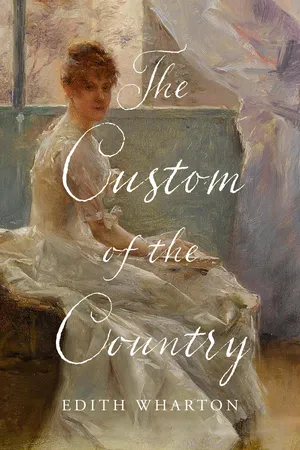
Edith Wharton's classic story of one woman's quest for wealth and status after the turn of the twentieth century
Beautiful, selfish, and driven, Undine Spragg arrives in New York with all of the ambition and naiveté that her midwestern, nouveau riche upbringing afforded her. As cunning as she is lovely, Undine has but one goal in life: to ascend to the upper echelons of high society. And so with a single-minded tenacity, Undine continues to maneuver through life, finding all the while that true satisfaction remains just beyond her grasp.
Hailed by Elizabeth Hardwick as "Edith Wharton's finest achievement,"
The Custom of the Country is a riveting novel of ruthless ambition and a literary master class in the art of the antiheroine.
This ebook has been professionally proofread to ensure accuracy and readability on all devices.
- 432 pages
- English
- ePUB (mobile friendly)
- Available on iOS & Android
eBook - ePub
The Custom of the Country
About this book
Information
Subtopic
ClassicsIndex
LiteratureXVIII
UNDINE STOOD ALONE on the landing outside her father’s office.
Only once before had she failed to gain her end with him—and there was a peculiar irony in the fact that Moffatt’s intrusion should have brought before her the providential result of her previous failure. Not that she confessed to any real resemblance between the two situations. In the present case she knew well enough what she wanted, and how to get it. But the analogy had served her father’s purpose, and Moffatt’s unlucky entrance had visibly strengthened his resistance.
The worst of it was that the obstacles in the way were real enough. Mr. Spragg had not put her off with vague asseverations—somewhat against her will he had forced his proofs on her, showing her how much above his promised allowance he had contributed in the last three years to the support of her household. Since she could not accuse herself of extravagance—having still full faith in her gift of “managing”—she could only conclude that it was impossible to live on what her father and Ralph could provide; and this seemed a practical reason for desiring her freedom. If she and Ralph parted he would of course return to his family, and Mr. Spragg would no longer be burdened with a helpless son-in-law. But even this argument did not move him. Undine, as soon as she had risked Van Degen’s name, found herself face to face with a code of domestic conduct as rigid as its exponent’s business principles were elastic. Mr. Spragg did not regard divorce as intrinsically wrong or even inexpedient; and of its social disadvantages he had never even heard. Lots of women did it, as Undine said, and if their reasons were adequate they were justified. If Ralph Marvell had been a drunkard or “unfaithful” Mr. Spragg would have approved Undine’s desire to divorce him; but that it should be prompted by her inclination for another man—and a man with a wife of his own—was as shocking to him as it would have been to the most uncompromising of the Dagonets and Marvells. Such things happened, as Mr. Spragg knew, but they should not happen to any woman of his name while he had the power to prevent it; and Undine recognized that for the moment he had that power.
As she emerged from the elevator she was surprised to see Moffatt in the vestibule. His presence was an irritating reminder of her failure, and she walked past him with a rapid bow; but he overtook her.
“Mrs. Marvell—I’ve been waiting to say a word to you.”
If it had been any one else she would have passed on; but Moffatt’s voice had always a detaining power. Even now that she knew him to be defeated and negligible, the power asserted itself, and she paused to say: “I’m afraid I can’t stop—I’m late for an engagement.”
“I shan’t make you much later; but if you’d rather have me call round at your house—”
“Oh, I’m so seldom in.” She turned a wondering look on him. “What is it you wanted to say?”
“Just two words. I’ve got an office in this building and the shortest way would be to come up there for a minute.” As her look grew distant he added: “I think what I’ve got to say is worth the trip.”
His face was serious, without underlying irony: the face he wore when he wanted to be trusted.
“Very well,” she said, turning back.
Undine, glancing at her watch as she came out of Moffatt’s office, saw that he had been true to his promise of not keeping her more than ten minutes. The fact was characteristic. Under all his incalculableness there had always been a hard foundation of reliability: it seemed to be a matter of choice with him whether he let one feel that solid bottom or not. And in specific matters the same quality showed itself in an accuracy of statement, a precision of conduct, that contrasted curiously with his usual hyperbolic banter and his loose lounging manner. No one could be more elusive yet no one could be firmer to the touch. Her face had cleared and she moved more lightly as she left the building. Moffatt’s communication had not been completely clear to her, but she understood the outline of the plan he had laid before her, and was satisfied with the bargain they had struck. He had begun by reminding her of her promise to introduce him to any friend of hers who might be useful in the way of business. Over three years had passed since they had made the pact, and Moffatt had kept loyally to his side of it. With the lapse of time the whole matter had become less important to her, but she wanted to prove her good faith, and when he reminded her of her promise she at once admitted it.
“Well, then—I want you to introduce me to your husband.”
Undine was surprised; but beneath her surprise she felt a quick sense of relief. Ralph was easier to manage than so many of her friends—and it was a mark of his present indifference to acquiesce in anything she suggested.
“My husband? Why, what can he do for you?”
Moffatt explained at once, in the fewest words, as his way was when it came to business. He was interested in a big “deal” which involved the purchase of a piece of real estate held by a number of wrangling heirs. The real-estate broker with whom Ralph Marvell was associated represented these heirs, but Moffatt had his reasons for not approaching him directly. And he didn’t want to go to Marvell with a “business proposition”—it would be better to be thrown with him socially as if by accident. It was with that object that Moffatt had just appealed to Mr. Spragg, but Mr. Spragg, as usual, had “turned him down,” without even consenting to look into the case.
“He’d rather have you miss a good thing than have it come to you through me. I don’t know what on earth he thinks it’s in my power to do to you—or ever was, for that matter,” he added. “Anyhow,” he went on to explain, “the power’s all on your side now; and I’ll show you how little the doing will hurt you as soon as I can have a quiet chat with your husband.” He branched off again into technicalities, nebulous projections of capital and interest, taxes and rents, from which she finally extracted, and clung to, the central fact that if the “deal went through” it would mean a commission of forty thousand dollars to Marvell’s firm, of which something over a fourth would come to Ralph.
“By Jove, that’s an amazing fellow!” Ralph Marvell exclaimed, turning back into the drawing-room, a few evenings later, at the conclusion of one of their little dinners. Undine looked up from her seat by the fire. She had had the inspired thought of inviting Moffatt to meet Clare Van Degen, Mrs. Fairford and Charles Bowen. It had occurred to her that the simplest way of explaining Moffatt was to tell Ralph that she had unexpectedly discovered an old Apex acquaintance in the protagonist of the great Ararat Trust fight. Moffatt’s defeat had not wholly divested him of interest. As a factor in affairs he no longer inspired apprehension, but as the man who had dared to defy Harmon B. Driscoll he was a conspicuous and, to some minds, almost an heroic figure.
Undine remembered that Clare and Mrs. Fairford had once expressed a wish to see this braver of the Olympians, and her suggestion that he should be asked meet them gave Ralph evident pleasure. It was long since she had made any conciliatory sign to his family.
Moffatt’s social gifts were hardly of a kind to please the two ladies: he would have shone more brightly in Peter Van Degen’s set than in his wife’s. But neither Clare nor Mrs. Fairford had expected a man of conventional cut, and Moffatt’s loud easiness was obviously less disturbing to them than to their hostess. Undine felt only his crudeness, and the tacit criticism passed on it by the mere presence of such men as her husband and Bowen; but Mrs. Fairford’ seemed to enjoy provoking him to fresh excesses of slang and hyperbole. Gradually she drew him into talking of the Driscoll campaign, and he became recklessly explicit. He seemed to have nothing to hold back: all the details of the prodigious exploit poured from him with Homeric volume. Then he broke off abruptly, thrusting his hands into his trouser-pockets and shaping his red lips to a whistle which he checked as his glance met Undine’s. To conceal his embarrassment he leaned back in his chair, looked about the table with complacency, and said “I don’t mind if I do” to the servant who approached to re-fill his champagne glass.
The men sat long over their cigars; but after an interval Undine called Charles Bowen into the drawing-room to settle some question in dispute between Clare and Mrs. Fairford, and thus gave Moffatt a chance to be alone with her husband. Now that their guests had gone she was throbbing with anxiety to know what had passed between the two; but when Ralph rejoined her in the drawing-room she continued to keep her eyes on the fire and twirl her fan listlessly.
“That’s an amazing chap,” Ralph repeated, looking down at her. “Where was it you ran across him—out at Apex?”
As he leaned against the chimney-piece, lighting his cigarette, it struck Undine that he looked less fagged and lifeless than usual, and she felt more and more sure that something important had happened during the moment of isolation she had contrived.
She opened and shut her fan reflectively. “Yes—years ago; father had some business with him and brought him home to dinner one day.”
“And you’ve never seen him since?”
She waited, as if trying to piece her recollections together. “I suppose I must have; but all that seems so long ago,” she said sighing. She had been given, of late, to such plaintive glances toward her happy girlhood but Ralph seemed not to notice the allusion.
“Do you know,” he exclaimed after a moment, “I don’t believe the fellow’s beaten yet.”
She looked up quickly. “Don’t you?”
“No; and I could see that Bowen didn’t either. He strikes me as the kind of man who develops slowly, needs a big field, and perhaps makes some big mistakes, but gets where he wants to in the end. Jove, I wish I could put him in a book! There’s something epic about him—a kind of epic effrontery.”
Undine’s pulses beat faster as she listened. Was it not what Moffatt had always said of himself—that all he needed was time and elbow-room? How odd that Ralph, who seemed so dreamy and unobservant, should instantly have reached the same conclusion! But what she wanted to know was the practical result of their meeting.
“What did you and he talk about when you were smoking?”
“Oh, he got on the Driscoll fight again—gave us some extraordinary details. The man’s a thundering brute, but he’s full of observation and humour. Then, after Bowen joined you, he told me about a ne...
Table of contents
- Cover
- Title Page
- I
- II
- III
- IV
- V
- VI
- VII
- VIII
- IX
- X
- XI
- XII
- XIII
- XIV
- XV
- XVI
- XVII
- XVIII
- XIX
- XX
- XXI
- XXII
- XXIII
- XXIV
- XXV
- XXVI
- XXVII
- XXVIII
- XXIX
- XXX
- XXXI
- XXXII
- XXXIII
- XXXIV
- XXXV
- XXXVI
- XXXVII
- XXXVIII
- XXXIX
- XL
- XLI
- XLII
- XLIII
- XLIV
- XLV
- XLVI
- Copyright
Trusted by 375,005 students
Access to over 1.5 million titles for a fair monthly price.
Study more efficiently using our study tools.
Frequently asked questions
Yes, you can cancel anytime from the Subscription tab in your account settings on the Perlego website. Your subscription will stay active until the end of your current billing period. Learn how to cancel your subscription
No, books cannot be downloaded as external files, such as PDFs, for use outside of Perlego. However, you can download books within the Perlego app for offline reading on mobile or tablet. Learn how to download books offline
Perlego offers two plans: Essential and Complete
- Essential is ideal for learners and professionals who enjoy exploring a wide range of subjects. Access the Essential Library with 800,000+ trusted titles and best-sellers across business, personal growth, and the humanities. Includes unlimited reading time and Standard Read Aloud voice.
- Complete: Perfect for advanced learners and researchers needing full, unrestricted access. Unlock 1.5M+ books across hundreds of subjects, including academic and specialized titles. The Complete Plan also includes advanced features like Premium Read Aloud and Research Assistant.
We are an online textbook subscription service, where you can get access to an entire online library for less than the price of a single book per month. With over 1.5 million books across 990+ topics, we’ve got you covered! Learn about our mission
Look out for the read-aloud symbol on your next book to see if you can listen to it. The read-aloud tool reads text aloud for you, highlighting the text as it is being read. You can pause it, speed it up and slow it down. Learn more about Read Aloud
Yes! You can use the Perlego app on both iOS and Android devices to read anytime, anywhere — even offline. Perfect for commutes or when you’re on the go.
Please note we cannot support devices running on iOS 13 and Android 7 or earlier. Learn more about using the app
Please note we cannot support devices running on iOS 13 and Android 7 or earlier. Learn more about using the app
Yes, you can access The Custom of the Country by Edith Wharton in PDF and/or ePUB format, as well as other popular books in Literature & Classics. We have over 1.5 million books available in our catalogue for you to explore.