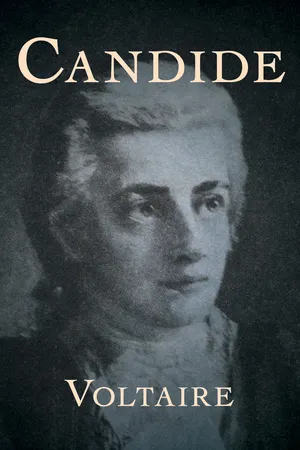
Voltaire's satire of eighteenth-century Europe, hailed as one of the most influential works in the Western canon
Candide's misfortunes begin when his uncle, a German baron, banishes him for kissing the baron's daughter, Cunégonde. Forced to make his own way in the world, Candide goes from conscription in the Bulgar army, to Lisbon, after a harrowing voyage by sea, to the tutelage of the Enlightenment philosopher Pangloss. After an unexpected reunion with his beloved Cunégonde, Candide finds that further misadventure awaits, first through South America and then back in Europe, where he settles in the countryside.
Among the most widely renowned texts of western literature,
Candide lives on two hundred fifty years since its first publication as a supreme example of political, philosophical, and religious satire whose wit and power of observation have influenced writers for generations.
This ebook has been professionally proofread to ensure accuracy and readability on all devices.
eBook - ePub
Candide
About this book
Information
Subtopic
ClassicsIndex
LiteratureXXII
WHAT HAPPENED IN FRANCE TO CANDIDE AND MARTIN.
Candide stayed in Bordeaux no longer than was necessary for the selling of a few of the pebbles of El Dorado, and for hiring a good chaise to hold two passengers; for he could not travel without his Philosopher Martin. He was only vexed at parting with his sheep, which he left to the Bordeaux Academy of Sciences, who set as a subject for that year’s prize, “to find why this sheep’s wool was red;” and the prize was awarded to a learned man of the North, who demonstrated by A plus B minus C divided by Z, that the sheep must be red, and die of the rot.
Meanwhile, all the travellers whom Candide met in the inns along his route, said to him, “We go to Paris.” This general eagerness at length gave him, too, a desire to see this capital; and it was not so very great a détour from the road to Venice.
He entered Paris by the suburb of St. Marceau, and fancied that he was in the dirtiest village of Westphalia.
Scarcely was Candide arrived at his inn, than he found himself attacked by a slight illness, caused by fatigue. As he had a very large diamond on his finger, and the people of the inn had taken notice of a prodigiously heavy box among his baggage, there were two physicians to attend him, though he had never sent for them, and two devotees who warmed his broths.
“I remember,” Martin said, “also to have been sick at Paris in my first voyage; I was very poor, thus I had neither friends, devotees, nor doctors, and I recovered.”
However, what with physic and bleeding, Candide’s illness became serious. A parson of the neighborhood came with great meekness to ask for a bill for the other world payable to the bearer. Candide would do nothing for him; but the devotees assured him it was the new fashion. He answered that he was not a man of fashion. Martin wished to throw the priest out of the window. The priest swore that they would not bury Candide. Martin swore that he would bury the priest if he continued to be troublesome. The quarrel grew heated. Martin took him by the shoulders and roughly turned him out of doors; which occasioned great scandal and a law-suit.
Candide got well again, and during his convalescence he had very good company to sup with him. They played high. Candide wondered why it was that the ace never came to him; but Martin was not at all astonished.
Among those who did him the honours of the town was a little Abbé of Perigord, one of those busybodies who are ever alert, officious, forward, fawning, and complaisant; who watch for strangers in their passage through the capital, tell them the scandalous history of the town, and offer them pleasure at all prices. He first took Candide and Martin to La Comédie, where they played a new tragedy. Candide happened to be seated near some of the fashionable wits. This did not prevent his shedding tears at the well-acted scenes. One of these critics at his side said to him between the acts:
“Your tears are misplaced; that is a shocking actress; the actor who plays with her is yet worse; and the play is still worse than the actors. The author does not know a word of Arabic, yet the scene is in Arabia; moreover he is a man that does not believe in innate ideas; and I will bring you, to-morrow, twenty pamphlets written against him.”*
“How many dramas have you in France, sir?” said Candide to the Abbé.
“Five or six thousand.”
“What a number!” said Candide. “How many good?”
“Fifteen or sixteen,” replied the other.
“What a number!” said Martin.
Candide was very pleased with an actress who played Queen Elizabeth in a somewhat insipid tragedy* sometimes acted.
“That actress,” said he to Martin, “pleases me much; she has a likeness to Miss Cunegonde; I should be very glad to wait upon her.”
The Perigordian Abbé offered to introduce him. Candide, brought up in Germany, asked what was the etiquette, and how they treated queens of England in France.
“It is necessary to make distinctions,” said the Abbé. “In the provinces one takes them to the inn; in Paris, one respects them when they are beautiful, and throws them on the highway when they are dead.”*
“Queens on the highway!” said Candide.
“Yes, truly,” said Martin, “the Abbé is right. I was in Paris when Miss Monime passed, as the saying is, from this life to the other. She was refused what people call the honours of sepulture—that is to say, of rotting with all the beggars of the neighbourhood in an ugly cemetery; she was interred all alone by her company at the corner of the Rue de Bourgogne, which ought to trouble her much, for she thought nobly.”
“That was very uncivil,” said Candide.
“What would you have?” said Martin; “these people are made thus. Imagine all contradictions, all possible incompatibilities—you will find them in the government, in the law-courts, in the churches, in the public shows of this droll nation.”
“Is it true that they always laugh in Paris?” said Candide.
“Yes,” said the Abbé, “but it means nothing, for they complain of everything with great fits of laughter; they even do the most detestable things while laughing.”
“Who,” said Candide, “is that great pig who spoke so ill of the piece at which I wept, and of the actors who gave me so much pleasure?”
“He is a bad character,” answered the Abbé, “who gains his livelihood by saying evil of all plays and of all books. He hates whatever succeeds, as the eunuchs hate those who enjoy; he is one of the serpents of literature who nourish themselves on dirt and spite; he is a folliculaire.”
“What is a folliculaire?” said Candide.
“It is,” said the Abbé, “a pamphleteer—a Fréron.”*
Thus Candide, Martin, and the Perigordian conversed on the staircase, while watching every one go out after the performance.
“Although I am eager to see Cunegonde again,” said Candide, “I should like to sup with Miss Clairon, for she appears to me admirable.”
The Abbé was not the man to approach Miss Clairon, who saw only good company.
“She is engaged for this evening,” he said, “but I shall have the honour to take you to the house of a lady of quality, and there you will know Paris as if you had lived in it for years.”
Candide, who was naturally curious, let himself be taken to this lady’s house, at the end of the Faubourg St. Honoré. The company was occupied in playing faro; a dozen melancholy punters held each in his hand a little pack of cards; a bad record of his misfortunes. Profound silence reigned; pallor was on the faces of the punters, anxiety on that of the banker, and the hostess, sitting near the unpitying banker, noticed with lynx-eyes all the doubled and other increased stakes, as each player dog’s-eared his cards; she made them turn down the edges again with severe, but polite attention; she showed no vexation for fear of losing her customers. The lady insisted upon being called the Marchioness of Parolignac. Her daughter, aged fifteen, was among the punters, and notified with a covert glance the cheatings of the poor people who tried to repair the cruelties of fate. The Perigordian Abbé, Candide, and Martin entered; no one rose, no one saluted them, no one looked at them; all were profoundly occupied with their cards.
“The Baroness of Thunder-ten-Tronckh was more polite,” said Candide.
However, the Abbé whispered to the Marchioness, who half rose, honoured Candide with a gracious smile...
Table of contents
- Cover
- Title Page
- INTRODUCTION
- I. HOW CANDIDE WAS BROUGHT UP IN A MAGNIFICENT CASTLE, AND HOW HE WAS EXPELLED THENCE.
- II. WHAT BECAME OF CANDIDE AMONG THE BULGARIANS.
- III. HOW CANDIDE MADE HIS ESCAPE FROM THE BULGARIANS, AND WHAT AFTERWARDS BECAME OF HIM.
- IV. HOW CANDIDE FOUND HIS OLD MASTER PANGLOSS, AND WHAT HAPPENED TO THEM.
- V. TEMPEST, SHIPWRECK, EARTHQUAKE, AND WHAT BECAME OF DOCTOR PANGLOSS, CANDIDE, AND JAMES THE ANABAPTIST.
- VI. HOW THE PORTUGUESE MADE A BEAUTIFUL AUTO-DA-FÉ, TO PREVENT ANY FURTHER EARTHQUAKES; AND HOW CANDIDE WAS PUBLICLY WHIPPED.
- VII. HOW THE OLD WOMAN TOOK CARE OF CANDIDE, AND HOW HE FOUND THE OBJECT HE LOVED.
- VIII. THE HISTORY OF CUNEGONDE.
- IX. WHAT BECAME OF CUNEGONDE, CANDIDE, THE GRAND INQUISITOR, AND THE JEW.
- X. IN WHAT DISTRESS CANDIDE, CUNEGONDE, AND THE OLD WOMAN ARRIVED AT CADIZ; AND OF THEIR EMBARKATION.
- XI. HISTORY OF THE OLD WOMAN.
- XII. THE ADVENTURES OF THE OLD WOMAN CONTINUED.
- XIII. HOW CANDIDE WAS FORCED AWAY FROM HIS FAIR CUNEGONDE AND THE OLD WOMAN.
- XIV. HOW CANDIDE AND CACAMBO WERE RECEIVED BY THE JESUITS OF PARAGUAY.
- XV. HOW CANDIDE KILLED THE BROTHER OF HIS DEAR CUNEGONDE.
- XVI. ADVENTURES OF THE TWO TRAVELLERS, WITH TWO GIRLS, TWO MONKEYS, AND THE SAVAGES CALLED OREILLONS.
- XVII. ARRIVAL OF CANDIDE AND HIS VALET AT EL DORADO, AND WHAT THEY SAW THERE.
- XVIII. WHAT THEY SAW IN THE COUNTRY OF EL DORADO.
- XIX. WHAT HAPPENED TO THEM AT SURINAM AND HOW CANDIDE GOT ACQUAINTED WITH MARTIN.
- XX. WHAT HAPPENED AT SEA TO CANDIDE AND MARTIN.
- XXI. CANDIDE AND MARTIN, REASONING, DRAW NEAR THE COAST OF FRANCE.
- XXII. WHAT HAPPENED IN FRANCE TO CANDIDE AND MARTIN.
- XXIII. CANDIDE AND MARTIN TOUCHED UPON THE COAST OF ENGLAND, AND WHAT THEY SAW THERE.
- XXIV. OF PAQUETTE AND FRIAR GIROFLÉE.
- XXV. THE VISIT TO LORD POCOCURANTE, A NOBLE VENETIAN.
- XXVI. OF A SUPPER WHICH CANDIDE AND MARTIN TOOK WITH SIX STRANGERS, AND WHO THEY WERE.
- XXVII. CANDIDE’S VOYAGE TO CONSTANTINOPLE.
- XXVIII. WHAT HAPPENED TO CANDIDE, CUNEGONDE, PANGLOSS, MARTIN, ETC.
- XXIX. HOW CANDIDE FOUND CUNEGONDE AND THE OLD WOMAN AGAIN.
- XXX. THE CONCLUSION.
- Copyright
Trusted by 375,005 students
Access to over 1.5 million titles for a fair monthly price.
Study more efficiently using our study tools.
Frequently asked questions
Yes, you can cancel anytime from the Subscription tab in your account settings on the Perlego website. Your subscription will stay active until the end of your current billing period. Learn how to cancel your subscription
No, books cannot be downloaded as external files, such as PDFs, for use outside of Perlego. However, you can download books within the Perlego app for offline reading on mobile or tablet. Learn how to download books offline
Perlego offers two plans: Essential and Complete
- Essential is ideal for learners and professionals who enjoy exploring a wide range of subjects. Access the Essential Library with 800,000+ trusted titles and best-sellers across business, personal growth, and the humanities. Includes unlimited reading time and Standard Read Aloud voice.
- Complete: Perfect for advanced learners and researchers needing full, unrestricted access. Unlock 1.5M+ books across hundreds of subjects, including academic and specialized titles. The Complete Plan also includes advanced features like Premium Read Aloud and Research Assistant.
We are an online textbook subscription service, where you can get access to an entire online library for less than the price of a single book per month. With over 1.5 million books across 990+ topics, we’ve got you covered! Learn about our mission
Look out for the read-aloud symbol on your next book to see if you can listen to it. The read-aloud tool reads text aloud for you, highlighting the text as it is being read. You can pause it, speed it up and slow it down. Learn more about Read Aloud
Yes! You can use the Perlego app on both iOS and Android devices to read anytime, anywhere — even offline. Perfect for commutes or when you’re on the go.
Please note we cannot support devices running on iOS 13 and Android 7 or earlier. Learn more about using the app
Please note we cannot support devices running on iOS 13 and Android 7 or earlier. Learn more about using the app
Yes, you can access Candide by Voltaire in PDF and/or ePUB format, as well as other popular books in Literature & Classics. We have over 1.5 million books available in our catalogue for you to explore.