In Tearing Down the Lost Cause: The Removal of New Orleans's Confederate Statues James Gill and Howard Hunter examine New Orleans's complicated relationship with the history of the Confederacy pre– and post–Civil War. The authors open and close their manuscript with the dramatic removal of the city's Confederate statues.
On the eve of the Civil War, New Orleans was far more cosmopolitan than Southern, with its sizable population of immigrants, Northern-born businessmen, and white and Black Creoles. Ambivalent about secession and war, the city bore divided loyalties between the Confederacy and the Union. However, by 1880 New Orleans rivaled Richmond as a bastion of the Lost Cause. After Appomattox, a significant number of Confederate veterans moved into the city giving elites the backing to form a Confederate civic culture.
While it's fair to say that the three Confederate monuments and the white supremacist Liberty Monument all came out of this dangerous nostalgia, the authors argue that each monument embodies its own story and mirrors the city and the times. The Lee monument expressed the bereavement of veterans and a desire to reconcile with the North, though strictly on their own terms. The Davis monument articulated the will of the Ladies Confederate Memorial Association to solidify the Lost Cause and Southern patriotism. The Beauregard Monument honored a local hero, but also symbolized the waning of French New Orleans and rising Americanization. The Liberty Monument, throughout its history, represented white supremacy and the cruel hypocrisy of celebrating a past that never existed.
While the book is a narrative of the rise and fall of the four monuments, it is also about a city engaging history. Gill and Hunter contextualize these statues rather than polarize, interviewing people who are on both sides including citizens, academics, public intellectuals, and former mayor Mitch Landrieu. Using the statues as a lens, the authors construct a compelling narrative that provides a larger cultural history of the city.
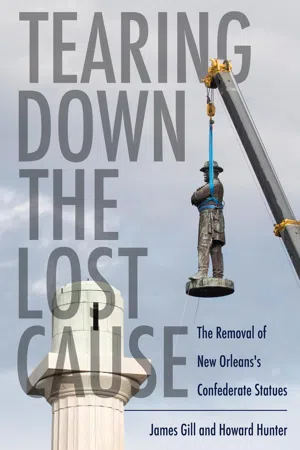
eBook - PDF
Tearing Down the Lost Cause
The Removal of New Orleans's Confederate Statues
- 242 pages
- English
- PDF
- Available on iOS & Android
eBook - PDF
Tearing Down the Lost Cause
The Removal of New Orleans's Confederate Statues
About this book
Information
Publisher
University Press of MississippiYear
2021Print ISBN
9781496833327
9781496833327
eBook ISBN
9781496833549
Table of contents
- Cover
- TEARING DOWN THE LOST CAUSE
- Title
- Copyright
- CONTENTS
- Acknowledgments
- 1 Robert E. Lee
- 2 New Orleans before the Civil War
- 3 New Orleans in the Civil War
- 4 Reconstruction
- 5 New Orleans and Jim Crow
- 6 The Formidable Mrs. Behan
- 7 P. G. T. Beauregard and the Waning of Creole New Orleans
- 8 Moonlight and Magnolias
- 9 The Second Battle of Liberty Place
- 10 Nuisance Ordinance
- 11 Pros and Cons
- 12 Legal Challenge Denied
- 13 Resolving a Middle Ground
- 14 Where to Put Them?
- Epilogue
- Appendix 1: Mayor Landrieu, May 19, 2017
- Appendix 2: Interview with Mitch Landrieu
- Notes
- ABOUT THE AUTHORS
Trusted by 375,005 students
Access to over 1.5 million titles for a fair monthly price.
Study more efficiently using our study tools.
Frequently asked questions
Yes, you can cancel anytime from the Subscription tab in your account settings on the Perlego website. Your subscription will stay active until the end of your current billing period. Learn how to cancel your subscription
No, books cannot be downloaded as external files, such as PDFs, for use outside of Perlego. However, you can download books within the Perlego app for offline reading on mobile or tablet. Learn how to download books offline
Perlego offers two plans: Essential and Complete
- Essential is ideal for learners and professionals who enjoy exploring a wide range of subjects. Access the Essential Library with 800,000+ trusted titles and best-sellers across business, personal growth, and the humanities. Includes unlimited reading time and Standard Read Aloud voice.
- Complete: Perfect for advanced learners and researchers needing full, unrestricted access. Unlock 1.5M+ books across hundreds of subjects, including academic and specialized titles. The Complete Plan also includes advanced features like Premium Read Aloud and Research Assistant.
We are an online textbook subscription service, where you can get access to an entire online library for less than the price of a single book per month. With over 1.5 million books across 990+ topics, we’ve got you covered! Learn about our mission
Look out for the read-aloud symbol on your next book to see if you can listen to it. The read-aloud tool reads text aloud for you, highlighting the text as it is being read. You can pause it, speed it up and slow it down. Learn more about Read Aloud
Yes! You can use the Perlego app on both iOS and Android devices to read anytime, anywhere — even offline. Perfect for commutes or when you’re on the go.
Please note we cannot support devices running on iOS 13 and Android 7 or earlier. Learn more about using the app
Please note we cannot support devices running on iOS 13 and Android 7 or earlier. Learn more about using the app
Yes, you can access Tearing Down the Lost Cause by James Gill,Howard Hunter in PDF and/or ePUB format, as well as other popular books in History & North American History. We have over 1.5 million books available in our catalogue for you to explore.