In Policing Intimacy: Law, Sexuality, and the Color Line in Twentieth-Century Hemispheric American Literature, author Jenna Grace Sciuto analyzes literary depictions of sexual policing of the color line across multiple spaces with diverse colonial histories: Mississippi through William Faulkner's work, Louisiana through Ernest Gaines's novels, Haiti through the work of Marie Chauvet and Edwidge Danticat, and the Dominican Republic through writing by Julia Alvarez, Junot Díaz, and Nelly Rosario. This literature exposes the continuing coloniality that links depictions of US democracy with Caribbean dictatorships in the twentieth century, revealing a set of interrelated features characterizing the transformation of colonial forms of racial and sexual control into neocolonial reconfigurations.
A result of systemic inequality and large-scale historical events, the patterns explored herein reveal the ways in which private relations can reflect national occurrences and the intimate can be brought under public scrutiny. Acknowledging the widespread effects of racial and sexual policing that persist in current legal, economic, and political infrastructures across the circum-Caribbean can in turn bring to light permutations of resistance to the violent discriminations of the status quo. By drawing on colonial documents, such as early law systems like the 1685 French Code Noir instated in Haiti, the 1724 Code Noir in Louisiana, and the 1865 Black Code in Mississippi, in tandem with examples from twentieth-century literature, Policing Intimacy humanizes the effects of legal histories and leaves space for local particularities. By focusing on literary texts and variances in form and aesthetics, Sciuto demonstrates the necessity of incorporating multiple stories, histories, and traumas into accounts of the past.
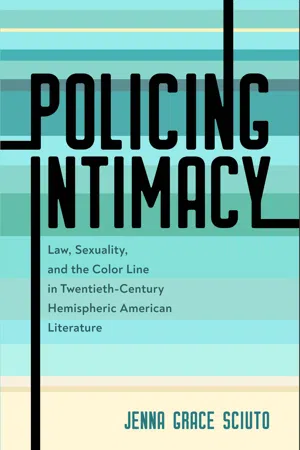
eBook - PDF
Policing Intimacy
Law, Sexuality, and the Color Line in Twentieth-Century Hemispheric American Literature
- 247 pages
- English
- PDF
- Available on iOS & Android
eBook - PDF
Policing Intimacy
Law, Sexuality, and the Color Line in Twentieth-Century Hemispheric American Literature
About this book
Information
Publisher
University Press of MississippiYear
2021Print ISBN
9781496833457
9781496833440
eBook ISBN
9781496833488
Table of contents
- Cover
- POLICING INTIMACY
- Title
- Copyright
- Dedication
- CONTENTS
- ACKNOWLEDGMENTS
- INTRODUCTION
- CHAPTER 1. “We Will Have to Wait” Racial Hierarchies, Plantation Intimacy, and Sexual Policing in William Faulkner’s Mississippi
- CHAPTER 2. “There Is No In-Between” Community, Sexuality, and the Shifting Construction of Race in Ernest Gaines’s Louisiana
- CHAPTER 3. “They Were Starting Something” Race, Gender, and Failed Revolution in Ernest Gaines’s Of Love and Dust
- CHAPTER 4. “For Fear of a Scandal” Sexual Control, Racism, and the Public Nature of Private Relations in Marie Chauvet’s Twentieth-Century Haiti
- CHAPTER 5. “We Are Trawling in Silences Here” Race, Sexuality, and Unnarratable Histories in Literary Depictions of Dominican Dictatorship
- CODA Looking Back in Resistance, Looking to the Present
- NOTES
- WORKS CITED
- ABOUT THE AUTHOR
Trusted by 375,005 students
Access to over 1.5 million titles for a fair monthly price.
Study more efficiently using our study tools.
Frequently asked questions
Yes, you can cancel anytime from the Subscription tab in your account settings on the Perlego website. Your subscription will stay active until the end of your current billing period. Learn how to cancel your subscription
No, books cannot be downloaded as external files, such as PDFs, for use outside of Perlego. However, you can download books within the Perlego app for offline reading on mobile or tablet. Learn how to download books offline
Perlego offers two plans: Essential and Complete
- Essential is ideal for learners and professionals who enjoy exploring a wide range of subjects. Access the Essential Library with 800,000+ trusted titles and best-sellers across business, personal growth, and the humanities. Includes unlimited reading time and Standard Read Aloud voice.
- Complete: Perfect for advanced learners and researchers needing full, unrestricted access. Unlock 1.5M+ books across hundreds of subjects, including academic and specialized titles. The Complete Plan also includes advanced features like Premium Read Aloud and Research Assistant.
We are an online textbook subscription service, where you can get access to an entire online library for less than the price of a single book per month. With over 1.5 million books across 990+ topics, we’ve got you covered! Learn about our mission
Look out for the read-aloud symbol on your next book to see if you can listen to it. The read-aloud tool reads text aloud for you, highlighting the text as it is being read. You can pause it, speed it up and slow it down. Learn more about Read Aloud
Yes! You can use the Perlego app on both iOS and Android devices to read anytime, anywhere — even offline. Perfect for commutes or when you’re on the go.
Please note we cannot support devices running on iOS 13 and Android 7 or earlier. Learn more about using the app
Please note we cannot support devices running on iOS 13 and Android 7 or earlier. Learn more about using the app
Yes, you can access Policing Intimacy by Jenna Grace Sciuto in PDF and/or ePUB format, as well as other popular books in Literature & Latin American & Caribbean Literary Criticism. We have over 1.5 million books available in our catalogue for you to explore.