- 352 pages
- English
- ePUB (mobile friendly)
- Available on iOS & Android
eBook - ePub
About this book
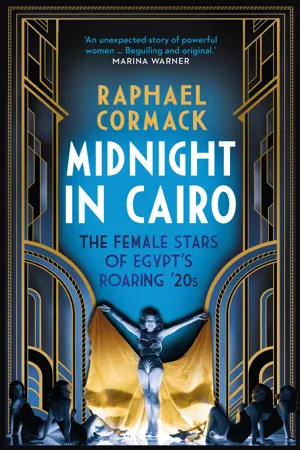
1920s Cairo: a counterculture was on the rise. A passionate group of artists captivated Egyptian society in the city's bars, hash dens and music halls - and the most dazzling and assertive were women. Midnight in Cairo tells the thrilling story of Egypt's interwar nightlife, through the lives of these pioneering women, including dancehall impresario Badia Masabni, innovator of Egyptian cinema Aziza Amir and legendary singer Oum Kalthoum. They exploited the opportunities offered by this new era, while weathering its many prejudices. And they held the keys to this raucous, cosmopolitan city's secrets. Introducing an eccentric cast of characters, Raphael Cormack brings to life a world of revolutionary ideas and provocative art. This is a story of modern Cairo as we have never heard it before.
Information
Topic
HistoriaSubtopic
Historia del mundoPART I
SETTING
THE SCENE
CHAPTER I
‘Pardon Me, I’m Drunk’
IN THE CLASSIC EGYPTIAN PLAY THE PHANTOM, the main characters are having dinner soon after a particularly harsh government crackdown on vice – brothels have been closed, the wine shops shuttered, and Cairo’s hashish supplies cast into the fires. One disappointed character consoles the assembled guests with an ‘Elegy to Satan’, in which he describes the city’s debauched nightlife in earlier days, a demi-monde of drunkards, musicians, hashish-heads, clowns and prostitutes. ‘From now on,’ his poem laments, ‘no more hugging, no more fucking, no more kissing’; the good times have come to an end.1
This scene is not from modern Egypt. It was written for shadow puppets in the thirteenth century CE by Ibn Daniyal, an eye doctor originally from Mosul but based in Cairo. He composed his poem under the administration of the Mamluk Sultan Baibars, who is best known for his military victories against the crusaders and the Mongols but also, according to Ibn Daniyal’s play, started a moral crusade of his own at home. One of his three extant shadow plays, The Phantom is among the earliest dramatic scripts in Arabic to survive from Egypt and a rare medieval example of the genre, in which a huge range of elegant and finely made leather puppets acted out bawdy and often unapologetically obscene dramas. Light on plot – but stuffed full of songs and short sketches – the plays seem designed to show off the poet’s wit and the puppeteer’s skill while painting a vivid picture of the city’s culture and entertainment. Another of Ibn Daniyal’s shadow plays, Strange and Amazing, consists of a procession of characters who enter briefly to perform short skits and then leave. He populated Mamluk Egypt with an array of oddballs, acrobats, preachers, magicians, animal tamers, tricksters, tattooists and sword swallowers.
For centuries afterwards, shadow plays continued to be performed on the streets of Egypt and at religious festivals. Later surviving manuscripts include The Crocodile, in which a fisherman is eaten by a crocodile as a Nubian and a North African compete to save him from its stomach, and The Café, in which two characters debate the relative merits of homosexuality and heterosexuality. The proponent of heterosexuality wins the argument but loses the war because the former proponent of homosexuality promptly has an affair with his wife. As late as 1911, the German Orientalist scholar (and later spy) Curt Prüfer described the shadow plays that he had seen:
The player sets up his kushk, a movable wooden booth, wherever he wishes it; there he sits behind a tightly stretched muslin curtain, which is lighted from behind by a primitive oil lamp, and presses the transparent leather figures against the curtain by means of wooden sticks fastened to figures at the back, and serving at the same time to move their limbs. The player is supported by his troupe, who help him in the manipulation of the figures and in reciting the different roles.2
At the beginning of the 1800s, some six hundred years after Ibn Daniyal’s plays were first performed, many different public entertainment traditions existed alongside shadow plays. There was, for instance, another kind of puppet show called Aragoz, an Egyptian version of the Turkish shadow plays called Karagoz, that used hand puppets like a Punch and Judy show but kept the stock characters, slapstick humour and dirty jokes characteristic of the shadow theatre. As well as puppet shows, itinerant farce players (usually called Muhabbazin) were a regular feature at weddings, religious ceremonies and private parties. Their sketches, often concerned with contemporary rulers or the plight of the downtrodden, managed to mock the strong and weak alike. ‘It is chiefly by vulgar jests, and indecent actions, that they amuse, and obtain applause,’ the traveller and Orientalist Edward Lane wrote in the 1830s. Performances like these were not based on a precise script and had considerable room for improvisation and audience interaction. For the most part, details about the shows come from the (not always reliable) accounts of European travellers.3
In the cafés, storytellers recited oral epics, sometimes with musical backing and sometimes without. The most popular tales in the early nineteenth century were al-Sira al-Hilaliyya, the epic story of the migration of the Beni Hilal tribe from the Arabian Peninsula to North Africa; Sirat Antar, a tale about Antar, the son of a slave who became a great poet and warrior in pre-Islamic Arabia; and al-Sira al-Zahiriyya, an epic about the life of the Sultan Baibars (whose reforms Ibn Daniyal had mocked centuries before).
Then there were the singers and dancers. According to Lane, still a major source for nineteenth-century entertainment history (even if used a little cautiously), Egyptians were, in comparison to the British, ‘excessively fond of music’. He divided musical entertainers into three main types. The first was the alatee, a male musician who sang and accompanied himself on an instrument such as the oud (lute). Lane viewed these as ‘people of very dissolute habits’; however, he remarked that they were ‘hired at most grand entertainments, to amuse the company; and on these occasions they are usually supplied with brandy, or other spirituous liquors, which they sometimes drink until they can no longer sing, nor strike a chord’. The second type was the almeh, a female singer who almost exclusively performed in the houses of the elite. Lane said these women were often very skilled, writing their own poetry and receiving large sums for their performances. The third kind of musical entertainer, in Lane’s early nineteenth-century categorisation, was the ghawazee, a dancing girl who performed either in public streets or at the private parties of ordinary people. He considered their dancing to be inelegant and more highly sexualised than the dances he had seen in wealthy houses, but he admitted that ‘women, as well as men, take delight in witnessing their performances’ even if ‘many persons among the higher classes, and the more religious, disapprove of them’.4
For the residents of Cairo at the beginning of the nineteenth century, the city had a rich cultural life. But the coming decades would transform Egypt – and its nightlife – almost beyond recognition. Over this time, Egypt would develop from a largely unremarkable province of the Ottoman Empire into a flourishing, politically important modern state; a booming economic powerhouse; and before long, a (semi-formal) protectorate of the British Empire. As a new Egypt took shape, theatres, cinemas, cabarets and music halls – like those that were popular around the world – would take over Cairo. By the end of the century, Cairo’s nightlife would converge on the district of Ezbekiyya, named after an old Mamluk emir called Ezbek who once had a palace there. The district boasted at least thirteen large entertainment venues and innumerable smaller bars and cafés. Many of these places offered shows by singers or dancers in rooms heavy with smoke and alcohol, and they also housed gambling halls, hashish dens and more. This was Cairo’s equivalent of Montmartre, Broadway or Soho.
Alongside the nightlife venues were several hotels that catered to European travellers. Most prominent among them was Shepheard’s, with its renowned terrace where, in the winter season, the world’s elite thronged. According to an article in Harper’s Bazaar in 1884, ‘In olden days, before the canal diverted the course of travel between India and Egypt, Shepheard’s Hotel was the spot where the streams from the East and West met.’5 These hotels, combined with the new French-style buildings springing up in this part of Cairo, led people to call Ezbekiyya the European Quarter. More was going on there, however, than that name indicates. To the north of the gardens was St. Mark’s Cathedral, seat of the Coptic Patriarchate and one of the most important sites of Egyptian Christianity. To the east was Mouski, a historic area with Arabic architecture and narrow streets leading to the heart of the Fatimid old city, which Europeans viewed as hugely exotic. Ezbekiyya, far from being just a tourists’ hotspot, was the place for pleasure-seeking Cairenes to go out at night.
*
The story of Ezbekiyya is also the story of modern Egypt. In most history books, the year 1798 is singled out as the beginning of a new phase in the country’s history. In that year, Napoleon led his armies across the Mediterranean and conquered Egypt, defeating the Ottoman armies at the Battle of the Pyramids. Living out a fantasy in which he played a cross between Muhammad and Alexander the Great, the French emperor took Cairo by storm, accompanied by thousands of soldiers and a team of 151 savants tasked with a minute analysis of the history, culture and geography of this ‘antique land’. The French army took up residence all around Cairo, including Ezbekiyya – then a neighbourhood of only middling importance – where they set up a temporary theatre to entertain the troops with dramatic performances including Voltaire’s Death of Caesar and a new opera (The Two Millers) written by two members of the expedition.
Many people have been tempted to see the French invasion as a decisive turning point in Egypt’s history and the beginning of modernity in the country – for this reason, many books on modern Egyptian history begin in 1798. However, in reality, Napoleon’s short but romanticised Middle Eastern campaign (which lasted only until 1801) probably had more of an impact on the European imagination than anything else. The most important result of the French invasion came about totally by chance. In 1801 Muhammad Ali, an Albanian military commander, arrived from Kavala in modern-day Greece as second-in-command of a small contingent of soldiers – one small part of the joint Ottoman–British army that defeated the French. But by 1805 Muhammad Ali had skilfully managed to manipulate the political chaos and make himself the Ottoman governor of Egypt. In 1811, he took complete control of the country by comprehensively defeating his powerful rivals – a caste of warrior-slaves called the Mamluks, who had been the Ottoman vassals in Egypt before the French invasion. In a brutal and now legendary ploy, he invited hundreds of the most powerful Mamluks to a party in Cairo’s citadel; once they were inside, he shut the gates and had them all killed.
From the 1810s to the 1840s, Muhammad Ali turned Egypt into a de facto self-governing state, establishing a dynasty of his own only nominally under the control of the Ottoman Empire. He instigated a huge programme of modernisation, professionalising the army, bringing in European advisors to help with state-building projects, and setting up a printing press, hospitals and educational institutes. He also set about the work of transforming Ezbekiyya into something new. In the early days of his reign, the area had been an elite enclave consisting of sumptuous palaces built around a small lake. The lake was drained and then turned into a garden, and soon hotels, small ramshackle bars, billiard rooms and music halls all started popping up around it.
By the time Muhammad Ali died in 1849, he had established a dynasty that his sons and grandsons continued with varying degrees of success for almost 150 years. After a brief period of rule by Muhammad Ali’s sons Ibrahim and Said and his grandson Abbas, ‘Ismail the Magnificent’, another grandson of Muhammad Ali, became the khedive (viceroy) of Egypt in 1863 (though the Ottomans did not let him formally use the title until 1867). More than anyone else, Ismail turned Ezbekiyya (and downtown Cairo more generally) into the centre of Egypt’s cultural life. In the 1860s, because of the American Civil War, cotton was in high demand globally, and Egypt capitalised on this. The crop, which had only recently been introduced to the country by Muhammad Ali, became a gold mine, and Ismail suddenly found he had huge amounts of money to spend on his passion for building. He spent lavishly on public works and private extravagances across the country, including the Gezira Palace that now houses the Marriott Hotel in Zamalek.
Ismail also began to design a whole new centre for Cairo. His workers knocked down crumbling old palaces to build new streets. He employed Jean-Pierre Barillet-Deschamps, the former chief gardener of Paris who had planned the Bois de Boulogne, to lay out the new Ezbekiyya Gardens on the spot where Muhammad Ali had drained the old lake. Around the new gardens, Ismail ordered the construction of a series of luxury entertainment venues. Between 1869 and 1872, a ‘French theatre’, a circus, a hippodrome, a ‘garden theatre’ and an Italian-style opera house all sprang up. As pride of place in his building project, he erected a large bronze equestrian statue of his own illustrious father, the successful General Ibrahim Pasha, by the French sculptor Charles Cordier. Ibrahim Pasha’s statue pointed its finger to the horizon in a triumphal pose, befitting a general who had won decisive victories for his father, Muhammad Ali, in the Arabian Peninsula, Greece and Syria.

Opera Square, Ezbekiyya, 1934.
In Ismail’s Ezbekiyya, modern Egyptian nightlife and entertainment were born and went on to thrive. Clowns, acrobats, farce players and animal trainers carried on as they had done for centuries – a shadow theatre existed in Ezbekiyya until 1909, when authorities shut it down because they considered it too raunchy – but new attractions were now on the rise too.
*
The Khedive Ismail’s vision for Cairo’s new entertainment district was dominated by theatre and opera, largely following European models in European languages. He wanted to show his court and his most elite subjects the best examples of those genres that existed, in order to glorify his rule. With the vast sums of money available to him as the ruler of Egypt, this goal was within his reach. In 1869, he inaugurated the Théâtre Français with a production of his favourite opera, Offenbach’s La belle Hélène. Two years later, Ismail realised one of his great triumphs when he persuaded the highly sought-after Italian composer Giuseppe Verdi, helped along by the vast sum of 150,000 gold francs, to write him an opera to be performed at his new opera house. The opera was Aida, the story of an Ethiopian princess in Pharaonic Egypt, and it premiered in Cairo in 1871. A long-standing myth holds that the opera was com...
Table of contents
- Cover
- Title
- Copyright
- Contents
- Introduction: The Past Is a Set of Old Clothes
- Part I: Setting the Scene
- Part II: The Leading Ladies
- Part III: Curtain Call
- Conclusion: How to End a Story
- Acknowledgements
- Notes
- Sources and Further Reading
- Credits
- Index
Trusted by 375,005 students
Access to over 1.5 million titles for a fair monthly price.
Study more efficiently using our study tools.
Frequently asked questions
Yes, you can cancel anytime from the Subscription tab in your account settings on the Perlego website. Your subscription will stay active until the end of your current billing period. Learn how to cancel your subscription
No, books cannot be downloaded as external files, such as PDFs, for use outside of Perlego. However, you can download books within the Perlego app for offline reading on mobile or tablet. Learn how to download books offline
Perlego offers two plans: Essential and Complete
- Essential is ideal for learners and professionals who enjoy exploring a wide range of subjects. Access the Essential Library with 800,000+ trusted titles and best-sellers across business, personal growth, and the humanities. Includes unlimited reading time and Standard Read Aloud voice.
- Complete: Perfect for advanced learners and researchers needing full, unrestricted access. Unlock 1.5M+ books across hundreds of subjects, including academic and specialized titles. The Complete Plan also includes advanced features like Premium Read Aloud and Research Assistant.
We are an online textbook subscription service, where you can get access to an entire online library for less than the price of a single book per month. With over 1.5 million books across 990+ topics, we’ve got you covered! Learn about our mission
Look out for the read-aloud symbol on your next book to see if you can listen to it. The read-aloud tool reads text aloud for you, highlighting the text as it is being read. You can pause it, speed it up and slow it down. Learn more about Read Aloud
Yes! You can use the Perlego app on both iOS and Android devices to read anytime, anywhere — even offline. Perfect for commutes or when you’re on the go.
Please note we cannot support devices running on iOS 13 and Android 7 or earlier. Learn more about using the app
Please note we cannot support devices running on iOS 13 and Android 7 or earlier. Learn more about using the app
Yes, you can access Midnight in Cairo by Raphael Cormack in PDF and/or ePUB format, as well as other popular books in Historia & Historia del mundo. We have over 1.5 million books available in our catalogue for you to explore.