- 160 pages
- English
- ePUB (mobile friendly)
- Available on iOS & Android
eBook - ePub
Welsh Environments in Contemporary Poetry
About this book
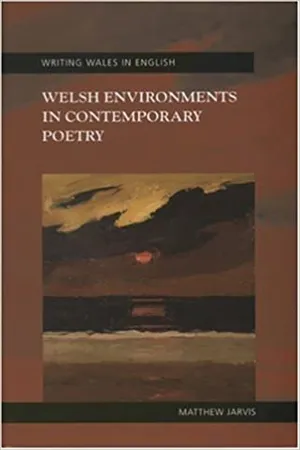
Welsh Environments in Contemporary Poetry' examines the question of how recent English-language poetry from Wales has responded to the diverse physical environments of Wales. The first volume to offer a sustained assessment of Welsh poetry in English within the context of recent developments in environmental literary criticism, this book also draws on aspects of human geography to explore the rich contemporary poetics of Welsh space and place. Opening with an examination of poets from the 1960s as well as the early work of R.S. Thomas, 'Welsh Environments in Contemporary Poetry' subsequently concentrates on the poetry of writers who have come to prominence since the 1970s: Gillian Clarke, Ruth Bidgood, Robert Minhinnick, Mike Jenkins, Christine Evans, and Ian Davidson.Close reading of key texts reveals the way in which these writers variously create Welsh places, landscapes, and environments – fashioning rural and urban spaces into poetic geographies that are both abundantly physical and inescapably cultural. Far from reducing Wales to mere scenery, the poetry that emerges from this book engages with the environments of Wales, not just for their own sake, but as a crucial way of exploring key issues in Welsh culture – from the negotiation of female identity in a land of masculine myths to the exploration of Welsh space in a global context.
Information
I
Starting with Trees
1
Conifers
As a boy, I used to go with my family to north-west Wales for our yearly holidays. We would make our slow way from the English midlands in a white Morris Marina that was well past its sell-by date. Seeing the Rhinogs rise up sternly to the west of the A470 would signal our arrival, and it is a view that still fills me with a surge of excitement when I see it. Those Welsh holidays were highlights of my early years. They were an escape to a place I felt was entirely different from the one where I passed my day-to-day life. I couldn’t quite believe it when, after a fatefully inclement July in 1988, my parents said that they were fed up with the Welsh weather and that we would be visiting somewhere else from then on. We had been holidaying in Wales since June 1979, when I was not quite 8 years old, so when those yearly pilgrimages stopped it felt like the final passing of childhood. But while our Welsh escapes lasted, I was always particularly drawn to the Coed y Brenin forest, just a few miles to the north of Dolgellau. Whenever I could, I would drag my sometimes-reluctant family down as many of its way-marked woodland paths as possible, making a particular point of seeking out the steep ones if such a route could be engineered. What was the attraction? For one thing, I think I assumed that the forest around me was thoroughly ancient. Isn’t that what forests were? Especially in Wales, which somehow seemed to my boyhood self so much older than England. I think I would have been startled to learn that Coed y Brenin was not even sixty years old when I started visiting it.1 But perhaps more important was the fact that this coniferous place felt so entirely un-English – certainly by comparison with the 1980s suburban landscape that I knew in Derby. In fact, along with the view of that part of the Rhinogs where the Roman Steps make their way between Moel Ysgyfarnogod and Rhinog Fawr, it is fair enough to say that the conifers of Coed y Brenin were pretty much Wales for me when I was 9 or 10 years old.2
So I imagine I would have been thoroughly perplexed if anyone at the time had shown me R. S. Thomas’s poem ‘Afforestation’ which, published around fifteen years before my Welsh holidays began,3 figures the conifers of Wales in a way so different from that of my own boyhood perceptions. At the very start of the poem, for example, the trees are aggressive, ‘Colonising the old / Haunts of men’. What I had thought of as embodying Wales, in other words, were for Thomas nothing less than a colonizing attack on its communities – a takeover by an alien force. In the words of Kirsti Bohata, the trees of ‘Afforestation’ are explicitly ‘colonial instrument[s] designed to usurp traditional Welsh life’.4 Indeed, their oppressive presence is emphasized by the way in which, at night, the poem sees them as menacing, threatening, ‘Standing in black crowds / Under the stars’, whilst by day they block out the sun (they are ‘in the sun’s way’). Moreover, unlike the grass or the sheep that feed upon the grass, the trees are without value:
The grass feeds the sheep;The sheep give the woolFor warm clothing, but these –?
The final questioning blank here suggests Thomas’s absolute inability to see anything good coming from the conifers. Instead, the poem goes on to connect them with the ‘Thin houses for dupes’ and ‘Pages of pale trash’ which characterize the ‘cheap times / Against which they grow’. The new conifers visited upon Thomas’s Wales are thus seen as growing up against the background of an impoverished era, which their existence both defines and helps to produce.5 This is, as the poem puts it, a ‘world that has gone sour / With spruce’. But I think it is the poem’s finish that would have most perplexed my younger self, happily roaming those paths amongst Coed y Brenin’s Sitka spruce. Thomas’s solution to the coniferous invasion is simple: ‘Cut them down’, says the poem. Why? Because they are unable to:
take the weightOf any of the strong bodiesFor which the wind sighs.
For Thomas, this newly forested landscape is weak in a way that manifestly constitutes a moral judgement, as the conifers’ flimsiness is set in emphatic negative against the ‘strong bodies’ for which the speaker hears the wind sighing. This is not the innocent landscape of a boy’s holiday wanderings. Rather, Thomas’s Welsh environment is a crucially cultural and political event to which the poem is a deeply felt and deeply critical response.6
2
A Digression on Writing and Environment
Such poetic renditions of the Welsh environment are what concern me in this book. Specifically, I am interested in how a selection of recent English-language poets writing from Wales – Gillian Clarke, Ruth Bidgood, Robert Minhinnick, Mike Jenkins, Christine Evans and Ian Davidson – each constructs the idea of Welsh space and place, and to what purpose. Their immediate forebears – the poets of the 1960s revival of Welsh poetry in English and R. S. Thomas as senior figure at the start of the 1970s – also concern me in Part I. In effect, I am trying to answer this question: what are the landscapes that these poets have made for Wales? Or alternatively: what Wales do the hills, valleys, towns, farms, industry, pollution or weather of these poets create? Or again: on what terms and to what apparent ends do these poets offer up their Welsh environments?
Discussion of literature in terms of its engagement with the environment has become a significant trend in recent years, particularly in the USA, where ecocriticism – ‘the omnibus term by which the new poly-form literature and environment studies movement has come to be labeled’1 – is a notable presence on the critical scene.2 Whether my work in this volume constitutes ecocriticism is, however, open to question. As Greg Garrard explains, ‘Ecocritics generally tie their cultural analyses explicitly to a “green” moral and political agenda.’3 By contrast, my agenda here is far more to do with Welsh cultural identity than it is to do with ‘green’ politics: the ultimate concern of this book is the rhetorical construction of Welsh environments – not literature and environmental crisis, nor literary manifestations of ‘green’ politics, nor again literature analysed in the light of ecological science. What I am writing here is, in short, far less green-focused than it is Welsh-focused. Which is not to say that questions to do with environmental problems and particular sorts of green consciousness do not play a part in the analysis which follows; for example, my discussion of Mike Jenkins is, in part, concerned with the environmental degradation caused by pollution, whilst my analysis of Robert Minhinnick engages with issues to do with human/nature dualism. However, such considerations are always ultimately in the service of my primary aim: to provide an analysis of the idea of Welsh space and place, as that idea is manifest in the visions of recent English-language poetry from Wales. As such, it might be best to describe what I am trying to achieve in this study as a work of literary geography.
My approach is thus distinct from that taken by Jonathan Bate – Britain’s highest-profile proponent of ecocritical literary analysis and author of two important volumes, Romantic Ecology: Wordsworth and the Environmental Tradition (1991) and The Song of the Earth (2000). The preface to The Song of the Earth explains the latter book’s purpose:
This is a book about why poetry continues to matter as we enter a new millennium that will be ruled by technology. It is a book about modern Western man’s alienation from nature. It is about the capacity of the writer to restore us to the earth which is our home.4
Bate’s idea, in short, is to offer up literature – and poetry in particular – as a means to environmental salvation, returning what the book presents as a humanity alienated from the earth to an awareness of the non-human world, a respect for ‘A planet that is fragile, a planet of which we are a part but which we do not possess’ (p. 282).5 Thus, in the book’s concluding analysis, Bate asks ‘What are poets for in our brave new millennium?’ and offers the following answer to his own question:
Could it be to remind the next few generations that it is we who have the power to determine whether the earth will sing or be silent? As earth’s own poetry, symbolized for Keats in the grasshopper and the cricket, is drowned ever deeper – not merely by bulldozers in the forest, but more insidiously by the ubiquitous susurrus of cyberspace – so there will be an ever greater need to retain a place in culture, in the work of human imagining, for the song that names the earth. (p. 282)
I have absolutely no argument with Bate’s sense of a need for ‘the next few generations’ – clearly including our own – to become increasingly aware of our responsibility towards planetary environmental health. Indeed, it was just such a sense of ethical responsibility which spurred on my initial thoughts about the status of space, place, environment and landscape in poetry. But there are manifest problems with this passage – including the sense that poetry should be tied to a particular programme (even one as important as writing ‘the song that names the earth’),6 and the rhetorical attempt to align a linguistic art form with non-human sounds by calling the latter ‘earth’s own poetry’ in an apparent effort to claim poetry as the primary cultural mode in which the earth can be remembered. However, such issues to one side, this passage also makes clear the distinction in approach between the current book and that of the ecocriticism in The Song of the Earth: if Bate is interested in poetry insofar as it provides a ‘song that names the earth’, I am here interested in poetry insofar as it names Wales – Wales, that is, in all of its environmental diversity.
Having said which, however, I must acknowledge that this book manifestly shares a number of preoccupations with ecocriticism, and draws various perspectives from its now considerable literature as well as from that of the more broadly defined green humanities. It would be critically mean-spirited and fundamentally disingenuous to deny such debts and affiliations,7 and these connections will become apparent as the book progresses. More important to acknowledge in this initial discussion, however, is that such debts also underlie ways of understanding a number of key ideas used throughout this study – ideas such as environment, nature (‘perhaps the most complex word in the [English] language’, according to Raymond Williams),8 landscape. But prior to all of these – to which I shall return in a moment – is Simon Schama’s sense, put forward in his magisterial Landscape and Memory, that any human attempt to approach even the most natural of environments as in some way free from human culture is defeated before it even starts. Schama writes this:
The founding fathers of modern environmentalism, Henry David Thoreau and John Muir, promised that ‘in wildness is the preservation of the world.’ The presumption was that the wilderness was out there, somewhere, in the western heart of America, awaiting discovery, and that it would be the antidote for the poisons of industrial society. But of course the healing wilderness was as much the product of culture’s craving and culture’s framing as any other imagined garden.9
To support this idea, Schama goes on to discuss ‘the first and most famous American Eden: Yosemite’, suggesting that however much it may have been developed and despoiled – he cites parking ‘almost as big as the park’ and ‘bears rooting among the McDonald’s cartons’ – Yosemite remains, in the imagination, ‘the way Albert Bierstadt painted it or Carleton Watkins and Ansel Adams photographed it: with no trace of human presence’. The cultural framings, in other words, have given us the wilderness (which is not to say, of course, that they have actually created the land itself):10
The wilderness, after all, does not locate itself, does not name itself. It was an act of Congress in 1864 that established Yosemite Valley as a place of sacred significance for the nation, during the war which marked the moment of Fall in the American Garden. Nor could the wilderness venerate itself. It needed hallowing visitations from New England preachers like Thomas Starr King, photographers like Leander Weed, Eadwaerd Muybridge, and Carleton Watkins, painters in oil like Bierstadt and Thomas Moran, and painters in prose like John Muir to represent it as the holy park of the West; the site of a new birth; a redemption for the national agony; an American re-creation.11
To put it another way, the nature that is on view through the operation of human discourse is never natural – by which I mean that it is always cultural.12 Indeed, the very idea of ‘landscape’ should suggest precisely this. As Schama explains, the word entered the English language ‘as a Dutch import at the end of the sixteenth century’, with ‘landschap, like its Germanic root, Landschaft, signif[ying] a unit of human occupation’. In other words, the idea of landscape was inextricably tied up with what Schama calls ‘human design and use’ from its very beginning. Thus Schama observes that ‘it is our shaping perception that makes the difference between raw matter and landscape’.13 Patently, this applies to built environments too. Admittedly, roads, houses, tower blocks are all human cultural products in a way that the ‘geology and vegetation’ (p. 12) Schama discusses as ‘raw matter’ are not. But when such cultural products are spoken or written about (or painted, or photographed) they are culturally produced again, framed, re-created, manifest as landscape. Thus, just as the production of American wilderness was an act of culture (as Schama explains, the longing for a place in which to heal the ‘national agony’ of the Civil War), so here I unde...
Table of contents
- Cover
- Title Page
- Copyright Page
- Dedication
- Contents
- General Editor’s Preface
- Acknowledgements
- Part I: Starting with Trees
- Part II: Welsh Environments in Contemporary Poetry
- Notes
- Bibliography
Trusted by 375,005 students
Access to over 1.5 million titles for a fair monthly price.
Study more efficiently using our study tools.
Frequently asked questions
Yes, you can cancel anytime from the Subscription tab in your account settings on the Perlego website. Your subscription will stay active until the end of your current billing period. Learn how to cancel your subscription
No, books cannot be downloaded as external files, such as PDFs, for use outside of Perlego. However, you can download books within the Perlego app for offline reading on mobile or tablet. Learn how to download books offline
Perlego offers two plans: Essential and Complete
- Essential is ideal for learners and professionals who enjoy exploring a wide range of subjects. Access the Essential Library with 800,000+ trusted titles and best-sellers across business, personal growth, and the humanities. Includes unlimited reading time and Standard Read Aloud voice.
- Complete: Perfect for advanced learners and researchers needing full, unrestricted access. Unlock 1.5M+ books across hundreds of subjects, including academic and specialized titles. The Complete Plan also includes advanced features like Premium Read Aloud and Research Assistant.
We are an online textbook subscription service, where you can get access to an entire online library for less than the price of a single book per month. With over 1.5 million books across 990+ topics, we’ve got you covered! Learn about our mission
Look out for the read-aloud symbol on your next book to see if you can listen to it. The read-aloud tool reads text aloud for you, highlighting the text as it is being read. You can pause it, speed it up and slow it down. Learn more about Read Aloud
Yes! You can use the Perlego app on both iOS and Android devices to read anytime, anywhere — even offline. Perfect for commutes or when you’re on the go.
Please note we cannot support devices running on iOS 13 and Android 7 or earlier. Learn more about using the app
Please note we cannot support devices running on iOS 13 and Android 7 or earlier. Learn more about using the app
Yes, you can access Welsh Environments in Contemporary Poetry by Matthew Jarvis in PDF and/or ePUB format, as well as other popular books in Literature & English Literary Criticism. We have over 1.5 million books available in our catalogue for you to explore.