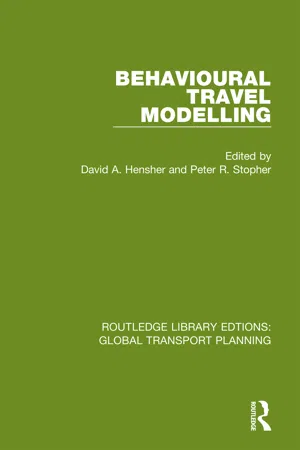
Originally published in 1979, this study deals on a fully comprehensive level with both passenger and freight travel. The 40 chapters deal with an extensive range of related topics, including equilibrium modelling, theoretical and conceptual developments in demand modelling, goods movement and forecasting and policy. It outlines approaches to understanding travel behaviour, which move beyond the individual choice theory towards a broader consideration of activities.
eBook - ePub
Behavioural Travel Modelling
- 868 pages
- English
- ePUB (mobile friendly)
- Available on iOS & Android
eBook - ePub
Behavioural Travel Modelling
About this book
Information
Part One
Chapter 1
Behavioural Travel Modelling
David A. Hensher and Peter R. Stopher
General
The purpose of this initial chapter in a state-of-the-art book is to highlight the advances in theory, method and application that have been made since the previous comprehensive overview which outlined developments up to mid-1975(124). In the last two years, not only has there been a proliferation of research in the relatively established topics (e.g. valuation of travel-time savings, goodness-of-fit measures, model structure, estimation techniques), there has also been a significant reappraisal of the conceptual framework in which individual traveller behaviour and values are studied. The diversity of ongoing research is a healthy indicator of the importance of the new philosophy on travel modelling. Together with these advances in theory and method that are increasing the understanding of the behavioural process, there is also a translation of the research tools into real-world planning tools. The ultimate success of any models is their usefulness in everyday planning as part of the process leading to advice on policy formulation and implementation. The usefulness has to be assessed in terms of existing modelling approaches, the issues confronting planning agencies and the relative costs per predictive accuracy and contribution to the evaluation process.
The strength of the behavioural approach to travel modelling is that it is formulated on a set of hypotheses related to the decision-making unit (the individual) and tested with models which adopt the decision-making unit as the unit of analysis, even though at present most individual-choice models seek a set of parameters to describe a group of individuals. Any major doubts about the current behavioural models relate to the hypotheses of behaviour rather than the models per se; and hence in recent years, there have been a wide range of alternative hypotheses on behaviour. Some of the new hypotheses can be tested within the same conceptual framework as that within which the familiar multinomial logit model operates. These hypotheses include those derived from notions of habit, uncertainty and thresholds. Other hypotheses have led to the development of alternative conceptual frameworks, as discussed later.
In one sense, this chapter provides a guide to the topic areas of the following chapters. However, additionally the chapter is designed to provide a single reference source on the major emphases of developments in individual travel-choice modelling during the period mid-1975 to mid-1977, and future research directions. Cross-referencing to other chapters is for the benefit of those wishing to follow up particular issues in more detail. Readers unfamiliar with the area are recommended to read the Proceedings of the Second International Conference on Behavioural Travel-Demand Models (124) in order to have enough background to get maximum value out of the present book.
Consistent with the principal objectives of the Third International Conference,* particular consideration is given to the policy relevance of individual-choice models, in addition to the synthesis of recent developments in theory, method and application, noted above. The chapter concludes with a perception of the most likely achievements for the next two years and the most needed areas for research and development.
Theoretical Developments
Introduction
Theoretical research in the last two years can be classified initially according to the conceptual framework in which approaches to understanding traveller behaviour have been incorporated. There is a well-defined division between the economic-psychological contemporary framework, primarily associated with McFadden (90) and Luce (ΘΘ) and the more speculative (yet potentially stronger) framework being developed by Jones (66,67) and Fried and Havens (34) which owe much of their influence to Hagerstrand (43,44) and Chapin (15). Essentially, the former framework is conditioned on the utility-maximisation assumption with the travel task being modelled as a choice process in isolation from the wider set of human activities, involving the separability notions of Leontief (74). The latter framework, also conditioned on the utility-maximisation assumption but with a broader behavioural base, assumes that travel is one of a range of complementary and competitive activities operating in a continuous pattern or sequence of events in space and time (see Chapter 2). This framework has the property that travel represents the procedure by which individuals trade time to move location in space in order to partake in successive activities. There is one school of thought within this latter framework which argues that activities are seen as the outcome of choices (15). However, the dominant belief or hypothesis is that time and space are seen as resources and that the constraints which operate on individuals are the main dictates of individual experience (136) which may in many instances remove the choice element.
* The general objectives of the conference were:
- To define those research areas that are likely to impact policy as opposed to those that may be principally of theoretical interest; and among those areas that are likely to impact policy, to define the extent of that impact.
- To identify those aspects of individual-choice models that are ready for implementation, to identify which of those will be most relevant to policy, and to determine the likely basis for implementation, i.e. project or sub-area planning, or strategic or area-wide planning.
- To identify the highest priority areas for research in terms of those that will impact or influence policy, particularly in the short run.
Within the contemporary framework, the theoretical developments can be divided into two groups. First are those associated with the efforts to improve the multinomial logit (MNL) formulation of individual-choice models (in particular the general-share structure that results from the independence-of-irrelevant alternatives property (IIA) ). Second are those attempts to examine alternative model structures of travel behaviour, in particular Markov and semi-Markov processes (11,37,76) and threshold models (137,70,26, 27).
Extensions to the Multinomial-logit Formulation
1. The MNL model of choice assumes that the ratio of probabilities of choosing one alternative over another (where both alternatives have a non-zero probability of choice) is unaffected by the presence or absence of any additional alternatives in the set. The existence of the IIA property, implicit in any general-shar...
Table of contents
- Cover
- Half Title
- Title Page
- Copyright Page
- Original Title Page
- Original Copyright Page
- Table of Contents
- Foreword
- Preface
- Acknowledgements
- PART ONE
- PART TWO
- PART THREE
- PART FOUR
- PART FIVE
- PART SIX
- PART SEVEN
- PART EIGHT
- PART NINE
- PART TEN
- PART ELEVEN
- PART TWELVE
- APPENDIX I List of Workshop Members
- APPENDIX II The Third International Conference on Behavioural Travel Modelling
Trusted by 375,005 students
Access to over 1.5 million titles for a fair monthly price.
Study more efficiently using our study tools.
Frequently asked questions
Yes, you can cancel anytime from the Subscription tab in your account settings on the Perlego website. Your subscription will stay active until the end of your current billing period. Learn how to cancel your subscription
No, books cannot be downloaded as external files, such as PDFs, for use outside of Perlego. However, you can download books within the Perlego app for offline reading on mobile or tablet. Learn how to download books offline
We are an online textbook subscription service, where you can get access to an entire online library for less than the price of a single book per month. With over 1.5 million books across 990+ topics, we’ve got you covered! Learn about our mission
Look out for the read-aloud symbol on your next book to see if you can listen to it. The read-aloud tool reads text aloud for you, highlighting the text as it is being read. You can pause it, speed it up and slow it down. Learn more about Read Aloud
Yes! You can use the Perlego app on both iOS and Android devices to read anytime, anywhere — even offline. Perfect for commutes or when you’re on the go.
Please note we cannot support devices running on iOS 13 and Android 7 or earlier. Learn more about using the app
Please note we cannot support devices running on iOS 13 and Android 7 or earlier. Learn more about using the app
Yes, you can access Behavioural Travel Modelling by David A. Hensher, Peter R. Stopher, David A. Hensher,Peter R. Stopher in PDF and/or ePUB format, as well as other popular books in Technology & Engineering & City Planning & Urban Development. We have over 1.5 million books available in our catalogue for you to explore.