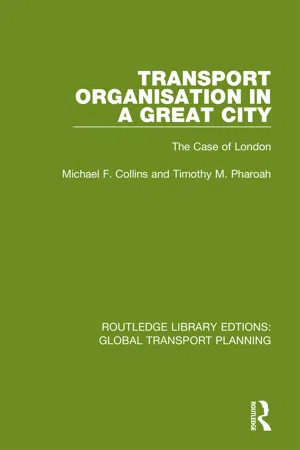
Originally published in 1974 this book examines the problems confronting the London public transport system in the 1970s. After a brief historical introduction the book then pays particular attention to planning, capital investment, co-ordination, the relationship between transport and housing, the competition between road and rail and the grants paid by central government. There are 15 case studies of significant topics ranging from station car parks to bus lanes, new tube trains to facilities for pedestrians. Although the focus is on London, many of the issues are common to other UK cities and across the world.
eBook - ePub
Transport Organisation in a Great City
The Case of London
- 660 pages
- English
- ePUB (mobile friendly)
- Available on iOS & Android
eBook - ePub
About this book
Information
Chapter 1
The Development of Transport Organisation in London Since the Mid-Nineteenth Century
The means by which London today meets the challenge, common to all great cities, of providing for the extensive and complex movement of people and goods have developed over many years. The current institutional arrangements reflect how transport problems have been interpreted, how solutions have been sought and how Government influence and control over transport has grown. As the institutional system itself has a profound effect on the quality of transport it is important to understand how it has evolved. Consequently, in this chapter a brief history of institutional developments is set out.
Other studies have described the growth and development of London and its transport facilities.1 This chapter focuses on the formation and evolution of institutions and other events which from the mid-nineteenth century onwards contributed to the system of transport organisation that existed at the time of the reorganisation of London’s government in the mid-1960s. Several main phases of transport development and urban growth during these dozen decades, which help to explain the context within which the institutional changes occurred, are also briefly described.
The 1850s and the Formation of the London General Omnibus Company
During the nineteenth century Londoners made most of their journeys on foot although, as Barker and Robbins have described, the outward spread of the city and the rapid growth of its population was accompanied by a growing volume of Hackney carriage, short-stage coach and hansom-cab traffic. The horse-drawn omnibus appeared on London’s streets in the 1830s, after its success had been demonstrated in Paris, and it provided at first an alternative to making journeys on foot within the city for those able to afford the relatively high fares, and then increasingly a means of distributing passengers to or from the main line railway termini. It has been estimated that in 1854 245 000 people entered the City of London each day, of whom 80% travelled on foot, about 9% by bus, 6% by Thames steamboat and 5% by train.1 Excess omnibus capacity, created to serve the 1851 international exhibition, together with increased operating costs led to fierce competition between the rival proprietors; many went out of business or were taken over.
1 For examples of the former see R Clayton (ed) (1964), The Geography of Greater London, esp chs by J T Coppock. Also H C Prince (1964), Greater London, esp ch 11 by P Hall. Railway histories include H P White (1963), A Regional History of the Railways of Great Britain, vol3, Greater London, and E Course (1961), London’s Railways. Perhaps the most reliable general transport history is H J Dyos and D H Aldcroft (1969), British Transport.
Between 1853 and 1856 financial interests in a large horse bus company in Paris began operations in London and many of London’s bus companies were bought up and operated by their London General Omnibus Company (LGOC). The venture did not match up to the financial aspirations of the French owners, however, and in 1859 the LGOC became an independent British company. After initial difficulties the company’s fortunes improved, boosted partly as a result of another international exhibition in 1862, and it was to dominate public road transport in London for the next forty years.
During this period the number and frequency of horse buses on London’s streets grew considerably and Barker has reflected that the service provided was the nearest to a continuous system of passenger conveyor belts yet devised.2 But he has also emphasised that traffic congestion was a common phenomenon at the time:
The traffic jam is not a product of the motor car age. When the main thoroughfares were narrower and fewer, and when vehicles were more ponderous and speeds slower, it did not take much traffic to cause serious congestion. And, in the 1830s, and 1840s, the volume of traffic was rising quickly. 3
After the reports on London’s traffic problems of a Royal Commission in 1844-51 and a Select Committee in 1854-55, a Metropolitan Board of Works was established in 1855, inter alia, in the hope of relieving congestion by improving the city’s street pattern. It proceeded to do this vigorously4 until it was supplanted by the new London County Council in 1888, which implemented some of the later schemes initiated by the Board. Attention also turned to the regulation of traffic, including the requirement of drivers to observe ‘the rule of the road’ (keeping on the left) and of buses to pick up passengers at the nearside kerb rather than in the middle of the carriageway (bus stops had not yet been designated).5 It was in such matters that the police became involved in traffic supervision.
1 Much of this chapter draws on T C Barker and R M Robbins (1963), A History of London Transport, voll, The Nineteenth Century. The references to horse buses fall on pp4-39, 56-98.
2 T C Barker, Lecture at Bedford College, London, 29 October 1970.
3 Barker and Robbins (1963), p64.
4 Creating such streets as Victoria Street, Queen Victoria Street, Shaftesbury Avenue, Clerkenwell Road, Charing Cross Road and the Victoria Embankment on the north side of the Thames.
5 Metropolitan Streets Act 1867, ch 134, s8.
The Beginnings of the Underground and Suburban Railways
By 1845 only five radial main-line railways served the capital, with short ‘suburban’ routes to Blackwall and Greenwich. Fifteen years later four major radial routes had been added, with several branches and the North London Line to serve the docks.1
A Royal Commission on Metropolitan termini had prevented the intrusion of railways into the main built-up area, or what now forms the central area of the city. The Great Western Railway (GWR) was anxious to gain a link with the City and subscribed one-fifth of the capital (as did the City Corporation) for the construction of the Metropolitan Railway between 1859 and 1863, using the cut-and-cover method. Its success was immediate, with traffic almost trebling in the first five years.2 There was a great upsurge in interest in London railways as part of a ‘railway mania’ and Parliament was overwhelmed with proposals; for example, in 1864 there were 259 projects for over 300 miles of new railway in London alone.
Then, as now, developers’ plans were challenged by local interests; residents objected to the prospect of London being ‘cut up in such style,’ but only some of the proposals actually went ahead. For example, a Joint Select Committee of both Houses of Parliament recommended the establishment of an Inner Circle route including a line along the north bank of the Thames where the Board of Works was embarking on the construction of a new highway.
The Inner Circle route was at first considered too expensive but part of it, the District Line, was opened from Kensington to Westminster in 1868 and extended to Blackfriars in 1870. The line was originally worked by both Metropolitan and District trains but a breakdown in the agreement in 1871 was one factor which prompted the first statutory move towards transport co-ordination in London.3 The following year Sir Edward Watkin, chairman of the South-Eastern Railway, was appointed general manager of the Metropolitan. Watkin was already a rival to the Managing Director of the District, James Forbes, in the operation of services south of the Thames, for Forbes was also General Manager of the London, Chatham and Dover Railway. The Metropolitan and District companies competed directly for suburban traffic from west London (the Metropolitan to the north, the District to the south)4 and for traffic to and from the Kensington exhibitions. This rivalry made completion of the Inner Circle seem unlikely, but the Metropolitan and District (City Lines and Extensions) Act of 1879 required that ‘each company shall, for the purpose of securing to the public the advantage of continuous working of the said Inner Circle with the other portions of the two organisations’ lines, work over the railways of the other company forming part of such Inner Circle.’ This was almost certainly the first statutory obligation for metropolitan transport co-ordination and remained in force until the London Passenger Transport Board (LPTB) was formed in 1933.1 The complete Inner Circle was eventually opened in 1882.
1 Barker and Robbins (1963), pp44-52, 99-165.
2 C E Lee (1972), The Metropolitan Line (published by London Transport), esp pp8-13.
3 C E Lee (1968), 100 Years of the District, pp7-13.
4 H F Howson (1967), London’s Underground.
Meantime a spate of suburban railw...
Table of contents
- Cover
- Half Title
- Title Page
- Copyright Page
- Original Title Page
- Original Copyright Page
- Contents
- Foreword
- Preface
- Acknowledgements
- The Greater London Group
- Addenda
- 1 The Development of Transport Organisation in London Since the Mid-Nineteenth Century
- 2 The Roles of the Institutions
- 3 The Operation of the System
- Case Studies
- 4 London’s Transport Problems
- 5 The Choices to be Made in Metropolitan Transport Planning
- 6 The Organisation of Transport in London : An Appraisal
- 7 A Better Organisation for Transport Planning and Management in London
- Index
Trusted by 375,005 students
Access to over 1.5 million titles for a fair monthly price.
Study more efficiently using our study tools.
Frequently asked questions
Yes, you can cancel anytime from the Subscription tab in your account settings on the Perlego website. Your subscription will stay active until the end of your current billing period. Learn how to cancel your subscription
No, books cannot be downloaded as external files, such as PDFs, for use outside of Perlego. However, you can download books within the Perlego app for offline reading on mobile or tablet. Learn how to download books offline
Perlego offers two plans: Essential and Complete
- Essential is ideal for learners and professionals who enjoy exploring a wide range of subjects. Access the Essential Library with 800,000+ trusted titles and best-sellers across business, personal growth, and the humanities. Includes unlimited reading time and Standard Read Aloud voice.
- Complete: Perfect for advanced learners and researchers needing full, unrestricted access. Unlock 1.5M+ books across hundreds of subjects, including academic and specialized titles. The Complete Plan also includes advanced features like Premium Read Aloud and Research Assistant.
We are an online textbook subscription service, where you can get access to an entire online library for less than the price of a single book per month. With over 1.5 million books across 990+ topics, we’ve got you covered! Learn about our mission
Look out for the read-aloud symbol on your next book to see if you can listen to it. The read-aloud tool reads text aloud for you, highlighting the text as it is being read. You can pause it, speed it up and slow it down. Learn more about Read Aloud
Yes! You can use the Perlego app on both iOS and Android devices to read anytime, anywhere — even offline. Perfect for commutes or when you’re on the go.
Please note we cannot support devices running on iOS 13 and Android 7 or earlier. Learn more about using the app
Please note we cannot support devices running on iOS 13 and Android 7 or earlier. Learn more about using the app
Yes, you can access Transport Organisation in a Great City by Michael F. Collins,Timothy M. Pharoah in PDF and/or ePUB format, as well as other popular books in Tecnologia e ingegneria & Pianificazione e sviluppo urbano. We have over 1.5 million books available in our catalogue for you to explore.