A detailed overview of the tumultuous events of this pivotal period, in which a divided Rome was plagued by assassination, civil wars, and invading hordes.
This ambitious series offers a comprehensive narrative of late Roman military history from 284–641. Each volume gives a detailed account of the changes in organization, equipment, strategy, and tactics among both the Roman forces and their enemies in the relevant period, while also giving a detailed but accessible account of the campaigns and battles.
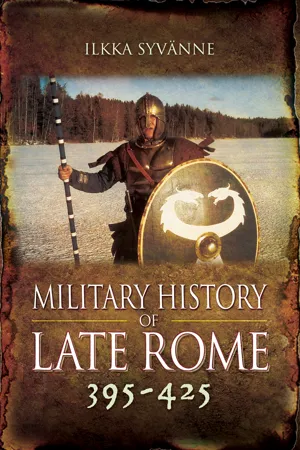
This third volume analyzes in great detail the pivotal years of 395–425. It was then that the mighty Roman Empire faced the Great Migrations while being wracked by civil wars. In 395 the task of defending the Roman Empire fell on the great generalissimo Stilicho. He faced a series of hostile bureaucrats, emperors, usurpers, and foreign foes until he was killed in a conspiracy in 409. His death led to an event that shook up the Empire to its very core. The city of Rome fell to the Visigoths of Alaric in 410. The book shows why this happened and how and why the Germanic tribes were able to settle inside the borders of the Empire. This, however, is not the entire picture. In contrast to the West Romans, the East Romans survived the civil wars and faced the Germans, Huns, and Persia successfully. Why it was so and why were the East Romans able to take control also of West Rome in 425? The information in this book will give history buffs much to consider and debate.
Praise for
Military History of Late Rome 425–457
"An outstanding work . . . [the series] gives us a very good picture of the long process that has come to be known as the 'Fall of Rome.' This is an invaluable read for anyone with an interest in Late Antiquity." —
The NYMAS Review
- 384 pages
- English
- ePUB (mobile friendly)
- Available on iOS & Android
eBook - ePub
Military History of Late Rome, 395–425
About this book
Information
Chapter One
Introduction
1.1: Roman Society and Administration in 395
At the time of Theodosius the Great’s death in 395 the Roman Empire was not only divided administratively into two halves, East and West Rome, but it was also a society which was deeply divided within. It was divided by religion, class, and race.
The weakness of the emperors vis-à-vis their generals after the year 363 had resulted in the permanent division of the Empire so that each half possessed its own Emperor, administration and armed forces. The administrators and soldiers of each half had their own vested interests to uphold, which meant that the two halves could cooperate effectively only for short periods of time – typically, cooperation in the fifth century ended when some Western individual (emperor or magister) reasserted his own power vis-à-vis the easterners by resorting to the use of foreign tribesmen against the easterners. The widespread corruption of the high-ranking military and of civil servants had alienated both the common soldiers and civilians from society, so that both could see their own ruling classes as their real enemies and the barbarians as their saviours.
Some sections of the population, which included a very significant portion of the senatorial class, had also grown tired of the presence of barbarian federates on their soil and had started to yearn for the old glory days of the ancient Roman Empire. These persons had formed a false image of the past so that they thought that it had been the native Romans who had forged the Empire without any help from the allies. These same persons also considered the high ranking military officers of barbarian or half-barbarian descent to be obstacles to their own careers and had therefore developed highly-racist attitudes towards the barbarians living in their midst. These men accused the foreigners of disloyalty and thought that the top positions within the Empire should be the preserve of native, cultured Romans.
At the very top of the Roman administration was naturally the Emperor, with the title of Augustus, who usually designated his successor with the title Caesar, but in 395 there were no Caesars and neither of the augusti ruled in practice because both were young and inexperienced. In the West the de facto ruler was Mag.Ped. Stilicho and in the East the PPO Rufinus. The Emperor was advised in all important matters by the Consistory, which acted as a Council of the State. In practice, however, the Emperor (or the power behind the throne) could make whatever decisions were necessary without consulting this body of advisors, let alone the Senate, which was also supposed to act in this advisory role. Indeed, there still existed senates in Rome and Constantinople which could be included in the decision making process as a rubber stamp when the Emperor (or the power behind the throne) wanted to court the goodwill of the moneyed senators, but this was not usually necessary and could not be done when it was important to make decisions fast.
The imperial administration was divided into three sections: 1) Military; 2) Palatine; and 3) Imperial and Fiscal Administration. In the West the Mag.Ped. acted as a supreme commander of all armed forces thanks to the power wielded by the Mag.Ped. Stilicho. In the East the Military Command was hierarchially divided among the magistri (masters) so that the two praesental magistri had a superior position. The division of the uppermost command into two commands in the East weakened the relative position of the military vis-à-vis the Emperor and other members of the administration, with the result that the de facto power in the East was in the hands of the PPO Rufinus in 395. The morale of the armed forces was low thanks to the widespread corruption of the top brass. (See Vol. 2.) The top brass acted as a sort of godfathers for criminal gangs who extorted the salaries of the soldiers. The men who stole the money and gave their higher-ups their share of the loot were naturally the officers directly in contact with the rank-and-file. The military mafia also offered protection to those civilians who paid bribes so that they would not have to pay taxes. The officers also kept ‘dead souls’ in the books so that they could pocket their salaries. The relationship between the armed forces and civilians was also very low thanks to this very same fact. The officers in general can be considered to have been greedy criminals.
The Palatine Administration was divided into two halves. The Palace and its staff were controlled by the Praepositus Sacri Cubiculi (First/Chamberlain of the Sacred Bedchamber), who was usually a eunuch. The spatharii (sword-bearers) who served under the PSC were also used as bodyguards of the Emperor and Empress. The other half of the Palatine Administration consisted of the imperial bodyguards proper, who served under the Magister Officiorum (Master of Offices) under whom served the Comes Domesticorum or comites domesticorum and the actual bodyguards.
The actual administrators of the Empire served under the Magister Officiorum. In this capacity the Magister Officiorum acted as a sort of Prime and Foreign Minister. In addition to this, he was the Spy Master of the Empire who commanded the professional spies, bodyguard units, the agentes in rebus, and the notarii. The actual military intelligence was primarily conducted by the armed forces under the guidance of the protectores domestici, dispatched to the staffs of generals for this purpose. The imperial Quaestor prepared legislation and wrote responses to the petitions and letters sent to the emperor.
The provinces and collection of taxes were under three parallel administrations (the Praetorian Prefecture, the Comes of the Sacred Largesse, and the Comes res privatae). The annona (taxes in kind paid to the soldiers) and other regular taxes were collected by the local city councils under the guidance of the praetorian prefects and their personnel. The so-called donatives (money and bullion given to soldiers on special occasions, paid by the middle class and the rich) were collected by the Comes of the Sacred Largesse through his workforce. The Comes res privatae was in charge of collecting the taxes/profits/rents from imperial lands and businesses. In practice, the soldiers, agentes in rebus, curiosi and notarii infringed upon this system so that they extorted money from the city councils, taxpayers and civil servants. This was too easy for all of these organizations to do. The civil servants needed detachments of soldiers to protect them during the collection of taxes, which meant that the soldiers stole part of the taxes. The other officials in their turn could extort part of the taxes/profit thanks to their position as spies and inspectors.
The diagram below gives a general overview of the administrative system of the Roman Empire in 395. It is based on the diagrams of Syvänne (Vols. 1–2), Haldon and Delmaire. It gives only a general glimpse of the system and may contain some features which were not in force in 395, the reason for this being the fact that emperors changed the system as required by the situation so that the administrative system was not the same throughout the Late-Roman period. For example, it is well known that the PPO Rufinus had control of the imperial arms factories, which were then taken away from the prefecture and placed under the Magister Officiorum when he fell from power.

Intelligence Gathering
The Late-Roman intelligence gathering network consisted of the following basic components: 1) the Emperor’s special operatives; 2) the units of bodyguards and their detached personnel (esp. the Protectores Domestici); 3) professional spies operated by the military leadership with the help of the Protectores on their staff; 4) regular military forces; 5) Agentes in Rebus and Notarii; 6) civilian policemen and paramilitary forces; 7) religious control wielded by the emperor through priests; and 8) informers. The first seven organizations were used for both internal and external security functions, while number eight served only internal security needs. The following diagram gives a summary of the organization. At the turn of the fifth century the effectiveness of the organization suffered from the effects of the massive corruption of the military forces. For further details, see Syvänne MHLR Vols. 1–2 and Syvänne 2015 ASMEA.1

1.2: The Military in 3952
Strategy
The era from 395 until about 491 saw a massive increase in the size of a typical field army. This process had already started during the period under discussion (395–425). There were several reasons for this sudden massing together of the manpower to form massive field armies that had been previously distributed around the various frontiers and cities. Firstly, the migrating peoples increased the sheer scale of the problems facing the Romans. Secondly, the frontier- and field-armies were less effective than previously thanks to the poor motivation and morale among the rank-and-file caused by corruption, which made it necessary to gather together resources. Thirdly, fifth-century military commanders preferred on a conceptual level quantity over the quality, which was criticized by Vegetius (see below). It was largely thanks to the vast resources, wealth and the sophisticated administrative structures of the Roman Empire that the Roman marshals could adopt this ultimately self-destructive course.
Vegetius’ treatise includes scathing criticisms of this approach:
However, in every battle it is not so much numbers and untrained force as it is skill and training that are accustomed to bring victory.
Preface, tr. by Stelten p.3
An army is referred to as a multitude, not only of legions, but also of auxiliaries [i.e. foederati] and even of cavalrymen, brought together for waging war. The extent of this is determined by the teachers of warfare. For when the examples are reread of Xerxes, Darius, Mithridates and other kings, who equipped innumerable peoples for battle it appears evident that exceedingly large armies were suppressed more because of their own multitude than because of the courage of the enemy [i.e. Vegetius criticizes the contemporary use of huge armies which consisted of numerous different peoples and compares this with the Persian practice]. For too great a multitude is subject to very many misfortunes; it is always slower on the marches in proportion to its own mass of men: indeed, on longer lines of march it is liable to suffer sudden attack even from a few men; moreover, in crossing difficult places of rivers, it is often caught off guard on account of the delay caused by the baggage; furthermore, food for numerous animals and horses is gathered with great effort. Also the problems involving the grain supply, which in every expedition must be avoided, quickly wear out larger armies; for no matter with what diligence the grain supply is prepared, it fails that much sooner in proportion to the greater number of whom it is sought. And finally the water itself is sometimes barely sufficient for an excessive multitude. But if by accident the battle line should retreat, it is inevitable that many from a large number fall and those who have fled, once they have b...
Table of contents
- Cover
- Title
- Copyright
- Contents
- Acknowledgements
- List of Plates
- List of Maps
- Preface
- Abbreviations
- Chapter 1 Introduction
- Chapter 2 Enemies and Allies
- Chapter 3 The Year 395: Stilicho vs. Rufinus: The Puppet Masters: Stilicho and Rufinus: The Puppets: Honorius and Arcadius
- Chapter 4 The Years 395–399: Stilicho vs. Eutropius: The Puppet Masters: Stilicho and Eutropius: The Puppets: Honorius and Arcadius
- Chapter 5 Gainas’ Revolt and the Rise of Arcadius in 399–400
- Chapter 6 Stilicho vs. Barbarians 400–406
- Chapter 7 The East 400–408: Arcadius, Eudoxia and the Consistorium in Charge
- Chapter 8 The British Usurpers and Barbarian Invasions in 406–408: the Downfall of Stilicho
- Chapter 9 Honorius in Power: The West Roman Collapse in 408–410
- Chapter 10 The West Roman Counter-Attack in 410–418
- Chapter 11 The West 418–423
- Chapter 12 The East 408–423
- Chapter 13 The Usurper John (423–425) Sets the Stage for the Rise of Aetius and Bonifatius, the ‘Last Romans’
- Chapter 14 The Roman Empire in 425
- Appendix I
- Appendix II
- Appendix III: Libya and Egyptian frontier from ca. 390 until 460
- Bibliography
- Notes
- Plate section
Trusted by 375,005 students
Access to over 1.5 million titles for a fair monthly price.
Study more efficiently using our study tools.
Frequently asked questions
Yes, you can cancel anytime from the Subscription tab in your account settings on the Perlego website. Your subscription will stay active until the end of your current billing period. Learn how to cancel your subscription
No, books cannot be downloaded as external files, such as PDFs, for use outside of Perlego. However, you can download books within the Perlego app for offline reading on mobile or tablet. Learn how to download books offline
Perlego offers two plans: Essential and Complete
- Essential is ideal for learners and professionals who enjoy exploring a wide range of subjects. Access the Essential Library with 800,000+ trusted titles and best-sellers across business, personal growth, and the humanities. Includes unlimited reading time and Standard Read Aloud voice.
- Complete: Perfect for advanced learners and researchers needing full, unrestricted access. Unlock 1.5M+ books across hundreds of subjects, including academic and specialized titles. The Complete Plan also includes advanced features like Premium Read Aloud and Research Assistant.
We are an online textbook subscription service, where you can get access to an entire online library for less than the price of a single book per month. With over 1.5 million books across 990+ topics, we’ve got you covered! Learn about our mission
Look out for the read-aloud symbol on your next book to see if you can listen to it. The read-aloud tool reads text aloud for you, highlighting the text as it is being read. You can pause it, speed it up and slow it down. Learn more about Read Aloud
Yes! You can use the Perlego app on both iOS and Android devices to read anytime, anywhere — even offline. Perfect for commutes or when you’re on the go.
Please note we cannot support devices running on iOS 13 and Android 7 or earlier. Learn more about using the app
Please note we cannot support devices running on iOS 13 and Android 7 or earlier. Learn more about using the app
Yes, you can access Military History of Late Rome, 395–425 by Ilkka Syvänne in PDF and/or ePUB format, as well as other popular books in History & Military & Maritime History. We have over 1.5 million books available in our catalogue for you to explore.