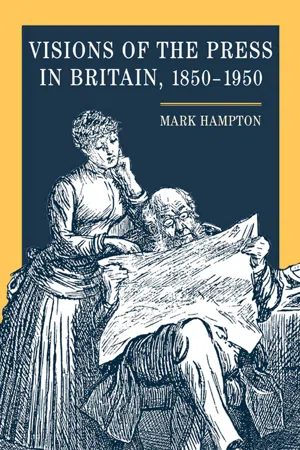
Visions of the Press in Britain, 1850-1950
eBook - ePub

Visions of the Press in Britain, 1850-1950

  1. English
  2. ePUB (mobile friendly)
  3. Available on iOS & Android
eBook - ePub

Visions of the Press in Britain, 1850-1950

About this book

Historians recognize the cultural centrality of the newspaper press in Britain, yet very little has been published regarding competing historical understandings of the press and its proper role in British society.

In Visions of the Press in Britain, 1850-1950, Mark Hampton argues that qualities expected of the contemporary British press--lively writing, speed, impartiality, depth, and the ability to topple corrupt governments by informing readers--are not obvious attributes of journalism but derive from more than a century of debate. He analyzes the various historical conceptions of the British press that helped to create its modern role, and demonstrates that these conceptions were intimately involved in the emergence of mass democracy in the late nineteenth and early twentieth centuries.

Hampton surveys a diversity of sources--Parliamentary speeches and commissions, books, pamphlets, periodicals and select private correspondence--in order to identify how governmental elites, the educated public, professional journalists, and industry moguls characterized the political and cultural function of the press. The resulting blend of cultural history and media sociology demonstrates how once optimistic visions of the press have given way to more pessimistic contemporary views about the power of the mass media.

With clarity and panache, this book shows that many competing conceptions continued to influence twentieth-century understandings of the press but did not remain satisfactory in new political, cultural, and media environments. Visions of the Press in Britain, 1850-1950 provides a rich tapestry against which to understand the contemporary realities of journalism, democracy, and mass media.

Frequently asked questions

Yes, you can cancel anytime from the Subscription tab in your account settings on the Perlego website. Your subscription will stay active until the end of your current billing period. Learn how to cancel your subscription.
No, books cannot be downloaded as external files, such as PDFs, for use outside of Perlego. However, you can download books within the Perlego app for offline reading on mobile or tablet. Learn more here.
Perlego offers two plans: Essential and Complete
  • Essential is ideal for learners and professionals who enjoy exploring a wide range of subjects. Access the Essential Library with 800,000+ trusted titles and best-sellers across business, personal growth, and the humanities. Includes unlimited reading time and Standard Read Aloud voice.
  • Complete: Perfect for advanced learners and researchers needing full, unrestricted access. Unlock 1.4M+ books across hundreds of subjects, including academic and specialized titles. The Complete Plan also includes advanced features like Premium Read Aloud and Research Assistant.
Both plans are available with monthly, semester, or annual billing cycles.
We are an online textbook subscription service, where you can get access to an entire online library for less than the price of a single book per month. With over 1 million books across 1000+ topics, we’ve got you covered! Learn more here.
Look out for the read-aloud symbol on your next book to see if you can listen to it. The read-aloud tool reads text aloud for you, highlighting the text as it is being read. You can pause it, speed it up and slow it down. Learn more here.
Yes! You can use the Perlego app on both iOS or Android devices to read anytime, anywhere — even offline. Perfect for commutes or when you’re on the go.
Please note we cannot support devices running on iOS 13 and Android 7 or earlier. Learn more about using the app.
Yes, you can access Visions of the Press in Britain, 1850-1950 by Mark Hampton in PDF and/or ePUB format, as well as other popular books in Business & Business General. We have over one million books available in our catalogue for you to explore.

Table of contents

  1. Cover
  2. Title
  3. Copyright
  4. Contents
  5. Acknowledgments
  6. Introduction
  7. 1. The Press in Britain, 1850–1950
  8. 2. Imagining the Press, 1850–80: The Educational Ideal Ascendant
  9. 3. The Educational Ideal of the Press in the Era of the New Journalism, 1880–1914
  10. 4. “Representing the People”: The Press as a “Fourth Estate,” 1880–1914
  11. 5. Persuasion or Propaganda? Thinking about the Press in Britain, 1914–50
  12. Epilogue: The First Royal Commission on the Press (and Beyond)
  13. Bibliography
  14. Index