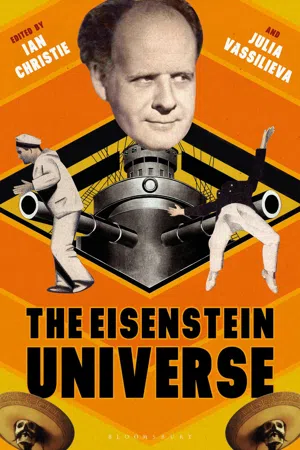
Over the decades since he was first hailed by critics and filmmakers around the world, Sergei Eisenstein has assumed many identities. Originally cast as a prophet of revolution and the maestro of montage, and later seen as both a victim of and apologist for Stalin's tyranny, the scale and impact of Eisenstein's legacy has continued to grow. If early research on Eisenstein focused on his directorial work – from the legendary Battleship Potemkin and October to the still-controversial Ivan the Terrible – with time scholars have discovered many other aspects of his multifarious output.
In recent years, multimedia exhibitions, access to his vast archive of drawings, and publication of his previously censored theoretical writings have cast Eisenstein in a new light. Deeply engaged with some of the leading thinkers and artists of his own time, Eisenstein remains a focus for many of their successors, contested as well as revered. Over half a century since his death in 1948, an ambitious treatise that he hoped would be his major legacy, Method, has finally been published. Eisenstein's lifelong search for an underlying unity that would link archaic art with film's modernity, individuals with their historic communities, and humans as a species with the universe, may have more appeal than ever today. And among his many thwarted film projects, those set in Mexico and what were once the Soviet Central Asian republics reveal complex and still-intriguing realms of speculation.
In this ground-breaking collection, sixteen international scholars explore Eisenstein's prescient engagement with aesthetics, anthropology and psychology, his roots in diverse philosophical traditions, and his gender politics. What emerges has surprising relevance to contemporary media archaeology, intermediality, cognitive science, eco-criticism and queer studies, as well as confirming Eisenstein's prestige within present-day film and audiovisual media.
- 312 pages
- English
- ePUB (mobile friendly)
- Available on iOS & Android
eBook - ePub
The Eisenstein Universe
About this book
Information
Part One
Creativity, Nature, Politics
1
Odd and Even: Eisenstein and Unfinished Work
In November 1927, barely five years into his career as a filmmaker, Sergei Eisenstein was already beginning to feel the symbolic burden of a growing number of projects he had not been able to complete. In a diary entry from this time, amidst notes that show him considering what seems to be a book chapter on such ‘unrealised’ projects, he lists the major theatre and film endeavours of his young career chronologically. In compiling this list, he detects a strange pattern: all of the odd-numbered projects of this sequence – The Mexican (staged March 1921), Wiseman (staged April 1923), Are You Listening, Moscow?! (staged November 1923), Gasmasks (staged February 1924), The Strike (premiered April 1925), The Battleship Potemkin (premiered December 1925) and The General Line – had been successfully completed.1 The even-numbered projects, however – King Hunger (1921), Garland’s Inheritance (1923), Patatras (1923), Triapitsyn (date unclear), Red Cavalry (1924) and Dzhungo (1926) – had all failed to come to fruition. Eisenstein then bestows on these unrealized works the comical but ominous epithet, ‘even-numbered productions’ (chetnye postanovki).2
After meticulously charting this pattern – in which the transition from theatre to film happened also to fall in line with this odd/even alternation, making The Strike, for example, both the first (odd) work of film and the ninth (odd) work overall – the filmmaker pauses to wonder, with a kind of superstitious submission to this law of numbers, which of his three currently developing film projects – October, The Glass House and Capital – should, if the pattern were to continue, be placed in the list as odd and destined for completion and which designated as even, and thereby doomed to failure.3 This instance of almost gnostic self-interrogation, even if half-playful, suggests a kind of superstitious view of the creative process in which not only is non-completion of projects inevitable but also necessary for the completion of the projects with which they alternate; without the even, the logic suggests, there can be no odd.
And yet, it would seem that the rigidity of this essentially dialectical system still allowed for the possibility of its manipulation. That Eisenstein meant to manoeuvre within the system he had himself outlined is demonstrated in a diary entry made almost one year later, on 12 September 1928, in which he records another hasty thought about two of the projects he currently had in parallel development: ‘Ganz intim: Khap will be an odd-numbered work. And Glass House will be even!!!! It is not worth it to do it in America – [where it would be] not even!!!’4 Here there is a sense of hope (still highly exclamatory and, therefore, we must assume, best read with some irony) that a total change of location, from the USSR to the United States, might have enabled Eisenstein to restart the sequence, thus changing Glass House from an even-numbered to an odd-numbered work, as the first to be done in America, and therefore, by this magical thinking, possible to realize.5
The plunge into numerology aside, this diary analysis of the success of his own oeuvre demonstrates the extent to which the growing corpus of unrealized works had begun to embed itself in Eisenstein’s creative self-concept, even at a relatively early stage and, perhaps more intriguingly, shows how the gravity of these unmade films triggered the abstract functions of his imagination. At the same time, the notes betray his stoic sense that the completed work almost demands the experience gained from planning the unrealized work to generate the momentum necessary for it to move towards its proper conclusion. This is not to suggest that Eisenstein maintained a rigid view of some law of strict alternation between the complete and the incomplete, as these notes might imply if taken in isolation, but it is to observe that his perception of a meaningful, productive and even dialectical relationship between the completed and the unachieved is undeniable.
As a specific instance, there are hints of such a belief in Eisenstein’s formulation of the reciprocal relationship between two of his ambitious projects of the late 1920s, The Glass House and Capital, neither of which would reach fruition. Despite this fact of his filmography, in more than one sense the magisterial accomplishment of intellectual cinema that was the anticipated outcome of the Capital project was fully dependent on the discoveries to be made in pursuit of the Glass House project – itself ultimately intended to be a way station on the path towards purely intellectual film. In a note of 5 September 1928, in which he discussed in detail the synthesis upon which ‘the new film’ is predicated, he wrote, switching to German, ‘Rein wird die Synthese erst in Marx-Eisenstein-Film “Kapital” sein!!!’6 The Capital project – here presented hyperbolically, almost absurdly, as a true collaboration between Karl Marx and Eisenstein – is given the burden of carrying the new ‘pure’ (rein) language of film into creation. Further down the notebook page, however, we see how Capital is dependent on The Glass House; as he writes, ‘(Just as The Glass House film must be maximally impure – through the clay bath of The Glass House to the sun of the Marx film!) Through “purgatory” to “paradise!”’7 Again, Eisenstein makes the proper achievement of his goals in Capital contingent upon the ‘dirty work’ to be done in The Glass House, which, inevitably, was to include many elements of the old, non-intellectual cinema within its idiosyncratic structure. Though it would aspire towards ‘pure’ intellectual film, it would necessarily remain ‘impure’ in the particulars of its execution – this included a total reconstitution of the film frame and dalliance in an unrein implementation of the language of intellectual cinema, a process he characterizes here as a movement ‘through “purgatory” to “paradise”’. Undoubtedly, the director would have liked to make both films, but there is a certain sense in his notes of 1927–8 that in the case of these simultaneously pursued projects, work on the one was oriented towards the realization of technique that would make possible the creation of the other.
In this treatment of the concept of the reciprocal relationship between works – of the odd and even, so to speak – and in the suggestion of a quasi-mystical view of creative sequencing, we may see the seed, still far from full development, of what would be expressed in Eisenstein’s much later essay ‘Even and Odd: Bifurcation of the Singular’, included in the materials planned for the second volume of Method. Eisenstein opens that essay with a long passage quoted from Marcel Granet’s 1934 book La pensée Chinoise that detailed the conceptual operation of Chinese dialectic: ‘The Odd contains within itself and separates out from itself the Even, which is merely the external two-sided (right and left, Yin and Yang) manifestation of the Odd.’8 The passage ultimately demonstrates the coexistence and interdependence of the two figures, Odd and Even, and suggests that what separates the one from the other is a question not of numerical quantity but of internal quality. This is also what unites each manifestation of the Odd with all others, and likewise each Even with every other manifestation of its kind. Following this long passage, Eisenstein writes:
Is it not the case that this sounds like some kind of strange half-mystical raving? And at the same time, somewhere [and] somehow – I would say somewhere ‘apart from’ consciousness – you feel some sort of rightness in these assertions. Somewhere not in the brain, but in the region of the … tendons (!) you feel that somewhere in the dynamism of these concepts there is something real.9
These last observations, here on the Chinese sequential system, could just as easily have been written about the sequential system he proposed for his own creative biography – although it may sound like a sort of ‘strange half-mystical raving’, one senses something truly operative in the conceptual dynamic.
From a position of historical distance, these observations on the dialectical power of the even and odd sequence over his creative output cannot help but highlight the tragic naïveté of the young Eisenstein, writing in 1927 about his future endeavours in filmmaking. How was he to know, after all, that this steady pattern of completion and non-completion would break very soon, how it would break, and with what dramatic force? How different his interpretation of the pattern might have been had he known that every feature film project he would undertake in the decade between 1929 and late 1938 – between the compromised completion of The General Line and the release of Alexander Nevsky – would remain unstarted, unfinished or unseen. Already by 1933, in recognition of the tenth anniversary of his working in cinema, and having experienced a series of intense creative disappointments in his two-year sojourn in Europe, Hollywood and Mexico, along with some false starts in his first year back in the Soviet Union, the director took up the task of editing for publication the screenplays from these unmade projects in the hopes of demonstrating the quality of some of the work that he had done over the past few years. Though this publication project itself never came to fruition, thereby multiplying the layers of non-realization, Eisenstein did prepare the draft of a preface for the collection, which has been preserved in his archive and was published by Naum Kleiman in Iskusstvo kino in 1992 as ‘Toward a Preface for the Unfinished Pieces’.10 In its task of introducing the film scripts to the reading public, the essay also demonstrates Eisenstein’s developing attitude towards his expanding corpus of unfinished work and its relevance for his artistic legacy.
In the essay, he characterizes some of the work done in the West as the development of a cycle of films around ‘superhuman’ characters such as John Sutter, Henri Christophe, Basil Zakharov, and the fictional Clyde Griffiths of An American Tragedy. This description culminates with a quotation from the nineteenth-century Austrian writer Franz Grillparzer, who wrote in his diary ‘I would like to be able to write a tragedy in thoughts. It would be a masterpiece!’11 The possibility of such an immaterial masterpiece was compelling for Eisenstein, who wrote, ‘Alas, such a fate has befallen the second five-year period of my creative work. To what extent the compositions of this period are masterpieces I do not know, but that they remained … in the mind, unfortunately, is a fact.’12 Eisenstein then goes on to make an outline list of the ‘meteoric’ proposals for films that had appeared fleetingly in the last years (a jubilee film for Belgian independence, a globe-trotting advertisement about the benefits of Nestlé cocoa, a film about the benefits of British colonial rule in Africa, and adaptations of Vicki Baum’s Grand Hotel and Lion Feuchtwanger’s Jud Süß, to name but a few) before coming to a list of eight more substantial unrealized projects,...
Table of contents
- Cover
- Halftitle Page
- Title Page
- Dedication Page
- Contents
- List of Illustrations
- Notes on Contributors
- Acknowledgements
- Introduction: Eisenstein Unbound
- Part One Creativity, Nature, Politics
- Part Two Grundproblem, Regress, Sensuality
- Part Three Pathos, Immersion, Affect
- Part Four History, Representation, Montage
- Part Five Space, Place, Legacy
- Index
- Imprint
Trusted by 375,005 students
Access to over 1.5 million titles for a fair monthly price.
Study more efficiently using our study tools.
Frequently asked questions
Yes, you can cancel anytime from the Subscription tab in your account settings on the Perlego website. Your subscription will stay active until the end of your current billing period. Learn how to cancel your subscription
No, books cannot be downloaded as external files, such as PDFs, for use outside of Perlego. However, you can download books within the Perlego app for offline reading on mobile or tablet. Learn how to download books offline
Perlego offers two plans: Essential and Complete
- Essential is ideal for learners and professionals who enjoy exploring a wide range of subjects. Access the Essential Library with 800,000+ trusted titles and best-sellers across business, personal growth, and the humanities. Includes unlimited reading time and Standard Read Aloud voice.
- Complete: Perfect for advanced learners and researchers needing full, unrestricted access. Unlock 1.5M+ books across hundreds of subjects, including academic and specialized titles. The Complete Plan also includes advanced features like Premium Read Aloud and Research Assistant.
We are an online textbook subscription service, where you can get access to an entire online library for less than the price of a single book per month. With over 1.5 million books across 990+ topics, we’ve got you covered! Learn about our mission
Look out for the read-aloud symbol on your next book to see if you can listen to it. The read-aloud tool reads text aloud for you, highlighting the text as it is being read. You can pause it, speed it up and slow it down. Learn more about Read Aloud
Yes! You can use the Perlego app on both iOS and Android devices to read anytime, anywhere — even offline. Perfect for commutes or when you’re on the go.
Please note we cannot support devices running on iOS 13 and Android 7 or earlier. Learn more about using the app
Please note we cannot support devices running on iOS 13 and Android 7 or earlier. Learn more about using the app
Yes, you can access The Eisenstein Universe by Ian Christie, Julia Vassilieva, Ian Christie,Julia Vassilieva in PDF and/or ePUB format, as well as other popular books in Media & Performing Arts & Film History & Criticism. We have over 1.5 million books available in our catalogue for you to explore.