A fascinating guide for business leaders looking to ensure that their teams remain productive and engaged in the digital era.
Businesses across all sectors now realise that, if they intend on staying competitive in the 21st century, then they must embrace new innovative technologies and methodologies such as AI, automation, digital platforms and Agile. But when too much focus is placed on digital transformation, teams within the organization become overlooked – the uniquely human benefits that arise from a well-functioning, collaborative team become neglected, and the employees themselves become unmotivated and overly dependent upon the quantifiable benefits of technology.
In People Before Tech, Duena Blomstrom uncovers the true potential of teams in modern organizations by highlighting the importance of psychological safety. This ground-breaking approach leads to a powerful group dynamic that allows teams to take risks, create and innovate without fear of repercussion.
With fascinating research, controversial approaches and an international array of case studies, this book provides practical guidance on how business and technology leaders as well as HR professionals can draw upon psychological safety to create and cultivate satisfied, efficient and high-performing teams within their organization.
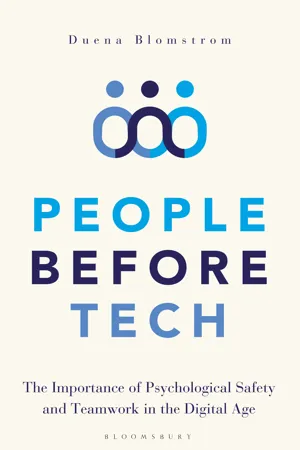
eBook - ePub
People Before Tech
The Importance of Psychological Safety and Teamwork in the Digital Age
- 272 pages
- English
- ePUB (mobile friendly)
- Available on iOS & Android
eBook - ePub
People Before Tech
The Importance of Psychological Safety and Teamwork in the Digital Age
About this book
Information
CHAPTER ONE
Work Today, Work Tomorrow
• VUCA, Digital Disruption and The Speed of Technology
• The ‘Human Debt’
• The Age of Humanity
• The Organization – The Human, The Team
• Get Clarity
• A ‘Speak-Up’ Culture – Create Real Dialogue for Collaboration
• Get a Real To-Do
• Make HR Great Again
• Permissions
• Focus on Teams
• Become Truly Agile – WoT For WoW
VUCA, Digital Disruption and The Speed of Technology
The age of information has changed everything. Technology has affected the way we live our lives in deeper and more impactful ways than we have yet had the chance to even analyse.
If a generation ago we could so happily live without modern technology, nowadays, we have become reliant on it for nearly everything. From our social lives to our private lives, to the way we work, all have dramatically changed over the past 30–40 years, but the speed of change has accelerated furthermore over the last 10–15 years and to be efficient in this new paradigm, we must spend time understanding what that means for the way we interact with others in a professional environment.
Every aspect of our working lives has now been touched by digital, irrespective of what industry we are in, and there is no sign of stopping this trajectory of change. With every week, a new type of technology springs up and the resulting products and offerings are constantly evolving or transforming. As a result, customer expectations have risen tremendously now that they avail themselves of the effects of digital. The expectation of ‘new’ and ‘better’ is growing continuously as consumers develop a clearer understanding of what is possible and instinctively know they can continue to up the ante and ask for more.
When apps first came out, they were a luxury. Mostly designed for entertainment, consumers viewed them as non-essential and had little to no expectation of them. When smartphones became more commonplace, the way people interacted with technology changed, in particular as these applications became tightly interwoven with every moment of our lives. Nowadays, there are very few actions that are ‘non-digital’ in that they neither happen online nor on our phone, nor are enhanced, aided or enabled by technology and for most people in the western world, a life completely off the grid and devoid of technology feels nigh on impossible.
Driven by market competition, technological advancements have only accelerated and with this increased speed of innovation comes a greater expectation from consumers. Living in a world where we provide, expect and consume, fast technology changes the pace of everything. The fluidity of the situation gave birth to the term of VUCA. VUCA stands for Volatility, Uncertainty, Complexity, Ambiguity and it defines our new world. In fact, if you work in technology, this is the new normal and dreaming of any kind of return to the clarity and stability of the past is useless.
In the work environment, we have leapt from typewriters and paper shuffling to bytes and Zoom meetings within the space of what is practically years. For most professionals, this has involved a serious transformation process which requires a transformed mindset beyond the practical aspects of work. Coming to grips with the continual changes in the way we work hasn’t been an easy endeavour – it is made even more difficult by the uncertainty and acceleration which faces us in the future.
Everything is moving faster than we can keep track of – it took airlines 68 years to reach 50 million consumers, while it took Facebook only three. It took Pokémon Go just 19 days to reach 50 million users.
In Superfast: Lead at Speed Sophie Devonshire lists example after example of the speeds at which our world is changing. Among them, she describes Google’s firm sense of urgency and growth, accredited by their EMEA president Matt Brittin to ‘Moonshots’ – a groundbreaking innovation project out of California, where they only focus on ambitious, speculative research projects which may not necessarily be profitable but represent tremendous leaps forward. Matt Brittin summarizes them:
Look at it this way, if you try and make something 10 per cent better, you’re likely to take an incremental approach – start from what you’ve got and refine it. If you try and make something 10 times better though, you’ve got to start from scratch – first principles – find a new way. To compete in the age of the Internet that’s what you need to do because the rate of change in the digital world is faster than it’s ever been.
It is in this world of speed that we see extreme growth happen. Companies come and go faster than ever before (in 1965, the average tenure of a company in the US was 33 years, by 1990, it had shrunk to 20 and by 2026, it is estimated to reach 14) and these numbers are skewed by meteoric raises to the glory of companies that are natively digital and comfortable with VUCA (Dollar Shave Club sold pre-profit for 1 billion dollars to Unilever in five years and Airbnb’s valuation went to $58 billion in the same time frame).
This is the unimaginable speed that renders what we learned in school and what we took years to perfect as utterly irrelevant. This is why the mere notion of skills or training can be seen as useless. This is why our existent ways of measuring risk and preparing for every eventuality are no longer serving us. This is why we ought to rebel whenever we hear the term ‘process’ and why outdated ways of work should horrify us. This is what makes everything around us unclear, ever-shifting and supremely uncomfortable.
In these times, the only certain elements we can count on, the only useful parts that remain sustainable and relevant are those fundamental human qualities, abilities and skills that help us breathe in what feels like a never-ending crisis response mode, which is arguably what our VUCA world brings. Chief among them are courage, flexibility and resilience. Empathy, purpose, passion. Connection, communication, trust, decency, goodwill, spirit. Emotional intelligence and heart. The essence of our humanity. All virtually untouched and underappreciated in the ‘professional’ realm.
When a company has been built with people at its core and maintains these values, they stand a good chance of remaining competitive but for most organizations, VUCA and Digital are recent and bedazzling entrants in their business’s life so they lack the luxury of a tabula rasa exercise where they can build on these pillars, where their foundations would be laid around the humans in the organization. They cannot very well organize a purist exercise where everyone gets out and only those with the brains and the heart to match what they are building get back in. If only that were possible, they would stand a chance to start reducing their Human Debt and therefore win in this fast-paced digital VUCA world.
The ‘Human Debt’
‘Technical debt’ (also known as ‘code debt’ or ‘design debt’) is defined in software development as the cost and effort of rework needed to correct choices made due to taking ‘the easy way out’ when designing a solution instead of ‘doing the right thing’ and implementing a better approach if the latter implied more work and effort. In other words, it is what happens when software developers cut corners. As with monetary debt, the technical debt incurs heavy interest as the need for changes is ignored time and again until that’s not possible anymore and often leads to a need to completely rebuild the codebase from the ground up.
It occurred to me that, in the same ways in which we incur technical debt, we have also incurred its equivalent at the organizational level, regarding our employees. Hence the term ‘Human Debt™’, which refers to all the shortcuts we have collectively taken in the professional world when we ignored some of the heavy lifting that would have been needed to ensure our people were happy at work.
‘Human Debt’ is an umbrella which includes moral concerns of employee well-being, happiness, care and respect. The mere term of ‘human resources’ is intensely disrespectful and practically sums up the theme of Human Debt – we have collectively treated our people, our humans, our employees as nothing but another resource. In some modern-day enterprises, it has been corrected to ‘capital’ and that’s accurate and welcomed if sincere. They are typically the same enterprises that will have a ‘chief heart officer’, a ‘chief purpose officer’ or a ‘chief happiness officer’ before they have a ‘chief human resources officer’ but of course, this is only important in the instances where this is not a simple rebrand of a title for the sake of PR or trends but a reflection of a true change in mentality. The companies who have undergone this change are far and few between.
Changing the narrative to focus on qualitative elements rather than quantitative has always been challenging. The best example of this is when in 1975, in San Francisco, Tom Peters and Richard Pascale, two well-respected management consultants and strategists, sat down to work out what could be done to change the dire situation of American workers in recession. Both in awe of what the Japanese were doing to turn their loss into an industrial revolution win by work ethics and methodology, they proposed the difference between them and their American counterparts lies in the lack of a higher sense of mission. They are certain that people and tools are no different and the competitive advantage of different processes is the result of one major gain they have: a sense of shared value that runs down the organization to the employees. A mission to match a strong vision.
Both go on to write books but Pascale’s book, The Art of Japanese Management, is met with reticence and raised eyebrows – what’s this talk of mission and shared values? So what if the Japanese went to work for a higher purpose? Peters’ In Search of Excellence: Lessons from America’s Best-Run Companies has a different tone if it touts the same concepts and as a result, lands better popularizing the idea that a company must have values and a real vision and not simply offer jobs.
Nowadays, everyone has a marble plaque in the hallway with the vision carved out and laid bare for all to see and we can debate its effectiveness and raison d’être all we like, but having had that introduced back in the day, it has shaped the way we view work and elevated the economy when the focus shifted from employed worker bees to invested partners so it stands as the first example of the idea of ‘purpose’.
We have to move past the discomfort and advance to discussing the crux of the issue: How do you make employees genuinely love you? How do you avoid ever mandating it and instead nurture and painstakingly build it within your people until they are all owner-level invested? All in. All heart. All about reducing or better yet, eradicating this Human Debt.
The Age of Humanity
We have known for a long time that we have to ask the hard questions, and examine the true extent of the Human Debt and be willing to take a can of kerosene to the status quo, but it was never clearer than during the 2020 COVID-19 crisis.
With our very lives at stake, humanity had to show its magnificently adaptive nature to survive. We saw the fabric of our day-to-day lives modify as needed to respond to the threat and with it, a beautiful community spirit shining through as examples of deeply human acts came from every part of the world and every walk of life.
In business, with usual practices impossible, the topic of remote and flexible work became an overnight reality, showing beyond doubt that it was entirely possible to let go of at least one of the many fixed ideas we carried around in the world of work – how people must be chained to a desk in a physical office space for a certain amount of time, in a certain location to work together. Once that assumption was successfully proven wrong, many others started to be questioned and, coupled with the newly found appetite for true humanity, a vibrant dialogue on the value of humans in the workplace ensued.
Perhaps we can finally all agree that we need a culture change, respectful and kind working environments, but the answers as to how to arrive there have to be able to dictate a radically different approach to what we value and how we see work, as the health of an organization won’t improve discreetly and incrementally as a result of a few workshops and a few office posters but through radical and deep change.
What doesn’t work
• Doing what we’ve been doing – organizing and managing the enterprise as we have in the past with the same hierarchies, the same structures and the same job titles based on the same selection criteria, same definitions of value and same lack of respect and care our humans have been feeling;
• Ignoring the concept of ‘team’ – it’s a neglected structure which incidentally happens to be the only one we can reliably affect in terms of behaviours and practices;
• Theorizing or preaching about the organization and culture as a whole – while potentially all true, it is also ineffective rhetoric which achieves no real change;
• Offering generic ‘don’t be an a-hole’-type advice – needed as it may be, it won’t accomplish anything as, while most people already have good intentions, they don’t know how to correct problematic behaviours while caught up in the web of a toxic culture in which defensive, protective attitudes stemming from the lack of Psychological Safety can pervade in their particular team bubble;
• Paying lip service to the ‘future of work’ concept – talking about a new paradigm in general as an overall concept of ample importance and then consider it sorted with the implementation of the new cycle-to-work scheme or the new office layout;
• Hoping for any ‘out-of-the-box’ solutions – in particular, adopting any newfangled ‘framework’ or ‘process’ some expensive consultancy pushed with no introspection, cr...
Table of contents
- Cover
- Series
- Title
- Contents
- Foreword by Prof. Dr Amy Edmondson
- Preface
- CHAPTER ONE Work Today, Work Tomorrow
- CHAPTER TWO Process Versus People – Agile, WoW and WoT
- CHAPTER THREE Teams and the Search for High Performance
- CHAPTER FOUR Psychological Safety – The Only Lever for High Performance
- CHAPTER FIVE Putting a Number on Psychological Safety and Emotional Intelligence
- CHAPTER SIX Soft Skills are Hard
- CHAPTER SEVEN What Happens Next and the Post-Pandemic World of Work
- Appendix: Interview with Gene Kim, award-winning CTO, researcher and author
- Glossary
- Reading and References
- Acknowledgements
- Index
- Copyright
Trusted by 375,005 students
Access to over 1.5 million titles for a fair monthly price.
Study more efficiently using our study tools.
Frequently asked questions
Yes, you can cancel anytime from the Subscription tab in your account settings on the Perlego website. Your subscription will stay active until the end of your current billing period. Learn how to cancel your subscription
No, books cannot be downloaded as external files, such as PDFs, for use outside of Perlego. However, you can download books within the Perlego app for offline reading on mobile or tablet. Learn how to download books offline
Perlego offers two plans: Essential and Complete
- Essential is ideal for learners and professionals who enjoy exploring a wide range of subjects. Access the Essential Library with 800,000+ trusted titles and best-sellers across business, personal growth, and the humanities. Includes unlimited reading time and Standard Read Aloud voice.
- Complete: Perfect for advanced learners and researchers needing full, unrestricted access. Unlock 1.5M+ books across hundreds of subjects, including academic and specialized titles. The Complete Plan also includes advanced features like Premium Read Aloud and Research Assistant.
We are an online textbook subscription service, where you can get access to an entire online library for less than the price of a single book per month. With over 1.5 million books across 990+ topics, we’ve got you covered! Learn about our mission
Look out for the read-aloud symbol on your next book to see if you can listen to it. The read-aloud tool reads text aloud for you, highlighting the text as it is being read. You can pause it, speed it up and slow it down. Learn more about Read Aloud
Yes! You can use the Perlego app on both iOS and Android devices to read anytime, anywhere — even offline. Perfect for commutes or when you’re on the go.
Please note we cannot support devices running on iOS 13 and Android 7 or earlier. Learn more about using the app
Please note we cannot support devices running on iOS 13 and Android 7 or earlier. Learn more about using the app
Yes, you can access People Before Tech by Duena Blomstrom in PDF and/or ePUB format, as well as other popular books in Business & Human Resource Management. We have over 1.5 million books available in our catalogue for you to explore.