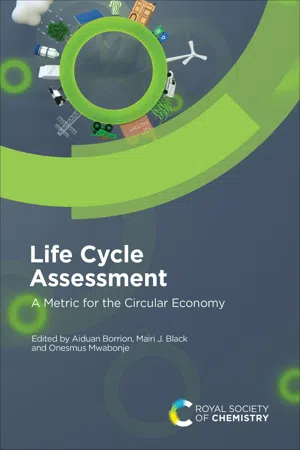
Life cycle assessment (LCA) is an established methodology used to quantify the environmental impacts of products, processes and services. Circular economy (CE) thinking is conceptual way of considering the impacts of consuming resources. By taking a closed loop approach, CE provides a framework for influencing behaviours and practices to minimise this impact. Development of the circular economy is a crucial component in the progression towards future sustainability. This book provides a robust systematic approach to the circular economy concept, using the established methodology of LCA. Including chapters on circular economic thinking, the use of LCA as a metric and linking LCA to the wider circular economy, this book utilises case studies to illustrate the approaches to LCA. With contributions from researchers worldwide, Life Cycle Assessment provides a practical, global guide for those who wish to use LCA as a research tool or to inform policy, process, and product improvement.
eBook - ePub
Life Cycle Assessment
A Metric for the Circular Economy
- 400 pages
- English
- ePUB (mobile friendly)
- Available on iOS & Android
eBook - ePub
Life Cycle Assessment
A Metric for the Circular Economy
About this book
Information
Publisher
Royal Society of ChemistryYear
2021Print ISBN
9781788014458
9781788014458
Edition
1eBook ISBN
9781839161360
Table of contents
- Cover
- Title
- Copyright
- Foreword
- Preface
- Contents
- Chapter 1 Theories and Tools for the Assessment of Environmental Impacts of Human Activities
- Chapter 2 The Circular Economy: Concept, Tools and Implementation
- Chapter 3 Life Cycle Assessment as a Metric for Circular Economy
- Chapter 4 Case Study – Construction Material (Steel)
- Chapter 5 Case Study – Construction Materials (Cement, Aggregates and Concrete Products)
- Chapter 6 Assessing the Environmental Benefits of Using Glass Powder as a Supplementary Cementitious Material in a Context of Open-loop Recycling
- Chapter 7 Life Cycle Assessment of Sustainable Polymer Packaging
- Chapter 8 Case Study: Textiles
- Chapter 9 Refining Made Circular: The Potential for Substituting Biogenic for Fossil Carbon
- Chapter 10 Case Study – Packaging
- Chapter 11 Case Study: Agricultural Crop Production
- Chapter 12 Livestock Production
- Chapter 13 Case Study – Bioenergy Life-cycle Analysis and Implications on Bioenergy-driven Circular Economy
- Chapter 14 Resource Impacts of Fully Renewable Energy Systems: The Case of Metals
- Chapter 15 Linking Life Cycle Assessment to the Wider Circular Economy
- Subject Index
Trusted by 375,005 students
Access to over 1.5 million titles for a fair monthly price.
Study more efficiently using our study tools.
Frequently asked questions
Yes, you can cancel anytime from the Subscription tab in your account settings on the Perlego website. Your subscription will stay active until the end of your current billing period. Learn how to cancel your subscription
No, books cannot be downloaded as external files, such as PDFs, for use outside of Perlego. However, you can download books within the Perlego app for offline reading on mobile or tablet. Learn how to download books offline
Perlego offers two plans: Essential and Complete
- Essential is ideal for learners and professionals who enjoy exploring a wide range of subjects. Access the Essential Library with 800,000+ trusted titles and best-sellers across business, personal growth, and the humanities. Includes unlimited reading time and Standard Read Aloud voice.
- Complete: Perfect for advanced learners and researchers needing full, unrestricted access. Unlock 1.5M+ books across hundreds of subjects, including academic and specialized titles. The Complete Plan also includes advanced features like Premium Read Aloud and Research Assistant.
We are an online textbook subscription service, where you can get access to an entire online library for less than the price of a single book per month. With over 1.5 million books across 990+ topics, we’ve got you covered! Learn about our mission
Look out for the read-aloud symbol on your next book to see if you can listen to it. The read-aloud tool reads text aloud for you, highlighting the text as it is being read. You can pause it, speed it up and slow it down. Learn more about Read Aloud
Yes! You can use the Perlego app on both iOS and Android devices to read anytime, anywhere — even offline. Perfect for commutes or when you’re on the go.
Please note we cannot support devices running on iOS 13 and Android 7 or earlier. Learn more about using the app
Please note we cannot support devices running on iOS 13 and Android 7 or earlier. Learn more about using the app
Yes, you can access Life Cycle Assessment by Aiduan Borrion, Mairi J Black, Onesmus Mwabonje, Aiduan Borrion,Mairi J Black,Onesmus Mwabonje in PDF and/or ePUB format, as well as other popular books in Biological Sciences & Environmental Science. We have over 1.5 million books available in our catalogue for you to explore.