Cost Engineering for Pollution Prevention and Control
eBook - ePub

Cost Engineering for Pollution Prevention and Control

  1. 458 pages
  2. English
  3. ePUB (mobile friendly)
  4. Available on iOS & Android
eBook - ePub

Cost Engineering for Pollution Prevention and Control

About this book

Environmental engineers work to increase the level of health and happiness in the world by designing, building, and operating processes and systems for water treatment, water pollution control, air pollution control, and solid waste management. These projects compete for resources with projects in medicine, transportation, education, and other fields that have a similar objective. The challenge is to make the investments efficient – to get the best project outputs with a minimum of inputs. Cost Engineering for Pollution Prevention and Control examines how to identify the best solution by judging alternatives with respect to some measure of system performance, such as total capital cost, annual cost, annual net profit, return on investment, cost-benefit ratio, net present worth, minimum production time, maximum production rate, minimum energy utilization, and so on.

Key Features:


  • Explains how to estimate preliminary costs, how to compare the life cycle costs of alternative projects, how to find the optimal balance between capital costs and operating costs.


  • Emphasis is placed on formulating the problem rather than on the mathematical details of how the calculations are done.


  • Provides numerous practical examples and case studies.


  • Includes end-of-chapter exercises dealing with water, wastewater, air pollution, solid wastes, and remediation projects.

The important concepts presented in this book can be understood by those students who have taken an introductory course in environmental engineering. Advanced knowledge of process design is not required. The material can also be utilized by engineers, managers, and others who would benefit from a better understanding of how engineers look at problems.
Frequently asked questions

Yes, you can cancel anytime from the Subscription tab in your account settings on the Perlego website. Your subscription will stay active until the end of your current billing period. Learn how to cancel your subscription.
No, books cannot be downloaded as external files, such as PDFs, for use outside of Perlego. However, you can download books within the Perlego app for offline reading on mobile or tablet. Learn more here.
Perlego offers two plans: Essential and Complete
  • Essential is ideal for learners and professionals who enjoy exploring a wide range of subjects. Access the Essential Library with 800,000+ trusted titles and best-sellers across business, personal growth, and the humanities. Includes unlimited reading time and Standard Read Aloud voice.
  • Complete: Perfect for advanced learners and researchers needing full, unrestricted access. Unlock 1.4M+ books across hundreds of subjects, including academic and specialized titles. The Complete Plan also includes advanced features like Premium Read Aloud and Research Assistant.
Both plans are available with monthly, semester, or annual billing cycles.
We are an online textbook subscription service, where you can get access to an entire online library for less than the price of a single book per month. With over 1 million books across 1000+ topics, we’ve got you covered! Learn more here.
Look out for the read-aloud symbol on your next book to see if you can listen to it. The read-aloud tool reads text aloud for you, highlighting the text as it is being read. You can pause it, speed it up and slow it down. Learn more here.
Yes! You can use the Perlego app on both iOS or Android devices to read anytime, anywhere — even offline. Perfect for commutes or when you’re on the go.
Please note we cannot support devices running on iOS 13 and Android 7 or earlier. Learn more about using the app.
Yes, you can access Cost Engineering for Pollution Prevention and Control by Paul Mac Berthouex,Linfield C. Brown in PDF and/or ePUB format, as well as other popular books in Ciencias biológicas & Derecho medioambiental. We have over one million books available in our catalogue for you to explore.

Information

1 An Introduction to Cost Engineering

Cost binds a variety of components and considerations into an understandable whole. What all engineering projects have in common is the competition for resources and the challenge to efficiently invest the resources that are available. Cost engineering is about methods that are used to evaluate investments so that available monies are used wisely.
The fundamentals are estimating costs, making economic comparisons of alternative solutions, financing construction and facility operations, and financial management of projects. Some special methods are formulating and solving problems to minimize costs, optimizing processes by experimentation, building statistical models, and engineering to accommodate uncertainty, variability, and reliability.
These methods and concepts apply to all engineering disciplines and specialties, to private and public works projects, and to decisions in business and personal finance. This book shows how they are used to solve pollution prevention and control problems.

1.1 Health and Happiness

Albert Einstein said that the environment was “everything that is not me.” For “me” to be healthy and happy, everything that is “not me” must be healthy and happy. We disturb the environment as we draw from it food, water, shelter, clothing, and energy for our material needs, and as we dispose into it our wastes. Our disturbances must be managed carefully to avoid damaging our health and happiness.
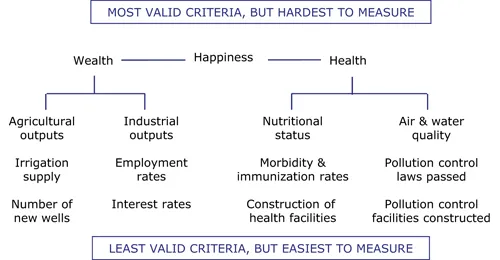
The goal is to promote health and happiness. The difficulty for engineers, who like to measure and quantify outputs, is that there is no metric for measuring happiness, and not very precise ones for measuring healthiness. The things we can count and measure are at the bottom of the hierarchy of goals shown in Figure 1.1.
FIGURE 1.1 The hierarchy of goals for environmental and human health.

1.2 The Cost of Action and No Action

The cost of no action toward environmental protection is greater than the cost of action. Action delayed will increase future costs, endanger lives, and it may cause irreversible environmental damage. Action is required by law in all parts of the world, and the required actions improve environmental quality and protect public health.
Table 1.1 lists a few of the impacts of investing money to improve health and environmental quality.
TABLE 1.1 Examples of No-Action Impacts on Health, Environmental Quality, and Productivity
Impacts on
Examples of Impacts
Health
Increased burden of disease due to reduced drinking water quality
Increased burden of disease due to reduced bathing water quality
Increased burden of disease due to unsafe food (contaminated vegetables, fish, and other farm products)
Increased risk of disease when working or playing in wastewater irrigated areas
Increased financial burden on health care
Environment
Diminished recreational opportunities
Decreased biodiversity
Degraded ecosystems (e.g., eutrophication and dead zones)
Increased greenhouse gas emissions
Increased odors and unsightly conditions
Production
Reduced industrial productivity
Reduced agricultural productivity
Reduced market value of harvested crops due to unsafe irrigation
Reduced tourism and the willingness to pay for recreational activities
Reduced fish and shellfish catches, or reduced market value of fish and shellfish

1.3 About This Book

This book has 20 chapters that are organized into six sections.
Chapters 27: Planning and Cost Estimating
Capital costs buy fixed assets, such as equipment, land, and structures. The capital cost estimates in this book are the kind that is made early in the design process to evaluate project feasibility and budgets. The accuracy of cost estimates improves as design details are fixed and uncertainties are removed. Operating costs for labor, electricity, natural gas, and various chemicals keep personnel, equipment, and processes working.
Chapters 810: Economic Evaluation of Projects
Projects have a life cycle cost that consists of the capital costs and the operating costs. Capital costs often are a lump sum that is invested at the beginning of the project. Operating costs go on year after year. These two kinds of costs need to be combined into a single measure of the economic attractiveness of a project, or for several projects that are to be compared. One approach is to convert an initial cost into an equivalent series of annual costs; this is amortization of the capital cost. A second approach is to convert a stream of annual costs into an amount that is equivalent to a lump su...

Table of contents

  1. Cover
  2. Half-Title
  3. Title
  4. Copyright
  5. Contents
  6. Preface
  7. Author Bios
  8. Chapter 1 An Introduction to Cost Engineering
  9. Chapter 2 Defining the Engineering Problem
  10. Chapter 3 Planning for the Future
  11. Chapter 4 Capital Cost Estimates
  12. Chapter 5 Operating Costs
  13. Chapter 6 Cost Indexes
  14. Chapter 7 Economy of Scale
  15. Chapter 8 The Time Value of Money
  16. Chapter 9 Depreciation and Asset Valuation
  17. Chapter 10 Financing Capital Costs
  18. Chapter 11 Financial Management for Operations
  19. Chapter 12 Utility Service Revenues and Rate Making
  20. Chapter 13 Financial Management for Engineering Projects
  21. Chapter 14 Optimization of Linear Models
  22. Chapter 15 Optimization of Nonlinear Problems
  23. Chapter 16 Building and Fitting Statistical Models
  24. Chapter 17 Experimental Methods for Engineering Optimization
  25. Chapter 18 Designing under Uncertainty
  26. Chapter 19 Monte Carlo Simulation
  27. Chapter 20 Designing for Safety and Reliability
  28. Chapter 21 References and Recommended Reading
  29. Chapter 22 Appendix AStaged Construction for Linear Growth
  30. Chapter 23 Appendix BEconomy of Scale Factors
  31. Chapter 24 Appendix CFactors for Economic Calculations
  32. Chapter 25 Appendix DInterpreting the LINGO Solution Report
  33. Chapter 26 Appendix EGenerating Random Numbers in Excel
  34. Index