A much-maligned feature of ancient and medieval political thought is its tendency to appeal to nature to establish norms for human communities. From Aristotle's claim that humans are "political animals" to Aquinas' invocation of "natural law," it may seem that pre-modern philosophers were all too ready to assume that whatever is natural is good, and that just political arrangements must somehow be natural. The papers in this collection show that this assumption is, at best, too crude. From very early, for instance in the ancient sophists' contrast between nomos and physis, there was recognition that political arrangements may be precisely artificial, not natural, and it may be questioned whether even such supposed naturalists as Aristotle in fact adopt the quick inference from "natural" to "good." The papers in this volume trace the complex interrelations between nature and such concepts as law, legitimacy, and justice, covering a wide historical range stretching from Plato and the Sophists to Aristotle, Hellenistic philosophy, Cicero, the Neoplatonists Plotinus and Porphyry, ancient Christian thinkers, and philosophers of both the Islamic and Christian Middle Ages.
eBook - ePub
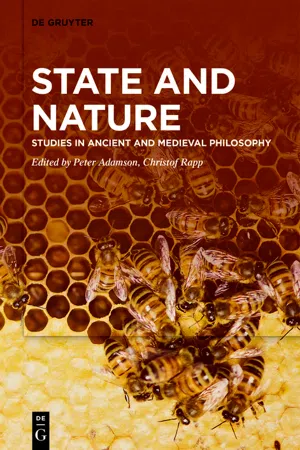
State and Nature
Studies in Ancient and Medieval Philosophy
- 435 pages
- English
- ePUB (mobile friendly)
- Available on iOS & Android
eBook - ePub
State and Nature
Studies in Ancient and Medieval Philosophy
About this book
Information
Topic
PhilosophySubtopic
Ancient & Classical PhilosophyPart I: Plato and Aristotle
Human Nature and Legal Norms: Antiphon the Sophist as Anonymous Target in Plato’s Republic IX
Oliver Primavesi
Abstract
This paper focuses on a passage from Plato’s Republic book IX, which describes the tripartite soul as a fusion of three animals or ‘natures’ (phuseis), whose growth (phuesthai) must be regulated by the legal norms (nomima). This is presented as a response to the problem posed earlier in the Republic with the example of the Ring of Gyges. In this paper, it is argued that the image is directed at Antiphon’s theory of a fundamental antithesis between human phusis and nomima, so that the fictitious interlocutor of book IX, who is introduced as an upholder of the ‘Gyges-thesis’—namely that that practicing injustice is beneficial provided that it is committed in complete secrecy—in fact represents the sophist Antiphon.
1 Introduction
From Book II of Plato’s Republic onwards,1 Socrates attempts to establish the composition of the human soul according to the model of a much larger and therefore clearer item, the city-state (polis). He establishes what he regards as the ideal constitution for the polis, and he does so by acting as imaginary legislator (nomothetês), with the assistance of his interlocutors Glaucon and Adeimantos.2 The most important of his laws divides the citizens of the polis up into three classes: (i) craftsmen and farmers, (ii) soldiers, (iii) philosopher kings. Socrates aims to legitimize this imaginary class-division as a natural one by means of a founding myth that he frankly admits to be an ‘indispensable, noble falsehood’ (pseudos en tôi deonti gignomenon […] gennaion),3 by which ideally even the rulers should be persuaded, and failing that, at least all other citizens. The members of the first generation of the ideal city are apparently meant to believe the following (R. III, 414d–415c): their memories of adolescent education are simply an illusion. In fact they were raised inside the earth and born from the native soil itself only after they had become adults. Especially their future assignment to one of the three classes, or so they are to believe, was already determined at the moment of their emergence from the earth, depending on whether the divine creator, acting within the earth, has equipped them with gold to make them rulers, with silver to make them soldiers, or with iron (or bronze) to make them a farmer or craftsman.
In fact the citizens’ assignment to the different classes is, of course, regulated by an assessment, prescribed by Socrates’ laws, of their character and achievements.4 Yet according to the ‘noble lie’ the civic authorities will pretend to give to each citizen the rank appropriate to his nature. The same holds for the citizens of following generations. They too shall be divided into the three classes on the basis of an educational selection prescribed by law, and made to believe that their class membership is based solely on the admixture of metal with which they were born. In some cases, the classification will amount to a social descent or ascent from the parents’ class. A ruler’s child who is found to contain iron will, or so it is claimed, be downgraded without hesitation to the status of farmer that is appropriate to his or her nature (phusis),5 while a farmer’s child who, in spite of low origin, is found to be equipped with gold or silver due to his or her natural growth (phunai) will automatically be honoured with promotion into the rulers’ or soldiers’ class.6
The paramount importance of ‘nature’ (phusis) in this context is not only documented by the presence of the noun in 415c2 (têi phusei) and of the cognate verb in 415c4 (phuêi), but also by the narrative of the ‘noble lie’ as a whole. For the first inhabitants of the ideal city-state will be told that they were born from the earth, like plants.7 Now for native speakers of Ancient Greek there would be an obvious etymological relationship between phuomai (‘grow’, used especially of plants) and its two derivatives phuton (‘plant’) and phusis (usually translated as ‘nature’ but literally meaning ‘plant growth’). It is true that the literal meaning of phusis was normally generalized to ‘natural form of a living being,’ but this very generalization indicates that, in Greek, the growth of plants epitomizes the stability and regularity with which all genera of organic life reproduce themselves in basically unchanged form – as far as the Greeks could tell.8 Thus, when Socrates attempts to legitimize his class-division by tracing it back to a purportedly plant-like growth of human beings, he is just illustrating, for Greek ears, the literal meaning of the claim that the class-division is ‘by nature’ (phusei).
But why does the Platonic Socrates go to such lengths to establish that his class-division is by nature? He seems to take it for granted that the emphatically anti-democratic character of his legislation stands in need of justification, and that such justification is to be provided by convincing everybody that his laws concerning class-division simply acknowledge and preserve a division produced by natural growth. This strategy, however, presupposes an intellectual climate in which human nature (phusis) is given preference over the law (nomos). Thus, the introduction of the ‘noble lie’ seems to locate the Republic firmly within the debate over the relationship between human nature (phusis) and law (nomos) that was initiated in the late fifth century AD by the sophists.9 This observation leads to the further question as to whether Plato wrote the Republic with a particular sophist in mind. Whereas in his early and middle dialogues Plato explicitly engages with almost every prominent sophist,10 this appears not to apply to the main part of the Republic, that is, to Books II‒IX which come after the refutation of the sophist Thrasymachus in Book I.
Yet the absence of prominent sophists as interlocutors in the main part of the Republic is only an apparent one, as we will see. At the outset of R. II, Glaucon tells the story of Gyges and his ring in order to illustrate the thesis (henceforth: ‘Gyges-thesis’) that practicing injustice is beneficial provided that it is committed in complete secrecy – a thesis adopted by Glaucon just for the sake of the argument. In R. IX, Socrates comes back to the Gyges-thesis. He introduces a fictitious anonymous exponent of the thesis and refutes him by drawing on his own theory of the tripartite soul as expounded in R. IV. This fictitious anonymous interlocutor represents, or so we will argue, Antiphon the sophist.
Our evidence will be an Oxyrhynchus papyrus first published in 1915, which preserves large parts of a treatise (Aletheia, ‘On Truth’) by the late fifth century AD sophist Antiphon of Athens.11 In this treatise, the sophist defines ‘justice’, in an entirely legalistic manner, as “obedience to the legal norms (nomima) of the state,” and he claims that ‘justice’ is to be recommended if and only if one’s actions are observed by others, whereas one should follow one’s ‘nature’ (phusis) whenever there are no witnesses around. Now Hermann Diels noted almost immediately, in 1917, that Antiphon’s precepts reminded him of the ‘Machiavellian’ moral suggested by Glaucon’s Gyges-story in R. II.12 A few years later, in 1926, Alfred Edward Taylor went in the same direction – independently, as it seems, and more confidently – by making two claims. First, that when Glaucon complains that besides Thrasymachus there are innumerable other upholders of injustice13 we are meant to think, among others, also of Antiphon.14 Second, that the moral of the Gyges-story in particular is to be identified with the philosophical position of Antiphon’s Aletheia.15 It is true that Diels and Taylor based their remarks on interpretations of the new Antiphon papyrus that were not entirely accurate. According to Diels, Antiphon introduced his legalistic definition of ‘justice’ just in order to refute it, by demonstrating that it leads to immoral consequences,16 while according to Taylor, Antiphon used the concept of ‘natural justice’ as a complement to ‘conventional justice’.17 Both contentions were implicitly refuted by David Furley who, without ever mentioning Diels (1917) or Taylor (1926), demonstrated in 1981 that Antiphon nowhere criticizes or goes beyond a strictly legalistic definition of ‘justice’. Or, to put it in Furley’s own terms, Antiphon, while annulling the prescriptive value of the words ‘just’ and ‘unjust’, nowhere proposes a new descriptive use of them.18 Yet Furley’s helpful clarification does not undermine the link between the new Antiphon and the Gyges-thesis of R. II. On the contrary: the story of Gyges is obviously a perfect example for someone who, as recommended by Antiphon, denies any inherent prescriptive value of ‘justice’ while fully recognizing the factual power of the legal norms as soon as his actions are observed by witnesses. So it is unfortunate that in subsequent contributions on Antiphon’s Aletheia and its reception, the important link observed by Diels and Taylor seems to have been overlooked.19 It was Gerald F. Pendrick, in his useful edition of the fragments of Antiphon (2002), who not only rediscovered, as it were, the link between the Gyges-story and Antiphon, but a...
Table of contents
- Title Page
- Copyright
- Contents
- Introduction
- Part I: Plato and Aristotle
- Part II: Hellenistic Philosophy
- Part III: Late Antiquity
- Part IV: Medieval Philosophy
- Index of Names
- Index of Subjects
Trusted by 375,005 students
Access to over 1.5 million titles for a fair monthly price.
Study more efficiently using our study tools.
Frequently asked questions
Yes, you can cancel anytime from the Subscription tab in your account settings on the Perlego website. Your subscription will stay active until the end of your current billing period. Learn how to cancel your subscription
No, books cannot be downloaded as external files, such as PDFs, for use outside of Perlego. However, you can download books within the Perlego app for offline reading on mobile or tablet. Learn how to download books offline
We are an online textbook subscription service, where you can get access to an entire online library for less than the price of a single book per month. With over 1.5 million books across 990+ topics, we’ve got you covered! Learn about our mission
Look out for the read-aloud symbol on your next book to see if you can listen to it. The read-aloud tool reads text aloud for you, highlighting the text as it is being read. You can pause it, speed it up and slow it down. Learn more about Read Aloud
Yes! You can use the Perlego app on both iOS and Android devices to read anytime, anywhere — even offline. Perfect for commutes or when you’re on the go.
Please note we cannot support devices running on iOS 13 and Android 7 or earlier. Learn more about using the app
Please note we cannot support devices running on iOS 13 and Android 7 or earlier. Learn more about using the app
Yes, you can access State and Nature by Peter Adamson, Christof Rapp, Peter Adamson,Christof Rapp in PDF and/or ePUB format, as well as other popular books in Philosophy & Ancient & Classical Philosophy. We have over 1.5 million books available in our catalogue for you to explore.