eBook - ePub
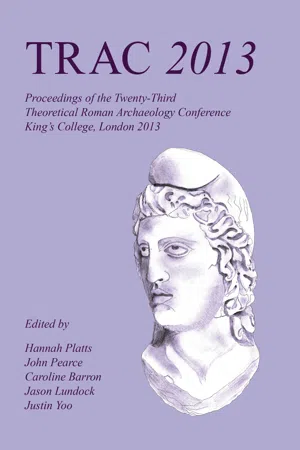
TRAC 2013
Proceedings of the Twenty-Third Annual Theoretical Roman Archaeology Conference, London 2013
- 160 pages
- English
- ePUB (mobile friendly)
- Available on iOS & Android
eBook - ePub
TRAC 2013
Proceedings of the Twenty-Third Annual Theoretical Roman Archaeology Conference, London 2013
About this book
The twenty-third Theoretical Roman Archaeology Conference (TRAC) was held at King's College, London in spring 2013. During the three-day conference nearly papers were delivered, discussing issues from a wide range of geographical regions of the Roman Empire, and applying various theoretical and methodological approaches. Sessions included those looking at Roman–Barbarian interactions; identity and funerary monuments in ancient Italy; migration and social identity in the Roman Near East; theoretical approaches to Roman small finds; formation processes of in-fills in urban sites; and new reflections on Roman glass. This volume contains a selection of papers from the conference sessions.
Information
Subtopic
Roman Ancient HistoryIndex
HistoryA Historiography of the Study of the Roman Economy: Economic Growth, Development, and Neoliberalism
Matthew S. Hobson
Introduction
This paper attempts a historiography of the study of the Roman economy over the last forty years. It is argued that a new paradigm, used in the sense of a broad set of values, assumptions and concepts shared by those within the field, began to emerge during the 1980s, reaching its most concrete form in the middle of the last decade with the publication of the Cambridge Economic History of the Graeco-Roman World (Scheidel et al. 2007a). The new paradigm manifests itself most clearly in the adoption of the ideological outlook of development economics, a body of economic theory which first came into being in the immediate post-war period with the ostensible motive of removing poverty from the ‘underdeveloped’ parts of the globe (Escobar 1995: 3–12, 21–54). This adoption has resulted in a shared terminological and conceptual framework between institutions such as the United Nations, International Monetary Fund and the World Bank, on the one hand (Chomsky 1999; Goldman 2005; Harvey 2005), and historians and archaeologists dealing specifically with questions of Roman economic history on the other (Garnsey and Saller 1987; Jongman 2007b; Saller 2002; Scheidel et al. 2007a).
Aligning themselves with the New Institutional Economics of Douglass North, a recent brand of American economic history that evolved from the cliometrics revolution of the late 1950s and 1960s (North 1981; 1990), the editors of the Cambridge Economic History of the Graeco-Roman World state that their aim is to compare the structure and performance of the ancient Greek and Roman economies with those of other historical epochs (Scheidel et al. 2007b: 5). In order to achieve this, an overriding concern has become the quantification of past economic growth, pursued through the measurement of per capita income, Gross Domestic Product (GDP) and, more recently, the evaluation of living standards through other statistical modes of interrogation, such as the Human Development Index (HDI) (Allen 2009; Millett 2001: 20; Scheidel 2010a; b; 2012a). The hegemony of this new system of logic has structured the discourse on the Roman economy in a very distinct way: for the neo-primitivists on the one hand, the Roman empire is apparently now to be viewed as analogous to a ‘developing nation’, and explanations for the failure of its economy to achieve the kind of ‘significant growth’ which supposedly could have improved living standards, are to be sought in the structural obstacles provided by its institutions and the cultural mind-set of its population (Jongman 2007a; b; Saller 2002; Scheidel et al. 2007b). On the other hand the modernists, for whom formal neoclassical economics remains entirely relevant and who have been increasingly welcomed back into the centre of discussion, continue to maintain that the Roman world should not be confused with a range of ‘primitive’ societies whose institutions wreck incentives and stifle ree-market performance (Silver 1995; 2007: 191; Temin 2001; 2013). What is argued here is that these two apparently opposed positions have in fact come to revolve around the same logical axis, and that at root this structural configuration has been directly determined by complex political and ideological adjustments that have taken place since the Second World War. Furthermore, in the wake of the ‘great contraction’ which began with the subprime loan crash of August 2007, this ideological framework now needs substantial reappraisal: all the more so, given that the political ideology of the second financial hegemony (more commonly referred to as neoliberalism) has precipitated a similarly deep and significant economic crisis to that triggered by the first (namely, the Great Depression of the 1930s). In spite of the economic turmoil of the last five years, neoliberalism remains nothing short of the dominant political and economic orthodoxy across the majority of the globe and, if anything, its political agenda is being pursued more aggressively than before (Duménil and Lévy 2011: 15; van Apeldoorn and Overbeek 2012: 3).
Why are these observations significant or important for the discipline? Running concurrently with the alterations in position within Roman economic history, trends in Roman studies more broadly have been characterised by a set of postcolonial reassessments over the last few decades, many of which claim to have successfully identified and rejected imperialist, ideological relics of the colonial period (Bénabou 1976; Hingley 2000; Mattingly 1996; 2006b; 2011; Modéran 2003). Surely, however, it is not overstating the case to point out that there may be a deep logical inconsistency in congratulating ourselves on this achievement, if at the same time we are unconsciously accommodating new models and approaches based on a different but related configuration of power and imperialism (see Faulkner 2008, for some astute criticism). The adoption of developmental economic theory, whether in the form of the New Institutional Economics or from other related sources, has entailed the assimilation of some troubling assumptions about the universal benefits of economic growth in general, which must now be unquestionably shaken by the current financial crisis, and by a string of examples of problematic Western intervention in ‘Third World’ contexts over the last half-century (Klein 2004; Scahill 2008). In spite of this, there has been a complete lack of interest in the vast body of post-development literature now available, the exploration of which could no doubt provide a useful counterpoint to the dominant voice of development economics (Baudrillard 1998; Escobar 1995; Latouche 2009; Rahmnema and Bawtree 1997; Victor 2008).
Naturally the description given above is a somewhat over-schematised picture, but while there are many who fall in between the two extremes outlined, the crucial fact remains that recent contributions to the debate have done little to alter the basic hegemonic structure of the discourse. Many archaeologists, for example, have simply joined the debate on one side or the other, and discussion has tended to centre on the correct use of this or that form of evidence, rather than on questioning the general validity of attempting to establish accurate measurements of economic performance in the first place, or on examining what the risks or benefits of asking such a question of the distant past might be (Bowman and Wilson 2009; Greene 1986; Harris 1993; Mattingly 2006a; Wilson 2009; 2011). The fact of the matter is that the current debate over the scale of economic growth in antiquity could continue ad infinitum, without it ever being acknowledged that a significant transformation has taken place in which both groups, primitivists and modernists, have come to share some fundamental presuppositions about what economic history is for and how it should be carried out (Morley 2007: xiii, 7–9).
The two factions now appear to share the idea that certain universal laws of economics pertain to all periods of human history. Although more prevalent amongst the modernists, there are those on both sides who believe that many of the economic concepts and methods developed for the analysis of capitalism are relevant to the ancient world, and may be applied to its study without danger of anachronism (Jongman 1988: 36–48; Temin 2013: x). Those modernists originating in American economics departments bring with them all of the same rhetoric about deductive reasoning and hypothesis testing which Hodder, Shanks and Tilley, and others attempted to exorcise from archaeological methodology in the 1980s in their exchanges with Binford (Hodder 1986; Shanks and Tilley 1987; Tilley 1992). The neo-primitivists represent a related, but contrasting, challenge. In their hands, the full weight of development economics, used for decades to inspire and govern economic intervention in the ‘Third World’, now falls upon all the pre-industrial societies of history with equal force. This mode of economic thought, inextricably linked with the economic imperialism of the Western Powers since the end of the Second World War, belongs to the same spectrum of modern neoliberal economics, but universalises its principles in a slightly altered manner. Whilst maintaining the pretence of greater historical sensitivity, it also develops indices and scales, like GDP or the HDI, or other conceptual machinery such as ‘transaction costs’, against which economic performance and development can be measured cross-culturally. The result of following this method, however, is that western systems of categorisation are projected onto all other forms of society, both past and present (thus the logic of equivalence can supposedly be discerned within the purely symbolic exchange of the Trobriand islanders: (North 1977; Verboven 2002: 16–20; cf. Baudrillard 1981: 62–87; Boldizzoni 2011: 20–53).
Arturo Escobar has examined the origins of development economics as a hegemonic discourse in the immediate post-war decades, and notes the results of this process rather succinctly:
‘[T]he coherence of effects that the development discourse achieved is the key to its success as a hegemonic form of representation: the construction of the poor and underdeveloped as universal, preconstituted subjects, based on the privilege of the representers; the exercise of power over the Third World made possible by this discursive homogenization (which entails the erasure of the complexity and diversity of Third World peoples, so that a squatter in Mexico City, a Nepalese peasant, and a Tuareg nomad become equivalent to each other as poor and underdeveloped); and the colonization and domination of the natural and human ecologies and economies of the Third World.’
(Escobar 1995: 53)
When used in the study of history, these logical axes delineate and project onto the past a basic distinction between a modern, developed West of the present day, with a high level of per capita income and affluence, and a ‘Third World’ of poverty and underdevelopment, which is seen as lagging behind in a more primitive age. Thus, one encounters the following statement in a work of the New Institutional Economics by North and Thomas:
‘[T]he affluence of Western man is a new and unique phenomenon. In the past several centuries he has broken loose from the shackles of a world bound by abject poverty and recurring famine and has realised a quality of life which is made possible only by relative abundance.’
(North and Thomas 1973: 1)
There is in this type of economic history, therefore, a parallel to the process of homogenisation pointed out by Escobar. The characterisation of all historical, pre-capitalist societies as impoverished and underdeveloped allows the entire spectrum of human history to be problematised under the heading of underdevelopment, the analysis of which apparently requires a single, universal body of theory (that of development economics) for its proper investigation.
The adoption of this body of theory by historians determines and limits the sorts of questions that can be asked of the past to a very narrow and specific inventory. Jongman, for example, recently asks:
‘[W]hy were the Romans not as prosperous as we are... Were they poor because they or their rulers failed to maximise their incomes, because they lacked the economically rational desire to improve their lot, or were they poor because they did not have any alternatives?’
(Jongman 2007b: 237–238)
Another author opens his examination of average income rates in a strikingly similar manner (Allen 2009: 327–329), while Scheidel has contributed this revealing statement:
‘[A]s far as I can see, ancient historians have not even begun to structure their enquiries in accordance with the basic concepts and questions of human development studies… Our ultimate goal has to be a comparative evaluation of different ‘poverties’: not just the poverty of whoever counted as poor at the time (or by our own standards), but also by the relative poverty (and hence the wealth) of nations…’
(Scheidel 2006: 58–59)
There is a danger that such broad-brush, comparative questions, which relate to concerns originating from outside of the discipline of Roman history and are essentially meaningless to it, will begin to drown out more pertinent and interesting problems. Although never explicitly stated, one is constantly being encouraged to conceive of the Roman world as a development economist would any foreign, ‘underdeveloped’ country, with institutions and industry apparently less efficient than our own, and populated by people labelled as less rational and less well organised than ourselves. In this manner all pre-industrial societies are subordinated to the same semantic categorisation, developed by the Western imperial powers from the end of the Second World War to the present day, which effectively erases their qualitative differences.
The orthodoxy of the 1970s and the ‘New Economic History’
All this is a very long way from the theoretical framework that predominated in ancient history during the 1970s, in which there was a strong resistance to the idea that modern economic analysis could be applied to the ancient economy in any meaningful way at all. This resistance was, of course, mounted chiefly by a school of historians based in the United Kingdom, headed by A.H.M. Jones and Sir Moses Finley, successively Professors of Ancient History at the University of Cambridge (Finley 1999; Jones 1964; 1974). A substantial portion of Finley’s most influential book, The Ancient Economy, put forward a detailed argument against the applicability of modern economic theory to the ancient world (1999, 1st ed. 1973). The ancient economy, Finley proposed, was far less integrated and the ancient mind-set far too different for such anachronistic modern analysis to be of any relevance at all. He put it simply: different concepts were needed to analyse a qualitatively different object (Finley 1999: 27). In rejecting abstract economic theory, Finley was following the argument made by Marx repeatedly against the classical economists: that is, that they mistook their observations of economic affairs under capitalism for economic affairs per se, and made of them universal and natural laws which they believed would hold true throughout history (Godelier 1972: xiv–xv; Marx 1993: 83–85; Meillassoux 1972: 93–96).
On the contrary, an obvious conclusion for Finley was that, as there was no identifiable conception of the economy in antiquity, it obviously did not exist as the same kind of phenomenon experienced and studied in the modern era (Finley 1999: 21–23). Karl Polanyi, with whom Finley had developed close contact during his time at Columbia University, had discussed the problem of the anonymity of the economy in ancient societies at length in Trade and Market in the Early Empires (Polanyi 1944; 1947; Polanyi et al. 1957). It is evident that in his analysis he drew heavily on the work of his contemporary and one-time childhood friend, the Hegelian Marxist Georg Lukács (Burawoy 2003: 211–212). Both Polanyi and Finley are commonly invoked as being fixedly Weberian, but the influence of Lukács is clearly referenced by Finley after the time of his departure from the United States (1999: 50 n. 34, 155 n. 9). It would no doubt have been politically difficult, if not impossible, for Polanyi to reference Lukács at the time of his writing in the US. In fact, his altered terminology allowed him to introduce much orthodox Marxist theory of the 1920s into the America of the 1940s and 50s more or less undetected (Polanyi 1944; 1947; Polanyi et al. 1957). Finley, of course, was eventually forced to flee the persecution of McCarthyism during this period, his active involvement with the Frankfurt School making him an obvious target (Shaw and Saller 1981: xi–xvi). The references to Lukács which Finley makes in The Ancient Economy are to an essay published in History and Class Consciousness titled ‘Class Consciousness’ (Lukács 1971: 55–59), and much of what he says about the autarky and cellular self-sufficiency of Roman society could equally be drawn from what Lukács asserts about pre-capitalist societies in general (also of fundamental importance on the point of historical method is another essay within the same book, titled ‘The Changing Function of Historical Materialism,’ Lukács 1971:...
Table of contents
- Cover Page
- Title Page
- Copyright Page
- Contents
- Introduction: TRAC Past, Present and Future: Where to go from here?
- A Historiography of the Study of the Roman Economy: Economic Growth, Development, and Neoliberalism
- Why Modern Economic Theory Applies, Even to the Distant Roman Past
- Dalmatian Silvanus: A Cognitive Approach to Reinterpretation of the Reliefs Representing Silvanus from Roman Dalmatia
- Votive Objects and Ritual Practice at the King's Spring at Bath
- Resurrecting Refuse at Pompeii: The Use-Value of Urban Refuse and its Implications for Interpreting Archaeological Assemblages
- Decline, Migration and Revival: Kom al-Ahmer and Kom Wasit, a History of a Forgotten City
- Small Finds and Roman Battlefields: The Process and Impact of Post-Battle Looting
- Methods and Difficulties in Quantifying Archaeological Vessel Glass Assemblages
- Pompeian Red Ware in Roman London: Insights on Pottery Consumption in Colonial Environments
- Roman Sexuality or Roman Sexualities? Looking at Sexual Imagery on Roman Terracotta Mould-made Lamps
- The Material Culture of Small Rural Settlements in the Batavian Area: a Case Study on Discrepant Experience, Creolisation, Romanisation or Globalisation?
Trusted by 375,005 students
Access to over 1.5 million titles for a fair monthly price.
Study more efficiently using our study tools.
Frequently asked questions
Yes, you can cancel anytime from the Subscription tab in your account settings on the Perlego website. Your subscription will stay active until the end of your current billing period. Learn how to cancel your subscription
No, books cannot be downloaded as external files, such as PDFs, for use outside of Perlego. However, you can download books within the Perlego app for offline reading on mobile or tablet. Learn how to download books offline
Perlego offers two plans: Essential and Complete
- Essential is ideal for learners and professionals who enjoy exploring a wide range of subjects. Access the Essential Library with 800,000+ trusted titles and best-sellers across business, personal growth, and the humanities. Includes unlimited reading time and Standard Read Aloud voice.
- Complete: Perfect for advanced learners and researchers needing full, unrestricted access. Unlock 1.5M+ books across hundreds of subjects, including academic and specialized titles. The Complete Plan also includes advanced features like Premium Read Aloud and Research Assistant.
We are an online textbook subscription service, where you can get access to an entire online library for less than the price of a single book per month. With over 1.5 million books across 990+ topics, we’ve got you covered! Learn about our mission
Look out for the read-aloud symbol on your next book to see if you can listen to it. The read-aloud tool reads text aloud for you, highlighting the text as it is being read. You can pause it, speed it up and slow it down. Learn more about Read Aloud
Yes! You can use the Perlego app on both iOS and Android devices to read anytime, anywhere — even offline. Perfect for commutes or when you’re on the go.
Please note we cannot support devices running on iOS 13 and Android 7 or earlier. Learn more about using the app
Please note we cannot support devices running on iOS 13 and Android 7 or earlier. Learn more about using the app
Yes, you can access TRAC 2013 by Hannah Platts, Caroline Barron, Jason Lundock, John Pearce, Justin Yoo, Hannah Platts,Caroline Barron,Jason Lundock,John Pearce,Justin Yoo, Jason Lundock in PDF and/or ePUB format, as well as other popular books in History & Roman Ancient History. We have over 1.5 million books available in our catalogue for you to explore.