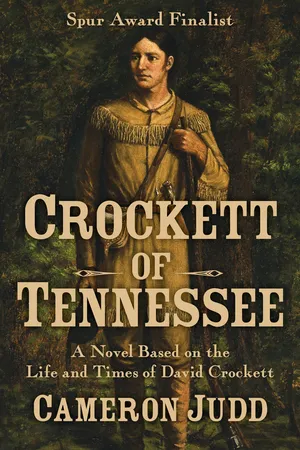
Finalist for the Spur Award: The thrilling adventures of an American icon come alive in this vivid and authentic retelling of his remarkable story
From humble beginnings in rural Tennessee to his heroic death defending the Alamo, frontiersman, adventurer, and politician David "Davy" Crockett embodies the spirit and ideals of the national character. Even during his lifetime, tales of the sharpshooting, skilled woodsman were—to his delight—told, retold, and elaborated on. As a US congressman, the former Creek War militiaman steadfastly opposed President Andrew Jackson's Indian Removal Act. As a soldier, he made the ultimate sacrifice fighting for an independent Texas. Nearly two centuries after his untimely demise, he remains a legendary figure in American lore.
In this fictional account of Crockett's life, author Cameron Judd offers a nuanced portrait of the man behind the myth. He depicts Crockett's triumphs as a hunter, cattle drover, warrior, and legislator in riveting detail and poignantly illustrates his subject's hardscrabble youth and complicated relationship with his father. Meticulously researched and rich in vibrant action,
Crockett of Tennessee captures the charisma, ambition, and bravery of the man known as the "King of the Wild Frontier."
- 518 pages
- English
- ePUB (mobile friendly)
- Available on iOS & Android
eBook - ePub
About this book
Trusted by 375,005 students
Access to over 1.5 million titles for a fair monthly price.
Study more efficiently using our study tools.
Information
Subtopic
WesternsIndex
LiteraturePart 1
POOR MAN’S SON
Chapter 1
Territory of the United States Southwest of the River Ohio, Spring 1794
He left the forest and ran barefoot across the meadow, dodging stumps and calling for his dog. It did not come, just as it had not come all morning, though he had called incessantly. The boy paused for breath, mounted one of the taller stumps, brushed a shock of dark hair from his eyes and scanned the landscape. No dog in sight. His throat was already sore from shouting; now it began to grow tight as well. Tears threatened to rise.
“Painter!” he called again. At age seven, he had a shrill shouting voice. “Here, Painter! Here, boy!”
He waited. No Painter. Drawing in a deep breath, he squatted on the log and looked around. The field was greening in the new spring, the wind was fresh and cool, moist and pleasant. This was the kind of day the boy usually loved, but at the moment he was near to despair and hardly noticed the weather. It appeared that the much-beloved Painter might have left for good this time. The mongrel had vanished from time to time before, as dogs will do, but until today had always returned within a few minutes of being called.
An urgent male voice came filtering through the trees from beyond the forest grove on the far side of the road. The boy cocked his ear to listen. His father was evidently scolding the older boys for some mistake or another as they worked to finish roofing the new mill. The mill, of the overshot style, stood on Cove Creek in the sprawling territorial county of Greene, and was almost ready for operation now, lacking only a portion of its roof, a final section of millrace, and installation of the grain hopper. Finishing the roof was the day’s foremost concern, frenetically pursued under threat of the clouds gathering on the horizon and all the various other signs of rain—low-flying birds, surfacing earthworms, ants covering the holes of their hills—that pointed toward a big storm on the way.
The boy descended from the stump, picked up a stick, and walked through the meadow, swinging glumly at flies and bugs that chanced to come within range. His father’s voice wafted to him again—was that his name being called? He wasn’t sure, and being in no humor at the moment to labor slavishly with his brothers around the unfinished mill while his dog was still missing, decided to pretend he hadn’t heard. He headed across the clearing into the woods on the opposite side.
He had just entered the edge of the forest when he heard the rattle and rumble of a wagon up the dirt road. He turned and watched as a big Conestoga, lacking a cover but laden with crates and casks and bundles, rolled into view. Driving the wagon was a tall, thin man with a narrow black beard, and beside him a young boy who would have been his double with the addition of age and whiskers, and the deletion of a certain coppery skin tone the man lacked.
As the wagon hit a section of the road paved with side-by-side logs laid crossways over a perpetually marshy area fed by a spring, the eyes of the boy at the woods’ edge and those of the boy on the wagon met and held for a few moments. The wagon jolted on across the logs, moving recklessly fast, and rounded a bend. As it went out of sight, the watching boy caught a snatch of a song, sung by the bearded driver. It sounded odd and slurred, like the song of a drunk. But it seemed awfully early in the day for anybody to be drinking.
The boy listened to the fading rumble of the wagon, then turned away from the road and went deeper into the woods, calling for his dog as he went. Far away, from somewhere along the horizon, thunder rumbled across the hills.
Another curve lay ahead, and the wagon veered around it and onto a long downgrade. The road was new, full of holes where stumps and roots had been dug out, along with a few stumps that still awaited removal. A particularly large one presented itself unexpectedly, and the driver responded with a shout and jerk on the reins, turning the team and wagon just in time. Bundles and packs shifted and bounced on the bed. The driver laughed. The boy beside him did not laugh; he was struggling to retain his seat, and grew pallid and hollow-eyed as he was tossed around. His left hand was gripped tightly across his middle.
“Keep holding tight there, Persius!” the driver cackled. “A devil of a ride, ain’t it!” He reached under his wool coat and pulled out a bottle. He unstoppered it without letting go of the reins, took a swallow, corked the bottle and returned it to its hiding place.
“You’re going to kill us both.”
“What? You afraid? You’re a Tarr, boy! Ain’t’ no Tarrs afraid of nothing!”
“I’m sick. My belly hurts.”
“Howdy do! Look at that one!” The man hurriedly redirected the team again. This time the side of the wagon grazed the stump he had dodged. They came around onto a flat and moved even faster, riding into the wind.
Persius Tarr said, “I’m sick,” then leaned over the side of the wagon and vomited. Matter blew back across the wagon sideboard and onto some of the contents of the bed. The driver glowered and swore violently, and pulled the panting, steaming team to an overdue halt.
The boy, gone pale beneath his swarthiness and struggling not to heave again, ducked his head low, staring at his feet, wiping his mouth with the back of a hand. His father’s gaze was searing. Silence held until it grew almost too heavy to bear.
“See what you’ve gone and did?” the man said in a voice that managed to be simultaneously soft and threatening. “Look at that mess you’ve spit up all over everything back yonder! You see it?”
“Yes.”
“No you don’t. No you don’t. You ain’t even looking.”
The boy, shoulders hunched, glanced briefly over his shoulder at the soiled cargo, then resumed his previous posture, avoiding his father’s eyes.
“Now, what can we do about that, Persius? Who do you reckon ought to have to clean that mess up? You think I should have to do it?”
“No.”
“Who do you allow should?”
“Me, I reckon.”
“That’s right, that’s right.” The man stopped talking for a few moments in order to take another drink. “That’s right. You’re going to clean it. And when you’re done, I’m going to whup you with a stout stick. You’ve spat up all over our wagon, boy! Spat up like some puny baby child! You not even big enough to hold down your victuals? Pshaw! Look at you! You’re yellow as the janders!”
“I’m feeling bad. I reckon was the wagon bouncing around that done it. And my belly, it’s been hurting a lot lately.”
His father snorted contemptuously, and clumsily began disengaging himself from his perch on the wagon. In his condition, it took quite some time. Once down, he almost tumbled to the ground until he finally steadied himself into a wavering upright posture. No trace of joviality remained. “You get to cleaning that mess, hear? I’ll go fetch a whupping stick. And I’m going to use it. I’m going to whup you. It’ll hurt me more than you, but I got to do it.”
He turned and weaved off into the forest. The moment he was out of sight, Persius Tarr muttered, with his lip quivering from emotion, “No, sir, I reckon you ain’t, not this time!” then leaped off the wagon seat and began running through the forest in the opposite direction, racing as fast as he could go, gripping his aching stomach as he went.
Dusk came early because of the clouds. They spread over the sky, making a low, black ceiling. The wind heightened, then raged, blowing tender leaves off the trees, jerking and tearing at the roof boards of the new mill. In gathering darkness the boy, still without his dog, stood beside his father in front of the cabin, looking at the mill with sorrow in his eyes. A fresh gust of wind grabbed at a roof board, wrestled with it and yanked it free, sending it sailing out into the air and down into the fast-running creek.
A short, homespun-clad woman with bright eyes, a sharp nose, and a belly big with pregnancy, walked quietly to the man’s side. She took his arm and smiled. “Don’t stand there worrying yourself, John Crockett. A mill roof can be repaired.”
Another wild burst of wind came; a second and third roof board jerked loose and joined the first in the water, floating rapidly away.
“Yes,” he replied. “But it’s more than the roof I worry about.” He looked skyward. “Them clouds … never seen clouds so black.” He fingered his beard. “We could lose it, Rebecca. The whole mill. Everything. I ain’t never seen falling weather so fearsome. It’s going to be a devil of a thunder gust.”
“Look there, Pap. The creek’s rising,” the boy said.
“That’s ’cause it’s already raining in the hills. It’ll be down upon us soon.” The wind regathered and made another sweep. More roof boards flew. John Crockett shook his head, lips pursed. “It’ll be on us, and nary a board will be left on that roof by the time it comes. I’d make a wager on it if I had a penny left to wager with.”
They stood together, a somber trio, until the first pebble-sized drops of rain began to splatter the ground around them. One hit the boy squarely atop the head. It was so heavy it made him jump.
“That will turn to hail, or I’m an Injun,” the woman said. She turned to the boy. “Come inside, David.”
“Painter’s still out there somewhere. He’ll get wet.”
“Painter’s dead,” John Crockett said. “If he wasn’t dead, he’d have come back by now.”
“John, there’s no need to talk so harsh to him. You know how he loves that dog.”
“It’s the truth, Rebecca. He might as well face it now as later. It’s just a dog, anyways, and a puny one at that. Last I seen it, it was a-bleeding out the mouth and whimpering. He’s crawled off and died somewhere, most likely. God! Look there—the whole deuced roof nigh blew off that time!”
“Come inside, David,” Rebecca Crockett said, tugging the boy away. “Let’s get out of the wet.”
John Crockett remained outside for nearly an hour, alone in the rain, before he joined his family inside the squat little cabin. Hail rattled the roof; water dripped through in almost a dozen places. Nine unsmiling faces looked at him by the dim light of a tallow lamp.
He spoke spiritlessly. “The creek is up. It will be in the cabin soon. We must leave.”
“In this storm?” Rebecca asked.
“Yes. Otherwise we’ll be washed out of here like deadwood.”
William Crockett, David’s older brother by four years, asked, “What about the mill?”
John Crockett turned his head away, blinking rapidly, and David was astonished to realize his father was fighting tears. He answered William very tersely, without looking him in the eye. “The mill’s gone. A good piece of it washed down the creek about half an hour ago.”
Chapter 2
The family moved together through the darkness, bending beneath the storm and the fearsome lightning. David stayed close behind his father, though it was a strain for his shorter legs to keep pace with John Crockett’s wide strides. The forest all around had grown wild and surreal, trees whipping about like ankle-shackled beasts straining for freedom, the sky an alternating display of blackness and hot light, the wind a cold, wet, face-slapping antagonist.
David stopped abruptly. Was that a dog’s bark he had heard from the direction of the cabin? “Painter!” he yelled. “Painter! Here, boy!”
“Quiet down, David,” John Crockett called over his shoulder. “A dog can fend for hisself. Keep on walking.”
David Crockett had already figured out where his father was taking them, even though he hadn’t said: a squat little hillside cabin, built many years before by hunters as a station camp, used since by others as a pig shelter and a chicken coop, and now not used at all except as a playhouse for David himself and his little brother, Joseph. David had sworn Joseph to silence, on pain of a thrashing, about their visits to the hut. Rebecca Crockett had ordered her sons to stay away from the place; she had seen an entire nest of snakes there once, and considered it dangerous. David and his brother had played there many times, despite the prohibition, and if there were snakes, they hadn’t seen them yet.
They entered the log hut, Rebecca Crockett moaning her alarm now that she saw where they were. The hut stank and leaked and was filled with cobwebs, but David thought it a great improvement over exposure to the open storm. He sat down on the mucky dirt floor and huddled close to his mother, who sat with a hand cupped in unconscious protectiveness over the swell of her pregnancy, and looked around nervously, though it was too dark to see any snakes, if there were any. At the other side of her, cradled under her arm, was two-year-old Jane; Betsy, three years younger than David; and little Joseph. The older children sat nearer the door, beside their father, watching the storm, which went on without diminishing.
“It’s Noah’s freshet, come again,” John Crockett muttered. “And no ark to save the Crocketts.”
William asked, “What will we do, Pap? Without the mill, I mean.”
A lightning flash limned John’s form against the uncovered doorway. He looked fearsome, somehow, against that backdrop. William’s question seemed to anger him. “How the devil should I know? I only wish I did.”
David felt so sad he was afraid he would cry. Whenever John Crockett was like this, it made David tense and afraid. And he was still thinking about Painter, out there in the storm somewhere, maybe dead, maybe hurt. He felt more and more sure that it was Painter he had heard barking back at the cabin.
On a deeper level of which he was almost unconscious, David also felt alarmed about the family’s future, now that the mill was gone. What would they do? How would they live? He was too young to comprehend monetary affairs in detail, but he was cognizant of his family’s poverty and the general instability of John Crockett’s finances. He had overheard his mother and father worrying together over debt many times. In David’s seven years, the family had moved twice. From David’s birthplace at the juncture of Great Limestone Creek and the Nolichucky River, a riverside home David had dearly loved, the Crocketts had moved to a farm some ten miles north of Greene Courthouse. From there they had come, very recently, to Cove Creek, to build and operate a mill in partnership with Tom Galbreath, a Pennsylvania native who had come to Greene County by way of Virginia. David knew his father had counted on the mill venture to provide a lasting security for his family … but now the mill was washed away, and security with it.
Another hour passed. David dozed against h...
Table of contents
- Cover Page
- Title Page
- Dedication
- Part 1: Poor Man’s Son
- Part 2: The Wandering Boy
- Part 3: Panther Creek
- Part 4: The Creek War
- Part 5: Gentleman from the Cane
- Part 6: Hell and Texas
- Afterword
- About the Author
- Copyright Page
Frequently asked questions
Yes, you can cancel anytime from the Subscription tab in your account settings on the Perlego website. Your subscription will stay active until the end of your current billing period. Learn how to cancel your subscription
No, books cannot be downloaded as external files, such as PDFs, for use outside of Perlego. However, you can download books within the Perlego app for offline reading on mobile or tablet. Learn how to download books offline
Perlego offers two plans: Essential and Complete
- Essential is ideal for learners and professionals who enjoy exploring a wide range of subjects. Access the Essential Library with 800,000+ trusted titles and best-sellers across business, personal growth, and the humanities. Includes unlimited reading time and Standard Read Aloud voice.
- Complete: Perfect for advanced learners and researchers needing full, unrestricted access. Unlock 1.5M+ books across hundreds of subjects, including academic and specialized titles. The Complete Plan also includes advanced features like Premium Read Aloud and Research Assistant.
We are an online textbook subscription service, where you can get access to an entire online library for less than the price of a single book per month. With over 1.5 million books across 990+ topics, we’ve got you covered! Learn about our mission
Look out for the read-aloud symbol on your next book to see if you can listen to it. The read-aloud tool reads text aloud for you, highlighting the text as it is being read. You can pause it, speed it up and slow it down. Learn more about Read Aloud
Yes! You can use the Perlego app on both iOS and Android devices to read anytime, anywhere — even offline. Perfect for commutes or when you’re on the go.
Please note we cannot support devices running on iOS 13 and Android 7 or earlier. Learn more about using the app
Please note we cannot support devices running on iOS 13 and Android 7 or earlier. Learn more about using the app
Yes, you can access Crockett of Tennessee by Cameron Judd in PDF and/or ePUB format, as well as other popular books in Literature & Westerns. We have over 1.5 million books available in our catalogue for you to explore.