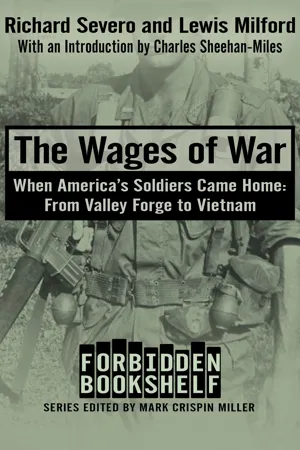
A disturbing chronicle of the US government's mistreatment of American soldiers and veterans throughout history, with a new introduction by Charles Sheehan-Miles
Time and time again, the sacrifices made by veterans and their families have been repaid with scorn, discrimination, lack of health services, scant financial compensation, and other indignities. This injustice dates back as far as the American Revolution, when troops came home penniless and without prospects for work, yet had to wait decades before the government paid them the wages they were owed. When soldiers returned from the Cuban campaign after the Spanish-American War, they were riddled with malaria, typhoid, yellow fever, and dysentery—but the government refused to acknowledge their illnesses, and finally dumped them in a makeshift tent city on Long Island, where they were left to starve and die.
Perhaps the most infamous case of disgraceful behavior toward veterans happened after the Vietnam War, when soldiers were forced to battle bureaucrats and lawyers,
and suffer media slander, because they asked the government and chemical industry to help them cope with the toxic aftereffects of Agent Orange. In
The Wages of War, authors Richard Severo and Lewis Milford not only uncover new information about the controversial use of this defoliant in Vietnam and the subsequent class action suit brought against its manufacturers, but also present fresh information on every war in US history. The result is exhaustive proof that—save for the treatment of soldiers in the aftermath of World War II—the government's behavior towards American servicemen has been more like that of "a slippery insurance company than a policy rooted in the idea of justice and fair reward."
eBook - ePub
The Wages of War
When America's Soldiers Came Home: From Valley Forge to Vietnam
- 495 pages
- English
- ePUB (mobile friendly)
- Available on iOS & Android
eBook - ePub
The Wages of War
When America's Soldiers Came Home: From Valley Forge to Vietnam
About this book
Information
Subtopic
Military & Maritime HistoryIndex
HistoryONE
After the Revolution
1
Lambs and Bees or Tigers and Wolves
Let the public only comply with their own promises, and the army will return to their respective homes the lambs and bees of the community. But if they should be disbanded previous to a settlement without knowing who to look to for an adjustment of accounts and a responsibility of payment, they will be so deeply stung by the injustice and ingratitude of their country so as to become its tigers and its wolves.
—Major-General Henry Knox, 1783
The soldiers who had been so hungry and wanting began to come home early in the summer of 1783. They came home slowly in the dust of summer’s heat to the unforgiving fields and insatiable creditors they had left to take up the great struggle. They included Eliphalet Allen and Jeremiah Klumph and Jehu Grant and William Finnie and William Drew and John L. Schermerhorn and Cornelius Sauquayonk. Their service was honorable but their exploits and adventures had not attracted very much attention during the war. Famous or not, they were at last finished fighting the revolution that established the American republic. But their struggle for back pay, for pensions, for honorable treatment by the very Government they had helped create, was only beginning.
To marginal farms in the loam of the Carolinas or in the rocks of New England and Upstate New York, to small towns with pleasant village greens and white churches, the soldiers came home. They would soon do combat again, these unfamous veterans, armed with foolscap and scratchy quill pens; abetted by advising, persistent wives; impelled by lovable, hungry children; and they would be far less successful in this effort than they were in the war they had fought. Once their paper combat was over and lost, they would inevitably recede into the further anonymity of the inky flourishes that constituted Government’s official record of their war—and of their efforts to get paid for fighting it.
Other veterans, hard-bitten New Englanders like Luke Day, Elijah Day, Asa Fisk, Aaron Jewett, Agrippa Wells, Luke Drury, Oliver Parker, Seth Murray, and most especially, Daniel Shays, were soldiers of another mind, another magnitude of desperation. They also had served well, if without much recognition, and were destined to earn some notoriety outside of Government ledgers kept by the War Office, although not the kind they had thought they would get when they volunteered to serve. Most certainly, not the kind they wanted. Not the kind they wanted to think about for the rest of their lives.
To New York, Boston, Baltimore, and Philadelphia the veterans came, eager to be civilians and to work as only they could. By late autumn and first snow they seemed to be everywhere in streets of cobbles and mud, lean and hungry, looking for work. But there was none for most of them. Sailmakers, blacksmiths, blockmakers, combmakers, tanners, coppersmiths, stonecutters, curriers, brewers, pewterers, silversmiths, chocolatemakers, carpenters, tanners, bakers, pot-bakers, ironmongers, clerks, liverymen, tobacconists, tallow chandlers, scriveners, chimney sweepers, hatters, coachmakers, staymakers, country lawyers, and common laborers: tradesmen without trade; artisans without commissions; workers without work. There was no work, and there was no money from the Government, either. At least, no money anybody could spend.
Paper money had been issued, toward the end of the war, by most of the states, in the form of bills of credit which generally promised to be “payable in Spanish milled dollars with 5 per cent interest.” The promise of ownership of a coin minted in Spain was an elegant proposition but it was hardly the sort of cachet that would engender confidence in the ability of the United States to create its own hard currency. And so there was no confidence, especially after the Continental Congress debased American paper early on by allowing too much of it to be printed.
Virginia’s finances, which were desperate, were a fair example of how much trouble the states were in. It had printed pound notes which were supposed to be redeemable at some future time at $1 specie (hard coin) for $40 in bills. Since hardly anybody thought that Virginia currency was worth that much, including the several state officials who personally signed each note, the ratio was changed in 1781 to $1 in specie for $1,000 in bills. All such bills bore the legend “Death to Counterfeit.” Counterfeit or real, the notes all became worthless to whoever held them on October 1, 1792.
Ironically, the money’s predictable downfall came just about a year after the British were so decisively drubbed at Yorktown. Its perceived value didn’t reflect that rebel victory or the reality of Britain’s doomed proprietorship of the colonies—only that Congress had overworked its printing presses to create a lot of new money to pay for a war it couldn’t afford.
So, the victors returning to their home states found themselves with fancifully decorated pieces of paper that were greeted with contempt by merchants from Maine to Georgia. Creditors reproached the returning veterans sternly. How could they expect to pay for shoes or seed or livestock or anything with paper that everybody knew had no value? Give us coins, said the creditors. Specie was the way to the good life. Veterans had to learn that, just like everybody else. They simply had to adjust to the reality of civilian life, and the creditors hoped it wouldn’t take forever.
But how appropriate was it to aspire to the good life? The veterans heard esteemed clergymen inveigh against the mammon pursued by the worldly people around them, resourceful landholders and burghers who, for the most part, had not been mere soldiers (although a few had been high-ranking officers) and who were crafty enough to survive in such disordered times. More than survive, they knew how to live well.
“If anything can be done by government to discourage prodigality and extravagance, vain and expensive amusements and fantastic foppery, and to encourage the opposite virtues, we hope it will not be neglected,” preached the Rev. Simeon Howard, pastor of Boston’s West Church. “We are ardently pursuing this world’s riches, honors, powers, pleasures; let us possess them and then know that they are nothing, nothing, nothing,” agreed Yale’s president, the Rev. Ezra Stiles.
In their abject want, the former soldiers heard such sermons and they wondered—how could such admonition be for the likes of them? The preachers may have been talking about the merchant princes, like John Jacob Astor, John Murray, Isaac Moses, Theophylact Bache, or Joseph Alsop, who became the first president of the New York Chamber of Commerce after the war. Or, perhaps they were referring to land speculators like the Livingstons, the Schuylers, the Van Rensselaers. There were a few veterans who were doing well in speculation—Alexander Hamilton and Henry Knox, to name two. Most others did not fare so well.
And just where were all of life’s pleasures? The Government had not paid them their promised due, and Army life had been an abomination. George Washington had taken note of their penury over the years in various speeches and letters, including one to the Secretary of War in which he complained that his officers suffered “mortification” when they “cannot invite a French officer, a visiting friend, or a travelling acquaintance to a better repast than stinking whiskey (and not always that).…”
But when he thought of that part of American society that had stayed home and profited from the war, Washington agreed fully with the clergymen. He complained that “stockjobbing, dissipation, luxury and venality, with all their concomitants, are [too] deeply rooted … to yield to virtue and the common good.” And he knew that the problems within his Army were not confined to the unavailability of good whiskey.
So did Joseph Plumb Martin, a private who served in the Army for seven years and was with Washington at Valley Forge. In 1783, he went home to Maine and told his neighbors that the condition of the troops was “pitiful and forlorn,” that what little meat he had been given was “not many degrees above carion,” and that the “six and two-thirds dollars” he had received for a single month—August of 1777—proved “scarcely enough to procure a man’s dinner.” Jeremiah Greenman, a regimental adjutant for Rhode Island troops, also served Washington well and believed in him but said of his fellow soldiers, as the war ended, “Some of them had not a Shoe or Stocking to their feet.”
And in Boston, already beginning to think of itself as a wellspring of culture on the edge of the vast and barbaric American wilderness that included New York and Philadelphia, Samuel Adams wrote a letter to John Adams complaining that too many people there “are imitating the Britons in every idle amusement and expensive foppery which it is in [their] power to invent for the destruction of a young country.… You would be surprised to see the equipage, the furniture, the expensive living of too many, the pride and vanity of dress which pervades thro’ every class, confounding the difference between the poor and the rich.”
Only rarely did anyone mention the soldiers who had won the war, men now down on their luck.
A writer in the Boston Gazette was a partial exception, carrying the banner in a lighthearted way for those veterans who, at least, had money before the war. He mused on the bon ton of the time, which apparently favored rising at ten, breakfasting at eleven, and “rattling through our paved streets” at midnight, “to the great annoyance of the peaceful inhabitants.” Then he asked: “How are our worthy patriots treated? Men who risked their lives and property, in the cause of freedom—lent their hard money to assist in the contest, and took securities or paper money for it, which now lie dormant in their desks, and they are obliged to pay specie for debts due to a set of vultures, who are now permitted to return.…”
If Lieutenant Joseph Bascomb had read the Gazette that day, he surely would have shaken his head sadly. Bascomb, who had been with the Minute Men at Concord, had all of $400 when he joined the Army, but was without a penny when he left it.
Major William Ballard, a veteran of Bunker Hill, had an estate when the war started. Now, as the men were coming home, he found himself a debtor. Even worse were the straits of Colonel Timothy Bigelow of Worcester, who had honorably served his country, but was destined to die soon, in debtor’s prison. And there were countless others who had nothing when they joined and nothing when they got out. These were men whose fortunes were never lamented by the Gazette or any other newspaper musing about Boston’s bon ton.
In the spring of 1782, when William Feltman decided to resign his lieutenancy in the 1st Pennsylvania Regiment, he asked General Nathaniel Greene for a “small some of money” so that he could get home. The general “very politely refused,” and told Feltman that “he had not any money for those people who chose to return home at their own will.” That was only part of the truth. In fact, General Greene had no money at all for any soldier who wanted to go home under anybody else’s will, either, and he did not even have money for those who wanted to stay.
Later that same year, the war caught up to Major Samuel Shaw, who had enlisted in 1775 and remained in the Army for nine years. He wrote to his father bitterly late in 1782 that he would pay a particular debt: “I intend to pay it when it is due; though to do this I must contract another debt. It is no satisfaction to me to reflect that I am obliged to do this, notwithstanding the public owes me for nearly three years’ service.…”
At the beginning of the war, Congress had passed a law that prohibited creditors from bringing lawsuits against those who enlisted. Soldiers were offered food, clothing, and land just for enlisting (one hundred acres for enlisted men and five hundred acres for officers—reflecting the constancy of history’s class distinctions, even in a new country that tried not to have any). The offering of such inducements to men willing to do deadly combat did not seem extreme to those who were determined to get the British out. In fact, it looked like a bargain, as, indeed, it was. “Let us look upon freedom from the power of tyrants as a blessing that cannot be purchased too dear,” the Rev. Samuel West had counseled when he appeared before the Honorable Council and the Honorable House of Representatives of the Colony of Massachusetts Bay in Boston.
Unfortunately, the eagerness and even the willingness to lavish material things on the nation’s champions had evaporated in parsimony long before the war’s meandering end. There had been mixed feelings about the war, and even the people who proudly waved goodbye to friends and neighbors who had volunteered felt a certain awkwardness at the homecoming of such poor men. For most soldiers, there were no homecoming parades, no flags flying nor bands playing, no smiles from many of the civilians whose fortunes had waxed with their liberties, whether they chose to acknowledge it or not. The veterans returned to a curious, chromatic world of indifference and even outright hostility; of gaunt privation and new-money opulence; of euphoria and bitterness; of former champions underemployed and assorted opportunists, charlatans, and thieves employed incessantly, it seemed.
There were few, if any, official welcomes. In Boston, for example, returning soldiers caused alarm among civilians. Indeed, the General Court there (the Massachusetts legislature) complained to Congress that needy veterans were creating problems for Bostonians since most of them came home without “a single month’s pay” nor “so much as the means to carry them to their respective homes.” But some of the same New Englanders complaining about penniless veterans with whom they were now forced to mingle had earlier condemned various plans to give the veterans pensions for life at half their wartime pay.
Probably nowhere was American life more eerie, more schizophrenic, than in the City of New York, a prize plum that the British had managed to dominate throughout the war.
Elkanah Watson was a member of the Continental Army that occupied New York on the 25th of November of 1783, after Englishmen under begrudging, laggard Sir Guy Carleton gave it up to George Washington, who found him tiresome but was determined to be ever polite and patient. Watson hardly felt like the conquering hero, for New York’s physical and psychic state was clearly not the equal of the strategic value of its splendid harbor. “Close on the eve of an approaching winter,” Watson wrote, “with a heterogeneous set of inhabitants, composed of almost ruined exiles, disbanded soldiery, mixed foreigners, disaffected Tories, and the refuse of a British army, we took possession of a ruined city.”
Nearly a quarter of New York’s settled area was rubble. The devastation from two major fires in 1776 and 1778 remained unremedied. Everywhere there was desolation. Roadways lay torn and treacherous, flanked by stumps of streetlamps; unrepaired wharves and docks lay moldering in Hudson’s River; enormous heaps of rubbish and filth were everywhere. The city’s population had dropped from its prewar high of nearly 22,000 to around 11,000. Those who remained were the targets of knaves and footpads, especially after the sun disappeared below the rim of the Palisades, across the river. The need for more police protection was a paramount concern among New Yorkers. The crimes most complained of were burglary, assault and battery, grand and petit larceny, the keeping of disorderly houses, gambling, arson, and dueling.
But within the squalor there was bounty. Fishmongers were everywhere, peddling the day’s sweet and succulent catch. There was plenty of meat; cattle were driven into town for slaughter. There was produce from upstate. And in the markets, women sold hot coffee and chocolate and little cakes. The war, after all, was won. Those Americans with the means wanted to celebrate peace with the material things that had been so hard to get during the war. And so, as soldiers—some of them not paid in four years—moved through the rubble looking for work, they found tidy shops bursting with “pies, tarts, cakes, puddings, syllabubs, creams, flummery, jellies, giams and custards.”
New York’s merchants—and the merchants of the other cities—offered the whipped cream of peace, some of it sugared by the very nation the Americans had fought a war to be free of. There were lemons in boxes, apricots and peaches in brandy, candy for coughs, truffles in oil, vinegar in hand-blown bottles, sweetmeats in pots. There were mangoes from India and olive oil from Florence. There were Malaga raisins and Zandt currants, French dried morels, Italian macaroni and German vermicelli. There was even Tory salt from Turks Island.
Stores celebrating immoderation offered hogsheads of English nuts, peppermint and ginger comfits, puncheons of New York rum, pipes of Cognac, Madeira, claret, bohea tea, cinnamon, molasses, and port wine from Tenerife and Lisbon. Buyers with acceptable currency—that meant almost anything not endorsed by the irresolute Continental Congress in Philadelphia—could select from a wide assortment of cambricks and muslins, silk laces and edgings, callicoes, linens from Dublin, ladies’ riding hats, corduroys, Seine twine, shallons and camblets and buttons made of fine mohair.
Once properly fed, warmed, coiffed, attired and decorated, the newly independent (and newly rich) could a...
Table of contents
- Cover Page
- Title Page
- Dedication
- Contents
- Series Introduction
- Introduction
- Prologue
- Part One: After the Revolution
- Part Two: The War of 1812 and the Mexican War
- Part Three: The Civil War
- Part Four: The War with Spain and the Philippine Insurrection
- Part Five: After the First World War
- Part Six: After the Second World War
- Part Seven: The Korean War
- Part Eight: The Vietnam War and the Agent Orange Affair
- Epilogue
- Notes
- Index
- Acknowledgments
- About the Authors
- Copyright Page
Trusted by 375,005 students
Access to over 1.5 million titles for a fair monthly price.
Study more efficiently using our study tools.
Frequently asked questions
Yes, you can cancel anytime from the Subscription tab in your account settings on the Perlego website. Your subscription will stay active until the end of your current billing period. Learn how to cancel your subscription
No, books cannot be downloaded as external files, such as PDFs, for use outside of Perlego. However, you can download books within the Perlego app for offline reading on mobile or tablet. Learn how to download books offline
Perlego offers two plans: Essential and Complete
- Essential is ideal for learners and professionals who enjoy exploring a wide range of subjects. Access the Essential Library with 800,000+ trusted titles and best-sellers across business, personal growth, and the humanities. Includes unlimited reading time and Standard Read Aloud voice.
- Complete: Perfect for advanced learners and researchers needing full, unrestricted access. Unlock 1.5M+ books across hundreds of subjects, including academic and specialized titles. The Complete Plan also includes advanced features like Premium Read Aloud and Research Assistant.
We are an online textbook subscription service, where you can get access to an entire online library for less than the price of a single book per month. With over 1.5 million books across 990+ topics, we’ve got you covered! Learn about our mission
Look out for the read-aloud symbol on your next book to see if you can listen to it. The read-aloud tool reads text aloud for you, highlighting the text as it is being read. You can pause it, speed it up and slow it down. Learn more about Read Aloud
Yes! You can use the Perlego app on both iOS and Android devices to read anytime, anywhere — even offline. Perfect for commutes or when you’re on the go.
Please note we cannot support devices running on iOS 13 and Android 7 or earlier. Learn more about using the app
Please note we cannot support devices running on iOS 13 and Android 7 or earlier. Learn more about using the app
Yes, you can access The Wages of War by Richard Severo,Lewis Milford,Richard Severo, Mark Crispin Miller in PDF and/or ePUB format, as well as other popular books in History & Military & Maritime History. We have over 1.5 million books available in our catalogue for you to explore.