- 416 pages
- English
- ePUB (mobile friendly)
- Available on iOS & Android
eBook - ePub
About this book
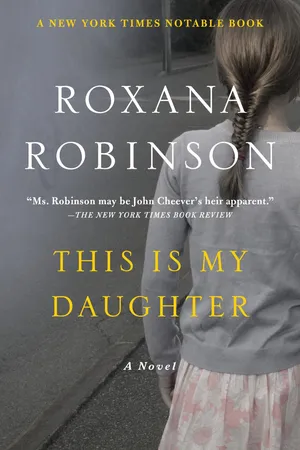
A New York Times Notable Book: A luminous, deeply affecting story of divorce, remarriage, and parenthood.
Peter and Emma, two single parents who have found love again after failed first marriages, dream of a peaceful and happy blended family with each of their daughters under one roof. They navigate this treacherous territory with the best of intentions, but face resistance from the girls, who, like many children of divorce, find their relationships tinged by grief, anger, and resentment. Emma's three-year-old daughter, Tess, takes to the arrangement while Amanda, Peter's sullen and unhappy seven-year-old, views it as a disaster rather than a fresh start. Over the course of this emotional powerhouse of a novel, Amanda becomes increasingly hostile and alienated—until one night she commits an act that threatens the already fragile bonds of the fledgling family.
Set on the Upper East Side of Manhattan, This Is My Daughter is a skillful and sensitive portrayal of the challenges facing modern families from master of the contemporary novel Roxana Robinson, whose acute observations of domestic life invite comparison to John Cheever and Henry James.
Trusted by 375,005 students
Access to over 1.5 million titles for a fair monthly price.
Study more efficiently using our study tools.
Information
Subtopic
Literature GeneralIndex
LiteraturePART ONE
1
“You’ll like my daughter,” Peter told Emma, “no matter what she does to you. If she bites you.”
Emma looked at him, to see if she was meant to laugh, but Peter was driving, and did not turn. Emma considered his profile, looking for clues: the long straight nose, the sober deep-set blue eye. The line of Peter’s mouth was stern, and his tone had suggested not mirth but reproval. Disturbed, Emma turned away to face the road herself.
“I’m sure I’ll like her,” she said politely.
But it was an alarming announcement. She wondered what Peter meant: was he warning her that his daughter was difficult? Was he reminding Emma that she had no choice? In either case, Emma didn’t need to be told. She knew it was important that she like Peter’s daughter. She knew his daughter was difficult. But perhaps Peter meant neither of these things, perhaps this was an awkward joke, heavy with anxiety. Emma did not quite dare ask him what he meant.
Emma and Peter had been seeing each other for four months. Often Emma felt she knew him well, but still there were moments of complete confusion for her, dark silent pools set unexpectedly in an open rolling landscape. It took so long to know someone, Emma thought, to know easily, at once, what was meant by a comment, a tone of voice. Married, you took this ease for granted. Starting all over again, learning someone new by heart, seemed so slow. To Emma, it seemed at times impossible.
Emma was always afraid that Peter would discover something about her that he had never imagined, something that would turn him utterly against her, forever. She had seen him once, taking off a pair of wet gloves, peeling them off his fingers, ridding his flesh of them and flinging them in a crumpled mass onto a chair, where they hung for a moment and then fell to the floor. This was what she imagined would happen to her if she disappointed him.
Emma looked out the window. They were driving down Park Avenue, through the seventies. The big apartment buildings rose on either side, solid and immutable, with their clean stone facades and crisp canvas awnings. Uniformed doormen, brisk and authoritative in braid-trimmed hats, stood guard at each doorway. It was a neighborhood Emma knew well: Park Avenue, with its narrow, sooty, dignified strip of green, had, until now, run down the center of her adult world. When she had first come to New York, six years ago, she had lived with friends of her parents, in a tiny maid’s room in a big duplex at Park and Eighty-first. When she was married to Warren, she had lived between Park and Madison, on Ninety-second. Peter’s wife and daughter—and once Peter—lived at Park and Sixty-eighth.
Peter and Emma were on their way to pick up Peter’s seven-year-old daughter, Amanda. Peter had lunch with her every Sunday, but this was the first time Emma had been included. She had been pleased and flattered when Peter asked.
“You know I’ve met Amanda before,” Emma reminded him now.
“You have? When?” Peter asked.
“When I met you. At your cocktail party.”
“I didn’t know that,” said Peter.
“It was very brief. She won’t remember me,” Emma said. “But I remember her.”
They had stopped for the light at Sixty-eighth Street. The avenue sloped broadly down before them, diminishing toward the handsome Beaux Arts silhouette of Grand Central Station, which was backed by the cold blunt rectangle of the Pan Am Building. The narrow beds of earth that divided Park Avenue held neat evergreen trees, regularly spaced like musical notations, green chords struck evenly between the high stone-faced buildings. It was a clean and orderly vista, and the February sky overhead was a high pale blue.
Crossing the avenue in front of their car was a middle-aged black woman in a too-long overcoat. She held the hand of a small white girl. The girl, in a bright pink parka, green corduroy pants and scarlet boots, hung sulkily back, her body jammed into a stubborn angle of resistance. She wore no hat, and her hair blew in a wild halo around her head. The woman paid no attention to her reluctance, pulling the girl steadily along behind her. In the middle of the street the woman turned and said something, her face threatening. The girl stuck out her lower lip. When they started again the girl gave up her leaning, but each step was sluggish and resentful. Her boots slid reluctantly along the pavement, her head was down. The woman plowed ahead without looking back.
Children have no choice: they are at our mercy, Emma thought. She was glad to see, at least, that the little girl had refused a hat.
“What did Amanda do? When you met her,” Peter asked, turning to Emma. One eyebrow was raised, and Emma felt the full strength of his blue gaze. He was a lawyer, and there were times when Emma felt she was being cross-examined.
“Oh, not much,” Emma said. “Caroline was taking her around the party to be introduced. Amanda wasn’t keen on it.”
“Sounds like Caroline. Sounds like Amanda,” said Peter. The light changed, and he turned the car onto his street. They pulled up in front of his old door. The doorman, short, dapper, militant, in a long buff overcoat, with heavy corded epaulets, stepped at once to the door of the car.
“Hello, Sam,” Peter said.
“Good morning, Mr. Chatfield,” said the doorman loudly, touching his big cap. He had bright black eyes, and the stiff overcoat nearly enveloped him.
“I’ll be right down,” Peter said to the doorman, and closed the car door. The doorman looked at Emma and nodded, brisk but neutral.
Emma, left sitting in the car, wished that Peter had spoken to her instead of to the doorman. She watched Peter walk into the building, where he still owned an apartment. Through the heavy glass of the door she could see the elevator man step forward to greet him. All the people here knew Peter; he would meet an old neighbor in the elevator. Emma watched, pressing her forehead against the window like a child, as Peter stood before the elevator door. His figure, tall and solid in his worn corduroys and old raincoat, turned vague and began to vanish. Emma blinked, focusing, but Peter turned steadily to smoke. She pressed closer to the window, staring intently, to retrieve him. But she could not, and drew back from the pane, perplexed. She saw it was her own anxiety that had made him vanish; her breath had steamed a widening circle of mist across the windowpane, a pale film of obscurity that blotted him out. When she drew back, she watched the window dry, and clarity spread across it.
The elevator doors reappeared, but now Peter had gone. The doors had glided somberly shut behind him, and he was now inside the hushed vault of the elevator, rising deliberately toward his wife, his daughter, his apartment, his past life. For nine years he had been part of Mr. and Mrs. Chatfield on the eleventh floor. What would he do up there, what would he say? How much could you trust a man who was in the middle of divorcing his wife? Taking back all the promises he had made to her?
The doorman stood like a small belligerent statue: chin raised, legs planted wide beneath his huge coat, one gloved hand on his taxi whistle. He ignored Emma. She felt like a trespasser, illicitly parked before this building. She turned away, wondering what was happening upstairs.
Emma had been in the Chatfields’ apartment only once, a year earlier, when she was still married to Warren. Warren had been on a board with Caroline, Peter’s wife, and she had asked them to a cocktail party. That night, Warren and Emma had stepped off the elevator into the foyer with its black marble floors and yellow-and-white striped walls. The front door was open, and the rooms beyond were full of noise and color. The spaces were big, the ceilings high. The surfaces shimmered: the porcelain figures on the mantelpiece, the satinwood tables, the Venetian glass mirror over the fireplace. The great satin curtains were fringed with dull gold, and held back with heavy tasseled cords. On the mahogany sideboard were twisting silver candelabra.
They stood for a moment in the front hall. A white-jacketed waiter came up, holding a silver tray of goblets, filled with pale wine. Emma and Warren each took one.
“This is quite something,” said Emma, looking around.
“I told you,” said Warren. He sounded smug, as though he were taking credit for the apartment. He turned. “Hello, Caroline,” he said, as a woman in brilliant blue came toward them. His voice was loud and jovial, his manner somewhat unctuous. Emma could see he was awed by Caroline.
“Warren, how nice to see you.” Caroline Chatfield was handsome, rather tall, and somewhat fleshy. She moved with authority, kissing Warren briskly on both cheeks. She then drew back, with a professional smile, to meet Emma.
“This is my wife, Emma,” Warren said. He turned to Emma and looked at her appraisingly, as Caroline did. Emma felt them both examining her.
Caroline at once held out her hand. She set her feet neatly together and gave a little comic-opera bow over the handshake. Her hair was shoulder length, blond streaked. She had very pale blue eyes and a pointed nose. She wore gold earrings, and a strand of pearls lay neatly against the yoke of her dress. The dress was patterned indigo silk, long sleeved, high necked, and full of discreet details: small neat tucks, stitched-down pleats.
“How nice of you to come,” Caroline said energetically. “Do you have a drink? I see you do.” She looked again at Warren and turned serious. “Now, you and I have to have a talk. The plans for the spring fund-raiser are foundering.”
Warren raised his eyebrows, smiling, conspiratorial. “Are they?”
“Have you spoken to Cynthia?” Caroline asked.
Warren shook his head. He was enjoying this.
“I wouldn’t look forward to it, if I were you,” Caroline said, and shook her head forebodingly.
“I think we’ll be able to deal with Cynthia,” Warren said.
Caroline turned to Emma. “Do forgive us for all this business,” she said charmingly. “Your husband is a treasure. We’re so thrilled to have him on the board.” Warren beamed. “He’s really stirring things up.”
Emma smiled. “I’m sure he is,” she answered, refusing to enter into the listing of Warren’s merits.
“But you know that about Warren, I’m sure,” Caroline said, withdrawing her attention. “Now there’s Serena, I want to talk to her before she leaves. It’s so nice to have met you,” she said to Emma. “Please excuse me, I hope I’ll see you later.” She moved off through the crowd, the silk pleats on her long skirt swaying briskly.
Warren watched her go. He stood visibly straighter, preening, exhilarated. “She is really something.”
“She is,” said Emma, noncommittal.
“She’s so elegant,” said Warren. “She always looks like that. Really beautifully turned out. Hair, dress, jewelry.”
Emma, who understood that this was a criticism of her, said nothing. She had grown up in Cambridge, Massachusetts, where vanity was frowned upon, and attention to appearance was considered vulgar. Beauty, like jewelry, was a matter of inheritance: either it came down in the family or you did without.
Emma was wary of women like Caroline who put such energy and concentration into their own presentation, who took such obvious pleasure in it, who looked so sleek and glowing and expensive. Emma felt both disapproving and envious: Caroline made it clear just how sure of yourself it was possible to appear.
“I want you to meet Peter, too,” said Warren. “He’s right up your street, actually. He has a wonderful art collection. You’ll love him.” He sounded bossy and proprietary: he clearly felt in charge.
Emma said nothing. She did not always love people who had wonderful art collections: they often became peculiar when they discovered that she worked at an art magazine. Their voices took on a certain urgency, they leaned too close as they spoke. The acrid smell of self-promotion began to permeate the atmosphere. They insisted on showing her their whole collection, every piece of it. They mentioned prominent museum curators who had, they claimed, said glowing things about the collection. They mentioned prices they had paid; often they lied about prices they had paid. They demanded praise, recognition, respectful attention. Sometimes Emma felt that collectors were what she liked least about art.
Emma had looked vaguely at the pictures in the front hall. Without her glasses she could see only that they were drawings, in heavy European frames. Now she entered the big living room and looked around: it was full of splendor. The walls were covered with leopard-skin paper, and there were high white wooden bookcases. A ban...
Table of contents
- Cover Page
- Title Page
- Dedication
- Part One
- Part Two
- Part Three
- Acknowledgments
- About the Author
- Copyright Page
Frequently asked questions
Yes, you can cancel anytime from the Subscription tab in your account settings on the Perlego website. Your subscription will stay active until the end of your current billing period. Learn how to cancel your subscription
No, books cannot be downloaded as external files, such as PDFs, for use outside of Perlego. However, you can download books within the Perlego app for offline reading on mobile or tablet. Learn how to download books offline
Perlego offers two plans: Essential and Complete
- Essential is ideal for learners and professionals who enjoy exploring a wide range of subjects. Access the Essential Library with 800,000+ trusted titles and best-sellers across business, personal growth, and the humanities. Includes unlimited reading time and Standard Read Aloud voice.
- Complete: Perfect for advanced learners and researchers needing full, unrestricted access. Unlock 1.5M+ books across hundreds of subjects, including academic and specialized titles. The Complete Plan also includes advanced features like Premium Read Aloud and Research Assistant.
We are an online textbook subscription service, where you can get access to an entire online library for less than the price of a single book per month. With over 1.5 million books across 990+ topics, we’ve got you covered! Learn about our mission
Look out for the read-aloud symbol on your next book to see if you can listen to it. The read-aloud tool reads text aloud for you, highlighting the text as it is being read. You can pause it, speed it up and slow it down. Learn more about Read Aloud
Yes! You can use the Perlego app on both iOS and Android devices to read anytime, anywhere — even offline. Perfect for commutes or when you’re on the go.
Please note we cannot support devices running on iOS 13 and Android 7 or earlier. Learn more about using the app
Please note we cannot support devices running on iOS 13 and Android 7 or earlier. Learn more about using the app
Yes, you can access This Is My Daughter by Roxana Robinson in PDF and/or ePUB format, as well as other popular books in Literature & Literature General. We have over 1.5 million books available in our catalogue for you to explore.