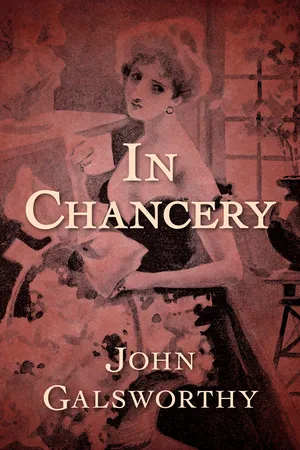
The moving story of a wealthy English clan and the infidelities and intrigues threatening to tear one marriage apart.
In Chancery begins where
The Man of Property—and its subsequent interlude—left off, pursuing Soames and Irene Forsyte across Edwardian England, meanwhile highlighting the failing marriage of Soames's sister, Winifred. Galsworthy juxtaposes the two relationships while bringing more members of the Forsyte clan into the drama, making for one of the most thought-provoking and entertaining satires on marriage and social class in the annals of British literature.
Following the events of
The Man of Property and the brief and profoundly touching interlude
Indian Summer of a Forsyte, siblings Soames and Winifred find themselves facing marital discord. Both Forsytes contemplate divorce, though Soames finds he is unwilling to let go of Irene, stalking her at home and abroad despite her reluctance to reconcile. When Irene inherits money from a patriarch within the Forsyte clan, Soames begins to suspect infidelities between his wife and his cousin Jolyon. But are his suspicions based on reality or the possessiveness that has haunted his marriage all along?
Meticulously detailed and deliciously suspenseful,
In Chancery is the pivotal second installment in the acclaimed Forsyte Saga and one of Nobel laureate John Galsworthy's finest novels.
This ebook has been professionally proofread to ensure accuracy and readability on all devices.
- 373 pages
- English
- ePUB (mobile friendly)
- Available on iOS & Android
eBook - ePub
In Chancery
About this book
Information
Subtopic
ClassicsIndex
LiteraturePART I
CHAPTER I
AT TIMOTHY’S
THE POSSESSIVE INSTINCT NEVER STANDS still. Through florescence and feud, frosts and fires, it followed the laws of progression even in the Forsyte family which had believed it fixed for ever. Nor can it be dissociated from environment any more than the quality of potato from the soil.
The historian of the English eighties and nineties will, in his good time, depict the somewhat rapid progression from self-contented and contained provincialism to still more self-contented if less contained imperialism—in other words, the “possessive” instinct of the nation on the move. And so, as if in conformity, was it with the Forsyte family. They were spreading not merely on the surface, but within.
When, in 1895, Susan Hayman, the married Forsyte sister, followed her husband at the ludicrously low age of seventy-four, and was cremated, it made strangely little stir among the six old Forsytes left. For this apathy there were three causes. First: the almost surreptitious burial of old Jolyon in 1892 down at Robin Hill—first of the Forsytes to desert the family grave at Highgate. That burial, coming a year after Swithin’s entirely proper funeral, had occasioned a great deal of talk on Forsyte ’Change, the abode of Timothy Forsyte on the Bayswater Road, London, which still collected and radiated family gossip. Opinions ranged from the lamentation of Aunt Juley to the outspoken assertion of Francie that it was “a jolly good thing to stop all that stuffy Highgate business.” Uncle Jolyon in his later years—indeed, ever since the strange and lamentable affair between his granddaughter June’s lover, young Bosinney, and Irene, his nephew Soames Forsyte’s wife—had noticeably rapped the family’s knuckles; and that way of his own which he had always taken had begun to seem to them a little wayward. The philosophic vein in him, of course, had always been too liable to crop out of the strata of pure Forsyteism, so they were in a way prepared for his interment in a strange spot. But the whole thing was an odd business, and when the contents of his Will became current coin on Forsyte ’Change, a shiver had gone round the clan. Out of his estate (£145,304 gross, with liabilities £35 7s. 4d.) he had actually left £15,000 to “whomever do you think, my dear? To Irene!” that runaway wife of his nephew Soames; Irene, a woman who had almost disgraced the family, and—still more amazing was to him no blood relation. Not out and out, of course; only a life interest—only the income from it! Still, there it was; and old Jolyon’s claim to be the perfect Forsyte was ended once for all. That, then, was the first reason why the burial of Susan Hayman—at Woking—made little stir.
The second reason was altogether more expansive and imperial. Besides the house on Campden Hill, Susan had a place (left her by Hayman when he died) just over the border in Hants, where the Hayman boys had learned to be such good shots and riders, as it was believed, which was of course nice for them, and creditable to everybody; and the fact of owning something really countrified seemed somehow to excuse the dispersion of her remains—though what could have put cremation into her head they could not think! The usual invitations, however, had been issued, and Soames had gone down and young Nicholas, and the Will had been quite satisfactory so far as it went, for she had only had a life interest; and everything had gone quite smoothly to the children in equal shares.
The third reason why Susan’s burial made little stir was the most expansive of all. It was summed up daringly by Euphemia, the pale, the thin: “Well, I think people have a right to their own bodies, even when they’re dead.” Coming from a daughter of Nicholas, a Liberal of the old school and most tyrannical, it was a startling remark—showing in a flash what a lot of water had run under bridges since the death of Aunt Ann in ’86, just when the proprietorship of Soames over his wife’s body was acquiring the uncertainty which had led to such disaster. Euphemia, of course, spoke like a child, and had no experience; for though well over thirty by now, her name was still Forsyte. But, making all allowances, her remark did undoubtedly show expansion of the principle of liberty, decentralisation and shift in the central point of possession from others to oneself. When Nicholas heard his daughter’s remark from Aunt Hester he had rapped out: “Wives and daughters! There’s no end to their liberty in these days. I knew that ‘Jackson’ case would lead to things—lugging in Habeas Corpus like that!” He had, of course, never really forgiven the Married Woman’s Property Act, which would so have interfered with him if he had not mercifully married before it was passed. But, in truth, there was no denying the revolt among the younger Forsytes against being owned by others; that, as it were, Colonial disposition to own oneself, which is the paradoxical forerunner of Imperialism, was making progress all the time. They were all now married, except George, confirmed to the Turf and the Iseeum Club; Francie, pursuing her musical career in a studio off the King’s Road, Chelsea, and still taking “lovers” to dances; Euphemia, living at home and complaining of Nicholas; and those two Dromios, Giles and Jesse Hayman. Of the third generation there were not very many—young Jolyon had three, Winifred Dartie four, young Nicholas six already, young Roger had one, Marian Tweetyman one; St. John Hayman two. But the rest of the sixteen married—Soames, Rachel and Cicely of James’s family; Eustace and Thomas of Roger’s; Ernest, Archibald and Florence of Nicholas’s; Augustus and Annabel Spender of the Hayman’s—were going down the years unreproduced.
Thus, of the ten old Forsytes twenty-one young Forsytes had been born; but of the twenty-one young Forsytes there were as yet only seventeen descendants; and it already seemed unlikely that there would be more than a further unconsidered trifle or so. A student of statistics must have noticed that the birth rate had varied in accordance with the rate of interest for your money. Grandfather “Superior Dosset” Forsyte in the early nineteenth century had been getting ten per cent. for his, hence ten children. Those ten, leaving out the four who had not married, and Juley, whose husband Septimus Small had, of course, died almost at once, had averaged from four to five per cent. for theirs, and produced accordingly. The twenty-one whom they produced were now getting barely three per cent. in the Consols to which their father had mostly tied the Settlements they made to avoid death duties, and the six of them who had been reproduced had seventeen children, or just the proper two and five-sixths per stem.
There were other reasons, too, for this mild reproduction. A distrust of their earning powers, natural where a sufficiency is guaranteed, together with the knowledge that their fathers did not die, kept them cautious. If one had children and not much income, the standard of taste and comfort must of necessity go down; what was enough for two was not enough for four, and so on—it would be better to wait and see what Father did. Besides, it was nice to be able to take holidays unhampered. Sooner in fact than own children, they preferred to concentrate on the ownership of themselves, conforming to the growing tendency—fin de siècle, as it was called. In this way, little risk was run, and one would be able to have a motor-car. Indeed, Eustace already had one, but it had shaken him horribly, and broken one of his eye teeth; so that it would be better to wait till they were a little safer. In the meantime, no more children! Even young Nicholas was drawing in his horns, and had made no addition to his six for quite three years.
The corporate decay, however, of the Forsytes, their dispersion rather, of which all this was symptomatic, had not advanced so far as to prevent a rally when Roger Forsyte died in 1899. It had been a glorious summer, and after holidays abroad and at the sea they were practically all back in London, when Roger with a touch of his old originality had suddenly breathed his last at his own house in Princes Gardens. At Timothy’s it was whispered sadly that poor Roger had always been eccentric about his digestion—had he not, for instance, preferred German mutton to all the other brands?
Be that as it may, his funeral at Highgate had been perfect, and coming away from it Soames Forsyte made almost mechanically for his Uncle Timothy’s in the Bayswater Road. The “Old Things”—Aunt Juley and Aunt Hester—would like to hear about it. His father—James—at eighty-eight had not felt up to the fatigue of the funeral; and Timothy himself, of course, had not gone; so that Nicholas had been the only brother present. Still, there had been a fair gathering; and it would cheer Aunts Juley and Hester up to know. The kindly thought was not unmixed with the inevitable longing to get something out of everything you do, which is the chief characteristic of Forsytes, and indeed of the saner elements in every nation. In this practice of taking family matters to Timothy’s in the Bayswater Road, Soames was but following in the footsteps of his father, who had been in the h...
Table of contents
- Cover
- Title Page
- Epigraph
- Dedication
- PART I
- PART II
- PART III
- Copyright
Trusted by 375,005 students
Access to over 1.5 million titles for a fair monthly price.
Study more efficiently using our study tools.
Frequently asked questions
Yes, you can cancel anytime from the Subscription tab in your account settings on the Perlego website. Your subscription will stay active until the end of your current billing period. Learn how to cancel your subscription
No, books cannot be downloaded as external files, such as PDFs, for use outside of Perlego. However, you can download books within the Perlego app for offline reading on mobile or tablet. Learn how to download books offline
We are an online textbook subscription service, where you can get access to an entire online library for less than the price of a single book per month. With over 1.5 million books across 990+ topics, we’ve got you covered! Learn about our mission
Look out for the read-aloud symbol on your next book to see if you can listen to it. The read-aloud tool reads text aloud for you, highlighting the text as it is being read. You can pause it, speed it up and slow it down. Learn more about Read Aloud
Yes! You can use the Perlego app on both iOS and Android devices to read anytime, anywhere — even offline. Perfect for commutes or when you’re on the go.
Please note we cannot support devices running on iOS 13 and Android 7 or earlier. Learn more about using the app
Please note we cannot support devices running on iOS 13 and Android 7 or earlier. Learn more about using the app
Yes, you can access In Chancery by John Galsworthy in PDF and/or ePUB format, as well as other popular books in Literature & Classics. We have over 1.5 million books available in our catalogue for you to explore.