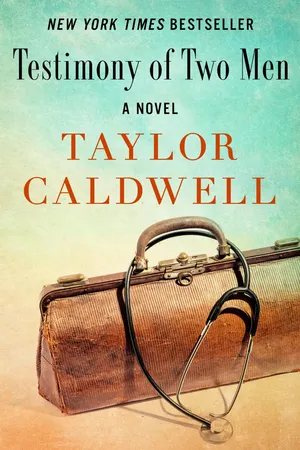
A small-town doctor acquitted of murdering his pregnant wife faces new charges in this
New York Times bestseller set in the early days of modern medicine.
Hambledon, Pennsylvania, is still reeling from the sensational murder trial that shattered the peace of the bucolic hamlet less than a year ago. Dr. Jonathan Ferrier was accused of killing his beautiful young wife after she died following a botched abortion. The scion of a powerful old eastern family, Jonathan hired the best attorneys money could buy. When he was acquitted, many believed he had bought his freedom. Now, he has returned home to sell his practice and move on. But haunted by his wife's death, Jonathan still strives to heal the judgmental people of his divided town.
Robert Morgan, a young, idealistic doctor, is determined to make up his own mind about the accused's innocence or guilt. Of one thing he is certain: Jonathan is a good doctor, perhaps even a great one. He is also a man who feels abandoned by God, his church, his family, and his friends. As Jonathan continues to be pilloried by the town, a new series of accusations are leveled at him. Is he a cold-blooded killer who murdered his wife and their unborn child? Or a man unjustly accused and wrongly maligned?
Testimony of Two Men explores the evolution of modern medicine and the tireless physicians who are its unsung heroes. Author Taylor Caldwell's bestselling novel touches on faith, religion, and the then-new field of mental health as it tells a mesmerizing tale of desire, betrayal, and love that can destroy or redeem.
- 600 pages
- English
- ePUB (mobile friendly)
- Available on iOS & Android
eBook - ePub
About this book
Information
Subtopic
Historical FictionIndex
LiteratureCHAPTER ONE
When young Robert Sylvester Morgan had occasion to write his mother he always made what he wryly called “a first draft.” This was done on foolscap paper (he had been taught thrift) and then recopied on a better grade where he could use his elegant Spencerian—which he loathed—in a way to please his mother, and in words and phrases which would not startle her.
“June 8th, 1901
Hambledon, Pennyslvania
Quaker Hotel
“Dear Mama:”
(He paused. Why in hell wouldn’t she let him call her Mother? “Mama,” at his age, for God’s sake!)
“You will be happy to know that matters have culminated successfully since I arrived here a week ago. Hambledon is a beautiful town of about twenty-five thousand people, not to be compared with Philadelphia, of course, but adequate and lively.” (After a moment’s thought he crossed out the last word and substituted “up-to-date.”) “It is situated on the river, quite broad near at hand, almost a bay, and studded, here and there, with pretty islands. Very picturesque.
“The people are pleasant and friendly and very civil.” (His mother’s pet word.) “There is considerable industry but it is located near the fringes of the town, so that the air is clear and fresh, an excellent thing for your arthritis and asthma. Though on the water, the atmosphere seems dry. There appears to be little poverty and the working-class is energetic.” (His mother would approve of that!) “The better sections of the town are charming, with broad streets, fine old lawns, magnificent trees—elms, birches, oaks, pine, spruces—and houses which would be considered impressive even in Philadelphia. I have already selected four for your choice and approval, and will take you about to them when you arrive next week. Any of them would delight you.” (Would they? Nothing delighted his mother very much. Perhaps he was being uncharitable, or even irritable. He had never felt this way toward his mother before. He paused to wonder, then shook his head, baffled.)
“Behind the town rises a whole ridge of mountains, inspiring at dawn.” (He had seen the dawn only once this week and then inadvertently, but his mother liked the mention of dawns.) “The very best people live on the lower reaches of the mountains in splendid residences. As for hospitals, the most important things to me at this time, there is one great one, called the Friends’, though it is not exactly Quakerish.” (His mother detested Quakers.) “It is partly town-supported. The other hospital is private and select and very expensive. To be on the staff is something to be coveted.”
Now came the difficult part of the letter, and he gnawed the end of his pen and contemplated the mountains he so admired through the polished window of his neat little room. He finally continued:
“Hambledon’s hospitals serve not only the town but the villages and the farms outside, of course, and have the best of reputations. In fact, the hospitals here would be admired even in Philadelphia or Boston or New York. Very modern.” (He frowned at the last word; his mother could not bear anything “modern.” But he let it remain.) “I confess I was agreeably surprised. I have met a number of physicians and surgeons here, all enlightened men except for a few, and all gentlemen with distinguished reputations. Three are regularly called into consultation in Philadelphia, Pittsburgh and even New York, for they are specialists in their field. One of them” (he winced) “is Dr. Jonathan Ferrier, though you may find that hard to believe. But I have read his lectures and his articles in the organ of the American Medical Association, and I can assure you that he is greatly esteemed.”
He wrote faster now: “It is my belief, based on constant association with Dr. Ferrier, that he has been a much-maligned man, and that he was truly innocent of his wife’s death. I need not recall to you that he was forced to demand a change of venue from Hambledon to Philadelphia in order to get a fair trial. But the Philadelphia newspapers were hardly more just than the newspapers in Hambledon. However, as you know, he was acquitted. He has had his license to practice restored, and his place on the staffs of both hospitals. But he is very embittered. He has talked little with me on the matter, but quite enough to arouse my own indignation, for have you not always taught me to weigh all things in a proper measure, and objectively?” (A nice touch, there. Please the old girl. I’m becoming a diplomat, he thought.) “I can’t blame him for his resolute decision not to practice in Hambledon any longer. He was once the most popular surgeon in the town, and his family is well-bred, established, wealthy and highly respected. Old settlers.” (His mother loved “old settlers.”) “But you will remember all this was aired in the newspapers. I have met his mother, a great lady though somewhat of an invalid. Mrs. Ferrier is very anxious to meet you and make you welcome.” (A rich lie, but certain to elate his mother.)
“Dr. Ferrier is not certain of his future plans at this time, though he mentioned going abroad for some time. I imagine he will finally settle in New York. He had helped to build up both the hospitals, using his own money lavishly, and was very devoted to The Poor.” (His mother approved of “the poor,” provided they never crossed her path except to furnish her with competent servants.) “He feels that never again can he feel any friendliness for the people of the community, considering their hostility toward him after his young wife’s death, their conviction of his guilt prior to his trial in Philadelphia and during it, and what he calls their ‘disappointment’ when he was acquitted. He was shabbily treated.” (Robert underlined this. His mother, herself, though never having met Dr. Ferrier, had detested him upon reading the newspaper accounts and had been “disappointed,” herself, upon the acquittal. She was still certain he was guilty.)
“Now the town feels very righteous when it accuses him of ‘deserting’ his own people. Some are beginning to remember his devotion to them, the free wards he built, and the excellent nursing schools he insisted on establishing in the hospitals. They cannot understand, they claim, why he wishes to leave them! Is that not a commentary on human nature? I sometimes thought, when I was a child, that you were slightly rigorous concerning human nature, but now I know you were correct.” (That ought to soften her!)
“There are still currents here.” (He stared at these words, pursing up his lips. Then he crossed them out. His mother couldn’t endure “currents” of any kind. She considered them impertinent and ill-bred and not to be countenanced at all. Gentlefolk never had “currents” in their lives. All was serenity—if they were gentlefolk.) He substituted: “Dr. Ferrier’s colleagues have tried to persuade him not to leave, but he is adamant. His mother is neutral on the subject. But his decision is very fortunate for me. We have come to an agreeably mutual decision on the price of his practice, etc. His offices, very large, very handsome, are near his house, where he lives with his mother, and are marvelously well-appointed. He had a telephone extension from his offices to his residence, so that he could be called in an emergency, and respond without delay. He now refuses all petitions except from old patients who stood by him during his unfortunate trouble.
“One of the houses I have in mind for us is near those offices, so it will be most convenient for me when I set up practice here. Dr. Ferrier has already introduced me to the most influential doctors and other citizens, and at the cost of modesty I must admit that they appeared to approve of me and my credentials, though this will be my first practice. They were impressed that I interned at Johns Hopkins. They had many searching talks with me! I feel certain that I said and did nothing to arouse doubt in them.
“The rent Dr. Ferrier has asked of me for the offices is most reasonable. I am sure you will be pleased. All in all, I feel extraordinarily lucky in obtaining this practice, though you would have preferred that I practice in Philadelphia. But when you see Hambledon, and breathe its delightful fresh air, and meet the ladies of the town, and understand my good fortune, you will feel reconciled. A young doctor in Philadelphia, in his first practice, has a miserable time—as I have discovered. Jealousy on the part of established doctors is not unknown in Philadelphia; they are very proud of their prerogatives. I did not meet with this attitude in Hambledon. They welcomed me, though they remain stiff with Dr. Ferrier because of his decision to leave them. Their position seems to be, ‘We have forgiven you. Why can’t you forgive us?’ I find that very unreasonable. Do you not think so?” (Of course, she wouldn’t think so. She would consider it very magnanimous on the part of the other physicians and surgeons to “forgive” Dr. Ferrier for a crime he had not committed, and she would also consider his rejection of them as “unpardonable.” What’s wrong with me lately? young Dr. Morgan asked of himself. I never had these thoughts of my mother before I came here; I was always the dutiful son, saying, “Yes, Mama, you are quite right, Mama,” when I knew damn well, in my heart, that the old girl was not only a prig but somewhat stupid, too, and pretentious.)
“I have already rented a fine rig with two spirited black horses.” (He crossed out the “spirited” and replaced it with a less disturbing word.) “Dr. Ferrier rarely uses any vehicles around the town, since his acquittal. He rides horseback, and has a wonderful stable of his own.”
The young man considered. Then he deleted these remarks about Dr. Ferrier. His mother would be outraged at such a lack of “gentility.” “Mama,” he said aloud, “you are an ass.” His own remark shocked him for a moment, then he grinned and straightened his young shoulders under the excellent broadcloth of his suit. After all, it was time for the old girl to remember that he was no longer a child and no longer dependent upon her.
He removed the big gold watch, which had belonged to his doctor father before his death, looked at it, saw that it was almost ten o’clock, and that Dr. Ferrier was calling for him soon. He replaced the watch in his vest pocket and straightened the heavy gold watch chain over his paunchless front. He concluded his letter with a flurry of affectionate remarks, then set out to recopy the edited paragraphs. Upon conclusion, it seemed to him a very priggish letter, itself, but just what his mother would expect. The unexpected, to her, was outrageous. Nothing unexpected occurred to the well-bred, certainly nothing disheveled. Such as life, thought the young man, feeling exhilarated by his new objectivity. How he’d like to lure her into an obstetrical ward! Or a VD one, for instance, not that she’d ever heard of venereal disease and the surprising numbers of the “gentry” who turned up there regularly! She had never heard of a D&C, he was sure. Ladies did not have uteruses. Their children “emerged” gracefully from undefined regions.
Robert had taken up, again, smoking “the filthy weed,” as his mother called it, since coming to Hambledon. So he lit a cigarette and relaxed, smiling thoughtfully through the window. It was a gorgeous June day, and the town was scented with its own roses and lilies and warm lawns, and the hearty odors of manure and the adjacent water and chimney smoke. Sun poured down the green and purple mountains in an avalanche of sparkling light, and there was a feeling of vivacity in the air which was not present in plodding Philadelphia. He could see the river from where he sat in his hotel room on the fifth floor. It ran with color, violet and green and shimmering blue, curving and broadening about the town. He saw the ferry boat bustling across the water to the other side, and heard its tooting. He saw other busy river traffic. And there was that island fancifully called “Heart’s Ease.” Yes, it was heart-shaped, and the largest island in the broad river, but only a woman could think of such a sickening name. It lay quite deeply in the water, and Robert could see the tops of its many crowding trees and a glimpse of the gray granite walls that hedged it in almost completely.
Dr. Ferrier’s brother, Harald, and the latter’s daughter, lived there all alone except for three servants. This was all young Robert knew of the island, except that Harald’s dead wife’s first husband had bought the island and had built what was called the “castle” on it, because, on his honeymoon, he had become enamored of the river and the island. He had never lived there, himself. But his widow had lived there prior to her marriage to Harald, and then for the two short years she had survived after that marriage. Dr. Ferrier had told Robert that much, but no more. He appeared reticent on the subject. He had mentioned that his brother had inherited a great fortune from his wife, or at least the huge income on it, for his lifetime so long as he lived on the island. The daughter had inherited only one hundred dollars a month pocket money. However, if Harald should tire of the arrangement, and leave the island permanently, he would receive only fifty thousand dollars and the money, in trust, would revert to the daughter. Jennifer? Jenny? Something like that. If Harald married again he would receive only twenty-five thousand dollars as a “wedding gift” from his dead wife.
Mrs. Ferrier’s first husband had owned a tremendous steel mill in Pittsburgh, and oil wells in Titusville. Income from both continued to bloat the trust. Very, very nice. There had been no envy in Dr. Ferrier’s voice when he had given these facts to Robert. But his dark face had become sardonic, and closed, and Robert’s curiosity, always very lively, was much stimulated. “Your much older brother?” he had asked with pardonable avidity.
“No,” said Jonathan Ferrier, and had appeared amused. “My younger brother. I’m thirty-five. Harald’s thirty-three.”
“The child must be just a baby,” Robert had suggested.
Dr. Ferrier had seemed even more amused. He had changed the subject. No, he was not envious of all that money. He was a rich man, himself, inherited as well as earned money. His mother had been a Farmington of Philadelphia, and everyone knew that the Farmingtons were immensely wealthy. It was rumored that the Ferriers had come from France, or Belgium, over two hundred years ago and had always lived in this vicinity. Dr. Ferrier owned three rich farms nearby, which he rented out.
“Never deprecate money,” Dr. Ferrier had told Robert. “Poverty is no crime, but the populace doesn’t really believe that. You can be a saint with all the heroic virtues, but if you have no money you’ll be despised. What does the Bible say? ‘A rich man’s wealth is his strong city.’ The old boys knew what they were talking about!”
It was “the strong city” of Dr. Ferrier’s wealth, the newspapers had more than hinted, which had procured his acquittal, for he had been able to “buy” the very best lawyers in Philadelphia, a city noted for its lawyers.
Robert, in his hotel room, and waiting to be called by Dr. Ferrier for another tour of the town, thought about the accusations and the trial, which had occupied the first pages in the Philadelphia papers for months. Dr. Ferrier had been charged with performing a botched abortion on his young wife, Mavis, which had resulted in her death two days later. That had happened nearly a year ago. The defense had had to struggle for weeks to obtain an unprejudiced jury. Dr. Ferrier had testified in his own defense. He had not been in Hambledon at the time of the alleged abortion, but in Pittsburgh, and he had witnesses. He had not even known that his wife was pregnant. She had never told him. No, he had not the slightest suspicion of the criminal.
“We had been married over three years,” he had testified calmly. “There were no children. My wife did not want any. She had always had a delicate constitution.” He had hesitated here. “Yes, I wanted children—No, I can’t even hazard a guess at the name of the abortionist. My wife died of septicemia, of course, as a result of the abortion. I am a surgeon. If I had performed the abortion, myself, it wouldn’t have been botched, I assure you!”
The jury hadn’t liked that remark. It had sounded heartless to them. In fact, they had not liked Dr. Ferrier, himself, with his tall thin arrogance, his tight dark face, his sharp “foreign” cheekbones, his polished black eyes, his air of disgust and impatience with all that was in that crowded courtroom, including the judge and the jury. He had shown no evidence of grief for his young wife, no sign of pity or regret. He had listened intently to the testimony of fellow physicians and sometimes his impatience leaped out upon his shut face. Septicemia, resulting from a bungled operation with lacerations. “I am a surgeon,” he had repeated. “There would have been no bungling.” His manner had been contemptuous.
And then he had appeared to be about to say something else, in his bitter impatience. However, he merely clenched his mouth tighter.
The witnesses called for the defense had been distinguished doctors and surgeons, themselves. They not only testified that Dr. Ferrier, indeed, could not have performed such a gross operation. He was, in fact, operating in Pittsburgh on the crucial days, under their very admiring eyes. Brain tumors. He had used the Broca method. He had been in Pittsburgh not only those days but the day before and two days afterward, to be certain that his patients were out of danger. Five days in all. Dr. Ferrier had not appeared to be listening to those testifying in his defense. He had ...
Table of contents
- Cover Page
- Title Page
- Dedication
- Foreword
- Chapter One
- Chapter Two
- Chapter Three
- Chapter Four
- Chapter Five
- Chapter Six
- Chapter Seven
- Chapter Eight
- Chapter Nine
- Chapter Ten
- Chapter Eleven
- Chapter Twelve
- Chapter Thirteen
- Chapter Fourteen
- Chapter Fifteen
- Chapter Sixteen
- Chapter Seventeen
- Chapter Eighteen
- Chapter Nineteen
- Chapter Twenty
- Chapter Twenty-One
- Chapter Twenty-Two
- Chapter Twenty-Three
- Chapter Twenty-Four
- Chapter Twenty-Five
- Chapter Twenty-Six
- Chapter Twenty-Seven
- Chapter Twenty-Eight
- Chapter Twenty-Nine
- Chapter Thirty
- Chapter Thirty-One
- Chapter Thirty-Two
- Chapter Thirty-Three
- Chapter Thirty-Four
- Chapter Thirty-Five
- Chapter Thirty-Six
- Chapter Thirty-Seven
- Chapter Thirty-Eight
- Chapter Thirty-Nine
- A Biography of Taylor Caldwell
- Copyright Page
Trusted by 375,005 students
Access to over 1.5 million titles for a fair monthly price.
Study more efficiently using our study tools.
Frequently asked questions
Yes, you can cancel anytime from the Subscription tab in your account settings on the Perlego website. Your subscription will stay active until the end of your current billing period. Learn how to cancel your subscription
No, books cannot be downloaded as external files, such as PDFs, for use outside of Perlego. However, you can download books within the Perlego app for offline reading on mobile or tablet. Learn how to download books offline
Perlego offers two plans: Essential and Complete
- Essential is ideal for learners and professionals who enjoy exploring a wide range of subjects. Access the Essential Library with 800,000+ trusted titles and best-sellers across business, personal growth, and the humanities. Includes unlimited reading time and Standard Read Aloud voice.
- Complete: Perfect for advanced learners and researchers needing full, unrestricted access. Unlock 1.5M+ books across hundreds of subjects, including academic and specialized titles. The Complete Plan also includes advanced features like Premium Read Aloud and Research Assistant.
We are an online textbook subscription service, where you can get access to an entire online library for less than the price of a single book per month. With over 1.5 million books across 990+ topics, we’ve got you covered! Learn about our mission
Look out for the read-aloud symbol on your next book to see if you can listen to it. The read-aloud tool reads text aloud for you, highlighting the text as it is being read. You can pause it, speed it up and slow it down. Learn more about Read Aloud
Yes! You can use the Perlego app on both iOS and Android devices to read anytime, anywhere — even offline. Perfect for commutes or when you’re on the go.
Please note we cannot support devices running on iOS 13 and Android 7 or earlier. Learn more about using the app
Please note we cannot support devices running on iOS 13 and Android 7 or earlier. Learn more about using the app
Yes, you can access Testimony of Two Men by Taylor Caldwell in PDF and/or ePUB format, as well as other popular books in Literature & Historical Fiction. We have over 1.5 million books available in our catalogue for you to explore.