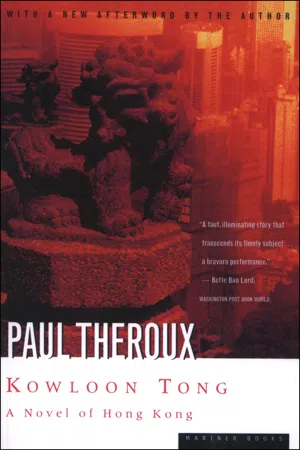
In this "moody thriller," a family business is targeted for takeover as control of Hong Kong shifts from the British to the Chinese (
The New York Times).
Ninety-nine years of colonial rule are ending as the British prepare to hand over Hong Kong to China. Betty Mullard and her son, Bunt, have lived here for years, mostly keeping apart from their foreign surroundings, except for some indulgence in the local food, or in Bunt's case, the local girls. The handover is not a concern for them—until the mysterious Mr. Hung from the mainland offers them a large sum for their family business.
They refuse. But they fail to realize that Mr. Hung is unlike the other Chinese people they've known: he will accept no refusals. When a young female employee whom Bunt has been dating vanishes, he is forced to make important decisions for the first time in his life—but his good intentions are pitted against the will of Mr. Hung, and the threat of the ultimate betrayal.
"A compact, provocative gem of a novel" (
The Boston Globe), from an award-winning author acclaimed for both his fiction and his travel memoirs—including
Deep South,
The Great Railway Bazaar, and
The Mosquito Coast—
Kowloon Tong was praised by Bette Bao Lord in
The Washington Post Book World as "a taut, illuminating story that transcends its timely subject."
- 248 pages
- English
- ePUB (mobile friendly)
- Available on iOS & Android
eBook - ePub
About this book
Information
1
SOME DAYS Hong Kong seemed no different from the London suburb she had lived in before the war. Today, for example, the cold early morning with fragments of fog at the windows, she was back in Balham. The gray sky was falling in big soft wisps of tumbled stuffing, like a cushion torn open—but not one of those stinky straw-filled Chinese cushions. When the wind gusted, the drops of rain, as though flushed from just above her, plopped harder on the roof, which was also the ceiling of the parlor at Albion Cottage. The sky, the roof, the ceiling—on a wet day like this they were one thing.
Betty Mullard sat in what she called the lounge waiting for her son, Bunt, to come in to breakfast.
“Fancy that,” she said softly to the plip-plop of the rain. “Chinky-Chonks.”
And she went on thinking: Chinese relatives? What Chinese relatives?
She had just put the phone down after speaking to Monty, who was Mr. Chuck’s solicitor, and also hers—theirs, the firm’s, everyone trusted Monty Brittain. He was a Londoner too, a lad, sported a bowler hat, and he just laughed and looked at her with dead eyes when she said, “I trust you because you’re a Jewboy.”
Mr. Chuck had never mentioned Chinese relatives.
The question was, How to tell Bunt?
Hearing another sudden clatter of raindrops, she was back in Balham again. She looked up and saw the Queen, the portrait over the mahogany sideboard, a larger photograph than that of Betty’s late husband, George, in his RAF uniform on the same wall. The portrait had been part of the room, as permanent a fixture as the lamps and candle brackets, but lately Betty had begun to look closely at the Queen’s face, querying it. The Queen was practically a goddess, but she was also a mother, and a ruler. Her kingdom was established and serene and orderly. “She works so hard” was all Betty had ever said, a kind of benediction.
The greatest change Betty had known in her life, keener than the death of her father, worse than the war but with the same unexpected surprises and hurts (all her sighs of “Whatever next!”), was the seismic shift in the domestic life of the royal family. Her father had been old and sick: his time had come. The war had been won. But in these past years Betty had felt a sense of overwhelming disillusionment—loss and grief and bewilderment of an almost blaspheming sort that had very nearly unhinged her—at the news of divorces and muddles and adulteries and scandals and secrets of the royal family. Her Majesty excepted, they were human and horrible, and they were naked, exposed for all the world to see. For the first time in her life she saw their flesh, the common freckles on Fergie’s moo-cow face, Diana’s skinny arms, even Charles, his white legs. To Bunt, who had no idea of the majesty of the Queen and how much had changed, his mother said, “And the youngest—just a shame—he’s a nancy boy, no question.”
The rain shaken from the overhanging trees fell noisily on the cobbles out front and on the crazy paving that George and Wang had put in. Betty looked in that direction too when she heard the loud dribbling spatter of the drizzle, and she saw the lily cluster, big leaves hit by the falling rain, and, nodding, the blossoms seemed to grieve like girls in white bonnets, to share her sorrow.
In her purple woolly sweater Betty matched the tea cozy that lay thick on the contours of the teapot before her, and the egg cozies, two of them, that sat on the soft-boiled eggs like bobble hats. On mornings like this Wang always fitted the items with these accessories that Betty had made. The color was unfortunate but the wool had been cheap, bought in bulk through one of the company’s wholesalers, which explained the amount of yarn. There were also purple coasters for the souvenir glasses on the sideboard, where they stood with the souvenir saucers and the letter holder and the sturdy thermos flask and the tiny ceramic wine barrel from Spain, with its clutch of toothpicks, and the various items (brass jar, crystal bear, enamel ashtray) she had bought in the gift shops of transit lounges on her London flights.
With the same wool she had made cuffs for the chairs and collars for the lamps, and the pictures too—of George and Ivy in Carshalton, of Reeny and Ken, of Bunt in his pram at Southend, and of an odd foursome, mothers and sons on the beach at Silver Mine Bay in Lantau: Betty and little Bunt with Jia-Jia and her small son Wang—the frames had purple knitted sleeves. They held the damp and filled the bungalow’s lounge with the smell of clammy wool. And cold toast and bacon fat and the savory sourness of just-sliced papaya—Wang had left the kitchen door ajar.
Albion Cottage was off Lugard Road, on a bluff above the Peak fire station. The fire brigade was inside today with the windows and doors shut. No voices, no music, no sirens. Everything in the bungalow on a morning like this had a film of dampness, and the dampness seemed to liven the mildew and gave the interior the ripe cheesy odor of a mortuary. Varnished wood was affected: a dampness dulled the case of the wind-up clock with its ponderous ticking and its iffy mainspring, caused a slick on the oak box of silver cutlery with its small silver plate, engraved George and Betty, 1946. There was damp on the newly twisted mechanical calendar that needed a turn every day, reading THU 7 MAR 96; on the sofa and the needlepoint cushion covers; on the leather footstool (still showing George’s heel marks), the jam jars, the tea tray, the old magazines stacked beside the armchair, and the armchair itself—it all ponged.
Yet on a clear morning, like a hallucination from the eastfacing windows, where heavy with blackflies and aphids there were nasturtiums tumbling from a window box, Betty could see China—Red China, as they used to call it. Shum Chun was an hour by train from the factory in Kowloon Tong across the harbor. In forty-five years she had never visited, nor had George when he was alive, nor had Bunt, for—near or far—what was the point in going to China?
Bunt came in blowing his nose, saying, “Did you hear the phone ring at six o’clock? Imagine a twit calling that early!”
Wang hurried after him with the toast rack and a plate of bacon, the papaya she had smelled, and a napkin bundle.
Bunt folded his handkerchief into his pocket and went to the table and hesitated. He was forty-three and balding, and he touched his scalp lightly with Braille-reading taps and tracings of his fingertips, as though for luck, or searching for hair—or was it perhaps a reflex from the time he had had hair?
“Wang made some fresh oaties. Have an oatie, Bunt. Give him an oatie, Wang, there’s a good chap.”
There was an element of pride in Betty’s encouragement. It was not really Wang’s food. She had taught the man her own recipes and so it was her food.
Wang was tall—taller than Bunt, with a broad north China face, a flattish head, and wide-apart eyes that gave him a snake’s features. He looked even more snake-like when he smiled, but that was seldom. His laughter was more frequent but even more sinister, since it never indicated pleasure, only anxiety and fear. He seemed to be on the verge of laughing this morning. Had he heard anything of the phone call?
Wang said nothing. He put the food on the table and withdrew. He had a sloping sideways walk which Betty blamed on his height. He was solitary. He was not mysterious. He jogged.
Bunt also said nothing. He was dealing with his egg, his mouth was full, a fleck of egg clung to his cheek.
“There’s a wee scrap of bacon going spare,” Betty said.
“If it’s going spare.” Bunt motioned with his spoon.
“I’ll do the honors.”
His mother slid the three stiff rashers onto his plate and then switched on the radio. It was green-painted bakelite with a yellow illuminated dial, as big as a breadbox, and it crackled. George had bought the radio. “It’s a pup,” Betty always said, and Bunt still boasted about it for its not being Japanese. It was a Roberts. Like the sturdy John Bull thermos flask on the sideboard it was English-made. “We manufactured radios once!” The TV was a Bush. The gramophone was a Bush. The toaster was a Dualite. The bathroom porcelain, basin, bath, and hopper were all Twyford Adamants. “And cars.” The Milliards’ car was a black 1958 Rover that George had bought. He’d been proud of these English goods because, he’d said, though they might need repair they would never need to be replaced in his lifetime. George was fond of saying, whether of these appliances or of his sturdy clothes, “These will see me out.”
The sounds the Roberts made were like those of an old dear who had had to learn a new language. This morning it was saying, In the run-up to 1997. . .
The Hand-over: they called it “the Chinese take-away,” and it was now the old refrain. It was the only news in Hong Kong, and any news related to it—the economy, land reclamation, sales of commercial property, the price of petrol, the new airport, the noisy fears of anxious politicians—was tied to the Hand-over. Because it was the same every day and had been for so long, Bunt never commented. Besides, they had vowed they were going to stay, just to see. There was no risk. They had British passports. And they were not so free as others in the colony, for they had a half-share in the factory; the other half belonged to Mr. Henry Chuck.
“You’ll want your U.K. woolly,” Betty said. It was one she had made. “And don’t forget your gamp.”
Anticipating that Bunt would say “Soldiers, Mum?,” meaning bread fingers, Betty was buttering bread. She did it her usual way, standing with her feet apart, holding the whole loaf and spreading the butter on the end. When the buttering was completed, she worked her knife through the bread and cut off the buttered end as a slice. But as she did this Bunt was wagging his finger, no, no, no, because his mouth was full, his cheeks bulging with tea.
Sensing that he could not deny it, Betty said, “You’re nid-nodding over your food. You look a little peaky.”
She knew she would not get the truth from him, but she was curious to know what his lie would be. She watched him closely as he swallowed. She had kept track of what he had eaten: a soft-boiled egg, five rashers of streaky bacon, an oatie, half the papaya, two slices of toast to one of which he had added jam, no soldiers.
Bunt’s reaction this morning was not to lie or make an excuse but to smile and pluck his umbrella from the stand and say he had to go.
“You were late last night,” his mother said, trying to provoke a lie.
Bunt smiled and said, “Cricket Club. Had a drink with Mr. Chuck.”
It was the worst lie he could have told, but perhaps it did not matter what he said. When she had put his shirt in the laundry basket, she had smelled cheap perfume—a hairy, cat-like odor of a sluttish woman. If she asked he would only deny it, but who was the woman? This was Hong Kong—it might be anyone, and the thought was alarming.
Bunt had gone thrashing into the rain and started the car. He was chafing some warmth into his hands and releasing the hand brake of his black lumpy Rover. He looked up and opened his mouth wide when he saw his mother coming towards him, buffeted by the wind and drizzle. She put her face and her lank rain-flecked hair against the passenger’s side window.
“Mr. Chuck’s dead,” she said.
It sounded like an afterthought, though it was anything but. The news had been worrying her since six o’clock, when Monty called. She simply did not know how to tell her son of the death of their business partner.
Bunt was not superstitious, but he knew that thereafter, every time he hitched forward on the leather seat of the old Rover and released the hand brake, or perhaps even gripped it, he would think of those words. The satisfying lift and click to free the mechanism would always be linked in his mind with Mr. Chuck’s death. He thought of death in the same way—the brakes are off, for that was how it seemed.
“I’m sorry,” Bunt said. “I didn’t really see him at the Cricket Club.”
Betty made a face—twitching eyes, pursed lips—that meant Never mind.
She said, “Evidently he didn’t have an earthly . . .”
His mother was still talking but he was no longer listening. There was too much to do. Instead of the closely regulated schedule of the factory, Imperial Stitching in Kowloon Tong, the entire day had to be improvised. Bunt hated surprises, even pleasant ones. This was terrible—and worse, now everything in his life was in doubt.
And as someone who hated surprises, who was thrown by anything unplanned, Bunt had an English loathing for improvisation. Urgency made him anxious and inaccurate, and hurry left him speechless. Yet the death demanded his attention, and at the end of the day he was astonished by what he had managed to accomplish at such short notice.
He arranged for the funeral service at St. John’s Cathedral, on Battery Path Road—Mr. Chuck, though Chinese, was a devout Anglican. Miss Liu at the factory took care of the flowers, and Mr. Cheung the insertion of death notices in all the papers, including the Chinese ones. Mr. Woo lowered the Union Jack on the roof of the factory to half-staff. Lily, Miss Liu’s assistant, faxed some dates and club names to the South China Morning Post for its obituary. Bunt spent almost an hour at the Hong Kong Club with Monty, the solicitor. By late afternoon, Bunt felt he knew Mr. Chuck a great deal better. Apart from his father’s death—but Bunt was young then, just eleven—this was his first proper funeral. He realized that death produced unexpected revelations.
They believed they knew the Chinese, he and his mother, knew them especially well because they knew Mr. Chuck and Wang so well. The Chinese were frugal first of all, but not mean; they were self-denying and Spartan, strangely cheese-paring and given to binges—also capable of going mental and throwing an entire fortune away at Happy Valley or Sha Tin. In the casinos of Macao they were melancholy and self-destructive. They might seem stern the rest of the time, but it was shyness, which was another reason they didn’t look you in the eye. They could be sentimental, they did not shed tears—they had much to blub about and that was probably the reason they didn’t. They could be tasteless, for frugality was the enemy of fashion. They did not care, they did not complain, they were totally predictable.
Whoever said the Chinese were enigmatic might have met one Chinese person but had not met two. They were nearly always the opposite—obvious, unsubtle, unambiguous, and what was the opposite of mysterious? They carried on their lives in whispers and their business in shouts. If they wanted you to accept a present, they rammed it down your throat. The present was never an expensive thing. They liked simplicity more than ingenuity, because ingenuity costs more. But novelty that was a bargain pleased them. Children pleased them, families generally. They hardly drank. They never gave speeches. Patience and long suffering were attributed to them. No, in Hong Kong they were animated by one emotion, and that was impatience. They were not timid—they could fight like cats. They were too shy to say it, but Hurry up was the angle and the statement in all their posture.
At the meeting, Monty had said, “And of course, as I told your mother, there are the Chinese relatives to consider.”
And Bunt had raised his face to the man. Chinese relatives? Mr. Chuck had never spoken of them. He had refused to speak of China at all. That was Chinese—don’t look back, don’t even think about it. Mr. Chuck had come to Hong Kong in 1948 and had started Imperial Stitching with Bunt’s father two years later. It was called Imperial Stitching and Labels then. Mr. Chuck had never gone back to China. Perhaps that had influenced Bunt in his not going. For many years it had been impossible, then it was merely difficult, but for the past fifteen years you had the impression that a visit to China was demanded of you. Americans went in their millions—and that convinced Bunt that he would never go, even though he was assured that he could easily manage the trip during his lunch hour.
“I’ve notified them,” Monty said. “They will want to do something.”
“I can’t imagine what,” Bunt said.
“And if they make demands?”
“They can get stuffed.”
Chinese relatives! Bunt saw himself with a hundred meddling Chinese partners, all named Chuck, in Imperial Stitching.
Mr. Chuck’s funeral at St. John’s, Central District, was a solemn affair, attended b...
Table of contents
- Title Page
- Contents
- Copyright
- Epigraph
- 1
- 2
- 3
- 4
- 5
- 6
- 7
- 8
- 9
- 10
- 11
- 12
- 13
- 14
- 15
- 16
- Afterword
- About the Author
- Connect with HMH
Trusted by 375,005 students
Access to over 1.5 million titles for a fair monthly price.
Study more efficiently using our study tools.
Frequently asked questions
Yes, you can cancel anytime from the Subscription tab in your account settings on the Perlego website. Your subscription will stay active until the end of your current billing period. Learn how to cancel your subscription
No, books cannot be downloaded as external files, such as PDFs, for use outside of Perlego. However, you can download books within the Perlego app for offline reading on mobile or tablet. Learn how to download books offline
We are an online textbook subscription service, where you can get access to an entire online library for less than the price of a single book per month. With over 1.5 million books across 990+ topics, we’ve got you covered! Learn about our mission
Look out for the read-aloud symbol on your next book to see if you can listen to it. The read-aloud tool reads text aloud for you, highlighting the text as it is being read. You can pause it, speed it up and slow it down. Learn more about Read Aloud
Yes! You can use the Perlego app on both iOS and Android devices to read anytime, anywhere — even offline. Perfect for commutes or when you’re on the go.
Please note we cannot support devices running on iOS 13 and Android 7 or earlier. Learn more about using the app
Please note we cannot support devices running on iOS 13 and Android 7 or earlier. Learn more about using the app
Yes, you can access Kowloon Tong by Paul Theroux in PDF and/or ePUB format, as well as other popular books in Literature & Literature General. We have over 1.5 million books available in our catalogue for you to explore.