Modern warfare takes to the skies in this novel by a master of science fiction and fantasy.
In 1907, young Bert Smallways, a brilliant mechanist and accidental aeronaut, finds himself a reluctant stowaway upon the very same airship that will begin the Great War. Soon, Smallways is swept away aboard the
Vaterland, the flagship piloted by a belligerent German prince, whose mastery of technology heralds a new age of war that takes to the sky.
Filled with petrol-powered war machines, ironclads, bombardments, and espionage,
The War in the Air prophesied methods of warfare that would only develop later in the twentieth century. A cornerstone of early science fiction, this exciting tale is H. G. Wells at his best.
This ebook has been professionally proofread to ensure accuracy and readability on all devices.
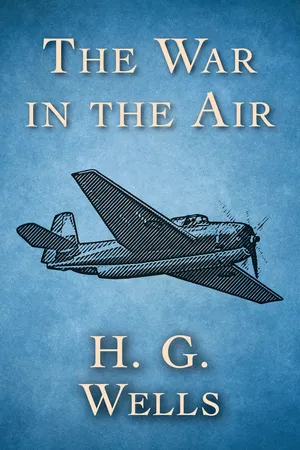
- 345 pages
- English
- ePUB (mobile friendly)
- Available on iOS & Android
eBook - ePub
The War in the Air
About this book
Information
Subtopic
ClassicsIndex
LiteratureCHAPTER I
OF PROGRESS AND THE SMALLWAYS FAMILY
1
“This here Progress,” said Mr. Tom Smallways, “it keeps on.”
“You’d hardly think it could keep on,” said Mr. Tom Smallways.
It was along before the War in the Air began that Mr. Smallways made this remark. He was sitting on the fence at the end of his garden and surveying the great Bun Hill gas-works with an eye that neither praised nor blamed. Above the clustering gasometers three unfamiliar shapes appeared, thin, wallowing bladders that flapped and rolled about, and grew bigger and bigger and rounder and rounder—balloons in course of inflation for the South of England Aero Club’s Saturday-afternoon ascent.
“They goes up every Saturday,” said his neighbour, Mr. Stringer, the milkman. “It’s only yestiday, so to speak, when all London turned out to see a balloon go over, and now every little place in the country has its weekly-outings—uppings, rather. It’s been the salvation of them gas companies.”
“Larst Satiday I got three barrer-loads of gravel off my petaters,” said Mr. Tom Smallways. “Three barrer-loads! What they dropped as ballase. Some of the plants was broke, and some was buried.”
“Ladies, they say, goes up!”
“I suppose we got to call ’em ladies,” said Mr. Tom Smallways.
“Still, it ain’t hardly my idea of a lady—flying about in the air, and throwing gravel at people. It ain’t what I been accustomed to consider ladylike, whether or no.”
Mr. Stringer nodded his head approvingly, and for a time they continued to regard the swelling bulks with expressions that had changed from indifference to disapproval.
Mr. Tom Smallways was a green-grocer by trade and a gardener by disposition; his little wife Jessica saw to the shop, and Heaven had planned him for a peaceful world. Unfortunately Heaven had not planned a peaceful world for him. He lived in a world of obstinate and incessant change, and in parts where its operations were unsparingly conspicuous. Vicissitude was in the very soil he tilled; even his garden was upon a yearly tenancy, and overshadowed by a huge board that proclaimed it not so much a garden as an eligible building site. He was horticulture under notice to quit, the last patch of country in a district flooded by new and (other) things. He did his best to console himself, to imagine matters near the turn of the tide.
“You’d hardly think it could keep on,” he said.
Mr. Smallways’ aged father, could remember Bun Hill as an idyllic Kentish village. He had driven Sir Peter Bone until he was fifty and then he took to drink a little, and driving the station bus, which lasted him until he was seventy-eight. Then he retired. He sat by the fireside, a shrivelled, very, very old coachman, full charged with reminiscences, and ready for any careless stranger. He could tell you of the vanished estate of Sir Peter Bone, long since cut up for building, and how that magnate ruled the country-side when it was country-side, of shooting and hunting, and of caches along the high road, of how “where the gas-works is” was a cricket-field, and of the coming of the Crystal Palace. The Crystal Palace was six miles away from Bun Hill, a great facade that glittered in the morning, and was a clear blue outline against the sky in the afternoon, and of a night, a source of gratuitous fireworks for all the population of Bun Hill. And then had come the railway, and then villas and villas, and then the gas-works and the water-works, and a great, ugly sea of workmen’s houses, and then drainage, and the water vanished out of the Otterbourne and left it a dreadful ditch, and then a second railway station, Bun Hill South, and more houses and more, more shops, more competition, plate-glass shops, a school-board, rates, omnibuses, tramcars—going right away into London itself—bicycles, motor-cars and then more motor-cars, a Carnegie library.
“You’d hardly think it could keep on,” said Mr. Tom Smallways, growing up among these marvels.
But it kept on. Even from the first the green-grocer’s shop which he had set up in one of the smallest of the old surviving village houses in the tail of the High Street had a submerged air, an air of hiding from something that was looking for it. When they had made up the pavement of the High Street, they levelled that up so that one had to go down three steps into the shop. Tom did his best to sell only his own excellent but limited range of produce; but Progress came shoving things into his window, French artichokes and aubergines, foreign apples—apples from the State of New York, apples from California, apples from Canada, apples from New Zealand, “pretty lookin’ fruit, but not what I should call English apples,” said Tom—bananas, unfamiliar nuts, grape fruits, mangoes.
The motor-cars that went by northward and southward grew more and more powerful and efficient, whizzed faster and smelt worse, there appeared great clangorous petrol trolleys delivering coal and parcels in the place of vanishing horse-vans, motor-omnibuses ousted the horse-omnibuses, even the Kentish strawberries going Londonward in the night took to machinery and clattered instead of creaking, and became affected in flavour by progress and petrol.
And then young Bert Smallways got a motor bicycle….
2
Bert, it is necessary to explain, was a progressive Smallways.
Nothing speaks more eloquently of the pitiless insistence of progress and expansion in our time than that it should get into the Smallways blood. But there was something advanced and enterprising about young Smallways before he was out of short frocks. He was lost for a whole day before he was five, and nearly drowned in the reservoir of the new water-works before he was seven. He had a real pistol taken away from him by a real policeman when he was ten. And he learnt to smoke, not with pipes and brown paper and cane as Tom had done, but with a penny packet of Boys of England American cigarettes. His language shocked his father before he was twelve, and by that age, what with touting for parcels at the station and selling the Bun Hill Weekly Express, he was making three shillings a week, or more, and spending it on Chips, Comic Cuts, Ally Sloper’s Half-holiday, cigarettes, and all the concomitants of a life of pleasure and enlightenment. All of this without hindrance to his literary studies, which carried him up to the seventh standard at an exceptionally early age. I mention these things so that you may have no doubt at all concerning the sort of stuff Bert had in him.
He was six years younger than Tom, and for a time there was an attempt to utilise him in the green-grocer’s shop when Tom at twenty-one married Jessica—who was thirty, and had saved a little money in service. But it was not Bert’s forte to be utilised. He hated digging, and when he was given a basket of stuff to deliver, a nomadic instinct arose irresistibly, it became his pack and he did not seem to care how heavy it was nor where he took it, so long as he did not take it to its destination. Glamour filled the world, and he strayed after it, basket and all. So Tom took his goods out himself, and sought employers for Bert who did not know of this strain of poetry in his nature. And Bert touched the fringe of a number of trades in succession—draper’s porter, chemist’s boy, doctor’s page, junior assistant gas-fitter, envelope addresser, milk-cart assistant, golf caddie, and at last helper in a bicycle shop. Here, apparently, he found the progressive quality his nature had craved. His employer was a pirate-souled young man named Grubb, with a black-smeared face by day, and a music-hall side in the evening, who dreamt of a patent lever chain; and it seemed to Bert that he was the perfect model of a gentleman of spirit. He hired out quite the dirtiest and unsafest bicycles in the whole south of England, and conducted the subsequent discussions with astonishing verve. Bert and he settled down very well together. Bert lived in, became almost a trick rider—he could ride bicycles for miles that would have come to pieces instantly under you or me—took to washing his face after business, and spent his surplus money upon remarkable ties and collars, cigarettes, and shorthand classes at the Bun Hill Institute.
He would go round to Tom at times, and look and talk so brilliantly that Tom and Jessie, who both had a natural tendency to be respectful to anybody or anything, looked up to him immensely.
“He’s a go-ahead chap, is Bert,” said Tom. “He knows a thing or two.”
“Let’s hop...
Table of contents
- Title Page
- PREFACE TO REPRINT EDITION
- CHAPTER I
- CHAPTER II
- CHAPTER III
- CHAPTER IV
- CHAPTER V
- CHAPTER VI
- CHAPTER VII
- CHAPTER VIII
- CHAPTER IX
- CHAPTER X
- CHAPTER XI
- THE EPILOGUE
- Copyright
Trusted by 375,005 students
Access to over 1.5 million titles for a fair monthly price.
Study more efficiently using our study tools.
Frequently asked questions
Yes, you can cancel anytime from the Subscription tab in your account settings on the Perlego website. Your subscription will stay active until the end of your current billing period. Learn how to cancel your subscription
No, books cannot be downloaded as external files, such as PDFs, for use outside of Perlego. However, you can download books within the Perlego app for offline reading on mobile or tablet. Learn how to download books offline
Perlego offers two plans: Essential and Complete
- Essential is ideal for learners and professionals who enjoy exploring a wide range of subjects. Access the Essential Library with 800,000+ trusted titles and best-sellers across business, personal growth, and the humanities. Includes unlimited reading time and Standard Read Aloud voice.
- Complete: Perfect for advanced learners and researchers needing full, unrestricted access. Unlock 1.5M+ books across hundreds of subjects, including academic and specialized titles. The Complete Plan also includes advanced features like Premium Read Aloud and Research Assistant.
We are an online textbook subscription service, where you can get access to an entire online library for less than the price of a single book per month. With over 1.5 million books across 990+ topics, we’ve got you covered! Learn about our mission
Look out for the read-aloud symbol on your next book to see if you can listen to it. The read-aloud tool reads text aloud for you, highlighting the text as it is being read. You can pause it, speed it up and slow it down. Learn more about Read Aloud
Yes! You can use the Perlego app on both iOS and Android devices to read anytime, anywhere — even offline. Perfect for commutes or when you’re on the go.
Please note we cannot support devices running on iOS 13 and Android 7 or earlier. Learn more about using the app
Please note we cannot support devices running on iOS 13 and Android 7 or earlier. Learn more about using the app
Yes, you can access The War in the Air by H. G. Wells in PDF and/or ePUB format, as well as other popular books in Literature & Classics. We have over 1.5 million books available in our catalogue for you to explore.