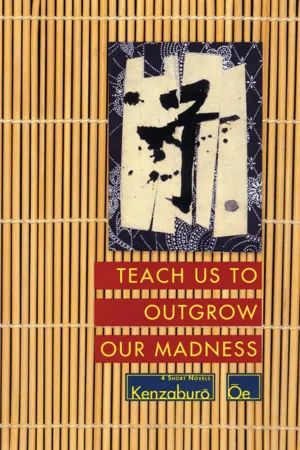
The Nobel Prize–winning "master of the bizarre plunges the reader into a world of tortured imagination" in this four-novella collection (
Library Journal).
In this startling quartet of his most provocative stories, the multiple prize-winning author of
A Personal Matter reaffirms his reputation as "a supremely gifted writer" (
The Washington Post).
In
The Day He Himself Shall Wipe My Tears Away, a self-absorbed narrator on his deathbed drifts off to the comforting strains of a cantata as he recalls a blistering childhood of militarism, sacrifice, humiliation, and revenge—a tale that is questioned by everyone who knew him. In
Prize Stock, winner of the Akutagawa Prize, a black American pilot is downed in a Japanese village during World War II, where the local children see him as some rare find—exotic and forbidden. In
Aghwee The Sky Monster, the floating ghost of a baby inexplicably haunts a young man on the first day of his first job. And in the title story, a devoted father believes he is the only link between his mentally challenged son and reality.
"[A] remarkable book." —
The Washington Post
"?e is definitely one of the Modern Masters." —Seattlepi.com
- 262 pages
- English
- ePUB (mobile friendly)
- Available on iOS & Android
eBook - ePub
About this book
Information
Subtopic
Literature GeneralIndex
LiteratureTHE DAY HE HIMSELF SHALL WIPE MY TEARS AWAY
I
Deep one night he was trimming his nose that would never walk again into sunlight atop living legs, busily feeling every hair with a Rotex rotary nostril clipper as if to make his nostrils as bare as a monkey’s, when suddenly a man, perhaps escaped from the mental ward in the same hospital or perhaps a lunatic who happened to be passing, with a body abnormally small and meagre for a man save only for a face as round as a Dharma’s and covered in hair, sat down on the edge of his bed and shouted, foaming,
____What in God’s name are you? What? WHAT? So startled that he yanked the clipper from his nose with several hairs still caught between the rotor and the blade, and, the pain adding an edge to his anger, he set the Rotex in rotary motion and hurled it at the hairy face, then screamed back, writhing with his chest and shoulders only because the other man’s weight on top of the blankets immobilized his legs,
____I’m cancer, cancer, LIVER CANCER itself is me! Throwing his robe open irritably he exposed the spidery welts that had appeared on his chest, then thrust in front of him both his bright red palms as well, whereupon the other man remarked, with a cool civility that can hardly have been normal,
____Sorry, I hadn’t realized you were bonkers! and abruptly vanished without a sound, like a drop of water sinking into sand.
The only image he retained with eyes rendered uncertain by the tinted underwater goggles he always wore was the arabesque pattern the whirling Rotex had cut along the outer edges of the Dharma’s beard. Had the late night intruder already shaved his beard away, he was left without a clue to his identity or whereabouts. Objectively, such was the case, despite the fact that he was ever surer inside himself that he had perceived in the hairy Dharma’s features a resemblance to a certain party.
[[Must I put down even that kind of silliness? asks the “acting executor of the will,” who is taking down his verbal account. As “he” has ceased to perceive those who share only present time with him as people living with him in this world, “he” makes no attempt to ascertain, nor is “he” the least concerned, whether she is his wife, a nurse, or simply an official scribe sent by the government or the United Nations solely to record the “history of the age” “he” is relating. To be sure, should the last possibility be correct, it would be awkward if, reeking of the garlic “he” has consumed in large quantity in an attempt to convert whatever surplus strength “he” possesses now, at thirty-five, as his life is about to end, to sexual energy, “he” attempted to drag her into his bed. But for the moment the entire energy of his body-and-soul is being channeled into talking, continuing to talk. Not even the doctors’ regular visits to his bedside, or the medicine the nurses administer to him, though “he” cooperates, are of any positive concern. Why, then, late at night, on July 1, 1970, at 2 A.M., had “he” taken cognizance of the intruder? Because even now it is not clear whether that hairy Dharma had actually appeared or had loomed out of certain hours of the past in his conscious-subconscious which constituted the only real world “he” wanted for his reality. And now, if you please, stop wasting time and get back to transcribing, you know my hours are numbered, I might go into the final coma tomorrow. When that happens you know what to do, it’s all in the “will,” just call the telephone company-post office in the valley in the forest right away and start the “tape on the occasion of entering the coma.” And don’t forget to arrange for the plane ticket, if I’m going to beat my mother to the punch once and for all and give her what she deserves, I need that ticket more than anything else, “he” says. Now then, push that pencil, don’t eat away the little time remaining this pitiful essence of liver cancer!]]
If, as those in attendance around his bed maintained, the late night appearance of that intruder was a dream, it was his first dream to remain vividly in memory since he had moved to this “final abode” with, like any Bantu tribesman, his liver in ruins despite his tender age, and, he confidently imagined, would be his last.
There were those who reported he often sobbed in his sleep and suggested he was confronting his own critical condition for the first time in his dreams. To be sure, these were the very people who insisted, on the other hand, that he was deluding himself about liver cancer, that all he really had was cirrhosis, and that, while recovery would not be easy, there was still room for hope. On his part, he maintained he remembered nothing of any dreams that would have made him sob. He even claimed he spent his waking hours enveloped in happy thoughts, breathing happiness. Frequently, for the benefit of those who came and went around his bed (who, although they were certain to outlive him, lying in his bed awaiting the moment of his own death as if it had been finally scheduled, were treated by him as if they were already among the dead), not necessarily to flaunt his happiness but simply to enjoy the sounds that reached his ears along his jawbone from his own eccentric vocal chords, and to revel in the furtive, complex sympathetic resonation of his internal organs, pregnant now with cancer cells, he would sing, in English, “Happy Days Are Here Again.” Admittedly, since the refrain was strung with high notes, if he mistakenly began too high, his voice climbed to a shrillness that not only threatened those around him but created an uneasiness in himself that seemed to center in his innards. He firmly believed that his liver, soon to complete its transformation into a rocklike mass, functioned in its ample fullness as a speaker embedded in his body, resonating with even the highest notes and filtering the dissonance due primarily to organic factors out of the music of his vital organs. “Let us sing a song of cheer again,” he sang, “Happy days are here again,” and the refrain went as follows:

And now, he thought, just as my Happy Days are about to revive at last and I pass the time in excited anticipation there is no one here who shared them with me, and the only person who actually witnessed them, my mother, remains secluded in the valley deep in the forest and continues to send the same high frequency signals principally of hatred to the antenna in my innards, which, now that I think about it, is probably the reason I got cancer, and since that’s the case I must be certain to record my Happy Days fully during this time I spend alone in a hospital bed, and, to place the record in perspective so that it can outlive my death, to record how, ever since the destruction of those former Happy Days, my imagination has been moving back in their direction as helplessly as a model airplane in a tailspin—and this he resolved to do.
However, since he was an invalid at the very brink of death, afflicted with, as he believed, liver cancer, or, at the very least, assuming only what was objectively recognized, an advanced cirrhosis, it was unthinkable that he should put pen to paper himself. At first, when he asserted this and asked for a stenographer, the voices around his bed replied that he was merely deluding himself, that if only he regained the “normal consciousness” that he was in the neurology and not the cancer ward and not so gravely ill that he could not hold a pencil, he would undoubtedly be able to write for hours on end, and even with an instrument as heavy as that giant Pelikan fountain pen which was an ostentatious souvenir from some trip abroad. The fountain pen in question, as well as the discolored brass underwater goggles he wore almost constantly as he lay in bed (the oval glass lenses set into two short cylinders had been covered long ago, before the days of synthetic tape, with dark green cellophane, and were still used that way; clipping his nostrils late that night with the goggles on, he must have looked to the intruder like an alien from outer space, one short, conic, metal cylinder neatly extending from each of his eyes and one nostril), were both mementoes of someone long dead about whom he and his mother disagreed violently yet both referred to as a certain party. Not only had a certain party’s former belongings, now in his possession, been unspeakably insulted by the manner in which they had been described, it had also been insinuated that if he were really about to enter a coma and die, the personal record of his Happy Days would be a waste: his anger mounted.
Angrily, he emphasized once again that what he intended to relate was a “history of the age” that would transcend the arbitrary reminiscences of a mere individual. If a certain party, who figured in the history, had not been killed in a street battle in a provincial city just before the war ended, he would certainly have been required to testify before the extraordinary session of the Military Tribunal for the Far East that had been obliged to make its way to the valley deep in the forest; the story he was about to tell should, therefore, be of great concern not only to the United Nations but, in particular, to the current administration of his own country, a nation controlled by men who were clearly war criminals who had survived.
And now he had an acting executor of the will who took down his account at his bedside, and he had as well the manuscript of a “history of the age” out of chronological order. To be sure, since he wore his cylinder-type underwater goggles like opera glasses with green cellophane covering the lenses regularly, reading over and checking the manuscript, though perhaps not impossible, would have been a fearfully difficult chore.
[[Why do you talk as if you believed you had terminal cancer and were about to go into a coma when all your symptoms contradict that? When I’m putting it all down on paper I have the feeling the characters I’ve written stand up on the page as fact and push at my fingers as I write, says the “acting executor of the will.” The doctor may have ordered you to keep lying to me about my cancer for the time being, but every time that lie jumps out of your mouth it solidifies and floats there alongside your head, and before long you’re going to find youself rooted to the spot in the middle of a mosquito-swarm of lies, “he” counters.]]
When he began to feel cancer growing in his body cavity with the vigor of fermenting malt, he also became aware that he was being gradually freed, by nature’s own power, from all that fettered him. It was not any accumulation of refusals willed by himself that was accomplishing this; he had only to lay his body down and, even while he slept, the cancer inside him that was an access to freedom continued ponderously to enlarge. What he saw, not only of reality but even in his imagination, was often blurred by fever, but within that vague dimness his cancer appeared to him as a flourishing bed of yellow hyacinths or possibly chrysanthemums bathed in a faint, purple light. At such moments, until fatigue penetrated to the core of his head, he would breathe in and out with particular concentration, summoning to his nostrils the power of all his senses, and attempt to smell those cancer hyacinths or possibly chrysanthemums. The existence inside himself of something growing on its own vitality which, by means of its own internal power alone, was about to conduct him to and beyond new realms he could not fully conceive, and which, moreover, he was able to locate in his body as actual sensations in blood and flesh, seemed an experience more momentous than any since sexual awakening. This analogy led to dreams of stirring up sexual embers nearly buried under ash and scarcely warm. Now that death was staring him in the face, he longed to dip up, to reconfront, and to liberate everything taboo that he had repressed during his thirty-five years of life, at which time it seemed likely a whole unexpected world of sex might gush from his rich, yellow bed of blossoming cancer and the purple light surrounding it.
However, becoming bold even to shamelessness required careful stages of preparation. Since he was no born genius at obscenity, transforming his entire body into, as it were, a vagina in heat, and then enjoying, heedless of the outrage in the eyes watching him, as if he were a sea anemone set free beneath the water, its tumid wetness and the incessant squirming of its tentacles, was a feat he could not be expected to perform. With the time remaining him limited and new sexual developments merely anticipated, he lay upon his bed like an abstinent mole.
[[Observing that the “acting executor of the will” was unsettled by these remarks, What, are you afraid I’m going to start begging you to masturbate me any minute? Are you afraid if my entire body has become a vagina in heat I may request some grotesque form of masturbation such as jamming a pole into the sea anemone of my body and stirring it around? “he” teased pathetically, half in ridicule but half solicitously.]]
The instant he felt the slightest premonition of pain or itchiness, in his vital organs or on his skin, he screamed at those around his bed to ask the doctor for a “morphine” injection. And he doubted not that the injections he received were always “morphine.” In fact, it was only after it had become possible for him to intercept the arrival of pain with “morphine” while pain was still a premonition that he had turned into a man who sang repeatedly a song of Happy Days, a happy man. After his injection he would sleep as though in a coma, and it was a sleep he had not tasted since he was a baby, cradled in sweet sensations. Awakening from such a sleep, he gazed at a photograph he had cut from a book by Georges Batailles, of a Chinaman being drawn and quartered while in a narcotic ecstasy. Looking into a mirror, he studied his face to see if it had come to resemble the Chinaman’s, which was like a braided rope of agony and pleasure and which, besides, unlike the merely erotic expressions in “spring pictures,” was suffused with something purely tragic. His own face, wan, with ink-black whiskers like the spines of a sea urchin sprouting around his lips, the skin particularly drawn because he had been lying on his back and, beneath the skin, scarcely any flesh or fat at all, seemed to have returned to the true face he had somewhere along the line lost the right to possess. Scrutinizing, in a field of vision narrowly limited by the dark green cellophane covering his underwater goggles, a face that had regained even its drawn, comic ugliness when as a child he had submerged after fish in the depths of the river at the bottom of the valley, he was content.
Inasmuch as he wanted to experience in its entirety the hopeless situation into which he had finally fallen at the age of thirty-five, there were times when he placed himself quite consciously in a nightmare governed by the fear of death. Early one morning, having made certain there was no one around his bed, he told himself that he was in the grips of the wretched, deluded hope that if he could stave off for just five minutes the slavering jaws of the liver-cancer goblin charging him like a fright-crazed cur, he would also be free of the cancer actually in his body. He began thrashing around, trying to evade the jaws of the goblin dog Cancer that had leaped onto his bed, and when presently he felt the need to urinate and stepped out of bed, he was entirely disoriented. Through the sea-floor dimness he beheld through his underwater goggles he made his way toward the door, which was always left open, but instead of the open space he expected he discovered, right in front of his eyes, nearly touching the cylinders of his goggles, an unexpectedly solid white wall in gleaming green shadow. The sensation that followed, of total physical enclosure, was death as real and concrete as it could be, its first appearance in his real life. Like a crude mechanical man unable to change direction, he stood in front of the wall in clumsy stupefaction, hands frozen in front of his eyes, unable to touch, as if it were a force field repelling him, the wall. In the reflected brightness, each of his slender, greenish fingertips appeared spatulate and suction-cupped, like frog fingers. Terrified by the game he had begun himself, in a reeling panic, he somehow managed to fall backward onto the bed, but he soaked the sheets with leaked urine.
However, even at times like these, he was able to enjoy imagining dreamily the clamor and bustle when the announcement of death would send all the systems of his body, alive now and metabolizing tirelessly, racing one another to be the first to decompose. At the end of the tape which the acting executor of the will would play when he had entered a coma he wanted to record the following words to his mother, who would be coming alone from the house in the valley: Please make sure you stay to observe my body decomposing; if possible I would like you to observe even my putrefied and swollen insides burst my stomach and bubble out as gas and muddy liquid. But it was not easy to deliver such lines without disagreeable masochistic overtones; besides, if the state of his stomach should oblige him to belch just as he began to record and his voice should falter or tremble, he could imagine carrying his chagrin with him right into the world of the dead, so he merely assembled these sentences in his silent head.
When he thought about cremation, particularly cremation hurriedly carried out before the body’s cells had fully decomposed, anger stiffened his own still living body. Incorporated in this reaction, he could sense, was rage being demonstrated independently of his own consciousness by the agitated cell systems themselves. He was also filled with disgust and outrage at the thought of his dead body being treated against decomposition and then dissected. Let that which is meant to decompose do so in peace, in its entirety and smallest part; let man impair not the dignity of decomposition! Tenderly pressing with both hands the liver like a stone pillow sewn into his belly, he entrusted the acting executor of the will with the additional, patient task, so as to ensure that nothing interfered with the Copernican rotation in which the cancer lodged in his liver, at the peak of its enterprise, would terminate all life functions and begin at once to decompose, of protecting his injured liver from premature cremation and antiseptic destruction by doctors who retained the experimental spirit of their intern days.
As he thought about that part of himself that would remain in this world after death, he developed an appreciation for the custom of platform burial, in which birds or the wind were allowed to take their course. He also considered what he had seen along the Ganges at the Hindus’ sacred Benares, placid corpses decomposing from inside and bloated up like sunfish floating half-submerged down the swift, muddy river, and reflected once again, admiringly, that the wise Hindus were correct, that theirs was a solution befitting the meditative tribe among all the countless tribes of humanity that had meditated longest and most accurately in history, in the climate best suited to meditation.
[[When you traveled to India did you really see corpses floating in the river at Benares? asks the “acting executor of the will.” Well now, when I sensed the difficulty in my liver was incurable, I declared my freedom from all bonds connecting me to the real world that was holding me dangling from its fingertips, so there’s no telling whether I’ve actually experienced what I say, correspondence with reality in itself has never meant anything anyway, “he” says. The truth is, I’m heading straight back toward my Happy Days in the past, and if bringing some detail in that past sharply to the surface requires it, I’m prepared to alter the present reality however I please. For example, when I’m trying to penetrate deeply into memories of fights I had as a child, I make myself believe that the thirty-five-year-old lying here in bed with a sick liver, and not only his liver but nearly every vital organ smashed and broken, is a professional bantamweight boxer long retired. When I set my internal time machine all the way back to myself fighting the older kids in the valley twenty-five years ago, with the boxing tricks I learned from the cadets who came to my village to tap pine tree roots for oil, my longing to become a soldier and also a boxer revives in me along with the nearly epileptic activity of the brain cells in my feverish young head, and it seems impossible that I could ever have chosen any profession other than boxing right down to this day. If I push myself too hard, a squirt in a torn, dirty, brown undershirt too large for him and short pants easily twice his size that he folded over at the sides and tied with a rope, fighting, with spit and blood whistling between his teeth, against the b...
Table of contents
- Cover Page
- Title Page
- Copyright
- Contents
- Dedication
- Introduction
- The Day He Himself Shall Wipe My Tears Away
- Prize Stock
- Teach Us To Outgrow Our Madness
- Aghwee The Sky Monster
- Footnote
Trusted by 375,005 students
Access to over 1.5 million titles for a fair monthly price.
Study more efficiently using our study tools.
Frequently asked questions
Yes, you can cancel anytime from the Subscription tab in your account settings on the Perlego website. Your subscription will stay active until the end of your current billing period. Learn how to cancel your subscription
No, books cannot be downloaded as external files, such as PDFs, for use outside of Perlego. However, you can download books within the Perlego app for offline reading on mobile or tablet. Learn how to download books offline
Perlego offers two plans: Essential and Complete
- Essential is ideal for learners and professionals who enjoy exploring a wide range of subjects. Access the Essential Library with 800,000+ trusted titles and best-sellers across business, personal growth, and the humanities. Includes unlimited reading time and Standard Read Aloud voice.
- Complete: Perfect for advanced learners and researchers needing full, unrestricted access. Unlock 1.5M+ books across hundreds of subjects, including academic and specialized titles. The Complete Plan also includes advanced features like Premium Read Aloud and Research Assistant.
We are an online textbook subscription service, where you can get access to an entire online library for less than the price of a single book per month. With over 1.5 million books across 990+ topics, we’ve got you covered! Learn about our mission
Look out for the read-aloud symbol on your next book to see if you can listen to it. The read-aloud tool reads text aloud for you, highlighting the text as it is being read. You can pause it, speed it up and slow it down. Learn more about Read Aloud
Yes! You can use the Perlego app on both iOS and Android devices to read anytime, anywhere — even offline. Perfect for commutes or when you’re on the go.
Please note we cannot support devices running on iOS 13 and Android 7 or earlier. Learn more about using the app
Please note we cannot support devices running on iOS 13 and Android 7 or earlier. Learn more about using the app
Yes, you can access Teach Us to Outgrow Our Madness by Kenzaburo Oe, John Nathan in PDF and/or ePUB format, as well as other popular books in Literature & Literature General. We have over 1.5 million books available in our catalogue for you to explore.