This account of a disaster at sea during World War II is "a powerful and engrossing story of tragedy, survival, and heroism" (Mark Bowden, author of
Black Hawk Down)
.
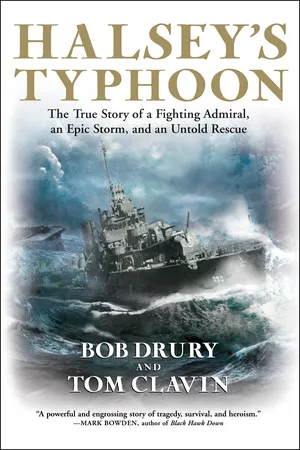
In the final days of 1944, Admiral William "Bull" Halsey is the Pacific theater's most popular and colorful naval hero. After a string of victories, the "Fighting Admiral" and his thirty-thousand-man Third Fleet are charged with protecting General MacArthur's flank during the invasion of the Philippine island of Mindoro. But in the midst of the landings, Halsey attempts a complicated refueling maneuver—and unwittingly drives his 170 ships into the teeth of a massive typhoon.
Halsey's men find themselves battling ninety-foot waves and 150 mph winds. Amid the chaos, three ships are sunk and nearly nine hundred sailors and officers are swept into the Philippine Sea. For three days, small bands of survivors battle dehydration, exhaustion, sharks, and the elements, awaiting rescue. It will be up to courageous lieutenant commander Henry Lee Plage to defy orders and sail his tiny destroyer escort, the USS
Tabberer, back into the storm to rescue drifting sailors.
Revealing a little-known chapter of WWII history in absorbing detail, this is "a vivid tale of tragedy and gallantry at sea." (
Publishers Weekly).
eBook - ePub
Halsey's Typhoon
The True Story of a Fighting Admiral, an Epic Storm, and an Untold Rescue
- 322 pages
- English
- ePUB (mobile friendly)
- Available on iOS & Android
eBook - ePub
Halsey's Typhoon
The True Story of a Fighting Admiral, an Epic Storm, and an Untold Rescue
About this book
Information
BOOK TWO
THE STORM
Bursts as a wave from the clouds impends, And swell’d with tempests on the ships descends; White are the decks with foam; the winds aloud Howl o’er the masts, and sing through every shroud: Pale, trembling, tir’d, the sailors freeze with fear; And instant death on every wave appears
—HOMER, THE ILIAD
CHAPTER 9
I received warnings continuously for 24 hours before I got into the storm, from my aerographer, from the action of the ship, and the condition of the sea. I was fully aware of the storm, and that it was going to be severe.
—TESTIMONY OF CAPT. MICHAEL H. KERNODLE, COMMANDING OFFICER, USS SAN JACINTO, TO THE COURT OF INQUIRY INVESTIGATING “HALSEY’S TYPHOON.”
Moments before first light on December 14, from a launch point several hundred miles northeast of Manila, Task Force 38 struck the Japanese with what one seaman called “God’s own hammer.”
Gouts of sand and shredded coconut palms erupted from the beaches of Mindoro as the big guns of battleships and cruisers cleared landing zones for MacArthur’s Sixth Army. Carriers turned into the wind and released deckloads of deafening aircraft that vanished over the western horizon, their targets the one hundred–odd Japanese-held airfields mapped by naval intelligence on Luzon. Low-altitude fighter squadrons from the “Jack Patrol,” scanning the wavetops for incoming kamikazes, flitted in formation like flocks of gulls three thousand feet above Halsey’s task groups.
Because the Imperial Fleet had lost all of its carrier-based air strike capability during the Battle for Leyte Gulf, there was no concern that an enemy flattop might flank the strike force. But midget submarines with their Kaiten payloads—manned suicide torpedoes—were reported prowling the area. Admiral Halsey relied upon his screen of picket destroyers and destroyer escorts to counter the threat.
As was his seagoing routine, the admiral had been awake since 5:00 A.M., seated in his high steel chair on the New Jersey’s flag bridge, watching his air squadrons lift off. There he would remain for three consecutive days as navy and Marine fighter pilots screamed low over the canefields and nipa shacks of the Philippine archipelago, flying in overlapping intervals, clamping an iron lid on enemy airfields. Between these round-the-clock “shifts,” U.S. Helldiver dive bombers and Avenger torpedo bombers ravaged Japanese runways, barracks, warehouses, and ships as far north as Formosa.
In central Luzon’s notorious Camp Cabanatuan, the largest American prisoner-of-war camp ever established on foreign soil, emaciated GIs who almost three years earlier had endured the Bataan Death March reacted to the planes streaking overhead with wonder and disbelief. Twenty-four hours earlier they had been hollow-eyed POWs without expression, as if coming from no past and having no future. Now small strands of hope rippled through their ranks as, above them, so close you could hit them with a rock, U.S. pilots, their leather helmets worn at cocky angles, waggled their wings.
Hardly a sailor or an aviator in Halsey’s fleet was not aware of the deprivations American prisoners had suffered at the hands of the Japanese. (It was an American chaplain who, during the retreat down the Bataan Peninsula, had coined the lasting phrase, “There are no atheists in foxholes.”) Since the surrender of Bataan and the Rock of Corregidor in April 1942, Cabanatuan had housed over nine thousand American POWs, nearly a third of whom now lay rotting in shallow graves beside the camp’s barracks. Those who survived had been degraded to living skeletons constructing a Japanese landing strip adjacent to the encampment. It was destroyed in an instant.
“All of us were watching through barbed wire when the planes came and turned it into a big hole,” said one prisoner. “I can’t tell you how ecstatic we were to see our own work go up in smoke.” Another American was “filled with joy” to see the panic in his sadistic jailers’ eyes.
Not all POWs were as fortunate. Just past daybreak on December 14, a Japanese reconnaissance seaplane spotted MacArthur’s invasion convoy steaming up the Sulu Sea toward Mindoro. A report was relayed to the commander of the small Puerto Princesa prison camp on the neighboring island of Palawan, who ordered 150 bewildered Americans herded into covered trenches that served as crude bomb shelters. They were doused with gasoline and set afire. The few who broke free were machine-gunned as they fled.
MacArthur and Halsey had expected atrocities, well aware that the enemy deemed foreign prisoners subhuman. The Allies also knew that five months earlier the Japanese War Ministry in Tokyo had fashioned a secret guideline for the “final disposition” of prisoners of war. The policy came to be known as the “August 1 Kill-All Order.” But neither American commander became cognizant of the specifics of the prisoners’ fate until weeks later.
For Halsey especially, the air strikes on Luzon were the most important foray any American fleet had made against a land-based enemy to this point in the war. He was ecstatic. The “Big Blue Blanket” had paralyzed Japanese airpower, breaking the kamikazes’ eight-week hold over the American navy. Only after MacArthur’s landing force had established a beachhead on Mindoro, on December 15, did enemy sorties swoop in to strike the expeditionary force. The belated Japanese counterattacks cost the general but two tanklanding ships and four LSTs.
Moreover, McCain’s “Tom Cat” strategy worked so well that not one enemy aircraft made it to within twenty miles of Third Fleet’s carriers. On the second day of fighting, a squadron of eight Zeros approaching “off the grid” was detected and blasted from the sky. The grizzled McCain glowed as if polished.
Halsey and his Dirty Tricksters had disproved the battlefield bromide that no military plan survives first contact with the enemy. Their strategy and tactics had worked to perfection. Halsey, in triumph, radioed Nimitz that every one of the Japanese planes thrown against MacArthur’s Sixth Army and Kinkaid’s Seventh Fleet had originated from airfields on either Formosa or the central Philippines; none had come from his areas of coverage on Luzon. As one eyewitness wrote, “What the toll would have been had Luzon not been covered by a huge and hostile air umbrella is easy to guess but impossible to define.”
It was, in fact, a shooting gallery. American aviators destroyed over 270 enemy aircraft, most of which never got off the ground. They reported sinking 18 Japanese ships, mostly small and mediumsized oilers, and crippling 37 more. (Unknown to Halsey’s pilots, one vessel struck by navy dive bombers on December 14 and 15 was the Oryoku Maru, a freighter moored on the west coast of Luzon in whose fetid hold were crammed sixteen hundred American prisoners of war. The POWs, most of them also survivors of the Death March, had been hastily evacuated from Camp Cabanatuan and were awaiting shipment to Japan as slave labor. Two hundred died in the bombardment.)
Third Fleet’s losses were scant. No ships took damage, and only 27 U.S. planes were destroyed by enemy fire, with another 27 put out of commission by: mechanical failure (7), empty fuel tanks (4), operational crashes (11), midair collisions (3), and 2 lost souls simply recorded as “unknown.”
In triumph, Halsey ached to press his advantage. Vae Victis. Woe to the conquered. On December 16 he petitioned Nimitz to be allowed to refuel and chase what was left of the Japanese Combined Fleet into the South China Sea, where spies in Saigon reported it to have fled after the Battle for Leyte Gulf. The admiral’s plan was typically succinct. He wanted to find it, engage it, and sink it. In his unwavering vision he saw a fleet-to-fleet showdown, a Midway redux. He knew he could not rest until he had caught the main Japanese armada right out in the open and smashed it for good. MacArthur’s words to him in November 1942 may well have echoed through his mind: “If you come with me I’ll make you a greater man than Nelson ever dreamed of being.”
Like the acclaimed British lord admiral at Aboukir Bay and Copenhagen Harbor, Halsey had tasted triumph in the Coral Sea and Leyte Gulf. He realized, like Nelson, that the way to make your mark in combat was to seize any opportunity with sureness and boldness. Now he dreamed of his own Trafalgar, the missing golden thread in his nautical tapestry. “It is annihilation that the country wants, not merely a splendid victory,” Nelson told his officers before the defining battle of the age of sail.
Halsey knew the speech; he yearned for the sensation. He surely also intuited that given the progress in modern military technology, the opportunity might be the last in history for two mighty armadas to slug it out at close quarters.
Admiral Nimitz denied Halsey his prize. CINCPAC determined that MacArthur’s defenseless concentration of men and material on the Mindoro beachhead, as well as the flood of Kincaid’s support ships just offshore, would be easy prey for land-based Japanese planes without Task Force 38’s saturated air cover. He directed Halsey to refuel and return to his attack station in the Philippine Sea, a sentinel guarding the expeditionary force’s soft underbelly. Halsey acquiesced, and trained his thoughts on the annihilation of the Japanese on Luzon.
By Saturday, December 16, Halsey’s entire task force was low on fuel, his destroyers in particular riding as high in the water as Spanish galleons beneath the dove gray sky. Escorting a carrier task force takes its greatest toll on DDs, as they continuously steam at high speed screening for submarines and enemy sorties, run at flank speed for downed pilots, and sail against the wind at a maximum 30 knots to keep pace as flattops launch and recover aircraft.
In addition, subchasing destroyer commanders bore a unique obligation. They were, naturally, accountable for the security of their own ships. But they alone in the U.S. Navy’s chain of command also bore responsibility for protecting the larger vessels they screened. This meant maintaining, uninterrupted, a submarine “sounding fence” of interconnected sonar arcs enveloping the American heavies around each of Halsey’s three individual task groups. This need to accurately remain “on station” was paramount. As one DD commander said, “Even when unusually severe sea conditions developed, a destroyer skipper normally would not have felt he could say, ‘To hell with the formation, I’m going to look out for my own ship.’”
This was an option, by contrast, open to the captains of battleships, cruisers, carriers, and even oilers. Because of this constant activity, many of Halsey’s “small boys” reported their bunkers nearly bone dry, running on perhaps a day’s worth of fuel. Among these was the former Little Beaver squadron stalwart Spence, which had been detached from the submarine screen on numerous occasions to run search-and-rescue missions for floating pilots.
That evening, his sailors and airmen exultant but exhausted, Halsey directed that Task Force 38 be withdrawn almost four hundred miles east into the Philippine Sea—to latitude 14° 50′N, longitude 129° 57′E—the prearranged rendezvous coordinates where Capt. Jasper Acuff’s oiler Task Group 30.8 would be waiting. The plan was to begin refueling operations at 8:00 A.M. the following morning.
Zigzagging in antisubmarine group formations some twenty miles apart, the outer limit of TBS, or talk-between-ships, phone range, this was as close to Luzon as Halsey dared take the fleet while remaining beyond the reach of any stray kami boys. If the replenishment went according to schedule, it would take no more than a day. He radioed MacArthur that his carrier task force would return “as soon as possible,” most likely within the next forty-eight hours, to commence another three-day series of strikes on Luzon.
MacArthur’s engineers and Kinkaid’s Seabees, slogging through unrelenting rain squalls on Mindoro, were already leveling large tracts of jungle and laying down heavy Marston matting runways over the ubiquitous mud. In a week or so, all-weather airfields for the Sixth Army’s bomber corps would sprout like mushrooms.
Meanwhile, MacArthur needed Halsey’s air cover. The Philippines campaign had reached a decisive moment. After securing Mindoro, looming just over the horizon was the invasion of Luzon, with its grand jewel of Manila. When MacArthur had vowed to “return” in 1942, no one doubted it was to the capital city that he’d directed his promise. He awaited Halsey’s imminent rearrival.
In several ways the reckless admiral and the imperious general were the opposite faces of the same Janus coin. One senses that Halsey’s overriding commitment to recapturing Luzon hinged as much on his desire to kill Japanese and avenge Pearl Harbor as to further America’s greater war aims. (Much later, on the eve of VJ Day, after the Japanese sued for peace but before the actual treaty was signed, Halsey’s “right arm,” Slew McCain, advised any pilots encountering enemy planes “to shoot them down in a friendly sort of way.”)
MacArthur, on the other hand, was a throwback, a Prussian in posture and thought, an atomic ego more at home in the eighteenth century than on the eighteenth green of Manila’s Wack Wack Golf and Country Club, the oldest and most prestigious course in the city. His chief concern lay in reclaiming the “honor” forfeited during his humiliating retreat from Corregidor. MacArthur chafed to reoccupy his penthouse headquarters in the Majestic Manila Hotel, to parade his troops through downtown Manila’s stately Rizal Park.
In the event, the crushing annexation of the largest and most strategic of the Philippine islands, a mere fifteen hundred miles from the southern tip of Japan, would be, foremost, the springboard for the coming invasions of Japanese soil—Iwo Jima, Okinawa, and beyond. Even the Imperial War Ministry understood this. “When you took the Philippines, that was the end of our resources,” wrote Japan’s naval minister Adm. Mitsumasa Yonai after the war. The Americans had indeed come far since December 7, 1941. This, Halsey knew, was something for its enemies to ponder.
Moreover, grinding just below the surface, as a sort of subconscious seismic fault, was Halsey’s sanguine memory of his near-disastrous “wild goose chase” during the Battle for Leyte Gulf two months earlier. Halsey would not stray so far from MacArthur this time, no matter the circumstances or temptations. Indeed, the fierce blowback from the Leyte Gulf incident weighed on Halsey’s mind as Task Force 38 set its course after the successful opening salvos of the Mindoro invasion. Despite his personal belief that chasing the Japanese carrier fleet had been the sound military decision, and despite MacArthur’s vote of confidence, the admiral knew that many of his peers were still sharpening long knives. In Washington, Admiral King was rumored to remain livid at the near disaster, and the perceived rebuke from Nimitz—“The World Wonders” —still stung. Halsey wanted nothing so awfully badly as to atone for the “Battle of Bull’s Run.”
The first three days of the Mindoro campaign had been a fine start, and for the first time since Ulithi, as he watched the fissures among the western cloudbanks fade from smoky crimson to violet on the evening of December 16, Halsey retired early as his task force steamed through the night to meet its oilers.
CHAPTER 10
That principle weight should have been given to the reports of the Chandeleur search plane received at 14:24 Dec. 17th, since no definite reports of the storm location had been received since the 16th.
That the aerological talent assisting Commander THIRD Fleet was inadequate in practical experience and service background in view of the importance of the services to be expected and required.
—GENERAL OPINIONS #4 AND #6 OF THE COURT OF INQUIRY’S REPORT INVESTIGATING “HALSEY’S TYPHOON.”
At 5:00 A.M. on December 17, the crew of a seaplane flying out of Ulithi spotted what appeared to be the telltale “zero-zero visibility” of what its radio operator referred to as a “tropical disturbance” some 225 miles southeast of Third Fleet’s rendezvous position. This was nearly 300 miles closer than fleet aerologist Comdr. George Kosco had forecast.
The scout plane returned to its tender, the USS Chandeleur, and its pilot encrypted the storm’s last known coordinates by means of the deliberate, handwritten cipher required for weather reports—as opposed to the faster, electronic ciphering machine used to relay intelligence and orders. This message, the dog that didn’t bark, failed to reach Halsey’s flagship until nine hours later, where it was inadvertently buried under a stack of communiqués....
Table of contents
- Cover Page
- Title Page
- Copyright Page
- Dedication
- CONTENTS
- DRAMATIS PERSONAE
- GLOSSARY
- PREFACE
- BOOK ONE THE FLEET
- BOOK TWO THE STORM
- BOOK THREE THE RESCUE
- EPILOGUE
- AFTERWORD 2006
- ACKNOWLEDGMENTS
- APPENDIX
- SELECTED BIBLIOGRAPHY
- INDEX
Trusted by 375,005 students
Access to over 1.5 million titles for a fair monthly price.
Study more efficiently using our study tools.
Frequently asked questions
Yes, you can cancel anytime from the Subscription tab in your account settings on the Perlego website. Your subscription will stay active until the end of your current billing period. Learn how to cancel your subscription
No, books cannot be downloaded as external files, such as PDFs, for use outside of Perlego. However, you can download books within the Perlego app for offline reading on mobile or tablet. Learn how to download books offline
Perlego offers two plans: Essential and Complete
- Essential is ideal for learners and professionals who enjoy exploring a wide range of subjects. Access the Essential Library with 800,000+ trusted titles and best-sellers across business, personal growth, and the humanities. Includes unlimited reading time and Standard Read Aloud voice.
- Complete: Perfect for advanced learners and researchers needing full, unrestricted access. Unlock 1.5M+ books across hundreds of subjects, including academic and specialized titles. The Complete Plan also includes advanced features like Premium Read Aloud and Research Assistant.
We are an online textbook subscription service, where you can get access to an entire online library for less than the price of a single book per month. With over 1.5 million books across 990+ topics, we’ve got you covered! Learn about our mission
Look out for the read-aloud symbol on your next book to see if you can listen to it. The read-aloud tool reads text aloud for you, highlighting the text as it is being read. You can pause it, speed it up and slow it down. Learn more about Read Aloud
Yes! You can use the Perlego app on both iOS and Android devices to read anytime, anywhere — even offline. Perfect for commutes or when you’re on the go.
Please note we cannot support devices running on iOS 13 and Android 7 or earlier. Learn more about using the app
Please note we cannot support devices running on iOS 13 and Android 7 or earlier. Learn more about using the app
Yes, you can access Halsey's Typhoon by Bob Drury,Tom Clavin in PDF and/or ePUB format, as well as other popular books in History & Military & Maritime History. We have over 1.5 million books available in our catalogue for you to explore.