"The best, the liveliest and most illuminating" account of Rockefeller, Morgan, and the other men who seized American economic power after the Civil War (
The New Republic).
John D. Rockefeller, J. P. Morgan, Cornelius Vanderbilt, Andrew Carnegie, E. H. Harriman, Jay Gould, Henry Clay Frick . . . their names carry a powerful historical ring, still echoing today in the countless institutions that are part of their legacy, from universities to museums to banks. But who were the people behind the legends, and how did they rise to their positions of vast wealth and influence in the latter half of the nineteenth century?
The Robber Barons is a classic work on the financiers and industrialists of the Gilded Age, who shaped their own era as well as the future of the United States—"not a mere series of biographies but a genuine history" (
The New York Times Book Review).
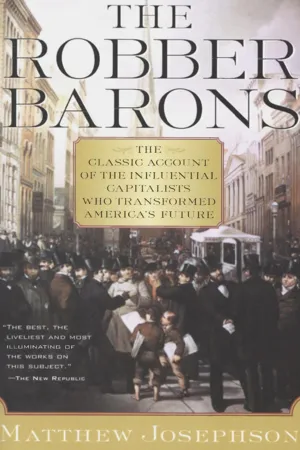
eBook - ePub
The Robber Barons
The Classic Account of the Influential Capitalists Who Transformed America's Future
- 492 pages
- English
- ePUB (mobile friendly)
- Available on iOS & Android
eBook - ePub
The Robber Barons
The Classic Account of the Influential Capitalists Who Transformed America's Future
About this book
Information
Subtopic
FinanceIndex
Social SciencesPART ONE
CHAPTER ONE
The National Scene: The National Character
THE cannonading that began at Charleston with the dawn of April 12, 1861, sounded the tocsin for the men of the new American union. The fatal clash of the two economic nations within the republic could no longer be escaped; the “irrepressible conflict” was at hand. When the trivial siege of Sumter was over, the North rallied from its stupor, its breathless waiting. A people who had barely known themselves a nation were unified at last by danger. The North, with a passion no less bitter than the South’s, moved to crush the rebel who had ruled the national policy for generations, and stubbornly barred the way of industrial growth as if he would halt inevitability itself.
In legions, the recruits, the young men of ’61, marched away to Bull Run for the three months’ war. On both sides they were the soldiers of a people without tradition or gift for military heroics; a people which had come out to attend three earlier wars only in small numbers, with remarkable apathy. The frontier democracy had known as little of the rule of the military captain as of the feudal noble or the prince of the Church. Its sons were no soldiers, yet possessed deathless courage; it had few battle leaders; most of these must rise up from disaster. Therefore the conflict would be long, the most stubborn, the most sanguinary in all the history of the West, and colossal in its scale of operations.
If the South did not truly estimate its powers for such a contest, neither did the North know its strength, its wealth, its destiny. Not many in either camp could have pictured the incredible transformations which would accompany those thundering years. And fewer still knew or sensed what the Civil War was really fought for.
The epoch of martial glory and martial stupidity need concern us but little here. We observe only that its grand blood-letting fixes a turning point at which the trend of our history declares itself: the opening of the Second American Revolution, that “industrial revolution” which worked upon society with far greater effect than the melodramatic battles. After Appomattox, in 1865, it is widely and conveniently assumed, the Old Order was ended.
“Had they been Tyrian traders of the year 1000 B.C., landing from a galley fresh from Gibraltar,” writes Henry Adams concerning his family’s return from diplomatic duties abroad, “they could hardly have been stranger on the shore of a world so changed from what it had been ten years before.” All this is true figuratively. But literally the symptoms of the future order of things, all the new shapes and forces existed vigorously in the days of Jefferson, side by side with the institutions and conditions of pre-capitalist or feudal eras. The process of change, the departure from the old ways toward large-scale industry, toward giant capitalism, toward a centralized, national economy, was long in preparing, gradual, and not too imperceptible. When the abyss of the Civil War suddenly yawned before men’s eyes it but registered a “lag” which had existed already during the whole of the preceding generation. Where England had officially recognized its economic transition peacefully by the repeal of the Corn Laws, America, through blood and iron, consecrated its own industrial revolution by the end of what had been comparatively free trade. . . .
All this we see in retrospect. But besides the young men who marched to Bull Run, there were other young men of ’61 whose instinctive sense of history proved to be unerring. Loving not the paths of glory they slunk away quickly, bent upon business of their own. They were warlike enough and pitiless yet never risked their skin: they fought without military rules or codes of honor or any tactics or weapons familiar to men: they were the strange, new mercenary soldiers of economic life. The plunder and trophies of victory would go neither to the soldier nor the statesman, but to these other young men of ’61, who soon figured as “massive interests moving obscurely in the background” of wars. Hence these, rather than the military captains or tribunes, are the subject of this history.
2
Shortly before or very shortly after 1840 were born nearly all the galaxy of uncommon men who were to be the overlords of the future society. They were born at a historical moment when by an easy effort one could as well look back at the mellow past as scan the eventful future. Their parents could remember the disturbed but very simple and light-hearted times of Mr. Jefferson, when pigs wandered unmolested at the steps of the Capitol; and it was only a comparatively few years since Mr. Jackson had “driven the money-changers from the temple.”
It was not true of course that the early Republic was a millennium of free farmers and artisans; yet in the simplicity of its organization and of its mercantile economy, the nation belonged almost to a precapitalist age. Over great regions of the country men still worked for a “livelihood” rather than for “money.” This man of the mercantile age, certainly contrasted with his successor, a few generations later, “did not stand on his head or run on all fours,” but was a “natural man” and in himself was “the meteyard of all things.” The handicrafts were widespread; little shops and factories were interspersed among the farms of New England. And it was still true, in many parts of the earlier America, that the artisan, as in olden times, loved his work and feared more that it might not be worthy of him than that he might not put a high enough price upon it. It was also true that goods circulated at a slow rate. The ingenious Yankee and his wife wove their cloth, turned their own furniture, molded their own pottery, in a manner now considered quaint but then truly economical. As their traffic in goods and moneys, while limited to narrow regions, was carried on at the pace of the horse-drawn post, the ox-cart, the river or canal vessel, so their opportunities were narrowed, while differences in station were correspondingly moderate. Thus although there were instances enough of large inequalities of wealth and power, there was more individual equality than in other countries. And of the possessors of great fortunes we note that their wealth was based on ownership of land. This was true of New York as of Virginia. In New England and elsewhere along the coast, the shipping trade was the medium of great fortune; but in this commerce too the pace of trade was long-breathed, temperate, at first.
In such spacious and leisurely days the art of politics and the art of rhetoric tended to flourish. Many documents testify to the charm of ideas and talk in the circle of Jefferson, Madison, Gallatin and Marshall, who held forth almost daily in the incompleted presidential “palace” of the village of Washington. These statesmen were latter-day Romans; in their own eyes, at least, their rôle was high. With an acrid passion, they, and behind them the mass in town dwellings and log cabins, the lowliest immigrants from Scotland and Germany, upheld the notions of the free republic upon which Napoleonic Europe and even English opinion habitually heaped its contempt. Proud of having cast off the incubus of feudal and aristocratic institutions, each toiler with “every stroke of the ax and the hoe” knew himself a gentleman and his children gentlemen. Where monarchies clerical and temporal and theatrical military adventurers sucked the nourishment of Europe, here was a land where government was simply to be a judicature and a police. In the mind of the tall, negligently dressed but eloquent statesman from Virginia, little more was necessary to make the happiness and prosperity of the people than
a wise and frugal government which shall restrain men from injuring one another, which shall leave them otherwise free to regulate their own pursuits of industry and improvement, and shall not take from the mouth of labor the bread it has earned. This is the sum of good government, and this is necessary to close the circle of our felicities.
Thus, under the lax political institutions, society would be wholly directed by interest, rather than by outworn traditions, or by the appetites of autocrats. Under favoring circumstances the Americans threw themselves into their tasks with a revolutionary zeal. And though Jefferson had hoped that only the “agricultural capacities of our country” would be furthered, rather than industry which would lead to “the mimicry of an Amsterdam, a Hamburg, a city of London,” it was soon evident that the outcome was to be a different and unattended one. It was the qualities of trade and industry, in most predatory form, and not the “agricultural capacities” that flourished in the turbulent laissez-faire society of the frontier democracy. This was one of the first effects that struck the eye Of visiting foreigners, such as Alexis de Tocqueville.
The Americans, and no less the newly arrived immigrants, were soon living in the future, filled with a large excitement over solid mountains of salt and iron, of lead, copper, silver and gold; over cornfields waving and rustling in the sun, over “limitless riches, unimaginable stores of wealth and power”—none of which the cultured satirists who frequently journeyed here could see. But the poor who came here saw those mountains of gold. These wandering Yankee traders, these “projectors,” these pioneers and immigrants remembered only how hungry and naked their forbears had been through the centuries, and were ravished by the future. To their minds, every new method which led by a shorter road to wealth, every machine which spared labor, diminished the cost of production, facilitated or augmented pleasure, seemed the grandest effort of the human intellect. Hence the two strains in the national character: political freedom and idealism, abetting a “sordid and practical” materialism, which asked nothing of ideas, of the arts, and of science, but their application toward ends of use and profit.
When we search for the springs of the national character we can never long forget that the original settlers were English Protestants. In the worshipers of the Reformed Church the individual conscience had been liberated from Catholic and Anglican formula and tradition; was freer to adjust itself flexibly to new hazards and opportunities. Among the New Englanders, for a time, and among the widely scattered Scotch-Irish, Calvinism was dominant and its influence was widespread in nearly all the colonies. And though it was not true that Calvin had introduced usury, as so many suppose, he had recognized its existence more candidly than the Catholic Church; and, as shown by R. H. Tawney, in his “Religion and the Rise of Capitalism,” Calvin liberated the economic energies of the rising bourgeoisie of Europe by his teachings. By the Calvinist scale of moral values, the true Christian “must conduct his business with a high seriousness as in itself a kind of religion.” By his sober ideal of social conduct the members of the merchant and artisan class, the roturiers, found their “soul”; saw all careers “open to character” rather than to the well-born; became wielded into a disciplined social force. Hence the combination of business address and discipline noted among the early New Englanders, as in similar milieux of the mother country whence they came. So many sayings of the time show how “among the Reformed, the greater their zeal, the greater was their inclination to trade and industry, as holding idleness unlawful.” Others commemorate the amalgam of piety and ruse which made the best of both worlds: “The tradesman meek and much a liar. . . .” We feel in the Puritan type that the will is organized, disciplined, nerved to the utmost, as Tawney concludes; and if his personal life is sober, then it is also true that he enjoys freedom in the deepest sense; he ends by utterly opposing the authority even of church officers to police him; in the end his own individual conscience is his final authority.
For the people of the Reformed Church (as for the Jews) money was long ago the sole means to power. We find early economists in the time of Charles II saying of the nonconformists that “none are of more importance than they in the trading part of the people and those that live by industry, upon whose hands the business of the nation lies so much.”
The first colonists, then, were brimming with the developed “middle-class virtues”; their strict sumptuary laws and domestic habits seemed to lead always to diligence, to cheerless self-restraint, and finally culminated in the parsimony and “holy economy” of the Quakers.1
Among those who won notable triumphs by pursuing the Puritan economic virtues was no other than the free-thinking Benjamin Franklin who was the son of Puritans; and none more than he was the representative and container of the national character in the early period of the republic. He was Defoe’s wise shopman, his “Compleat English Tradesman,” for whom “trade was not a ball where people appear in masque and act a part to make sport . . . but ‘tis a plain, visible scene of honest life . . . supported by prudence and frugality.” It was not for nothing that Franklin, even more than Washington, was held up as model for succeeding generations; indeed he was a paragon for the entire bourgeois world, inasmuch as no man of his time was more widely read than he, millions of copies of his “Poor Richard” and his “Autobiography” circulating in scores of languages, in all continents, at the outset of the nineteenth century.2 In him, as a result of the long slow process of economic and religious liberation there had crystallized what we may call the “bourgeois spirit,” as opposed to the feudal; he was the homo economicus of the new times. The usefulness of his virtue and thrift are all the more significant inasmuch as we now have the strongest reasons to believe they were public; for the rest he showed strong tendencies to relapse into little uninjurious vices in private, or when abroad in foreign land. . . .
It was Franklin, philosopher of the new middle class, inventor of a stove and the lightning rod, who lamented that we lose so much time in sleep; who framed the immortal dictum: “Time is money”; whose whole life was one long worship of “holy economy.” It was he who wrote:
. . . The way to wealth, if you desire it, is as plain as the way to market. It depends chiefly on two words, industry and frugality; that is, waste neither time nor money, but make the best use of both. Without industry and frugality nothing will do, and with them everything. He that gets all he can honestly and saves all he gets will certainly become rich, if that Being who governs the world, to whom all should look for a blessing on their honest endeavors; doth not, in His wise providence, otherwise determine.
Franklin believed that given personal restraint and prudence in the conduct of his affairs, God would oversee the rest. This Yankee was avid of novelty and invention, free of prejudices, ingenious mechanically, skillful with his hands, quick of wit. And, finally, he was respectable, his respectability being designed, as he said candidly, to impress his clients.
In order to secure my character and credit as a tradesman, I took care not only to be in reality industrious and frugal, but to avoid the appearance to the contrary. I dressed plain, and was seen at no places of idle diversion; I never went out a-fishing or shooting.
This respectability, this honesty toward customers, this conservatism, in good quality, small volume, high prices, was also a strong trait of the earlier capitalism which was already departing toward 1840. The keeping of clients, the avoidance of encroachment upon others’ trade, was part of the atmosphere of those unhurried times which referred back to a world already passing, in which man and his life were “the measure of all things” and, to a greater extent than ever afterward, of his business.
Franklin, the historic Yankee, the legendary Self-made Man, owed his success as a printer as much to his strict attention to new machinery studied in London as to his good and prudent business management; just as in journalism he owed his success to enterprise in the current of new ideas. Typical of the old order of early capitalism, he was in his own person a man of enterprise, a skilled artisan of nimble and strong hands; he was also a “small master” who having made his “primary accumulations,” held command over a little troop of apprentices and craftsmen whose associated toil represented the “division of labor” which was the momentous contribution of his century.
As in the case of Franklin, so in the other early Self-made Men of the young Republic we may study the naked process of change from the early stages of industrialism to the more advanced. We see Samuel Slater removing from England to the United States at the close of the eighteenth century, carrying in his brain the memory of Richard Arkwright’s machinery designs. Bounties had been offered for power-carding machinery by our government and the ingenious British craftsman by his skill and of course his want of scruples about the pirating and exporting of patents-then forbidden by English law-sets up at Pawtucket the first successful cotton-spinning mill. He is aided, to be sure, by local capital in the person of the pious Moses Brown of Providence who had written to him in 1790:
If thou canst do this thing, I invite thee to come to Rhode Island, and have the credit of introducing cotton-manufacture into America.
So with his own hands the Derbyshire master craftsman had set up numerous mills, employing numerous companies of workmen (whose labor as far as possible in those days was carefully divided into simple, routine motions), and had become by his technical talent a man of great wealth. Together with Moses and Obadiah Brown, the philanthropic Quakers, he had finally become a commander of armies of workmen whose mechanized and accelerated labor produced mountains of cotton and woolen cloth. But note how, while diligent and aggressive, these early masters of capital are godly men as well, giving their tithe to the Lord. Slater established in one of his mills in 1796 a Sunday-school for the improvement of his work people, “the first, or among the first, in the United States”; while Obadiah Brown, dying childless, left the stupendous sum of $100,000 to Quaker charities.
Thus at a time when most of the great fortunes were yet derived from the ownership of large landholdings, as in the Virginia of Washington or even along the Hudson River Valley, where the descendants of the Dutch patroons lived in feudal state, the first successes in manufacture and in use of natural resources revealed the significant symptoms of the new order of society.
The history of John Jacob Astor, legend of the p...
Table of contents
- Title Page
- Contents
- Copyright
- Dedication
- Foreword
- PART ONE
- The National Scene: The National Character
- What the Young Men Dream
- Of Empire-Builders
- The Winning of the West
- Two Captains of Industry
- The Fight for Erie
- Grandeurs and Miseries of Empire-Building
- PART TWO
- Rising from the Ruins
- Mephistopheles
- Caesar Borgia in California
- Giants of the Northwest
- Certain Industrialists Arose
- Morgan and the Railways
- The Robber Barons
- Again the Robber Barons
- Concentration: The Great Trusts
- The Empire of Morgan
- Battle of Giants
- Bibliography
- Index
- About the Author
- Footnotes
Trusted by 375,005 students
Access to over 1.5 million titles for a fair monthly price.
Study more efficiently using our study tools.
Frequently asked questions
Yes, you can cancel anytime from the Subscription tab in your account settings on the Perlego website. Your subscription will stay active until the end of your current billing period. Learn how to cancel your subscription
No, books cannot be downloaded as external files, such as PDFs, for use outside of Perlego. However, you can download books within the Perlego app for offline reading on mobile or tablet. Learn how to download books offline
Perlego offers two plans: Essential and Complete
- Essential is ideal for learners and professionals who enjoy exploring a wide range of subjects. Access the Essential Library with 800,000+ trusted titles and best-sellers across business, personal growth, and the humanities. Includes unlimited reading time and Standard Read Aloud voice.
- Complete: Perfect for advanced learners and researchers needing full, unrestricted access. Unlock 1.5M+ books across hundreds of subjects, including academic and specialized titles. The Complete Plan also includes advanced features like Premium Read Aloud and Research Assistant.
We are an online textbook subscription service, where you can get access to an entire online library for less than the price of a single book per month. With over 1.5 million books across 990+ topics, we’ve got you covered! Learn about our mission
Look out for the read-aloud symbol on your next book to see if you can listen to it. The read-aloud tool reads text aloud for you, highlighting the text as it is being read. You can pause it, speed it up and slow it down. Learn more about Read Aloud
Yes! You can use the Perlego app on both iOS and Android devices to read anytime, anywhere — even offline. Perfect for commutes or when you’re on the go.
Please note we cannot support devices running on iOS 13 and Android 7 or earlier. Learn more about using the app
Please note we cannot support devices running on iOS 13 and Android 7 or earlier. Learn more about using the app
Yes, you can access The Robber Barons by Matthew Josephson in PDF and/or ePUB format, as well as other popular books in Social Sciences & Finance. We have over 1.5 million books available in our catalogue for you to explore.