"This splendid reference describes every woman in Jewish and Christian scripture . . . monumental" (
Library Journal).
In recent decades, many biblical scholars have studied the holy text with a new focus on gender
. Women in Scripture is a groundbreaking work that provides Jews, Christians, or anyone fascinated by a body of literature that has exerted a singular influence on Western civilization a thorough look at every woman and group of women mentioned in the Bible, whether named or unnamed, well known or heretofore not known at all.
They are remarkably varied—from prophets to prostitutes, military heroines to musicians, deacons to dancers, widows to wet nurses, rulers to slaves. There are familiar faces, such as Eve, Judith, and Mary, seen anew with the full benefit of the most up-to-date results of biblical scholarship. But the most innovative aspect of this book is the section devoted to the many females who in the scriptures do not even have names.
Combining rigorous research with engaging prose, these articles on women in the Hebrew Bible, the Apocryphal/Deuterocanonical Books, and the New Testament will inform, delight, and challenge readers interested in the Bible, scholars and laypeople alike. Together, these collected histories create a volume that takes the study of women in the Bible to a new level.
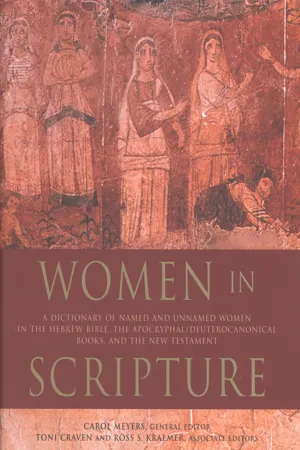
eBook - ePub
Women in Scripture
A Dictionary of Named and Unnamed Women in the Hebrew Bible, the Apocryphal/Deuterocanonical Books and the New Testament
- 608 pages
- English
- ePUB (mobile friendly)
- Available on iOS & Android
eBook - ePub
Women in Scripture
A Dictionary of Named and Unnamed Women in the Hebrew Bible, the Apocryphal/Deuterocanonical Books and the New Testament
About this book
Information
Subtopic
Les femmes dans l'histoirePART I

Named Women
Abi
"my father," from Hebrew 'āb, "father," a shortened form of Abijah
SEE Abijah 2 (Part I).
Abigail 1
meaning uncertain; perhaps "my father rejoices" or "my father is joy," from Hebrew 'ābi, "my father," and either the verb gyl, "to rejoice," or the noun gîl, "rejoicing, joy"
(1 Sam 25; 27:3; 30: 3, 5,18; 2 Sam 2:2; 3:3; 1 Chr 3:1)
Abigail is the wife of Nabal the Calebite from Carmel and later becomes the second wife of David. According to 1 Samuel 25, Abigail is married to Nabal, a wealthy rancher, and she is described as beautiful and intelligent. Her husband is just the opposite: mean and churlish. Despite Nabal's shortcomings, Abigail is an ideal wife, always protecting her husband's interests, taking the initiative when he is unable or unwilling to act, and apologizing for his rude behavior.
In her encounter with David, who is fleeing from Saul and trying to build up a following, Abigail is polite far beyond what is required. She is a woman of high socioeconomic status, by virtue of Nabal, whereas David, not yet king, is an outlaw on the run. Yet she acts toward David and addresses him as though he is the lord and she the servant. Abigail's good manners and diplomatic strategy succeed in protecting Nabal from David's wrath when Nabal fails to respond to David's request for gifts in payment for treating Nabal's shepherds well. When Nabal learns of Abigail's actions, after sobering up from a drunken state, "his heart died within him" (1 Sam 25:37). Shortly afterward he dies, and David loses no time in marrying Abigail. Whether it is because this bright and articulate woman catches his fancy, or, more likely, because the marriage is an astute political move calculated to win support in Judah, we cannot know for sure.
Abigail is mentioned along with Ahinoam the Jezreelite (David's third wife) when they accompany David in seeking refuge in Philistine territory and when they are captured by Amalekites and rescued by David (1 Sam 30:3, 5, 18). Abigail again appears with Ahinoam when these two wives go with David to Hebron, where they settle and where David is anointed king (2 Sam 2:2). Abigail is the mother of David's second son, Chileab (2 Sam 3:3; Daniel, according to 1 Chr 3:1), born in Hebron.
As a character, Abigail is not very well developed and does not figure to any great extent in the stories of David outside of 1 Samuel 25. Yet she serves the important function of glorifying and validating David's kingship. First, her prescient words, representing the narrator's pro-David point of view, foreshadow the future kingship of David and validate the legitimacy of his rule: "the LORD will certainly make my lord a sure house, because my lord is fighting the battles of the LORD. . .. When the LORD has done to my lord according to all the good that he has spoken concerning you, and has appointed you prince over Israel . . ." (1 Sam 25:28–30).
Moreover, 1 Samuel 25 is situated between two episodes in which David has the opportunity to kill Saul, but resists. In this article's episode, too, David maintains extraordinary self-control and leaves it to God to dispatch his opponent. The Abigail story, like the Saul stories, is a strong endorsement of David's destiny to reign as the chosen favorite of God.
1 Samuel 25 stands in stark contrast to, and serves as a mirror image of, the Bathsheba story in 1 Samuel 11–12. Both Abigail and Bathsheba are originally married to other men, and both become the wives of David, yet by very different courses of events. In the Abigail story, the woman is married to an evil husband, yet David is prevented by the woman from murdering her husband, as he clearly acknowledges (1 Sam 25:33–34). In the case of Bathsheba, whose husband is portrayed as a good man, David is led to order the murder of the husband because of his desire for the woman. The Abigail story contains no illicit sex, though the opportunity was present; the Bathsheba story revolves around an illicit relationship. In the Abigail story, David, the potential king, is seen as increasingly strong and virtuous, whereas in the Bathsheba story, the reigning monarch shows his flaws ever more overtly and begins to lose control of his family.
ADELE BERLIN
SEE ALSO Part I: Ahinoam 2; Bathsheba; Bath-shua 2; Eglah; Haggith; Maacah 2; Michal; Part II: Wives of David (2 Sam 12:11, etc.); Concubines of David (2 Sam 15:16, etc.).
FOR FURTHER READING: Berlin, Adele. Poetics and Interpretation of Biblical Narrative.
Levenson, Jon D. "1 Samuel 25 as Literature and History."
_____. and B. Halpern. "The Political Import of David's Marriages."
Abigail 2
(2 Sam 17:25; 1 Chr 2:16–17)
Abigail and Zeruiah are sisters of King David (reigned c. 1005–965 B.C.E.) and mothers of the rivals Amasa and Joab, respectively. Chronicles lists Abigail among the children of Jesse, David's father. However, Samuel's reference to Abigail as "daughter of Nahash" (king of Ammon), usually dismissed as a scribal error, may indicate that David and his sisters have different fathers.
Biblical sources conflict over the ethnicity of Abigail's husband, who is identified as Ithra the "Israelite" (2 Sam 17:25) and Jether the "Ishmaelite" (1 Chr 2:17). Nabal, a wealthy herdsman from Maon, also had a wife named Abigail who saved their household by countermanding her husband's refusal to feed David's men (1 Samuel 25). Nabal, meaning "fool," probably was not his actual name. If Ithra/Jether is the real name of Nabal, as Levenson and Halpern suggest, then David marries his (half?) sister.
Later tradition would suppress the memory of this incestuous union. This match might have been politically desirable if Abigail was the daughter of Nahash, king of Ammon (2 Sam 17:27). The Ammonites were enemies, and the simplest way to avoid conflict with one's foes was to make a marriage alliance.
RHONDA BURNETTE-BLETSCH
SEE ALSO Part I: Abigail 1; Zeruiah.
FOR FURTHER READING: Levenson, Jon D., and Baruch Halpern. "The Political Import of David's Marriages."
Abihail 1
meaning uncertain; perhaps "father is," from Hebrew 'āb, "father," and hyh, "to be"; or "my father is strength," from Hebrew 'ābî, "my father," and ḥāyil, "strength," with the first letter miswritten
(1 Chr 2:29)
Abihail is named as the mother of Ahban and Molid and the wife of Abishur, a fifth-generation descendant of Hezron, who also is David's ancestor. The genealogies in 1 Chronicles are designed to emphasize the primary role of the tribe of Judah within the national unit known as Israel, and also within Judah, the importance of the house of David.
DIANA VIKANDER EDELMAN
Abihail 2
(2 Chr 11:18)
This sexual partner, presumably a wife, of King David (reigned c. 1005–965 B.C.E.), is named only once in the Hebrew Bible, in connection with David's grandson King Rehoboam. Rehoboam's wife, Mahalath, is the granddaughter of Abihail and King David. The text identifies Abihail's father as Eliab, who, like David, is a son of Jesse. This seems to make Abihail not only David's wife, but also his niece. This double connection to David brings together Jesse's oldest son, Eliab, and his youngest son, David, perhaps reconciling them. Eliab becomes head of the tribe of Judah (1 Chr 27:18), and David becomes king.
ALICE L. LAFFEY
SEE ALSO Part I: Mahalath 2; Part II: Women of Rehoboam (Eighteen Wives, Sixty Concubines, and Sixty Daughters) (2 Chr 11:21).
Abijah 1
"my father is Yah," from Hebrew 'ābî, "my father," and yāh, a shortened form of YHWH
(1 Chr 2:24)
Abijah is the wife of Hezron, ancestor of an important clan in the tribe of Judah. She is mentioned at the end of the complicated genealogy of Hezron's family in 1 Chronicles 2, and it is not clear if she is the mother of Hezron's first three sons (1 Chr 2:19), the daughter of Machir, whom he married when he was sixty years old (2:21), or a third wife. Furthermore, perhaps because Abijah is more often a man's name than a woman's, the difficulties in this passage are sometimes resolved by eliminating Abijah from the translation (as in the RSV, NAB, and REB) and by assuming that 2:24 is referring to Ephrathah as the wife of Hezron.
JULIA MYERS O'BRIEN
SEE ALSO Part 1: Ephrath/Ephrathah.
FOR FURTHER READING: Williamson, H. G. M. "Source and Redaction in the Chronicler's Genealogy of Judah."
Abijah 2/Abi
Abi: "my father," from Hebrew 'āb, "father"; a shortened form of Abijah
(2 Kgs 18:2; 2 Chr 29:1)
Abijah was the chief wife of Ahaz, king of Judah from 743 to 727 B.C.E., and the daughter of Zechariah, a Judean aristocrat possibly associated with the prophet Isaiah (Isa 8:2). At the coronation of her son, Hezekiah, Abijah/Abi became queen mother, perhaps the highest position for a female in the Judean royal court. She is often identified as the "young woman," mother of the symbolic child Immanuel (meaning "God is with us"), in Isa 7:14.
RHONDA BURNETTE-BLETSCH
SEE ALSO Part I: Maacah 4; Hamutal/Hamital; Nehushta; Part II: Young Woman (Isa 7:14).
FOR FURTHER READING: Ackerman, Susan. "The Queen Mother and the Cult in Ancient Israel."
Abishag
"my father goes astray," from Hebrew 'ābî, "my father," and the verb šgg, "to go astray"
(1 Kgs 1:1–4,15; 2:13–25)
When King David (reigned c. 1005–965 B.C.E.) ages and his health fails, a beautiful young woman is sought throughout Israel to lie in his bosom and keep him warm. The king does not have sexual relations with Abishag (1 Kgs 1:4). This physical impotence mirrors his political impotence; the next verse reports the premature claim of his son Adonijah (son of his fourth wife, Haggith) to his throne. Bathsheba, David's major wife at this point in his life story, responds to Adonijah's preemption by convincing David to name her son Solomon as his successor, in a conversation at which Abishag is also present (1:15). After the death of David, the temporary reconciliation of Adonijah and Solomon ends when Adonijah uses Bathsheba as an intermediary to request from the new king Abishag's hand in marriage. Solomon responds violently, ordering Adonijah's assassination (2:13–25).
The unspeaking Abishag is more a tool to move the plot along than a developed character: she marks first the inability of David to continue his rule and, later, the inability of Adonijah to assume that power. The latter incident has perplexed commentators: why would Solomon react so strongly against Adonijah's marriage proposal? Many assume Adonijah makes a move on David's harem and, thus, a symbolic claim to his father's throne, although this seems to be an unlikely maneuver for a politically weakened man. This and other texts in which a king's sexual partner(s) are seized by other men (2 Sam 3:6–11; 16:20–22) may reflect broader cultural norms regarding male honor and "the traffic in women"—the roles women play as mediators between men—rather than specific political claims. Solomon thus asserts his claim on his mother's loyalty, and his right to determine the sexual fate of the female members of what is now his household, against Adonijah's insinuations of status.
CLAUDIA V. CAMP
SEE ALSO Part I: Abigail 1; Bathsheba; Rizpah; Part II: Concubines of David (2 Sam 15:16, etc.)
FOR FURTHER READING: Fewell, Danna Nolan, and David M. Gunn. Gender, Power, and Promise.
Stone, Ken. "Sexual Power and Political Prestige: The Case of the Disputed Concubines."
Abital
"my father is dew," from Hebrew 'ābî, "my father," and ṭal, "dew"
(2 Sam 3:4; 1 Chr 3:3)
Abital is the wife of King David (reigned c. 1005–965 B.C.E.) and the mother of Shephatiah. She is fifth on a list of six mother-son references concerning David's sons born in Hebron (2 Sam 3:2–5; 1 Chr 3:1–4). David's wives were apparently carefully chosen to form alliances with various factions in the emerging monarchy, thus securing loyalty of important segments of the tribal groups.
LINDA S. SCHEARING
SEE ALSO Part I: Abigail 1; Ahinoam 2; Bathsheba; Eglah; Haggith; Maacah 2; Part II: Wives and Concubines of David, Taken in Jerusalem (2 Sam 5:13);...
Table of contents
- Copyright
- Dedication
- Contents
- Contributors
- PREFACE
- AN INTRODUCTION TO THE BIBLE
- The Hebrew Bible
- The Apocryphal/Deuterocanonical Books
- The New Testament
- FEMINIST BIBLICAL SCHOLARSHIP
- NAMES AND NAMING IN THE BIBLICAL WORLD
- PART I NAMED WOMEN
- PART II UNNAMED WOMEN
- PART III FEMALE DEITIES AND PERSONIFICATIONS
- Additional Ancient Sources
- Abbreviations
- Bibliography
- Acknowledgments
Trusted by 375,005 students
Access to over 1.5 million titles for a fair monthly price.
Study more efficiently using our study tools.
Frequently asked questions
Yes, you can cancel anytime from the Subscription tab in your account settings on the Perlego website. Your subscription will stay active until the end of your current billing period. Learn how to cancel your subscription
No, books cannot be downloaded as external files, such as PDFs, for use outside of Perlego. However, you can download books within the Perlego app for offline reading on mobile or tablet. Learn how to download books offline
Perlego offers two plans: Essential and Complete
- Essential is ideal for learners and professionals who enjoy exploring a wide range of subjects. Access the Essential Library with 800,000+ trusted titles and best-sellers across business, personal growth, and the humanities. Includes unlimited reading time and Standard Read Aloud voice.
- Complete: Perfect for advanced learners and researchers needing full, unrestricted access. Unlock 1.5M+ books across hundreds of subjects, including academic and specialized titles. The Complete Plan also includes advanced features like Premium Read Aloud and Research Assistant.
We are an online textbook subscription service, where you can get access to an entire online library for less than the price of a single book per month. With over 1.5 million books across 990+ topics, we’ve got you covered! Learn about our mission
Look out for the read-aloud symbol on your next book to see if you can listen to it. The read-aloud tool reads text aloud for you, highlighting the text as it is being read. You can pause it, speed it up and slow it down. Learn more about Read Aloud
Yes! You can use the Perlego app on both iOS and Android devices to read anytime, anywhere — even offline. Perfect for commutes or when you’re on the go.
Please note we cannot support devices running on iOS 13 and Android 7 or earlier. Learn more about using the app
Please note we cannot support devices running on iOS 13 and Android 7 or earlier. Learn more about using the app
Yes, you can access Women in Scripture by Carol Meyers, Toni Craven, Ross S. Kraemer, Carol Meyers,Toni Craven,Ross S. Kraemer in PDF and/or ePUB format, as well as other popular books in Théologie et religion & Les femmes dans l'histoire. We have over 1.5 million books available in our catalogue for you to explore.