Practical Civil Engineering
eBook - ePub

Practical Civil Engineering

  1. 592 pages
  2. English
  3. ePUB (mobile friendly)
  4. Available on iOS & Android
eBook - ePub

Practical Civil Engineering

About this book

The book provides primary information about civil engineering to both a civil and non-civil engineering audience in areas such as construction management, estate management, and building. Basic civil engineering topics like surveying, building materials, construction technology and management, concrete technology, steel structures, soil mechanics and foundations, water resources, transportation and environment engineering are explained in detail. Codal provisions of US, UK and India are included to cater to a global audience. Insights into techniques like modern surveying equipment and technologies, sustainable construction materials, and modern construction materials are also included.

Key features:

• Provides a concise presentation of theory and practice for all technical in civil engineering.

• Contains detailed theory with lucid illustrations.

• Focuses on the management aspects of a civil engineer's job.

• Addresses contemporary issues such as permitting, globalization, sustainability, and emerging technologies.

• Includes codal provisions of US, UK and India.

The book is aimed at professionals and senior undergraduate students in civil engineering, non-specialist civil engineering audience
Frequently asked questions

Yes, you can cancel anytime from the Subscription tab in your account settings on the Perlego website. Your subscription will stay active until the end of your current billing period. Learn how to cancel your subscription.
No, books cannot be downloaded as external files, such as PDFs, for use outside of Perlego. However, you can download books within the Perlego app for offline reading on mobile or tablet. Learn more here.
Perlego offers two plans: Essential and Complete
  • Essential is ideal for learners and professionals who enjoy exploring a wide range of subjects. Access the Essential Library with 800,000+ trusted titles and best-sellers across business, personal growth, and the humanities. Includes unlimited reading time and Standard Read Aloud voice.
  • Complete: Perfect for advanced learners and researchers needing full, unrestricted access. Unlock 1.4M+ books across hundreds of subjects, including academic and specialized titles. The Complete Plan also includes advanced features like Premium Read Aloud and Research Assistant.
Both plans are available with monthly, semester, or annual billing cycles.
We are an online textbook subscription service, where you can get access to an entire online library for less than the price of a single book per month. With over 1 million books across 1000+ topics, we’ve got you covered! Learn more here.
Look out for the read-aloud symbol on your next book to see if you can listen to it. The read-aloud tool reads text aloud for you, highlighting the text as it is being read. You can pause it, speed it up and slow it down. Learn more here.
Yes! You can use the Perlego app on both iOS or Android devices to read anytime, anywhere — even offline. Perfect for commutes or when you’re on the go.
Please note we cannot support devices running on iOS 13 and Android 7 or earlier. Learn more about using the app.
Yes, you can access Practical Civil Engineering by P.K. Jayasree,K Balan,V Rani in PDF and/or ePUB format, as well as other popular books in Tecnología e ingeniería & Ingeniería civil. We have over one million books available in our catalogue for you to explore.

Information

1 Introduction to Civil Engineering

1.1 Scope of Civil Engineering

Engineering discipline is a vast area that offers unlimited specialization. It can be defined as the systematic presentation of scientific principles employed for the advantage of the public. It is the career in which the understanding of mathematics and natural sciences, achieved by learning, understanding, and rehearsal, is supported by wisdom to acquire methods to consume the material and forces of the environment for the utility of society in a cautious way. The conventional divisions of engineering are civil, mechanical, and electrical engineering. Other than these basic divisions, there are numerous other branches. To name a few, computer engineering, aeronautical engineering, industrial engineering, chemical engineering, marine engineering, automobile engineering, polymer engineering, textile engineering, ceramic engineering, and so on.
As engineers with specific skills established their logical knowledge and professional organizations, the opportunity of civil engineering was confined to construction, which was the first to utilize scientific principles. For example, the theory of cantilever was first explored by Galileo Galilei. Civil engineering is an engineering specialty and is considered to be the original one among all branches of engineering. The Institution of Civil Engineers (ICE), UK, in its royal charter has defined Civil Engineering as “the art of directing the great sources of power in nature for use and convenience of the man.” It includes planning, design, erection as well as repairs of the built structures like bridges, buildings, roads, dams, canals, railways, reservoirs, towers, spillways, and chimneys. However, Civil Engineering alone cannot sustain independently. It has to join hands with other branches of Engineering. In fact, different branches of engineering should balance and also complement each other, though each one including Civil Engineering has its own distinct and precise roles in the development and progress of the society.
An engineer means the one who converts the concepts into realism using the developed scientific information and accessible resources for the profit of the community. Civil engineers have one of the world’s most significant jobs. They work with structures. Civil engineers are constantly engaged in developing approaches and amenities to survive with most of the earth’s severe worries. In the present condition of polluted air, rotten cities, roadways, bridges, congested airports and highways, contaminated rivers, lakes and streams, the civil engineer is being called on to propose solutions that are feasible, sustainable, and economical. He will be responsible for refining the class of living in these areas and much more. Civil engineers are the principal manipulators of present day’s cutting-edge technology from all branches of engineering. They utilize the up-to-date perceptions in the computer-aided design during planning, designing, and construction. Various types of software are being used in project scheduling and cost constraints. It can be justifiably believed that we cannot have current advancements without civil engineers. Thus the key scope of civil engineering is planning, designing, estimating, contracting, and management of diverse construction events for the benefit of the society.

1.2 Responsibilities and Role of a Civil Engineer

Civil engineers are considered to be the engineers of progress. A building is designed by civil engineers by attributing a group of structural elements that sustain the architectural 3-D scattering. A civil engineer plans a highway by forming a plane that can sufficiently withstand the stress and strains of the moving vehicles and of the centrifugal forces at the curves. Civil engineers design water resource system with provision for the water intake at a suitable source, a water transmission arrangement to carry the water to a water treatment plant, and a water distribution network to supply the water to the end user. Waste water disposal and waste water treatment plant that empties the depleted water away from the user, treats it to neutralize the pathogen carriers and harmful organic materials, and carefully empties it into a suitable carrier without harmfully impairing its natural environment are also designed by a civil engineer.
Civil engineers are the leading performers of development during serene situations. They also design and construct the essential infrastructure on which fiscal progress of a nation relies.
The key responsibilities of a civil engineer can be attributed as given:
  • To gather information through exploration and assessment of property and resources.
  • To choose construction procedures which result in the accomplishment of the project with optimal period and rate.
  • To design the project in such a manner that it allows utmost benefits by scientific and engineering codes.
  • To confirm the usage of materials, manpower, and equipment present at the location of a project, which cuts the rates down.
  • To do surveying and leveling with survey instruments.
  • To make maps, plans, and all other appropriate sketches.
  • To do soil investigation.
  • To carry out scheduling and overseeing the project.
  • To formulate estimates, cost analysis, and tenders with specifications and conditions of contract for the project.
  • To design a structure by means of recent approaches to structural analysis.
  • To collaborate with the architect for attaining the needed exterior and overall aesthetics of the project.
  • To do the estimation of land and building.
  • To take up all duties and at times risks associated with the implementation of a project.
The role of the civil engineer with respect to the level he is working can be enlisted as follows:
  1. When he designs a building: Civil engineer plans the building, according to different architectural principles and to meet the basic needs of the proposed building like residential, commercial, or industrial. He should consider the orientation, aspect, prospect, roominess, privacy, ventilation and lighting, flexibility and circulation of the building and also keeps in mind the basic services like plumbing, electrical fitting, water supply, and drainage system.
  2. At a sector or colony level: At a sector or colony level, a greater emphasis is laid on social infrastructure like a community hall, dispensary, primary school, temple, planning of open spaces.
  3. At a city or town level: At a city or town level, a civil engineer works on the city/town development plan. He thinks and plans the circulation pattern, because, on the basis of the circulation pattern, the form of the city is decided. This is followed by zoning and thus the city is divided into various zones like residential zone, commercial zone, agricultural zone, industrial zone, vegetation zone, etc.
  4. At a regional level: At a regional level, the civil engineers work on accessibility among different centers. For achieving this they plan out various modes of transportation. They also plan out the various complexes for the government and government employees.
  5. At a state level: At a state level, the civil engineers are working for the connectivity of various regions, basically the state highways. They also plan out various hydraulic structures and also go for watershed development and management.
  6. At a national level: The responsibilities of civil engineer increase manifolds at the national level. Interconnectivity of various states takes his prime concern and he works for national highways, railways and also develops airports, docks, and harbors. Apart from this, he also has to plan for several constructions which are important for a country from the strategic point of view.

1.3 History of Civil Engineering

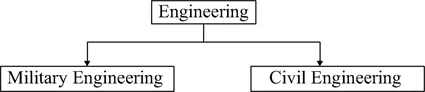
Earlier, engineering was divided into just two heads as shown in Figure 1.1.
FIGURE 1.1 Engineering was divided into just two heads.
Military engineering: During the former half of the 18th century, military engineers were mainly responsible for large-scale construction work. Military engineering involved works like design as well as construction of bridges and roads, topographical map preparation, the construction of docks and ports, etc., which are needed for the easy movement of military regiments.
However, presently, military engineering deals with employing engineering sciences for military purposes. It has grown into a specialized field of engineering and has resulted in separate engineering subdisciplines such as electrical engineering to provide solutions to all problems of radio, telephone, telegraph, and various other types of communications, chemical engineering for the research, analysis, and the development of propellants and the Signal Corps ordnance, also includes mechanical engineering for the development of guns.
Civil engineering: The term civil engineering was conceived in the 18th century. It describes the engineering effort that was done by ordinary civilians for nonmilitary uses. In other words, the various applications of scientific knowledge done for refining the standard and value of living of the civilians are categorized under civil engineering. Hence, it can be said that “Civilization is through Civil Engineering.”
Civil engineering has always played a vital role in human life. This oldest branch of engineering, civil engineering, had begun to commence during the period 4000 and 2000 BC. It is believed to have developed in ancient Egypt and Mesopotamia. When man began to put an end to his nomadic life, there developed a necessity for the construction of a home for his protection and shelter. Along with this, transportation became inevitable, since it was necessary to carry the construction materials. The Pyramids of Egypt (2700–2500 BC) are still regarded as the first large construction made. Some similar large prehistoric civil engineering structures are Apian Way of Rome (312 BC), the Great Wall of China (220 BC), and the Parthenon in Greece (447–438 BC). Historical evidence of construction of civil engineering structures like aqueduct, bridges, dams, reservoirs, and roads by the Romans has also been traced. Archim...

Table of contents

  1. Cover
  2. Half Title
  3. Title Page
  4. Copyright Page
  5. Table of Contents
  6. Authors
  7. Chapter 1 Introduction to Civil Engineering
  8. Chapter 2 Units, Measurements, and Symbols
  9. Chapter 3 Preliminary Mathematics
  10. Chapter 4 Engineering Mechanics
  11. Chapter 5 Mechanics of Structures and Their Analysis
  12. Chapter 6 Principles of Surveying
  13. Chapter 7 Building Materials
  14. Chapter 8 Building Construction Technology and Management
  15. Chapter 9 Concrete Technology
  16. Chapter 10 Reinforced Concrete Structures
  17. Chapter 11 Steel Structures
  18. Chapter 12 Fluid Mechanics
  19. Chapter 13 Engineering Hydrology
  20. Chapter 14 Water Resources Engineering
  21. Chapter 15 Soil Mechanics
  22. Chapter 16 Foundation Engineering
  23. Chapter 17 Traffic and Transportation Engineering
  24. Chapter 18 Water Supply Engineering
  25. Chapter 19 Sanitary Engineering
  26. Chapter 20 Environmental Engineering
  27. Chapter 21 Quantity Surveying and Valuation
  28. Chapter 22 Sustainable Technology and Green Building
  29. Bibliography
  30. Index