In the second half of the nineteenth century, the Zanzibar Sultanate became the focal point of European imperial and humanitarian policies, most notably Britain, France, and Germany. In fact, the Sultanate was one of the few places in the world where humanitarianism and imperialism met in the most obvious fashion. This crucial encounter was perfectly embodied by the iconic meeting of Dr. Livingstone and Henry Morton Stanley in 1871. This book challenges the common presumption that those humanitarian concerns only served to conceal vile colonial interests. It brings the repression of the East African slave trade at sea and the expansion of empires into a new light in comparing French and British archives for the first time.
"Raphaël Cheriau argues that the 'brutal power politics' of recent humanitarian interventions have shaped historians' perspectives on earlier interventions, but that he is able to escape these present-day sensibilities in his approach to British and French interventions in nineteenth-century eastern Africa. While I might challenge that suggestion, nonetheless he offers historians a valuable book that explores in detail the way imperialists of the nineteenth century did and did not use humanitarianism as a justification for their work in eastern Africa." - Elisabeth MacMahon, The English Historical Review
"The author weaves together a rich trove of primary documents from both British and French archives; some of these have been fruitfully exploited by previous historians, others reflect Cheriau's energetic digging to go beyond the obvious. He also draws upon an equally dense corpus of published primary sources in both languages, as well as several contemporary newspapers, while his mastery of the secondary literature is impressive." - Edward Alpers, Australian Institute of International Affairs
The right of visit, the French flag, and the repression of the slave trade in Zanzibar
1The repression of the slave trade
An impossible mission?
In the second half of the nineteenth century, the Royal Navy had, among many other imperial tasks, to complete a great humanitarian mission in the Western Indian Ocean. British sailing and steam vessels were engaged in the repression of the slave trade in this part of the world after having focused on the Atlantic in the first half of the century. This chapter will demonstrate how complex and difficult the task of the navy officers was. First of all, we will see that the Indian Ocean slave trade had nothing to do with what British sailors and officers had experienced before in the Atlantic. This proved to be a major obstacle to British repression because men on the spot lacked the knowledge which would have allowed them to tackle the traffic. Secondly, we will point that there was a great gap between the official political discourse in Britain and the means at the disposals of the men on the spot even though anti-slavery operations at sea made the pride of the British public opinion and government officials at home. The mission assigned to British navy officers could not be implemented because of the lack of resources dedicated to anti-slavery patrols in the Indian Ocean. The British government had given its navy a titanic task without providing the appropriate practical means. Finally, this chapter will demonstrate that far from being superior to native vessels engaged in the slave trade, the Royal Navy ships were, much like its officers, not adapted to patrols these seas whereas dhows fitted perfectly in their natural environment and could easily evade the control which a foreign imperial power tried to impose upon them.
1.1Zanzibar dhows and the elusive Indian Ocean slave trade
In the age of steam, speed, and empires, one might have thought that dhows were but the romantic remains of a bygone age. Dhow – or boutre in French – was a generic term used to describe more than 80 different types of sailing vessels in the Western Indian Ocean also known as the ‘dhows’ countries’.1 Since the 1500s, dhows characterized the navigation in the Gulf of Oman, the Red Sea, East Africa, and the Persian Gulf as well as the Western shores of India.2 These vessels, with their elegant and long thin hulls rigged with one or two lateen sails, were, and still are, iconic. They symbolize the historical naval supremacy of Arabian societies – Oman and the Gulf States in particular – in this part of the world.3 On the coast of Zanzibar, dhows flying Oman’s red flag materialized the Sultanate maritime Empire over East Africa and its connection to the Persian Gulf.4 Part of the Sultan’s sovereignty resided in the more or less 600 dhows that made trading and political as well as cultural interactions possible between Oman and Zanzibar.5 Although they had been dominating the Western Indian Ocean trade for at least three centuries, Swahili, Omani, Arabian, Persian, and Indian dhows were gradually challenged by European vessels – sails or steamers – and lost their pre-eminence throughout the Victorian age.
In Britain, dhows became known to the general public in the context of the suppression of the Indian Ocean slave trade during the second half of the nineteenth century. This was accomplished thanks to popular narratives written by famous British explorers – such as David Livingstone – and well-known Royal Navy officers – like Georges L. Sulivan or Philip Colomb. In the meantime, a larger readership was reached by the engravings published by The Illustrated London News in the 1870s and the 1880s.6 In Britain, dhows became ‘especially well known in connection with the slave trade on the east coast of Africa’ and, one should add, Zanzibar.7 In France however, dhows were more identified with the trade and traditions of the Indian Ocean as it clearly appears in the survey published by the naval officers Charles Guillain in 1856 or the work of the international lawyer Charles-Brunet Millon in 1910.8 Millon, for example, described dhow owners not as slavers but as the ‘old masters of the sea’.9 Whether seen as evil slavers or beautiful oriental sailing vessels, dhows were one of the many icons, which embodied a complex and fascinating Middle-East in Europe throughout the age of empires. To a certain extent, dhows were then a metaphor of European Orientalism.10
It was quite ironic that most of the western public associated the Indian Ocean slave trade with the words ‘Dhows’ or ‘Arabs’ since this nefarious traffic had been dominated by the Europeans in the eighteenth and most of the nineteenth century. It was for instance estimated by Richard B. Allen that more than half – nearly 60 per cent – of transoceanic slave exports from East Africa between 1801 and 1873 was carried out by European vessels, most notably French ones.11 Allen assesses that between 800,000 and 1 million people fell in the hands of European slave traders at the time while this traffic destroyed the lives of between 800,000 and over 3 million Africans in the nineteenth century as a whole.12 Paradoxically, the popular representation crafted at the height of the British Indian Ocean anti-slavery operations had somehow partly thrown these historical facts into oblivion.
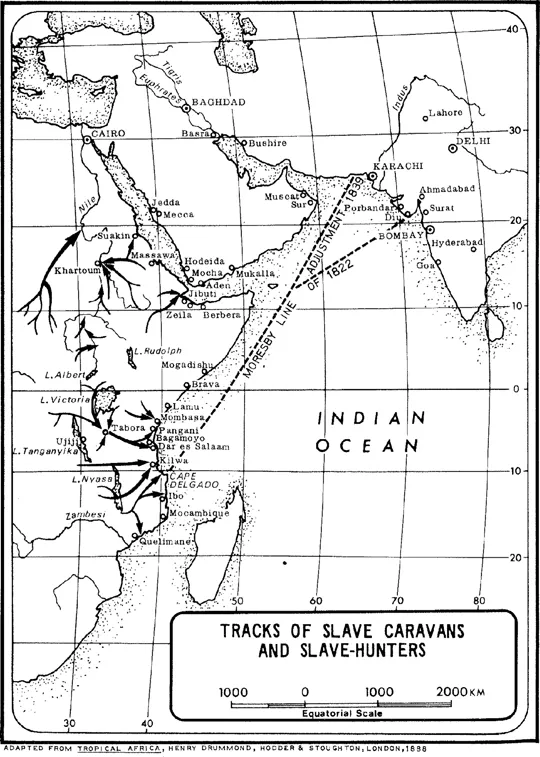
With the decline of the European slave trade, following British and French abolition of colonial slavery in 1833 and 1848, it is nevertheless undeniable that dhows quickly became the main purveyors of this ignominious traffic. Paul E. Lovejoy, referring to the works of Edmond B. Martin and T. C. I. Ryan, highlights that the East African slave trade to Arabia, Persia, and India amounted to 347,000 people between 1801 and 1896. On the East African coast alone, the figure rose to 769,000 (See Map 1.1).13 The vast majority of these children, men, or women were, without doubt, carried by dhows and sold to work on plantations in East Africa – cloves – and Arabia – dates – as well as pearl divers in the Persian Gulf.14 Notwithstanding, as we will see in Chapter Two, these dhows were far from all flying the colours of Zanzibar, Oman, or the Gulf states. As colonisation progressed in East Africa, more and more flew the French, the British, or the German flag. In a report addressed in 1880 to the French Consul of Zanzibar and the French Navy Minister, Admiral Aristide Vallon, commander of the French naval station in the Indian Ocean, remarked that: ‘all dhows sailed by Arabs whether they fly the French, the British, the Arab, or Malagasy flag are all equally tempted to get involved in the slave trade’.15
Map 1.1Slave caravans and slave hunters (from R. W. Beachey, The Slave Trade of Eastern Africa: A Collection of Documents, London: Rex Collings, 1976, 133).
However, the Indian Ocean slave trade carried out by dhows in the second half of the nineteenth century is much more elusive than its Atlantic counterpart. First of all, archives are not as readily accessible and comprehensive as in the Atlantic. In this part of the world, not only is the slaves’ voice almost lost but historians also rely heavily on the estimates which British Consuls and Navy Officers crafted while they coordinated British anti-slave trade operations.16 It i...
Table of contents
Cover
Half Title
Series Page
Title Page
Copyright Page
Dedication Page
Contents
List of figures
List of maps
List of tables
Acknowledgements
List of Abbreviations
A note on translations
Introduction: Zanzibar or the dramatic encounter of imperialism and humanitarianism
PART I The right of visit, the French flag, and the repression of the slave trade in Zanzibar
PART II Empire and humanitarian action in Zanzibar: A troublesome relationship
PART III Zanzibar’s contribution to international law and humanitarian operations
Conclusion: abolitionism and humanitarian intervention; ‘ugly business behind great words’?
Select bibliography
Index
Trusted by 375,005 students
Access to over 1.5 million titles for a fair monthly price.
Study more efficiently using our study tools.
Frequently asked questions
Yes, you can cancel anytime from the Subscription tab in your account settings on the Perlego website. Your subscription will stay active until the end of your current billing period. Learn how to cancel your subscription
No, books cannot be downloaded as external files, such as PDFs, for use outside of Perlego. However, you can download books within the Perlego app for offline reading on mobile or tablet. Learn how to download books offline
Perlego offers two plans: Essential and Complete
Essential is ideal for learners and professionals who enjoy exploring a wide range of subjects. Access the Essential Library with 800,000+ trusted titles and best-sellers across business, personal growth, and the humanities. Includes unlimited reading time and Standard Read Aloud voice.
Complete: Perfect for advanced learners and researchers needing full, unrestricted access. Unlock 1.5M+ books across hundreds of subjects, including academic and specialized titles. The Complete Plan also includes advanced features like Premium Read Aloud and Research Assistant.
Both plans are available with monthly, semester, or annual billing cycles.
We are an online textbook subscription service, where you can get access to an entire online library for less than the price of a single book per month. With over 1.5 million books across 990+ topics, we’ve got you covered! Learn about our mission
Look out for the read-aloud symbol on your next book to see if you can listen to it. The read-aloud tool reads text aloud for you, highlighting the text as it is being read. You can pause it, speed it up and slow it down. Learn more about Read Aloud
Yes! You can use the Perlego app on both iOS and Android devices to read anytime, anywhere — even offline. Perfect for commutes or when you’re on the go. Please note we cannot support devices running on iOS 13 and Android 7 or earlier. Learn more about using the app
Yes, you can access Imperial Powers and Humanitarian Interventions by Raphaël Cheriau in PDF and/or ePUB format, as well as other popular books in History & 19th Century History. We have over 1.5 million books available in our catalogue for you to explore.