Empowering Teachers through Environmental and Sustainability Education draws inspiration from an empirical study exploring early career teachers' attempts at enacting Environmental and Sustainability Education (ESE) in their everyday teaching practices. It showcases how a confluence of personal, professional and environmental identities supports implementation of ESE. Additionally, this book discusses key concepts and issues surrounding ESE and the ways in which teachers may claim agency and power to create change in their classroom practices. Drawing from theoretical perspectives, such as Bourdieu's 'thinking tools' habitus and capital, theories of identity, and Foucault's concept of power and knowledge relations, this book explores how teachers negotiate policies, curriculum and institutional norms to further theoretical and practical understanding of ESE. The use of personal narratives offers new insights into teachers' agency in creating localised yet powerful change through small and meaningful actions. The purpose of this book, therefore, is to explore ways in which meaningful change can be made in educational settings through these small agentive and yet empowering steps.
This book reveals that teachers can enact agency and navigate the power structures that exist within educational settings in order to make ESE meaningful within their classrooms.
Environmental concerns, issues and conversations are a key part of our everyday conversations. We are constantly being asked to take sides—either as supporters or deniers.
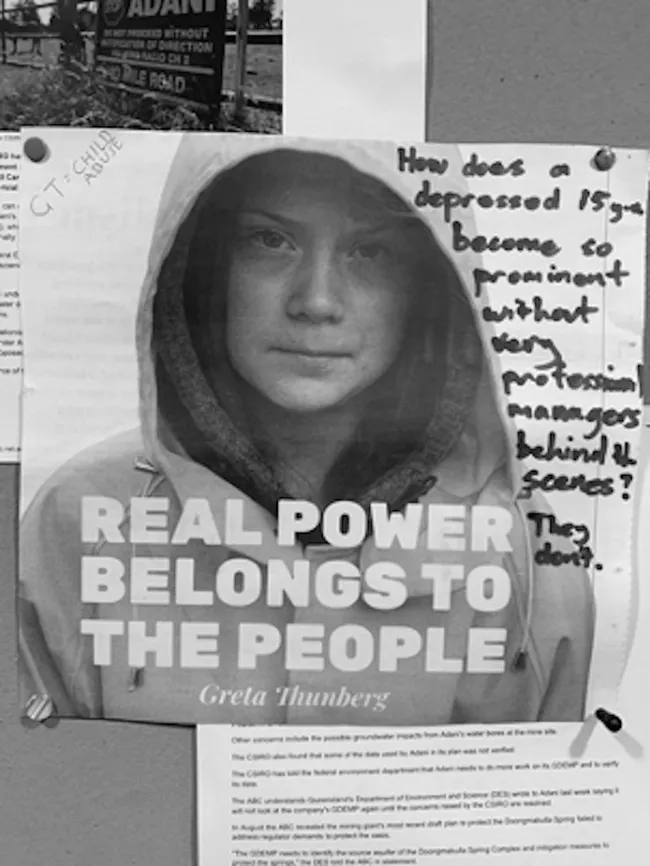
Climate emergency has undoubtedly been a contentious issue that has united or divided public opinion. Eleven thousand scientists declared that climate change conditions are now severe enough for us to rename this a ‘climate emergency’ demanding urgent action (ABC, 2019a). A key figure that has helped rally public opinion and evoked activism especially for the young is Greta Thunberg. The photo below (Figure 1.1) depicts a poster of Greta Thunberg that was placed on the noticeboard within our faculty as a sign of support for her movement. The anonymous graffiti on this poster provides a clear and diametrically opposing view to Greta and her influencers, thereby suggesting that young people cannot and should not have a voice. Their power and voice only comes from adults surrounding them. This in many ways is a powerful reminder to many of us about the role of media, scepticism and the many forces we as educators battle in our professions.
FIGURE 1.1 Poster of Greta Thunberg that had been posted on a noticeboard at the university. (Visual representations by Barnes, Moore & Almeida)
This book focuses on the constant tussles that passionate and motivated teachers with strong environmental identities grapple within their everyday practice. The book highlights the main issues, the power of education in providing a voice to young children and the journeys of teachers who are keen to make a difference.
Global environmental challenges
Environmental challenges have seen an unprecedented increase ranging from global population explosion (approximately 7.9 billion), higher rates of urbanisation, intrusive technological interventions like geo-engineering and nuclear warfare, slower economy fuelling trade wars, rising inequity caused by conflicts resulting in large-scale migration and triggering the refugee crisis and, ultimately, the overarching issue of climate change. The United Nations Environment Protection (UNEP) agency’s recent comprehensive Global Environment Outlook Report 6 (UNEP, 2019) identifies five major drivers for environmental degradation, namely population growth and demographics, urbanisation, economic development, new technological forces and climate change. It reckons these have created imbalance in wealth and access to quality healthcare, thereby offsetting gains in life expectancy and quality of life. They impact critical issues ranging from resource depletion, biodiversity loss, water scarcity, health, pollution and environmental degradation.
The Intergovernmental Science-Policy Platform on Biodiversity and Ecosystem Services (IPBES, 2019) in its first landmark report compiled by 145 experts from 50 countries highlights that nearly one million species are threatened with extinction and that global response has been insufficient in bringing about ‘transformative change’ that supports fundamental, system-wide reforms through technological, economic and social changes. Sir Robert Watson, its chair, points out that ‘the health of ecosystems on which we and all other species depend is deteriorating more rapidly than ever. We are eroding the very foundation of our economies, livelihoods, food security, health and quality of life worldwide’ (p. 1).
Notable findings of the report point out that 75% of land and 66% of marine environments have been altered by humans with more than one-third and nearly 75% of freshwater devoted to growing food. Findings also show the excessive unsustainable fishing patterns and plastic pollution of the oceans alongside the near doubling of urban areas in only 25 years (IPBES, 2019). The climate change crisis continues to dominate with increased concerns of permanent damage to environments and loss of life caused by erratic weather patterns. The latest Intergovernmental Panel on Climate Change report emphasises that climate change is directly impacting people, ecosystems and livelihoods on global scales (IPCC, 2019).
Two major events have preceded the writing of this book. The first major event is the COVID-19 pandemic which continues to engulf the world, straining health systems and economies across the world. Most nations have shown its long-lasting impacts on population and economy. This has brought attention to the frail human environment relationship and the delicate balance that supports the interdependence of human health on healthy ecosystems (Armstrong, Capon & McFarlane, 2020). COVID-19 outbreak was a direct result of a lack of respect for nature and biodiversity, thereby causing a jump in disease-causing viruses from these non-domesticated animals to humans. Given our human systems have not encountered these viruses before, the impact is devastating, as witnessed by the rising number of cases and related deaths. By mid-November 2020, there have been 54,296,615 globally confirmed cases with 1,315,881 deaths, providing a glimpse of the massive impact this pandemic is having across the world with numbers rising exponentially (John Hopkins, 2020).
The second major event has been the recent bush fires that devastated Australia in early 2020. These bush fires were a prudent reminder of local environmental impacts directly related to climate change during one of the hottest summers on record in Australia. The bush fires this summer in Australia have burned through ten million hectares of land, killed dozens of people and more than half a billion wildlife, destroying large communities and habitats. Australia has seen its hottest year on record and its most destructive bush fire season (news.com, 2020). The year 2019 alone has seen three major fires burning large swathes of the Amazon jungle, the Siberian wilderness and now the Australian bush. While large fires have been seen at other times in history, what is unprecedented is the size, intensity and frequency—all of which point clearly towards climate emergency (Guardian, 2020).
Climate change leads to habitat loss and shifting climate patterns, thereby causing migration of wildlife moving to new places where they might cause novel diseases through their encounters with new species. The close connection between the pandemic and climate change serves as a reminder to take into account ‘planetary consciousness’ and strive towards maintaining respect for the natural environment (Armstrong et al., 2020). Covid-19 has certainly opened everyone’s eyes to the many possibilities that can also positively impact the climate agenda. This includes reducing carbon emissions by working from home, reduced pollution and green transitions to support economic growth. One example is the river Yamuna, in India, which showed a marked difference in the level of pollution before the pandemic and two months into the lockdown in Delhi (Insider, 2020). There have been multiple attempts and monetary investment to the tune of millions of dollars to clean up the river over more than 25 years now. The pandemic and reduced pollution have led to a natural clean-up in less than three months.
Tackling the pandemic beyond a human/economic perspective and addressing the underlying issues of biodiversity conservation and climate stabilisation are important and provide a holistic approach for future responses.
What is environmental and sustainability education? Where does education fit into this?
Environmental Education (EE), Education for Sustainable Development (WCED, 1987, p. 43), Education for Sustainability (EfS), Environmental Education for Sustainability (EEfS) and Environmental and Sustainability Education (ESE) are terms that are often used interchangeably in relation to sustainability and education. A quick look at the historical perspectives and emergence of these terms here will help to understand the journey and trajectories of the field.
Before offering a review, it is imperative to point out the ambivalence and debate around the definitions and/or terminology. One of the key barriers in the uptake of sustainability has been this lack of strongly defined terminology that takes into account the multiple perspectives of an ever-changing global situation. A clearer standpoint is urgently required, given that the most widely used definition, namely the Brundtland definition created by the World Commission on Environment and Development (WCED) in 1987, cannot hold up today, given the many new changes in global systems (WCED, 1987).
Critiques have viewed sustainable development either as an oxymoron of irreconcilable opposites, or a paradox of contradicting terms or a still emerging concept that is yet to take a firm shape (Brown, Grootjans, Ritchie, Townsend & Verrinder, 2005). This definition is contradictory, pitching ecological and economic development as opposites, when there is ample evidence that shows that the only way forward is to take both into account.
Brief history of environmental and sustainability education
According to the existing literature, the first documented use of EE in an international setting was at a meeting of International Union for Conservation of Nature (IUCN) in Paris in 1948 (Disinger, 1982). Later, in 1970, IUCN held a conference themed Environmental Education in the School Curriculum in Nevada, USA, where Palmer and Neal (1994) claim that deliberations from that meeting have influenced major developments in EE, where IUCN officially defined EE in 1970:
Environmental education is the process of recognising values and clarifying concept in order to develop skills and attitudes necessary to understand and appreciate the interrelatedness among man, his culture and his biophysical surroundings. Environmental education also entails practice in decision-making and self-formulation of a code of behaviour about issues concerning environmental quality.
In 1980, with the unveiling of the concept of Sustainable Development, experts highlighted that environmental conservation and development should be mutually interdependent and this consensus led to another key international conference on environment and development The Earth Summit, which was held in Rio de Janeiro in 1992. As a key outcome of this summit, experts recommended bringing both environmental and sustainable development education together, within both formal and non-formal education sectors, as a crucial part of learning (Palmer & Neal, 1994). Another major breakthrough of the summit was the introduction of the Rio Declaration, which set out 27 principles for environmental protection and responsible development, reaffirming the declaration of the UN conference on the Human Environment adopted at Stockholm on 16 June 1972 (Palmer & Neal, 1994). Among them, the tenth principle was:
Environmental issues are best handled with the participation of all concerned citizens, at the relevant level. At the national level, each individual shall have appropriate access to information concerning the environment that is held by public authorities, including information on hazardous materials and activities in their communities, and the opportunity to participate in decision-making processes. States shall facilitate and encourage public awareness and participation by making information widely available. Effective access to judicial and administrative proceedings, including redress and remedy, shall be provided.
In view of that, one motive of the declaration was to increase the environmental sustainability awareness through information and education. Since 2000, agencies of the UN worked together with worldwide governments to focus on Sustainability Education (SE), and among many of them there are four key initiatives which focus solely on EfS in one way or another (O’Flaherty & Liddy, 2017). These are:
The Millennium Development Goals (MDGs)
Education for All (EFA)
The United Nations Literacy Decade (UNLD)
The United Nations Decade of Education for Sustainable Development (UNDESD)
Decade of Action 2020–2030
Among them UNDESD’s primary intention was to promote ESE through making people aware that education is an important pathway to a sustainable future. However, it is apparent that merely raising awareness is inadequate to create change, where ESE should intensely encourage the need for personal initiatives and p...
Table of contents
Cover
Half Title
Title Page
Copyright Page
Table of Contents
List of figures
List of boxes
Foreword
Preface
Acknowledgements
1 ESE: finding hope amidst future concerns
2 Educational landscapes: ESE curricular initiatives and change
3 Identities matter: teachers’ identities as a lens into teachers’ everyday practices
4 Enacting agency and negotiating power: a theoretical framework
5 Empowerment through storytelling: a combinational methodology
6 Community partnerships—‘Just sneak it in’: subversive ways to include ESE
7 The whole-school approach in ESE schools: ‘I’m the lucky one here’
8 ESE in early childhood education: ‘We do lots of little things … now’
9 ESE in status quo schools: ‘It’s just not a priority’
10 The hierarchical school and ESE: ‘New teachers cannot do anything’
11 ESE in a rural school: ‘We became the grade who does things’
12 Hope for the future: enacting power and agency in ESE
Index
Trusted by 375,005 students
Access to over 1.5 million titles for a fair monthly price.
Study more efficiently using our study tools.
Frequently asked questions
Yes, you can cancel anytime from the Subscription tab in your account settings on the Perlego website. Your subscription will stay active until the end of your current billing period. Learn how to cancel your subscription
No, books cannot be downloaded as external files, such as PDFs, for use outside of Perlego. However, you can download books within the Perlego app for offline reading on mobile or tablet. Learn how to download books offline
Perlego offers two plans: Essential and Complete
Essential is ideal for learners and professionals who enjoy exploring a wide range of subjects. Access the Essential Library with 800,000+ trusted titles and best-sellers across business, personal growth, and the humanities. Includes unlimited reading time and Standard Read Aloud voice.
Complete: Perfect for advanced learners and researchers needing full, unrestricted access. Unlock 1.5M+ books across hundreds of subjects, including academic and specialized titles. The Complete Plan also includes advanced features like Premium Read Aloud and Research Assistant.
Both plans are available with monthly, semester, or annual billing cycles.
We are an online textbook subscription service, where you can get access to an entire online library for less than the price of a single book per month. With over 1.5 million books across 990+ topics, we’ve got you covered! Learn about our mission
Look out for the read-aloud symbol on your next book to see if you can listen to it. The read-aloud tool reads text aloud for you, highlighting the text as it is being read. You can pause it, speed it up and slow it down. Learn more about Read Aloud
Yes! You can use the Perlego app on both iOS and Android devices to read anytime, anywhere — even offline. Perfect for commutes or when you’re on the go. Please note we cannot support devices running on iOS 13 and Android 7 or earlier. Learn more about using the app
Yes, you can access Empowering Teachers through Environmental and Sustainability Education by Melissa Barnes,Deborah Moore,Sylvia Christine Almeida in PDF and/or ePUB format, as well as other popular books in Education & Classroom Management. We have over 1.5 million books available in our catalogue for you to explore.