eBook - PDF
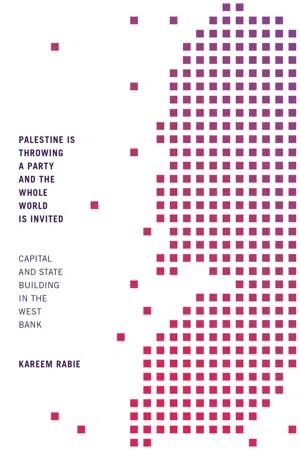
Palestine Is Throwing a Party and the Whole World Is Invited
Capital and State Building in the West Bank
- 273 pages
- English
- PDF
- Available on iOS & Android
eBook - PDF
Palestine Is Throwing a Party and the Whole World Is Invited
Capital and State Building in the West Bank
About this book
In 2008, Palestinian Prime Minister Salam Fayyad invited international investors to the first-ever Palestine Investment Conference, which was designed to jump-start the process of integrating Palestine into the global economy. As Fayyad described the conference, Palestine is "throwing a party, and the whole world is invited." In this book Kareem Rabie examines how the conference and Fayyad's rhetoric represented a wider shift in economic and political practice in ways that oriented state-scale Palestinian politics toward neoliberal globalization rather than a diplomatic two-state solution. Rabie demonstrates that private firms, international aid organizations, and the Palestinian government in the West Bank focused on large-scale private housing development in an effort toward state-scale economic stability and market building. This approach reflected the belief that a thriving private economy would lead to a free and functioning Palestinian state. Yet, as Rabie contends, these investment-based policies have maintained the status quo of occupation and Palestine's subordinate and suspended political and economic relationship with Israel.
Information
Publisher
Duke University Press BooksYear
2021Print ISBN
9781478014096
9781478011958
eBook ISBN
9781478021407
Table of contents
- Cover
- Contents
- Introduction
- 1. The Site
- 2. Developers and Designers
- 3. Image, Process, and Precedent
- 4. Public Urban Planning
- 5. Housing Shortage and National Priority
- 6. Public-Private Partnership
- 7. Buyers and Villagers
- 8. Critique, Capital, and the Landscape
- 9. Settlers and the Land
- 10. The Law, Mirroring, and the State
- Conclusion
- Acknowledgments
- Notes
- References
- Index
Trusted by 375,005 students
Access to over 1.5 million titles for a fair monthly price.
Study more efficiently using our study tools.
Frequently asked questions
Yes, you can cancel anytime from the Subscription tab in your account settings on the Perlego website. Your subscription will stay active until the end of your current billing period. Learn how to cancel your subscription
No, books cannot be downloaded as external files, such as PDFs, for use outside of Perlego. However, you can download books within the Perlego app for offline reading on mobile or tablet. Learn how to download books offline
Perlego offers two plans: Essential and Complete
- Essential is ideal for learners and professionals who enjoy exploring a wide range of subjects. Access the Essential Library with 800,000+ trusted titles and best-sellers across business, personal growth, and the humanities. Includes unlimited reading time and Standard Read Aloud voice.
- Complete: Perfect for advanced learners and researchers needing full, unrestricted access. Unlock 1.5M+ books across hundreds of subjects, including academic and specialized titles. The Complete Plan also includes advanced features like Premium Read Aloud and Research Assistant.
We are an online textbook subscription service, where you can get access to an entire online library for less than the price of a single book per month. With over 1.5 million books across 990+ topics, we’ve got you covered! Learn about our mission
Look out for the read-aloud symbol on your next book to see if you can listen to it. The read-aloud tool reads text aloud for you, highlighting the text as it is being read. You can pause it, speed it up and slow it down. Learn more about Read Aloud
Yes! You can use the Perlego app on both iOS and Android devices to read anytime, anywhere — even offline. Perfect for commutes or when you’re on the go.
Please note we cannot support devices running on iOS 13 and Android 7 or earlier. Learn more about using the app
Please note we cannot support devices running on iOS 13 and Android 7 or earlier. Learn more about using the app
Yes, you can access Palestine Is Throwing a Party and the Whole World Is Invited by Kareem Rabie in PDF and/or ePUB format, as well as other popular books in Social Sciences & Middle Eastern History. We have over 1.5 million books available in our catalogue for you to explore.