The Enlightenment was a time of monetary turmoil and transformation in Europe. Change began with a riot of experimentation, including novel ideas about human agency and capacity to promote economic progress, efforts to reframe divinity in terms (like the providential) compatible with market exchange, new instruments of credit, and innovative institutions such as national banks and capital markets. Europeans, including the settler societies in North America, improvised frantically: people faced the task of everyday exchange in changing media; governments took up the project of creating currencies that supported their political power; artists and writers raced to represent new forms of wealth and interpret the issues they raised; and intellectuals struggled to conceptualize, and tame, patterns of monetary transformation. The result was a rich debate, still unsettled, about the sources of value, the morality of the market, and the very nature of money.
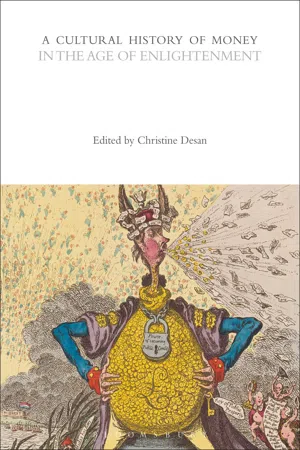
Drawing upon a wealth of visual and textual sources, A Cultural History of Money in the Age of Enlightenment presents essays that examine key cultural case studies of the period on the themes of technologies, ideas, ritual and religion, the everyday, art and representation, interpretation, and the issues of the age.
eBook - ePub
A Cultural History of Money in the Age of Enlightenment
- 256 pages
- English
- ePUB (mobile friendly)
- Available on iOS & Android
eBook - ePub
A Cultural History of Money in the Age of Enlightenment
About this book
Information
CHAPTER ONE
Money and its Technologies
Industrial Opposition and the Problem of Trust
MARA CADEN
The mint, Sir, is a manufacture, and it is nothing else; and it ought to be undertaken upon the principles of a manufacture; that is, for the best and cheapest execution, by a contract, upon proper securities, and under proper regulations.
—Edmund Burke, 17801
The concept of technology took on something like its contemporary meaning during the Age of Enlightenment in eighteenth-century Europe. Technology, in this period, began to describe the scientific pursuit of “useful knowledge” about the “mechanical arts” and manufactures.2 This chapter will explore money and its technologies during that same period: the eighteenth-century Enlightenment. And while the technologies of money now mean many things to us—modes of accounting, the calculation of interest rates, rates of exchange between various currencies, or even the calculation of value for digital currencies such as bitcoin—this chapter will focus on the technologies involved in the physical manufacture of money. There is a wealth of material on credit and banking, especially in early modern Europe, the European Enlightenment, and early America, but historians of money have paid relatively little attention to the manufacture of currencies themselves, outside of the conversations in numismatics journals (Dickson 1967; Murphy 2009).3 Economic and social historians of the eighteenth century have neglected this topic in part because they have tended to treat currency as merely an instrument in the increasingly complex networks and technologies of credit in this period. But other economic historians have shown that the extension of credit in the early modern period was dependent on and intimately linked to the supply of money (Mayhew 1995).4 Even as instruments of credit exploded, money continued to matter. Money backed the paper bills that circulated in the early modern and Enlightenment periods. Long-running book credit could be settled in money, and bills of exchange needed the promise of specie to function. Most states in the Enlightenment period maintained a monopoly on the manufacture of money from precious metals, or else they licensed and supervised local or private producers. Either way, money itself was central to the power of states. It was essential for collecting taxes. Monetary policy was one of the primary ways that early modern states regulated trade and economic activity at home and abroad. And it carried the mark of the sovereign, inserting royal power into every transaction.
All over Europe, the Atlantic world, the Indian Ocean world, among empires on the Eurasian land mass, and even across the Pacific Ocean, coins of silver, gold, copper, and tin circulated. In one sense, these coins were commodities, enabling a trade in precious metals between states and continents, and facilitating the trade in other commodities such as cloth, spices, sugar, and enslaved people. As a commodity, the market value of these precious metals gave coins their value. But states also assigned a legal value to the coins they produced, and the difference between what contemporaries considered their “intrinsic value,” that is, the exchange value of the metal that coins contained, and their face value was a matter of great debate and constant tinkering (Redish 2000; Desan 2014: 110–20).5 The seventeenth and eighteenth centuries were a time of significant and expanding global trade, and they also contained many moments of acute political crisis across Europe and the Atlantic world. As monarchs and governments sought to make money work domestically and across oceans, the problem of trust plagued their currencies. Most states passed foreign coins at rates according to their weight and metal content, and coins were judged on their fineness (that is, the ratio of precious metals to alloy), their weight, and other physical properties that signaled their authenticity. For those states and monarchs whose legitimacy was in question or who were weathering domestic upheaval and foreign wars, the quality of the coin they issued could be inseparable from their personal reputations and their legitimacy. The credit of a monarch or a state depended upon the precious metal content of their coins, and that credit could be rapidly undermined by counterfeits. Counterfeiting was both a lucrative industry and a capital crime in Europe and its colonies (Wennerlind 2011: 123–60).6 Whether at home or abroad, radically debased or counterfeit money made exchange difficult, and in the course of trade, many people refused to accept currency that was vulnerable to counterfeiting or paid a lower price for money that they suspected had reduced metal content. It is in this sense that trust was essential to making money work.
It is tempting to imagine that by the time that Enlightenment thought traversed Europe, thinkers had departed from an attachment to the metallic values of money. It seems intuitive, in other words, to associate an attachment to intrinsic value with ancient and medieval monetary worlds of coin hordes and sovereigns’ stamps, while the modern era ushered in a world of flexible credit instruments and a functionalist view of money as an instrument to facilitate trade. But the world of commodity money had not yet disappeared from view. In Denis Diderot and Jean le Rond d’Alembert’s classic compilation of Enlightenment thought, the Encyclopedie, Louis, chevalier de Jaucourt’s contribution, “Money,” presented a decidedly commodity-based view of money. Arguing against a Mr. Boizart, who had argued that money was politically constituted—that is, it held value because a public authority assigned it a value to facilitate trade—Jaucourt argued that the public authority that certified the value of the coin only demonstrated and affirmed its value, but did not create it. Rather, for de Jaucourt and many eighteenth-century monetary authorities and philosophers, coins derived value from the metal they contained; in other words, “the matter gives it its value.”7
It is possible to see the fact that people still cared about intrinsic value as an indication of a problem with trust in states. As the monetary economist Charles Goodhart writes,
. . . the balance between the metallic content and the face value of a coin represented the credible commitment of the issuer. Local confidence that an IOU could and would be honored meant that coins could generally be accepted and used in exchange. The better the credit of the issuer, the wider the circulation, and the less need for intrinsic value of the money object.
—2008: xii–xiii8
In this chapter, I will argue that the technological innovations in the minting of money during the Enlightenment period were an answer to the problem of trust. Virtually every new technological innovation was a response to the persistent problems of culling, clipping, and counterfeiting. When coins were irregular, some contained slightly more gold or silver than others, and so people would take the heaviest coins out of circulation to melt, hoard, or export, leaving only the lighter coins in circulation. Standard, mechanical processes of production ensured regularity, so that people could rely on the metal content of the coins they received. Coin clipping plagued currencies throughout Europe and the Atlantic, wherein people would take advantage of the irregularity of coins to cut slivers of silver or gold from the edges, circulating the diminished coins and keeping the precious metal. Techniques that produced perfectly round coins made it more difficult to clip undetected, and novel methods of inscribing letters and patterns around the edges of coins made clipping impossible. Finally, widespread counterfeiting threatened most currencies in Europe and the Atlantic, and this chapter will survey the technologies that minters and engineers invented to make counterfeiting more difficult and costly. When states sought to transform the technologies of minting to address these problems, however, they repeatedly encountered the opposition of guild-like bodies of mint workers who maintained and guarded traditional techniques of making money. After centuries of protracted struggle, when European states finally implemented new coining technologies, these mint workers saw their status depleted and their skill made obsolete.
This chapter will deal first with metal technologies. The process of minting underwent a gradual mechanization throughout Europe from the sixteenth through the eighteenth centuries. At the very end of the eighteenth century, British minting was transformed once again when industrial manufacturers applied steam-powered technology to the manufacture of money. Then, we will look at the ways that the technology of extracting, refining, and minting metals in the Americas changed over the course of our period. Mints in Spanish America adopted mechanical coining technology in the later eighteenth century, and a new amalgamation process in the silver mines there boosted silver production in a waning mining industry, enabling a higher volume of minting and continued trade across the Atlantic and the Pacific. Then we will turn our attention to paper money, which began to gain importance in European economies in the late seventeenth century and took on a central role in North American colonial economies. In each of these cases, novel inventions responded to the pressures of counterfeiting and sought to establish confidence in the value and authenticity of the currencies that circulated.
METAL TECHNOLOGIES: MECHANICAL COINING
Two great transformations in the technology of minting bookend our period. First, the mechanization of the coining process, where mills and presses replaced hand-hammered coinage; and second, the introduction of steam power to British coinage in the industrial mints of Birmingham and later at the new mint on Tower Hill. The move from hammered to milled coins marks the first transition, and its history stretches back beyond the confines of this volume. It is a story of experimentation and invention across Europe, but it is also a story of surprisingly slow implementation. Into the middle of the seventeenth century, most of the coins minted in Europe were made by hand using methods that were virtually unchanged from those of ancient Greek mints. Skilled engravers would create dies and puncheons: heavy stone pieces with engravings to be stamped onto each side of a coin. With the die resting on a pedestal, a moneyer would sit on a low stool, place a blank disk of gold or silver between the die and the puncheon, and strike the puncheon with a hammer to stamp the engravings simultaneously onto each side of the coin (Stewart 1992: 76–82).9
While the technology was rudimentary, it took great skill to make coins that were uniform, round, centered, and stamped in sharp relief by this method. In England, the medieval Corporation of Moneyers, which functioned very much as a craft guild, trained its members with long apprenticeships and carefully guarded entry into the Corporation. For many generations, their skill made them indispensable to the operation of the mint. France relied on a similar body to conduct and oversee the technical aspects of minting money for the kingdom: the Cour des Monnaies. In the sixteenth century, the Monnaies acquired a more heavily administrative role than the English Moneyers: France had many disparate mints throughout the kingdom, and the Monnaies, concentrated in Paris, became auditors of those provincial mints and gained the power to conduct criminal trials in cases of suspected corruption (Parsons 2015: 17–59).10 In both cases, the moneyers were exclusive and tightly controlled bodies of craftsmen who were the guardians of coinage techniques.
But by the seventeenth century, a new method would overtake the moneyers’ hammered coinage. The first traces of this technology originate in the Renaissance, at the Papal Mint in Rome. The architect Donato Bramante, who created medals and seals for Pope Julius II, developed and manufactured a novel machine for striking these medals at the beginning of the sixteenth century. His invention employed a screw mechanism, which used rotational torque to drive a press downward with great force. This screw press for striking medals had some advantages over hand-hammering: the strike was more exact, and so engravings could be more intricate; the medals had the gleam that we associate with newly minted coins because the power of the screw press made it possible to strike while the metal was cool; and the resulting medals were more uniform and more perfectly centered. But in order to make the most of this invention, perfectly smooth and round blanks were required, rather than the slightly irregular disks that metalworkers cut out of sheets of metal with shears. The inventions of the great polymath Leonardo da Vinci would eventually solve this problem. Da Vinci’s notebooks contain sketches of a machine designed for the Mint at Rome using a hollow cutting punch, which would cut perfectly round and uniform disks out of the strip of metal by forcing them upward into a hollow upper chamber. In his notebook, da Vinci described the benefit of making all coins perfectly round and uniform in size and thickness. Although it was not built in his lifetime, da Vinci’s invention would join Bramante’s to form the set of machines that would eventually transform European coinage (Hocking 1909: 60–2).

FIGURE 1.1Screw press, engraving originally printed in Diderot and d’Alembert’s Encylopédie. Case Number 7362775, the Royal Mint Collection. Bridgeman images.
Not long after, these machines found their way into the Mint at Rome when Benvenuto Cellini, the Italian goldsmith and sculptor, became the stamp-master of the Mint and used Bramante’s screw press to make medals there. It seemed a perfect opportunity to begin to use the new technology to make coins, and Cellini actively promoted the screw press as a superior method of coining money. The medals he was able to make with the press were beautiful, but they were more expensive to produce than traditional hammered coins. And so, despite Cellini’s skill and enthusiasm, the Mint at Rome maintained its traditional coining methods (Usher 1954–8: 338–9; Redish 2000: 55–6; Hocking 1909: 62–5).
But as the sixteenth century wore on and European kingdoms faced persistent problems of inflation, debasement, and counterfeiting in their currencies, the new technology wound its way through Europe. In 1551, the French ambassador to the Free Imperial City of Augsburg, Charles de Marillac, was awed by the machines that the inventor Marx Schwab was developing in the Augsburg Mint. These machines—a rolling mill to roll smooth sheets of metal of uniform thickness; a cutting press that punched out perfectly round blanks; and a screw press for imprinting the coins—so impressed de Marillac that he wrote to the king, Henry II, and convinced him to invest in such machines for France. De Marillac returned in a delegation that included his brother, who was master of the Lyon Mint, and the French engineer Aubin Olivier, and they worked for several months with the Augsburg engineer to perfect the machines and import them into France. Back in Paris, they installed the first truly mechanized mint for coinage on the site of a mill on the Île de la Cité that had originally been built to polish precious stones. The new Monnaie du Moulin, or mill-money, used a combination of water power, horse power, and human power to operate the Augsburg machines, and also featured Olivier’s own invention: the technology to mark the edges of coins with letters and patterns, which protected the new coins from the most persistent problem: clipping. In order to accomplish this feat, Olivier developed a segmented collar that surrounded the blanks as they were being pressed. This collar, which was slightly larger than the blanks, was engraved, so that when the screw press struck the blank, the coin expanded into the collar, taking on the letters and figures that were engraved into it. The ability to impress letters and patterns around the edges of coins would be one of the most c...
Table of contents
- Cover
- Half Title
- Series Information
- Title Page
- Contents
- List of Illustrations
- Notes on Contributors
- Series Preface
- Acknowledgments
- Introduction: Strange New Music—The Monetary Composition Made by the Enlightenment Quartet
- 1 Money and its Technologies: Industrial Opposition and the Problem of Trust
- 2 Money and its Ideas: Enlightenment Debates about the Morality of Money
- 3 Money, Ritual, and Religion: A Secularization Story
- 4 Money and the Everyday: New Practices in the Enlightenment
- 5 Money, Art, and Representation: The Look and Sound of Money
- 6 Money and its Interpretation: Paper Currency in Early America
- 7 Money and the Issues of the Age: Thinking about Money in the Eighteenth Century
- Notes
- Bibliography
- Index
- Copyright page
Trusted by 375,005 students
Access to over 1.5 million titles for a fair monthly price.
Study more efficiently using our study tools.
Frequently asked questions
Yes, you can cancel anytime from the Subscription tab in your account settings on the Perlego website. Your subscription will stay active until the end of your current billing period. Learn how to cancel your subscription
No, books cannot be downloaded as external files, such as PDFs, for use outside of Perlego. However, you can download books within the Perlego app for offline reading on mobile or tablet. Learn how to download books offline
Perlego offers two plans: Essential and Complete
- Essential is ideal for learners and professionals who enjoy exploring a wide range of subjects. Access the Essential Library with 800,000+ trusted titles and best-sellers across business, personal growth, and the humanities. Includes unlimited reading time and Standard Read Aloud voice.
- Complete: Perfect for advanced learners and researchers needing full, unrestricted access. Unlock 1.5M+ books across hundreds of subjects, including academic and specialized titles. The Complete Plan also includes advanced features like Premium Read Aloud and Research Assistant.
We are an online textbook subscription service, where you can get access to an entire online library for less than the price of a single book per month. With over 1.5 million books across 990+ topics, we’ve got you covered! Learn about our mission
Look out for the read-aloud symbol on your next book to see if you can listen to it. The read-aloud tool reads text aloud for you, highlighting the text as it is being read. You can pause it, speed it up and slow it down. Learn more about Read Aloud
Yes! You can use the Perlego app on both iOS and Android devices to read anytime, anywhere — even offline. Perfect for commutes or when you’re on the go.
Please note we cannot support devices running on iOS 13 and Android 7 or earlier. Learn more about using the app
Please note we cannot support devices running on iOS 13 and Android 7 or earlier. Learn more about using the app
Yes, you can access A Cultural History of Money in the Age of Enlightenment by Bloomsbury Publishing, Christine Desan in PDF and/or ePUB format, as well as other popular books in History & Economic History. We have over 1.5 million books available in our catalogue for you to explore.