The F.I.R.E. Planner
eBook - ePub

The F.I.R.E. Planner

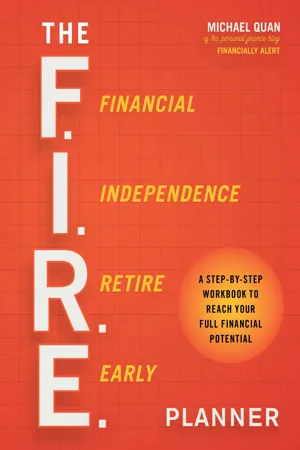
A Step-by-Step Workbook to Reach Your Full Financial Potential

  1. 192 pages
  2. English
  3. ePUB (mobile friendly)
  4. Available on iOS & Android
eBook - ePub

The F.I.R.E. Planner

A Step-by-Step Workbook to Reach Your Full Financial Potential

About this book

Plan for your financial future with this interactive guide to everything there is to know about mindful spending, strict saving regimes, clever investments, and sustainable living so you can achieve financial independence early and, ultimately, live a more simple, happier life. F.I.R.E—Financial Independence, Retire Early—is a popular lifestyle movement amongst millennials and Gen Xers. The F.I.R.E. Planner is the first illustrated, interactive guide to putting this philosophy into practice. This accessible book teaches you everything there is to know about strict savings, smart investing, mindful spending, and living sustainably to ensure financial independence for a much simpler and happier life. Start planning for your future life today and make the most of your current income so you can live the life of your dreams.
Frequently asked questions

Yes, you can cancel anytime from the Subscription tab in your account settings on the Perlego website. Your subscription will stay active until the end of your current billing period. Learn how to cancel your subscription.
No, books cannot be downloaded as external files, such as PDFs, for use outside of Perlego. However, you can download books within the Perlego app for offline reading on mobile or tablet. Learn more here.
Perlego offers two plans: Essential and Complete
  • Essential is ideal for learners and professionals who enjoy exploring a wide range of subjects. Access the Essential Library with 800,000+ trusted titles and best-sellers across business, personal growth, and the humanities. Includes unlimited reading time and Standard Read Aloud voice.
  • Complete: Perfect for advanced learners and researchers needing full, unrestricted access. Unlock 1.4M+ books across hundreds of subjects, including academic and specialized titles. The Complete Plan also includes advanced features like Premium Read Aloud and Research Assistant.
Both plans are available with monthly, semester, or annual billing cycles.
We are an online textbook subscription service, where you can get access to an entire online library for less than the price of a single book per month. With over 1 million books across 1000+ topics, we’ve got you covered! Learn more here.
Look out for the read-aloud symbol on your next book to see if you can listen to it. The read-aloud tool reads text aloud for you, highlighting the text as it is being read. You can pause it, speed it up and slow it down. Learn more here.
Yes! You can use the Perlego app on both iOS or Android devices to read anytime, anywhere — even offline. Perfect for commutes or when you’re on the go.
Please note we cannot support devices running on iOS 13 and Android 7 or earlier. Learn more about using the app.
Yes, you can access The F.I.R.E. Planner by Michael Quan in PDF and/or ePUB format, as well as other popular books in Personal Development & Personal Finance. We have over one million books available in our catalogue for you to explore.

Information

1 Introduction TO FIRE

What is FIRE?

THE BASIC CONCEPT OF FIRE IS TO FOCUS YOUR EFFORTS ON SAVING AND INVESTING (UP TO 70%), COMMIT TO LIVING A SIMPLER LIFESTYLE, AND CUT YOUR RETIREMENT DATE BY DECADES.
F inancial
I ndependence
R etire
E arly
What a catchy acronym! Who wouldn’t want to have financial independence and be able to retire early?
If you’ve picked up this book, then no doubt this idea appeals to you too. In this section, we’ll discover the basic components of FIRE and discuss why you could, and should, pursue FIRE.
With diligence and compounding interest on your side, your efforts will be rewarded with a nest egg large enough to (slowly) withdraw from… indefinitely.
TO START, LET’S COVER SOME TERMS YOU’LL WANT TO BE FAMILIAR WITH
FI (Financial Independence) = when passive income equals or exceeds your living expenses and you’re no longer reliant on earned income or dependent on others
RE (Retire Early) = retiring at a much earlier age than traditional standards (e.g., age thirty instead of age sixty-five), which enables you to pursue your interests without requiring additional income
Income = money that comes into your household from a job, investments, or other means
Active or Earned Income = money received from active work (e.g., a job, a business you operate, etc.)
Passive Income = money received that doesn’t require you to actively work (e.g., dividends, royalties, rental income, certain types of business income, etc.)
FI IS ARGUABLY THE MOST IMPORTANT PART OF FIRE BECAUSE IT’S USED TO DESCRIBE A POINT IN TIME WHEN YOUR PASSIVE INCOME EQUALS OR EXCEEDS YOUR MONTHLY EXPENSES. TO BETTER UNDERSTAND THIS, LET’S LOOK AT A FEW EXAMPLES.
Example 1
Paul has a job that earns him $60,000, or $5,000 per month. He has monthly expenses of $3,500 (taxes, rent, food, insurance, transportation, etc.).
Is he financially independent?
No. Paul is not financially independent. Even though he has a surplus of cash each month, he still needs to work for income.
Example 2
Jennifer has a job that earns her $50,000, or $4,167 per month. She also owns five rental properties that provide her with $2,500 of passive income per month. Her monthly expenses are $4,500.
Is she financially independent?
No. Although Jennifer is well on her way to achieving financial independence, she still has a shortfall of $2,000 per month not covered by passive income.
Example 3
Dave has a part-time job that earns him $36,000, or $3,000 per month. He also owns ten rental properties that provide him with $5,000 of passive income per month. His monthly expenses are $4,000.
Is Dave financially independent?
Yes. Dave’s rental properties bring in enough passive income every month to exceed his expenses of $4,000. Thus, Dave technically does not need to work his part-time job in order to meet his monthly expenses.
Next, let’s discuss RE, or “retire early.” Once you hit FI you have freedom of choice! Since your monthly expenses are fully covered by your passive income, you no longer have to actively work for earned income. You are free to “retire early.”
At this point, you could sit on the beach all day long and your expenses would still be taken care of. Or you could volunteer, start a business, write a book… the options are endless, and the choice is yours!

THE MODERN FIRE MOVEMENT

FI EXISTED LONG BEFORE FIRE BECAME A POPULAR CONCEPT IN TODAY’S CULTURE. HOWEVER, THE MODERN FIRE MOVEMENT IS UNIQUE IN THAT IDEAS CAN BE SPREAD QUICKER THAN EVER.
With the rise of the Internet, websites evolved from static pages sharing basic information to full-blown dynamic and interactive sites. Now we enjoy blogs with daily updates, rich media-like photos and video, and even applications that can do complex calculations (e.g., Monte Carlo simulations). Soon we will be living in a world where AR (augmented reality) and VR (virtual reality) are just a part of daily life.
Where did the modern FIRE movement come from?
We all love a good story. And when sites like Early Retirement Extreme (earlyretirementextreme.com) and Mr. Money Mustache (mrmoneymustache.com) championed and modeled the idea that retirement could occur decades earlier than usual, people were fascinated.
The premise was simple. By focusing on extreme savings and investing, you could feasibly cut the retirement age in half. And ideas such as intentional spending and living a simple life resonated with millions of people around the world.
People are waking up and beginning to question the traditional advice of:
Go to school, get good grades
Image
Go to college, get good grades
Image
Get a job, work your way up
Image
Retire when you’re sixty-five
I am a proponent of higher education, yet going to university doesn’t guarantee you a career, or even a job, for that matter. You need more than good grades and a degree to be successful these days.
In today’s job markets, you’ll find a dynamic marketplace that no longer rewards you for staying at a single company until retirement. Instead, the new generations know it’s reasonable to change jobs, and even careers, multiple times in one’s life.
Image
Common characteristics of those on the path to FIRE:
  • Save/invest aggressively (30% to 70% of earned income)
  • Invest in broad, low-cost index funds (e.g., VTSAX—Vanguard’s Total Stock Market Index Fund)
  • Seek to live a simpler life; reduce or eliminate wasteful spending
  • Focus on experiences over things
  • Use the 4% Rule to determine your FI baseline (see page 66)
Workers from older generations are being replaced with cheaper labor and technology, so it’s now a requirement to keep creating value and reinventing yourself throughout your entire career.
Even those who’ve followed a traditional path are coming up empty-handed; it’s all too common to see stories of retirees forced to go back to work because their finances weren’t in order, or because they were simply unprepared.
Most important, if you’re required to work until age sixty-five, then aren’t you giving away the prime years of your life to somebody else?
So it’s apparent that the traditional model may no longer be relevant.
The modern FIRE movement offers something far more exciting and practical. It offers choice, and the promise of financial freedom to those who are bold enough to reach for it.
But you must be willing to take the time to plan, understand what you value, and learn to make your money work for you—and you’re in the right place to start!
FIRE f...

Table of contents

  1. Cover
  2. Title Page
  3. Dedications
  4. Meet Michael
  5. How to Use This Planner as Your Guide
  6. Chapter 1: Introduction to FIRE
  7. Chapter 2: The FIRE Mindset
  8. Chapter 3: Your FIRE Numbers
  9. Chapter 4: Ways to Achieve FIRE
  10. Chapter 5: Designing Your FIRE Plan
  11. Chapter 6: You’re on FIRE—Now What?
  12. Acknowledgments
  13. Glossary
  14. Notes
  15. Index
  16. Copyright