Inclusive Urban Development in the Global South emphasizes the importance of the neighbourhood in urban development planning, with case studies aimed at transforming current intervention practices towards more inclusive and just means of engagement with individuals and communities. The chapters explore how diversity of gender, class, race and ethnicity, citizenship status, age, ability, and sexuality is taken (or not taken) into account and approached in the planning and implementation of development policy and interventions in poor urban areas. The book employs a practical perspective on the deployment of theoretical critiques of intersectionality and diversity in development practice through case studies examining issues such as water and sanitation planning in Dhaka, indigenous rights to the city in Bolivia, post-colonial planning in Hong Kong, land reform in Zimbabwe, and many more. The book focuses on radical alternatives with the potential to foster urban transformations for planning and development communities working around the world.
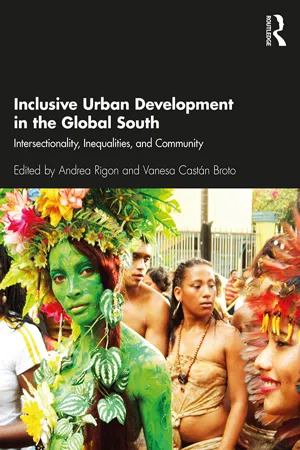
eBook - ePub
Inclusive Urban Development in the Global South
Intersectionality, Inequalities, and Community
- 230 pages
- English
- ePUB (mobile friendly)
- Available on iOS & Android
eBook - ePub
Inclusive Urban Development in the Global South
Intersectionality, Inequalities, and Community
About this book
Information
1
Introduction
“At a first glance the community governance structure in charge of making important decision on the distribution of the public land of the informal settlement to its residents seemed to contain a diverse range of residents. Project implementers told me that the criteria ensured fairness in the representation of all residents. For each section of the settlement, two landlords, one tenant, one woman, one elder and one youth were elected. As I got to know the committee members, I was surprised to find out that almost all representatives were landlords, despite tenants making up over 80% of the residents. I suddenly realized that because people do not have a single identity, the woman, the elder and the youth were also landlords, and in some cases, even the tenant was part of a landlord family. That’s when I realized that implementers’ problematic assumptions about identity and failure to understand local power relations consolidated local inequalities.”(Extract from a personal ethnographic diary of Andrea Rigon, Nairobi, 2008)
The growing interest in inclusive urban development follows decades of work on gender and intersectionality studies in development studies and the growing influence of feminist perspectives in urban development planning (as opposed to notions of urban development that emphasise efficiency, good governance, and entrepreneurship). However, as the quote above shows, that theoretical interest on diversity does not always translate into a recognition of the different conditions in which people live. Research projects and urban planning decisions are mired by assumptions that not only ignore the differentiated needs of a diverse urban community but also contribute to hide those differences in forms of research and planning that tend to exclude those who do not conform to those assumptions.
In practice, urban development interventions are, for the most part, based upon a particular homogenising perspective on urban development. Communities are rightly seen as a needed partner to provide legitimacy to interventions by state and other external actors. However, in fast-changing and diverse contexts such as informal settlements, the identification of community representatives and the creation of local government structures often invest local elites with power rather than ensuring marginalized voices are part of these processes, in a process that inevitably reinforces existing unequal power relations within communities (Guijt & Kaul Shah, 1998; Rose, 1999; Li, 2011; Rigon, 2014). The same interventions that seek to empower communities and their members to deliver sustainable and inclusive urban futures may reinforce the social structures that exclude some social groups and reinforce vulnerabilities.
Inclusive Urban Development in the Global South: Intersectionality, Inequalities, and Community puts a critical understanding of “community” at the centre of international development practice in urban environments. The objective of the book is to outline how current thinking on diversity and intersectionality challenges existing practices of urban development, because they remain wedded to a particular concept of a homogeneous community, something that happens either through the use of generalising language or the articulation of development discourses (Howard, López Franco, & Shaw, 2019). Thus, the book argues for the recognition of the diverse needs and aspirations of different urban residents as an engine for just and inclusive urban development and explores innovative methodologies to achieve it.
This book aims to provide orientation for more just and inclusive urban development practice. The papers in this edited collection engage with multiple diversity challenges related to gender, class, race and ethnicity, citizenship status, age, ability, religion, and sexuality that people face during the planning and implementation of development policy and interventions in lower-income urban areas. The book proposes an intersectionality approach as a means to account for the situated experiences of diverse individuals and social groups that experience the intersection of different structural drivers of exclusion in unique and situated ways.
Moving towards Inclusive Urban Development
The focus on the urban is not accidental. Parnell (2016) has pointed out that we are living through an era of urban optimism in the way the urban is constructed as a sphere of intervention. The urban, nevertheless, remains a location for the delivery of techno-economic fixes that do little for advancing justice-oriented emancipatory agendas (Hodson & Marvin 2017). This book thus responds with a new conceptualisation of the treatment of communities in urban development that emphasises the potential for progressive actions that reach the most disadvantaged, by challenging the mechanisms of exclusion within communities themselves.
Since the neighbourhood remains the critical scale in urban development planning, this book aims at transforming current intervention practices that could benefit from a critical understanding of community. By intervention we mean any intentional action aimed at shaping urban development towards a more desirable direction. To intervene is to take active part in something to change the course of events. Interventions may be initiated by actors within the community or by external players, including government and NGOs.1 The book reimagines the notion of community in a way that engages with current cutting-edge intersectional critiques, while also valuing existing social structures as mechanisms that enable the development of a collective project of urban futures.
The central argument of the book is developed in three parts: first, notions of community remain central to international development practices in urban environments whose success depends on improving people’s well-being and opportunity through neighbourhood-oriented interventions, often co-produced with and led by community members and their organizations; second, there is a consistent body of theoretical and empirical critique against static and homogeneous notions of urban communities, which often engages with practical examples about how this happens and that builds on an intersectionality perspective that begins any critique from the analysis of situated experiences of oppression and exclusion; third, while urban development practice has not yet engaged adequately with this critique, the debate opens opportunities for thinking new modes of urban development that put equality and justice at their centre.
Following this line of argumentation, the book seeks answers to three sets of questions:
- How do urban development interventions differently affect different groups and individuals? How fairly are the benefits of the interventions distributed within urban communities? How are notions of homogeneous, static community reproduced in urban planning and development practices, and with what consequence? What are the constraints and power relations that make it difficult for urban planning and development practice to achieve fairer outcomes through the adoption of an intersectional diversity approach?
- To what extent does urban development practice take into account the diversity of needs and aspirations of different groups and individuals? In what ways does diversity and intersectionality theory contribute to understanding urban communities and the diversity of needs and aspirations of individuals and groups?
- What new alternatives for urban development practices emerge from critiques of community representation and intersectional analysis? Are there new methodologies emerging that enable fairer forms of representation and meaningful participation of marginalized groups and individuals?
A theme running through all contributions is that diversity matters. The impact of development interventions is shaped by local social contexts that need to be deeply understood in the planning and implementation because community interventions can have “simultaneously emancipatory and repressive” outcomes (Butcher, this book) for different groups of people. The contributions will have a thread of common analysis, as they will engage with three key interlinked aspects of diversity that broadly correspond to the three dimensions of social justice in Nancy Fraser’s framework (1998, 2000, 2005):
- Recognition. Diversity of aspirations/needs requiring different interventions: Poor urban residents are very diverse and live in unequal settlements. We seek to explore how diversity and intersectionality theory contribute to understanding their diverse needs/aspirations. Development interventions in these neighbourhoods (e.g. slum-upgrading, infrastructure improvements, housing, tenure regulations, social programmes) differ greatly in their capacity to recognise and address the diversity of residents’ needs and aspirations.
- Redistribution. The diversity of the impact of interventions on different groups and individuals: Urban development interventions have profoundly different impacts on different groups and individuals residing in the city. Analyses of existing interventions counter any narratives of win-win projects benefiting all community members and present a more complex and nuanced perspective on who gains from what intervention. Such analyses highlight the political choices about which individuals and groups to prioritise inherent in any interventions.
- Participation. The diversity in participation to decision-making: Local governance structures often reflect unequal power relations at settlement level, making it difficult to ensure that they adequately represent the diversity of interests, particularly of the most marginalized women, men and non-binary people.
The book is organized in three parts that outline its contribution.
The limitations of community-led and community-based interventions: The idea that residents need to be involved in the planning and implementation of urban development interventions has gained traction in urban development planning, to become often the norm. However, in practice, actors’ understanding of the fact that residents are not a homogenous community expressing a single aspiration is still limited. These participatory efforts from government and development agencies often lead to specific elite interests be portrayed as community interest. Interventions are presented as being equally beneficial to all urban residents, but due to the diversity of needs they are benefiting only some and may even negatively affect other residents. Even when interventions such as infrastructures and services are supposedly provided for all, their access, use, and control are shaped by local power relations based on different dimensions of identity. Moreover, interventions in these settlements can activate market forces and, if the diverse conditions of residents are not taken into account, they can generate market-based displacement or the loss of residents’ livelihoods.
Critical alternatives from the gender, intersectionality and diversity literature: For over 20 years, academics have raised the importance of diversity in development (Anderson, 1996; Beall, 1997), and the heterogeneity within groups such as women living in poor urban neighbourhoods has been highlighted, pointing out the need for considering how gender intersects with other dimensions of identity (Khosla, 2009; Chant & McIlwaine, 2016). More recently, a range of intersectional approaches to analyse development interventions have emphasised the need for a relational understanding of power (e.g. Walker, Frediani, & Trani, 2013). This work has emerged and continues to be nurtured by feminist scholars and their growing body of work on gender and development, which highlights the specific disadvantages of women, particularly in informal settlements, but also acknowledges the importance of other intersecting dimensions of identity (Chant & McIlwaine 2016).
However, in development practice, the complex identities on which persistent inequalities are based and reproduce – in short, the issue of diversity – is rarely put at the centre of urban interventions. When something is done, the approach to diversity is often based on the segregation of people into different groups based on a single dimension of their identity (Bastia, 2014, p. 237). Indeed, many social interventions in these urban settings tend to prioritise specific marginalized groups and focus on one dimension of people’s identity, thus failing to consider the complex identity and social reality of their target groups. For example, it is common to see project consultations divided by groups such as the disabled, the youth, the elderly, assuming an homogeneity of needs and aspirations within these categories and failing to acknowledge the ways in which these dimensions of identity intersect with each other. Nevertheless, there are few attempts to put into practice an intersectional diversity approach in development policy and interventions.
Mapping the space of possibility for transformative, just and inclusive urban development: For those policies and interventions attempting to deal with diversity it is important to explore whether they ar...
Table of contents
- Cover
- Half Title
- Endorsements
- Title Page
- Copyright Page
- Dedication
- Table of Contents
- List of Illustrations
- List of Contributors
- Acknowledgements
- 1. Introduction
- PART 1: Community Diversity and Intersectionality
- PART 2: Impacts of Planning Interventions in Diverse, Changing Communities
- PART 3: Mapping the Space of Possibility for Just Urban Development
- Index
Trusted by 375,005 students
Access to over 1.5 million titles for a fair monthly price.
Study more efficiently using our study tools.
Frequently asked questions
Yes, you can cancel anytime from the Subscription tab in your account settings on the Perlego website. Your subscription will stay active until the end of your current billing period. Learn how to cancel your subscription
No, books cannot be downloaded as external files, such as PDFs, for use outside of Perlego. However, you can download books within the Perlego app for offline reading on mobile or tablet. Learn how to download books offline
Perlego offers two plans: Essential and Complete
- Essential is ideal for learners and professionals who enjoy exploring a wide range of subjects. Access the Essential Library with 800,000+ trusted titles and best-sellers across business, personal growth, and the humanities. Includes unlimited reading time and Standard Read Aloud voice.
- Complete: Perfect for advanced learners and researchers needing full, unrestricted access. Unlock 1.5M+ books across hundreds of subjects, including academic and specialized titles. The Complete Plan also includes advanced features like Premium Read Aloud and Research Assistant.
We are an online textbook subscription service, where you can get access to an entire online library for less than the price of a single book per month. With over 1.5 million books across 990+ topics, we’ve got you covered! Learn about our mission
Look out for the read-aloud symbol on your next book to see if you can listen to it. The read-aloud tool reads text aloud for you, highlighting the text as it is being read. You can pause it, speed it up and slow it down. Learn more about Read Aloud
Yes! You can use the Perlego app on both iOS and Android devices to read anytime, anywhere — even offline. Perfect for commutes or when you’re on the go.
Please note we cannot support devices running on iOS 13 and Android 7 or earlier. Learn more about using the app
Please note we cannot support devices running on iOS 13 and Android 7 or earlier. Learn more about using the app
Yes, you can access Inclusive Urban Development in the Global South by Andrea Rigon, Vanesa Castán Broto, Andrea Rigon,Vanesa Castán Broto in PDF and/or ePUB format, as well as other popular books in Política y relaciones internacionales & Planificación urbana y paisajismo. We have over 1.5 million books available in our catalogue for you to explore.