Alva and Gunnar Myrdal are the only couple ever awarded Nobel prizes as individuals: Gunnar won the prize in Economics in 1974, and Alva won the Peace Prize in 1982. This dual biography examines their work as architects of the modern welfare state and probes the connections between the public and private dimensions of their lives. Drawing on their extensive personal correspondence and diaries between their electrifying first meeting in 1919 and their protracted marital crisis in the early 1940s, this book presents the psychologist and the economist as they sought to combine love and work in an equal partnership. Alva and Gunnar simultaneously experimented with a new kind of intimate relationship and designed the social supports necessary for women both to bear and raise children and to contribute their talents and energies to society. Like all genuine revolutionaries, they struggled to free themselves from the burdens of their upbringings; to evaluate their own actions with what they called "unsparing honesty," and to test their policy recommendations in practice, measuring everything against the values they shared.
eBook - ePub
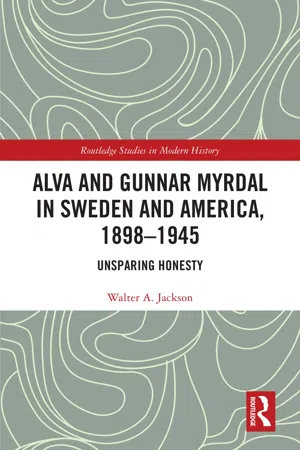
Alva and Gunnar Myrdal in Sweden and America, 1898–1945
Unsparing Honesty
- 332 pages
- English
- ePUB (mobile friendly)
- Available on iOS & Android
eBook - ePub
1 Unsparing Honesty
On the night of February 20, 1950, Gunnar Myrdal sat at his desk in Geneva and wept. He had just received word of the death of his closest friend from secondary school and university, the chemist and novelist Fritz Thorén, with whom he had had little contact during the previous decade. This shock led him to reflect on his early life in a handwritten letter to his wife, Alva Myrdal, who was living in New York. At 51, Gunnar directed the United Nations Economic Commission for Europe, charged with rebuilding the European economy and encouraging trade between the Soviet bloc and the West. Alva headed the United Nations Department of Social Affairs, which addressed the needs of children and women living in poverty amidst the aftermath of war. Together they had contributed important ideas to the formation of the Swedish welfare state in the 1930s. Now, as Gunnar and Alva pursued careers on different continents, their relationship had taken a new turn. Without Alva at his side and with the future of their marriage unclear, Gunnar felt peculiarly alone as he picked up the pen to capture the emotions he felt. (G to A, Feb. 20, 1950)
To Gunnar, the death of his old friend symbolized the loss of his own youth, and he sensed that a very deep-rooted part of himself had been severed and was now decaying.
A personality is constructed like a shell, like a suit of armor, and one manages ever greater things. But inside one remains frozen and sad. I am crying tonight for the first time in many years. . . . I had forgotten so much! If I had the time, I would like to shut myself away for a week and think about . . . myself. It is such a macabre pleasure to brood on one’s youth. What has gone wrong and what turned out right.
Suddenly terrified of being alone with these powerful memories, he blurted out: “Alva, I am so lonely here. . . . Alva, dearest, you won’t abandon me, will you?”
Why was it such a “macabre pleasure to brood” about his youth? What memories had he repressed in his rise from his parents’ cottage in the rural province of Dalarna to his position of worldwide prominence? Why does a man describe his personality as a “suit of armor” inside of which he remains “frozen?” What hidden side of his divided self had Fritz seen that no one else but Alva had glimpsed?
As Gunnar contemplated these vivid images from his youth, his early life seemed cut off from the professional and public persona he had fashioned as a young economist in the 1920s, an economic advisor to Sweden’s Social Democratic government in the 1930s, an internationally known expert on race relations and racism in the early 1940s, Sweden’s Minister of Trade in 1945–1946, and then director of a major UN commission during the early years of the Cold War. “I would like to write my memoirs,” he told Alva, but not about his public activities. Instead, he was focused on the “images” of the past “that continually pop up about the boy with a hip injury, and the girls, and the books and the dream” of being a “lawyer, handwriting, Father [underlined three times], Elsa [his sister], Stockholm, . . . the cold streets, yes . . . everything that is important and small and frightening.”
He was also tempted to write about “you [Alva] who were also a bit frightening but more and more the opposite.” At first, Gunnar remembered, he had been “scared of life,” but then “indifferent.” When does a person “live fully,” he wondered, and “what does it mean?” “What is truth and what is illusion?” Having lived through two world wars in Sweden and America, he asked, “What [is] an ideal which you are really prepared to—not die [for] because I am not willing to die for anything—but work for?” How does one distinguish “‘honest logic’ from . . . opportunism?” “And how does it all come together to form a fate?”
“What am I frightened of?” Gunnar wondered. On reflection, “mostly childish things, memories of fear. Everything is so complicated to work out. Much more complicated than all my books.” Gunnar nervously reassured his wife that he “will soon be normal again.” But “it feels so good for a depressive like me to cry. It is horrible to be alone.”
Gunnar Myrdal never wrote his memoirs. Until his early 80s, he strove to keep up the public persona of a wide-ranging social scientist engaging in global public policy debates. Over a decade after his death, his personal papers were opened to reveal some of the conflicts and self-doubts that he had learned to repress.
We do not have a written response to these anxious reflections from Alva Myrdal, but the couple discussed these memories in phone calls between Geneva and New York. The daughter of a family with roots in rural Sweden and in the working class, Alva was born in 1902. They moved many times before she was 12, as her father struggled to lift them out of poverty. Alva had to leave school at 14 because there was no high school for girls in the town where she lived. She was working as a secretary at age 17 in June 1919, when Gunnar, age 20, and two other Stockholm University students on a summer bicycle trip stopped at her family’s farm. The bond between the two was immediate and transformative for both and, despite chronic stresses and serious crises, lasted for 66 years.
They were passionately attracted to each other in spite of their differences in class background, education, and politics. Although both were the children of builders, Gunnar’s father had become a successful contractor in Stockholm, while Alva’s father had been a farm worker, clerk and bookkeeper, life insurance salesman, cement mixer, home builder, and farmer. When they met, Alva’s and Gunnar’s political outlooks differed sharply. Her father was an ardent Social Democrat. While Alva worked as a secretary, she dreamed of leading a life of service to humanity. His bourgeois father was quite conservative. As a law student, Gunnar considered himself an intellectual aristocrat and professed disdain for the uneducated masses.
Both Alva and Gunnar had grown up in unhappy families, considered themselves rebels against conventional Swedish society, and studied the social sciences in order to enable people to live happier and more productive lives. During the first year of their relationship, they wrote to each other constantly, both about their voracious reading and about themselves. They discussed psychology, analyzed each other, and even hoped to achieve a catharsis by correspondence during times of personal crisis. Although the youthful Gunnar believed men to be superior in intellectual capacity, he quickly became dependent on Alva, who served as both his debating partner and his counselor. While still a teenager, she came to function as a kind of therapist for Gunnar, whose extraordinary egotism, brilliance, and creativity were sometimes derailed by periods of paralyzing depression, anxiety, and fear. A university student 3 years older than Alva, Gunnar initially dominated their intellectual discussions, but Alva learned to be the strong one in the relationship, to listen sympathetically to Gunnar’s painful descriptions of psychological torment, build his self-confidence, and restore him to good health.
As the two young people discussed how to live their lives and how to find an ethical basis for decision making in an era when relativism had upended traditional moral values, honesty emerged as their highest value. If they could remain honest with each other, they believed, they could overcome personal difficulties and respond to changes in each other’s lives. Gunnar helped Alva take herself seriously as an intellectual and encouraged her efforts to complete a college-preparatory course and enroll in Stockholm University. After her graduation in 1924, they married. Gunnar pursued a PhD in economics, while Alva studied psychology in Uppsala and cared for their son Jan, born in 1927. Although they were not politically active during the 1920s, Gunnar managed to pull Alva away from her Social Democratic moorings into the intellectual elite, where social scientific expertise was more respected than democratic principles. Over time, however, her egalitarian and humanitarian outlook had an equally profound impact on Gunnar.
An important turning point in their lives came in 1929–1930, when Gunnar and Alva spent a year in the United States as Rockefeller fellows, visiting leading universities and immersing themselves in recent interdisciplinary social scientific research. Alva laid the foundation for a career as a child psychologist and educator, although she acceded to Gunnar’s demand that they leave their son with his parents during his second year. Her exposure to new work on early childhood development, psychoanalysis, Boasian anthropology, Chicago sociology, and John Dewey’s educational thought gave her new tools for understanding how cultural and environmental influences shape personality, gender, and family life. Although national politics in the United States was still dominated by conservative Republicans, the Myrdals were impressed by the continuation of progressive reforms at the state and local levels and by the role that applied social science research played in them. Glimpsing new possibilities for social engineering, the young Swedes decided to become politically active when they returned home.
In Sweden, the Myrdals emerged as prominent Social Democratic intellectuals and architects of the welfare state during the 1930s. Gunnar became a leading economist of the Stockholm School and a key author of the Social Democrats’ “Crisis Program,” which helped pull the country out of the depression. Alva helped to design apartment buildings with communal kitchens and daycare, enabling women to work outside the home and spend less time on housework. She founded a training school for preschool teachers and taught parenting.
The Myrdals were seen as heralds of modernity, advocates of a forward- looking, scientifically based form of social engineering designed to rationalize the family and childrearing, balance gainful work and family responsibilities in women’s lives, and provide greater equality of opportunity to all Swedes. In 1934 Alva and Gunnar coauthored a bestselling book, Kris i befolkningsfrågan (Crisis in the Population Question), which challenged Swedes to rethink social policy regarding birth control, education, and housing and played a formative role in the making of the Swedish welfare state. The national debate also brought unprecedented public attacks on the Myrdals, which had the effect of strengthening their professional partnership, which Gunnar liked to call “the firm” of “AGM.”
Despite Alva’s impressive achievements, she was held back in her professional development by class and gender barriers in higher education and public life. Moreover, she assumed far more of the responsibility for raising their three children than her husband. It was not until her early 30s that Alva came to the realization that much of what she had learned about the biological differences in the abilities and temperaments of men and women was bunk. “Where does ‘femininity’ come from?” she asked.
Sociologists and anthropologists trace the division of labor in primitive societies to notions of women’s “impurity,” such as the Christian idea of sin. Traditional concepts of “femininity” are rooted in women’s economic dependency on men and kept alive in women’s “psyche” by an “inferiority complex” which actually is the background to all ideas of “femininity.”
“The woman,” she concluded, was largely a social construction conditioned by centuries of male-dominated socialization. In fact, “the woman as she really is does not exist. We don’t know her. We will have to discover her.”1
The following year, in a speech to a Social Democratic youth group, she compared women to various “minorities,” including Negroes, Jews, the poor, and the unemployed, and insisted that their behavior is shaped by socialization, not determined by nature. Paradoxically, she observed, women are not a minority. “Why isn’t this considered a ‘man’s problem’ or a ‘masculinity problem’?” One answer she offered was that women had unconsciously accepted the subordination that had been forced on them. A second reason was the many social divisions among women, such as “home-makers versus working women, rural versus urban,” which are exacerbated by ideological differences among political parties.2
From this point on, Alva became a significant figure in the women’s movement in Sweden. She was already renowned as a developmental psychologist, educator, and family policy reformer, which made her especially effective. Working both within the Social Democratic Party and in all-women’s organizations, Alva sharpened her ability to think strategically and plan long-term policy changes that would advance the status of women in many areas of life. She learned to build coalitions with women from other political parties, uniting women of all classes to achieve common goals. What new qualities did Alva discover in herself as she plunged into the feminist movement? How did it affect the firm of AGM, and did she see her marriage to Gunnar in a different light?
While Gunnar won election to the upper house of the Swedish parliament, became a governor of the Bank of Sweden, and served on royal commissions on Population and Agriculture, Alva—like many women who actively addressed social questions—was not elected or appointed to an important public office. At the age of 36, she could look forward to continued success as a feminist writer, speaker, and educator, but the Social Democratic Party leadership was not interested in elevating her to a position with significant power.
In the fall of 1938, the Myrdals, with their children, returned to the United States at the invitation of the Carnegie Corporation of New York. This major philanthropic foundation commissioned Gunnar to lead an “unbiased” investigation into America’s “Negro problem” and supported Alva’s work on an English-language book on the Swedish experiment in social welfare and family policy.3 In a previous book, I have told the story of Gunnar Myrdal’s immersion in the issue of race, his creation of an interracial staff of social investigators representing several major points of view, and his production of a landmark study, An American Dilemma (1944), which was the key work in shaping postwar liberal thinking about race relations and framing the issue of civil rights as a problem “in the heart of the American.”4
This study takes a closer look at both Alva and Gunnar as intellectuals and political reformers in Sweden and the United States. Inspired by their commitment to the human and social sciences and their willingness to scrutinize themselves as well as their society, it focuses on the psychological dynamics of their marriage and their evolving views of how the social sciences can enable men and women to overcome the conditioning of race, gender, and class to achieve a more rational, equal, and modern way of living in which each person is free to develop their special talents and cooperate with others to enrich our common life.
I draw on a treasure trove of personal letters between Alva and Gunnar and their unpublished autobiographical writings, as well as oral history interviews, to explore their family backgrounds and the shaping of their personalities in early twentieth-century Sweden. Indeed, this book was made possible by the remarkable commitment of Gunnar and Alva Myrdal to collecting and preserving their correspondence and manuscripts. In order to make these documents available to future researchers, they donated them to the Arbetarrörelsens Arkiv och Bibliotek (Swedish Labour Movement’s Archive and Library), which has organized and catalogued them and offers valuable assistance to scholars. The Myrdals’ personal papers, including an extensive collection of letters they exchanged from their meeting in 1919 to Alva’s death in ...
Table of contents
- Cover
- Half Title
- Series Page
- Title Page
- Copyright Page
- Table of Contents
- List of Figures
- Author Biography and Bibliography
- Acknowledgments
- Editor’s Preface
- 1 Unsparing Honesty
- Part I Becoming Alva, Becoming Gunnar
- Part II Alva and Gunnar
- Part III Gunnar in Crisis, 1941
- Part IV Alva in Crisis, 1944
- Index
Trusted by 375,005 students
Access to over 1.5 million titles for a fair monthly price.
Study more efficiently using our study tools.
Frequently asked questions
Yes, you can cancel anytime from the Subscription tab in your account settings on the Perlego website. Your subscription will stay active until the end of your current billing period. Learn how to cancel your subscription
No, books cannot be downloaded as external files, such as PDFs, for use outside of Perlego. However, you can download books within the Perlego app for offline reading on mobile or tablet. Learn how to download books offline
Perlego offers two plans: Essential and Complete
- Essential is ideal for learners and professionals who enjoy exploring a wide range of subjects. Access the Essential Library with 800,000+ trusted titles and best-sellers across business, personal growth, and the humanities. Includes unlimited reading time and Standard Read Aloud voice.
- Complete: Perfect for advanced learners and researchers needing full, unrestricted access. Unlock 1.5M+ books across hundreds of subjects, including academic and specialized titles. The Complete Plan also includes advanced features like Premium Read Aloud and Research Assistant.
We are an online textbook subscription service, where you can get access to an entire online library for less than the price of a single book per month. With over 1.5 million books across 990+ topics, we’ve got you covered! Learn about our mission
Look out for the read-aloud symbol on your next book to see if you can listen to it. The read-aloud tool reads text aloud for you, highlighting the text as it is being read. You can pause it, speed it up and slow it down. Learn more about Read Aloud
Yes! You can use the Perlego app on both iOS and Android devices to read anytime, anywhere — even offline. Perfect for commutes or when you’re on the go.
Please note we cannot support devices running on iOS 13 and Android 7 or earlier. Learn more about using the app
Please note we cannot support devices running on iOS 13 and Android 7 or earlier. Learn more about using the app
Yes, you can access Alva and Gunnar Myrdal in Sweden and America, 1898–1945 by Walter A. Jackson in PDF and/or ePUB format, as well as other popular books in History & 20th Century History. We have over 1.5 million books available in our catalogue for you to explore.