![]()
1
Serving
DISCIPLINE OF SERVANT LEADERSHIP
If the thought of change instills in you the “FUD” factor—fear, uncertainty, and doubt—you’re not alone. Fear of change keeps people in relationships they’ve outgrown, jobs they don’t like, and even hairstyles that no longer suit them.
FEAR: F#©% Everything and Run
Likewise, even when organizations understand that change is necessary if they are to add value and remain competitive, they also suffer from FUD. They fear that they may fail; face uncertainty about how to change or, rather, what actions will lead to successful change; and, finally, doubt whether all the time, money, and effort it takes to implement change will be worth it.
That’s where you come in. The truth is, people don’t change their minds; they make new decisions—sometimes frequently—based on new or added information. This new and added information accelerates change by influencing decision-making in both individuals and groups.1
With that truth in mind, it becomes clear that “servant leaders” (like you) are not engaged to change peoples’ minds, but rather to make it easier for people to choose appropriate change supported with more informed decisions. By speaking with people rather than at them, servant leaders create environments that foster breakthrough solutions.
Table 1.1. Knowledge Transfer Molds the Optimal Leadership Technique
Information Storage | Knowledge Transfer | Leadership Technique |
Bard | Oral | Steward |
Book | Print | Manager |
Documentary | Broadcast | Executive |
Cloud | Digital | Facilitator |
In most organizations, this change begins during meetings. The problem is that meetings often fail for one of three reasons:
- The wrong people are attending (rare).
- The right people attend but are apathetic and don’t care (rarest).
- The right people care but they don’t know how to conduct an effective meeting (bazinga!).
We know that groups can make higher-quality decisions than the smartest person in the group alone, so why don’t we invest in learning how to run better meetings? Part of the problem can be found in our muscle memory. When part of a group or team, we are more attuned to taking orders than creating collaborative solutions.
Historically, leadership techniques have evolved based on where information was stored and how knowledge was shared—from rural stewards who knew about crops and animal behavior to complex urban environments layered with infrastructure and technology.
In recent centuries we relied on executives and managers for their experience and machine knowledge. As leaders, they told us what to do. Today’s complex knowledge base and knowledge transfer technique, however, requires a new breed of servant leaders. Most of them are trained to avoid problems attributable to weak meeting leadership, poor facilitation, and lack of meeting design. This new breed is not a person, but a role—the role of the meeting facilitator (see table 1.1).
From this point on, I use the following terms and understanding:
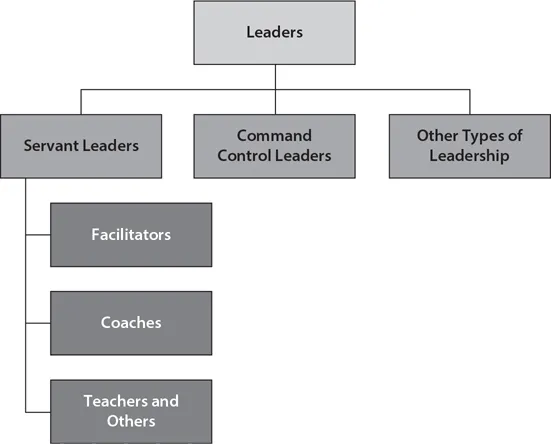
- All servant leaders are leaders, but not all leaders are servant leaders.
- – Servant leaders accept the likelihood of more than one right answer and serve others to help them find the best answer for their own situation.
- Early on I frequently use the term “servant leader,” because much of the material in the first four chapters applies to both servant leaders and meeting facilitators.
- All skilled meeting facilitators are servant leaders, but not all servant leaders facilitate meetings.
- – Servant leaders may also be found as advisers, arbitrators, coaches, consultants, and ombudspersons and in other roles in which they share primary skills with meeting facilitators, such as active listening, maintaining content neutrality, observing, questioning, and seeking to understand.
- Beginning in chapter 5, I refer more frequently to the meeting designer—a title that frequently also designates the meeting leader, distinguished from the “meeting facilitator.”
- To be precise, being a meeting leader requires managing three additional roles—meeting coordinator, meeting documenter, and meeting designer—that are quite independent of the role of meeting facilitator.
- – In a practical sense, however, people often act as meeting leaders because they usually perform all four roles, although not all the time—especially in more complicated meetings, frequently called “workshops.”
Figure 1.1. Hierarchy of Leadership
The Servant Leader Solution
As the workplace transforms, leadership techniques change. Today, instead of dealing mostly with individuals (one-on-one conversations), servant leaders work frequently with people in groups (ceremonies, events, meetings, and workshops). Instead of supervising hours of workload, servant leaders help their teams become self-managing (see figure 1.1). Instead of directing tasks, servant leaders motivate people to achieve results.
Facing consecutive days of back-to-back meetings, meeting participants value well-run meetings that focus on aligning team activities with organizational goals. Professionally trained facilitators solve communication problems in meetings or workshops by ensuring the group stays focused on the meeting objectives while applying meeting designs that lead to more informed decisions.
Compared to traditional or historic leaders, modern leaders exhibit many of these positive traits. A further shift is required, however, for many of these leaders to become truly facilitative, so that teams and groups realize the full potential of their commitment, consensus, and ownership.
Have you ever led a meeting? I’ll assume that you have. Ask yourself, What changed from the moment your participants walked into the meeting until the meeting ended?
As a servant leader and meeting facilitator, you become the change agent, someone who takes meeting participants from where they are at the beginning of the meeting to where they need to be at the conclusion. All leaders must know where they are going. They must know what the group is intending to build, decide, or leave with when the meeting is done. Effective servant leaders also start with the end in mind.
The servant leader does not have answers but rather takes command of the questions (see table 1.2). Optimal questions are scripted and properly sequenced. If you were designing a new home, for example, you would consider the foundation and structure long before you decide on the color of the grout. By responding to appropriate questions, meeting participants focus and generate their collective preferences and requirements.
A neutral meeting leader values rigorous preparation, anticipates group dynamics, and designs the meeting accordingly. The meeting leader becomes responsible for managing the entire approach—the agenda, the ground rules, the flow of conversations, and so on—but not the content developed during the meeting. Effective meetings result from building a safe and trustworthy environment, one that provides “permission to speak freely” without fear of reprisal or economic loss.
Table 1.2. Characteristics of the Facilitative Leadership Difference
Modern Leaders | Servant Leaders |
Are content experts, based on position and power | Are context experts, based on credibility, genuineness, and inspiration |
Are involved in directing tasks | Facilitate plans and agreements based on group input |
Communicate and receive feedback | Structure activities so that stakeholders and team members evaluate them, their leaders, and one another |
Have some meeting management skills | Are skilled in using groups to build complex outputs by structuring conversations based on a collaborative tone |
Re... |