Exploring the brilliant web of verbal hocus-pocus that J.R.R. Tolkien delightedly spun inThe Hobbit andThe Lord of the Rings, master hobbit investigator David Day reveals the myriad crafty puns and riddles, hidden meanings, and mythical associations beneath the saga's thrilling surface.
If we look at the evolution and history of the Hobbit races and the Anglo-Saxon tribes, we see an obvious pattern. The origins of both are lost in the mists of time somewhere beyond a distant and massive eastern range of mountains. The ancestors of both the Hobbits and the Anglo-Saxons migrated across these mountains and eventually settled in a homeland in a fertile river-delta region.
Eventually war and invaders forced the Hobbits to leave their homeland known as the Angle~a wedge of land between the Loudwater and Hoarwell Rivers~and migrate across the Brandywine River into what eventually became known as the Shire of Middle-earth.
Similarly, war and invaders forced the Anglo-Saxons to leave their homeland known as the Angle~a wedge of land between the Schlei River and Flensburg Fjord~and migrate across the English Channel into what eventually became known as the Shires of England. Furthermore, there were three breeds or tribes of Hobbits: Fallohides, Stoors, and Harfoots; which are directly comparable to the three races or tribes of English: Saxons, Angles, and Jutes.
Finally, we find the Hobbit founders of the Shire were the brothers Marcho and Blanco; while the Anglo-Saxon founders of England were the brothers Hengist and Horsa.
ANGLO-SAXONS MIGRATIONfrom original homeland EAST OF THE ALPINE MOUNTAINS. WESTto a wedge of river-delta land called the ANGLE. Then WESTagain to a new homeland called the SHIRES. Founders of the Shires known as HENGISTand HORSA. Original three tribes of Anglo-Saxons: ANGLES, SAXONS, and JUTES.
HOBBITS MIGRATIONfrom original homeland EAST OF THE MISTY MOUNTAINS. WESTto a wedge of river-delta land called the ANGLE. Then WESTagain to a new homeland called the SHIRE. Founders of the Shire known as: MARCHO and BLANCO. Original three tribes of Hobbits: FALLOHIDES, STOORS, and HARFOOTS.
Hengist in Old English
HORSE(Stallion) Horsa in Old English
HORSE MARCHO
HORSE
March in Welsh
Marc in Gaelic
Mearh in Old English *
BLANCO
HORSE(White)
Blanca in Old English
Blakkr in Old Norse
BREEDS OR STRAINS OF HOBBITS Like the Anglo-Saxon tribes, all Hobbits shared certain characteristics. Just as we have seen how the elements and associations with the word Hobbit went into the shaping of the racial and individual characteristics of Hobbits, so the names Harfoot, Fallohide, and Stoor contributed to the development of Hobbits and their world.
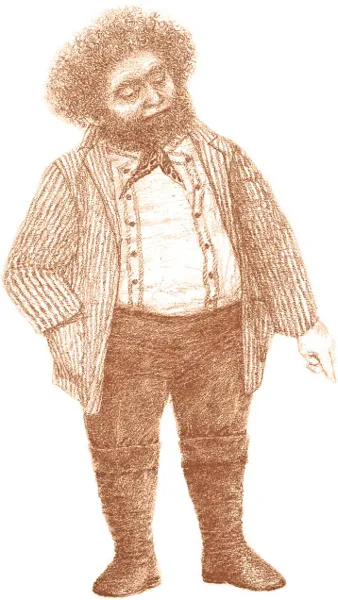
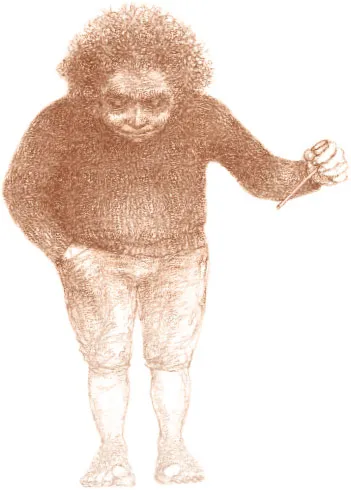
HARFOOTS The Harfoot are the smallest and most typical Hobbits: the standard-issue diminutive, brown-skinned, curly-headed, hairy-footed, hole-dwelling Hobbit. Harfoots have always made up the majority of the total Hobbit population. They are extremely conservative in their habits and are the least adventurous of Hobbits, although they are known to have had some commerce with itinerant bands of Dwarves. They delight in the peace and quiet of country life, especially hillsides, farmlands, and pastures. Harfoots are naturally gifted farmers and gardeners.
Harfoot is an excellent and highly descriptive name for this most typical of Hobbits, and originally was applied to all Hobbits. Harfoot is an English surname, derived from an Old English epithet or nickname meaning Hare-foot. This was not an uncommon nickname among Anglo-Saxons and usually meant “fast runner” or “as nimble as a hare.”
This is an accurate enough description of Hobbit behaviour, but it is also meant as an obvious joke: a pun, or play on the words hare and hair.
For, besides being naturally fast and nimble on their feet, Hobbits are also both hare-footed and hair-footed. That is, like the hare, the Hobbit has feet that are both large and hairy.
HARFOOT BREED OF HOBBIT Harfoot~English surname Hare-foot–Anglo-Saxon epithet or nickname Usually means fast runner or nimble as a hare
HOBBITISH PUNNING JOKE Harfoot
Hare-foot
Hair-foot
HARFOOT/HAREFOOT/HAIRFOOT Succinct description of Hobbits. (That is, small and nimble creatures with large, hairy feet.)
TYPICAL HARFOOT NAMES: Brown and Brownlock are descriptive of the hair and skin colour of Harfoots. Other names such as Sandheaver, Tunnelly, and Burrows suggest the construction of hole-dwelling Harfoot Hobbit homes. Names such as Gardner, Hayward, and Roper tell us of typical Harfoot occupations.
FALLOHIDES Fallohide is the name of the second strain, or breed, of Hobbits. They are woodland dwellers in origin and the least numerous of the breeds. The most unconventional and adventurous of Hobbits, they are the most likely to consort with Elves. They have the fairest skin and hair of the three, and are generally taller and thinner than their cousins. The name for the Fallohide breed of Hobbit can be seen in terms of Falo-Hide: Falo as in the Old High German for pale yellow or reddish yellow, that is the colour of a fallow deer; and Hide as in skin or pelt. This interpretation could reasonably be used to describe the fair-haired, pale-skinned Fallohide breed.
Another explanation of Fallohide is suggested from different root words. Fallow-Hide: Fallow as in Old English for “newly ploughed land;” and Hide as in keeping out of sight, hidi...
Table of contents
Cover
Title Page
Dedication
Copyright
Table of Contents
I. In the Beginning was the WORD
II. Dictionary HOCUS POCUS
III. Enter BILBO BAGGINS
IV. GOLLUM & the GOBLINS
V. HOBBIT Heritage & History
VI. ANCESTORS & Founding Fathers
VII. Buckland & BRANDY HALL
VIII. TOOKLAND & the Great Smials
IX. HOBBITS & the Land
X. The Shire & MICHEL DELVING
XI. Hometown of HOBBITON
XII. BAG END: The Hobbit Home
XIII. Conjuring GANDALF the WIZARD
XIV. TROLLS & GIANTS
XV. A Conspiracy of DWARVES
XVI. Naming the DRAGON
XVII. SHIRE SOCIETY
XVIII. FRODO the Ringbearer
XIX. Fellowship of HOBBITS
XX. HOBBITS & RINGS
BIBLIOGRAPHY
Trusted by 375,005 students
Access to over 1.5 million titles for a fair monthly price.
Study more efficiently using our study tools.
Frequently asked questions
Yes, you can cancel anytime from the Subscription tab in your account settings on the Perlego website. Your subscription will stay active until the end of your current billing period. Learn how to cancel your subscription
No, books cannot be downloaded as external files, such as PDFs, for use outside of Perlego. However, you can download books within the Perlego app for offline reading on mobile or tablet. Learn how to download books offline
We are an online textbook subscription service, where you can get access to an entire online library for less than the price of a single book per month. With over 1.5 million books across 990+ topics, we’ve got you covered! Learn about our mission
Look out for the read-aloud symbol on your next book to see if you can listen to it. The read-aloud tool reads text aloud for you, highlighting the text as it is being read. You can pause it, speed it up and slow it down. Learn more about Read Aloud
Yes! You can use the Perlego app on both iOS and Android devices to read anytime, anywhere — even offline. Perfect for commutes or when you’re on the go. Please note we cannot support devices running on iOS 13 and Android 7 or earlier. Learn more about using the app
Yes, you can access The Hobbit Companion by David Day, Lidia Postma in PDF and/or ePUB format, as well as other popular books in Literature & Classics. We have over 1.5 million books available in our catalogue for you to explore.