![]()
biology
(and a dash of music)
so, we think it’s time we got to know our guts, and for that we need to go...
‘Pencil cases and paper planes at the READY!’
Since this isn’t actual school and we can do what the hell we like, we thought we’d mash up a biology and music class – where cells meet bells and drums become bums.
Our gut is a wonderful orchestra, and we don’t just mean the trumpet at the end. The surface area of our digestive system is forty times larger than our skin and there are several organs involved (and we don’t mean the church kind). So that’s a lot of orchestra seats and stands, with Mother Nature the best conductor of all.
“what’s my gut? just my stomach yeah?”
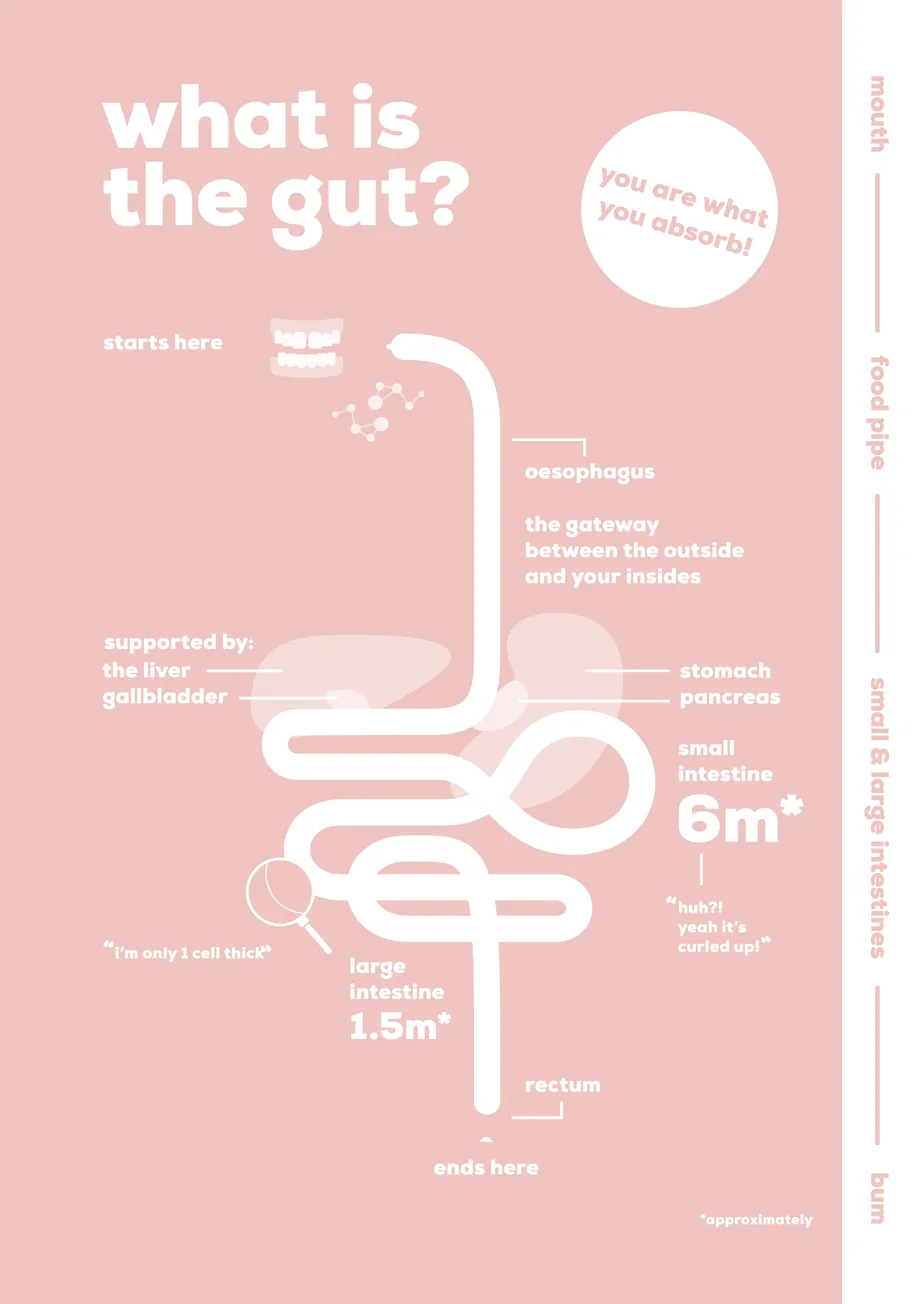
Your stomach isn’t actually your gut but one player in tune with other organs, including your liver, gallbladder and pancreas, working in harmony to support your gut. Yes, it can sound more like death metal than Bach at times, but all the players are there with their parts ready and willing it to work.
We shall call this aria, ‘To eat: the long journey out’.
Our mouth is the perfect introduction to the show, with a plodding duet of your teeth and saliva working together to break down your food both physically (teeth) and chemically (by clever enzymes contained in your saliva). Their tunes dance round each other with the same aim: to get the food as small as possible to make it easier for the next key players to read the sheet music. But too many of us don’t let the tunes play for long enough – cue not chewing – making it hard for the next players to continue playing.
If you thought your tongue was just for tasting, you’ve very much underestimated it – there are actually immune cells at the back of our tongue that are ‘on guard’ ready to protect us. More on them later...
The oesophagus is like a didgeridoo with a sphincter (valve) at the top and bottom that moves food from the back of your throat to your stomach. This is not to be confused with your windpipe (the clarinet next door). You’ll know if these two have ever been confused *spluttering cough*. The sphincter at the top stops air going in and the sphincter at the bottom allows food to enter the stomach but prevents the acidic contents of your stomach going up.
And now for the stomach, the big clever bagpipe, which acts as an expensive mixer to churn our food into chyme (another musical reference nearly hit, but not quite).
Our stomach is a lot higher up than we think (see here), so often when people complain of stomach ache, it’s not actually stomach ache, it’s probably something a lot further down the line.
Firstly, the stomach separates solids from liquids. The liquids get a VIP fast track onto the next phase, but the solids have to be mixed up in the queue a little longer.
“it’s bad if our stomach is really acidic.”
WRONG. Our stomach needs to have a low pH (acidic) to break down our food; the enzymes really like an acid party up in there and they need it to get rid of the unwanted ‘microbes’ that weren’t invited.
And so, to the small intestine where the song starts to gain momentum, as it’s got a lot of pals to help the process. Nutrients are absorbed here by the villi, which we think look like sea anemones, and the food is here for 2–6 hours (it’s a long tune!).
The small intestine is lined with tiny finger-like structures called villi. The inner wall of villi is only one cell thick, so it’s a sensitive Sally, and it’s pretty easy for substances to pass in and out of it (so not a soundproof music hall). Some foods and medications, excessive alcohol and stress may make Sally feel a bit out of sorts and she might occasionally let substances – like food particles and toxins produced by bacteria – into the bloodstream that she shouldn’t.
In comes the liver, like a big important double bass (arguably the most important organ, which is why it deserves its own bullet points). The liver tends to command a lot of attention (and rightly so) because it does so many things, the key ones being:
• Produces bile acids that ‘skoosh’ in via the gallbladder, which is a trusty sidekick that stores all the bile acids (not to be confused with hangover sickness) when the time is right – like a steady cello perhaps?
• Filters blood coming from the small intestine, in doing so it:
° ‘polices’ what’s in the blood, such as toxins or medications, which it then has a good sort through and either turns them into something less harmful or metabolizes them.
° converts food to fuel to give us energy (even our gut needs energy to work).
° stores vitamins, minerals, fats and sugar for later use.
• Produces hormones to help regulate lots of different functions around our body.
To round off the string section is the pancreas, which secretes enzymes and hormones that play a part in controlling blood sugar and sodium bicarbonate to change the pH of chyme that enters your small intestine and other things.
Hold up! Chyme? Whaaat?!
What is it? A cocktail of stomach acid, digestive enzymes, partially digested food and water.
What does it do? Chyme allows for further digestion by enzymes and carries food and enzymes to the small intestine.
Into the plodding adagio we move, as all the unabsorbed bits of food make their way into the large intestine (for around 12-30 hours – hope everyone brought snacks to this show). Here is where most of our gut microbes live (more on this after the show) and they LOVE everything that our human enzymes can’t break down, like fibre.
We forgot about the appendix. (Most people do.) It’s got a reputation for being the spare part, like the cow bell. It sits just below the junction between the small and large intestine and is seemingly completely bypassed. However, just like the cow bell in the Christmas nativity (nothing else can signify donkey steps quite like a cow bell), it isn’t just there for show. Some experts believe the appendix is like a big storage container for all the most helpful bacteria ready for when we need them most, like when we have diarrhoea.
AND SO FOR THE BIG CRESCENDO, aka getting it out the other end. This is our last chance to absorb any water. The music (hopefully the poo) swells as our intestinal muscles push along your poo to sit in the waiting room (your rectum)... the music stops dramatically... as our external sphincter closes, ready for the opportune time to introduce the trumpet and complete the song.
The audience are in POO-sitition (see here for how to do this optimally), the brain signals it’s time for the eagle to land and the final trumpet sings the final notes A round of applause, not dissimilar to the sound of a flush, and the audience are on their feet (washing their hands)...