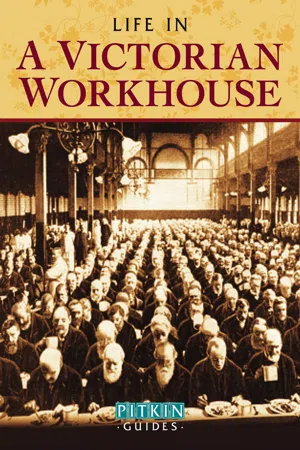
The word 'workhouse' has a grim resonance even today, conjuring up a vision of the darker side of Victorian Britain. Almost every town had at least one workhouse, and most people dreaded ending up there.
Here we examine how workhouses came into being, what life was like for men, women and children on the wrong side of the poverty line, and how social attitudes evolved through the momentous events of Victorian Britain into the 20th century. Illustrated from contemporary and modern sources, this fact-filled guide presents an intriguing picture of a world of steam engines, self-help, service and salvation - where workhouse life, and workhouse reform, influenced attitudes and services we now take for granted.
- 300 pages
- English
- ePUB (mobile friendly)
- Available on iOS & Android
eBook - ePub
Life in a Victorian Workhouse
About this book
Information
Subtopic
Modern HistoryIndex
HistoryDAILY LIFE
The workhouse daily routine was one of early rising and early bedtimes, with the hours in between mostly occupied by work, mealtimes and religious observances.
Workhouse inmates slept in dormitories, usually with the beds packed close together. Uniforms would be stored overnight in baskets placed under each bed. Bed sharing was common up until the 1870s. Children in particular often had very cramped accommodation – in 1838, it was revealed that in part of London’s Whitechapel workhouse 104 girls were sleeping four or more to a bed in a room 88 feet (27m) long, 16½ feet (5m) wide and 7 feet (2.1m) high.
Meals were to be eaten with ‘order, decorum’ and, until 1842, in silence. Communal prayers were read by the workhouse master before breakfast and after supper each day. On Sundays (and also on Good Friday and Christmas Day) work was restricted to essential domestic tasks only. Instead, inmates attended ‘Divine Service’ in the morning and evening, at which the workhouse chaplain officiated.
Inmates generally washed themselves in water from a bucket or bowl or direct from a hand-pump in one of the yards, although a small washroom – known as a lavatory – could also be provided for this purpose. Baths, if provided, were often of the portable tin variety, with hot water having to be carried in buckets from the workhouse kitchens.
Workhouse life was governed by numerous rules, with penalties for those who broke them. Lesser infringements such as swearing, gambling or failing to work were punishable by up to two days on a bread and potato diet. More serious offences such as assaulting another person or damaging workhouse property could result in a period of solitary confinement in the ‘refractory cell’ or being sent before a magistrate.
Life inside the workhouse was not entirely devoid of pleasure, however. By the 1890s, most workhouses had a library and a supply of newspapers and magazines. Concerts or other entertainments were sometimes put on, and trips to the country or seaside arranged in the summer. In 1898, inmates of the Haslingden workhouse in Lancashire were treated to a performance from a phonograph, then still a very novel experience.

A dormitory at London’s St Marylebone workhouse in around 1900. Inmates had no possessions so there was no need for drawers or lockers; their uniforms were stowed in a basket under their beds at night.
SPENDING A PENNY
Workhouse loos were fairly basic. The ‘privy’ provided one or more seats over a cesspit or tank which was emptied periodically, the contents often then used as manure. In the dormitories, chamber pots might be provided or a communal tub which was carried away and emptied each morning. The earth closet, patented in 1860, deodorized deposits with a sprinkling of dried earth which then produced excellent fertiliser. It proved particularly useful in rural areas or in buildings where no water supply existed. At around the same period, the water closet, with a reservoir of water to flush away deposits, was also gaining popularity. If a workhouse did provide such a luxurious facility, a single water closet would probably serve a very large number of inmates. Workhouse water closets often suffered from poor maintenance and erratic water supplies so could get extremely smelly.
DAILY TIMETABLE
Summer |
Winter |
|
Rising & roll call |
6 a.m. |
7 a.m. |
Breakfast & prayers |
6.30 a.m. |
7.30 a.m. |
Start work |
7 a.m. |
8 a.m. |
Dinner |
12 noon |
12 noon |
Resume work |
1 p.m. |
1 p.m. |
Supper & prayers |
6 p.m. |
6 p.m. |
Bedtime |
8 p.m. |
8 p.m. |
WORKHOUSE LABOUR
ANDOVER SCANDAL
In 1845, an official inquiry was launched after it was revealed that inmates at the Andover workhouse in Hampshire were so hungry that they had been fighting over shreds of rotting meat and marrow left on the bones they had been given for pounding. The resulting scandal led to the banning of the task from workhouses and, ultimately, to the demise of the Poor Law Commissioners.
In return for their board and lodging, adult workhouse inmates were required to work six days a week ‘according to their capacity and ability’ as the regulations put it. The work was unpaid and performed in the workhouse and its grounds; inmates were not sent to work for outside employers.
The women were mainly employed in carrying out the domestic chores of the workhouse. These included the daily cleaning of the workhouse, helping to prepare food in the kitchens, and laundry work. Workhouses generally had a wash-house where the dirty clothing and bed linen were washed, and a separate laundry room where, after being dried, it was ironed and folded. Females were also sometimes employed in making and maintaining the inmates’ workhouse uniforms. Other occasional jobs for the women could include nursing in the workhouse infirmary and supervising young children if the workhouse had a nursery.

Women at work in the laundry at the Mitcham workhouse in 1896.
Able-bodied men were employed in a wide variety of manual labour tasks. In the early years of the union workhouse, the work was often strenuous but with little practical value and was intended to add to the deterrent character of the institution. Some of the most common tasks of this type were stone breaking, corn grinding, oakum picking and bone crushing.
Stone breaking involved smashing up large lumps of stone with a hammer into pieces small enough to fit through a metal grille. The broken stone could then be sold off for road-making. Corn grinding involved several men turning a large capstan to rotate a heavy millstone. Oakum picking required the teasing apart of old hemp ropes into their raw fibres which could then be sold for mat-making, or for mixing with tar and used to seal the lining of wooden ships. Bone crushing entailed using a heavy iron ‘rammer’ to pound old meat bones from the kitchens into dust for use as fertilizer.
Many workhouses, particularly those in rural areas, cultivated the land around the workhouse. This provided both useful work for the inmates and also a supply of vegetables for use in the workhouse. Many workhouses also kept pigs, fattened with waste from the kitchens. For older or less physically able inmates, a common task was the chopping and bundling of wood which could then be sold to people living in the area.
Over the years, the range of work grew wider with incr...
Table of contents
- Cover
- Title
- Copyright
- Contents
- Important Dates
- The Workhouse
- Origins of the Victorian Workhouse
- Entering and Leaving the Workhouse
- Workhouse Buildings
- Daily Life
- Workhouse Labour
- Workhouse Food
- Children in the Workhouse
- Workhouse Medical Care
- Old Age and Death
- Tramps and Vagrants
- Running the Workhouse
- Ireland and Scotland
- The Workhouse in Literature and Art
- The End of the Workhouse
- Places to Visit
- Glossary
Trusted by 375,005 students
Access to over 1.5 million titles for a fair monthly price.
Study more efficiently using our study tools.
Frequently asked questions
Yes, you can cancel anytime from the Subscription tab in your account settings on the Perlego website. Your subscription will stay active until the end of your current billing period. Learn how to cancel your subscription
No, books cannot be downloaded as external files, such as PDFs, for use outside of Perlego. However, you can download books within the Perlego app for offline reading on mobile or tablet. Learn how to download books offline
Perlego offers two plans: Essential and Complete
- Essential is ideal for learners and professionals who enjoy exploring a wide range of subjects. Access the Essential Library with 800,000+ trusted titles and best-sellers across business, personal growth, and the humanities. Includes unlimited reading time and Standard Read Aloud voice.
- Complete: Perfect for advanced learners and researchers needing full, unrestricted access. Unlock 1.5M+ books across hundreds of subjects, including academic and specialized titles. The Complete Plan also includes advanced features like Premium Read Aloud and Research Assistant.
We are an online textbook subscription service, where you can get access to an entire online library for less than the price of a single book per month. With over 1.5 million books across 990+ topics, we’ve got you covered! Learn about our mission
Look out for the read-aloud symbol on your next book to see if you can listen to it. The read-aloud tool reads text aloud for you, highlighting the text as it is being read. You can pause it, speed it up and slow it down. Learn more about Read Aloud
Yes! You can use the Perlego app on both iOS and Android devices to read anytime, anywhere — even offline. Perfect for commutes or when you’re on the go.
Please note we cannot support devices running on iOS 13 and Android 7 or earlier. Learn more about using the app
Please note we cannot support devices running on iOS 13 and Android 7 or earlier. Learn more about using the app
Yes, you can access Life in a Victorian Workhouse by Peter Higginbotham in PDF and/or ePUB format, as well as other popular books in History & Modern History. We have over 1.5 million books available in our catalogue for you to explore.