![]()
GLOSSARY
Aqueduct – a structure of brick, stone or iron for carrying a canal across a river or valley. The most spectacular is Pontcysyllte near Llangollen.
Balance beam – a beam at the top of a lock gate, which is pushed to open and close the gate.
Barge – a canal or river boat with a beam approximately twice that of a narrow boat.
Beam – a term to that refers to the maximum width of a boat.
Boatman, boatwoman – the correct name for narrow-boat crew, never ‘bargee’.
Butty – an unpowered boat, part of a working pair and pulled by the motor boat.
Day boats – boats without cabins, used for short journeys.
Flats – a class of river barges, named from being flat bottomed and not having a keel.
Flight – a series of locks set close together; the longest in Britain is the 30-lock flight at Tardebigge on the Worcester & Birmingham Canal.
Fly boat – a boat run continuously, using crews working in shifts.
Gauging – the system used to measure the draught of a vessel so that the weight of the cargo on board can be calculated to determine how much should be paid in tolls.
Legging – a method of moving boats through tunnels that have no towpaths, by ‘walking’ the boat along with feet pressed against the sides or roof of the tunnel.
Lock – the device used to overcome changes of level on rivers and canals. It generally consists of a chamber lined with brick or masonry, with gates at either end. Water can be let in and out through a system of sluices.
Narrow boat – the traditional boat of the English Midland canals, usually 7–7½ foot (2–2.5m) beam.
Paddle gear – the mechanism for letting water into and out of a lock. These can either be gate paddles, where the ratchet gear is used to raise and lower the paddle that covers an opening in the gate, or ground paddles where the paddle covers a sluice let into the side of the lock.
Piles – wooden or metal posts driven into the ground at the canal’s edge to protect the bank from erosion.
Pound – the length of canal between locks.
Staircase – a series of linked locks, where the top gate of the lower lock is also the bottom gate of the one above, such as in the Bingley Five-Rise on the Leeds & Liverpool Canal.
Trows – sailing barges, mainly used on the River Severn, usually two-masted and having a distinctive square stern.
Wide boat – a vessel with a beam of a size between that of a narrow boat and a barge.
Windlass – a detachable handle used for working paddle gear, also known as a lock key.
Look out for other ebooks in the Pitkin range
Life in Ancient Britain
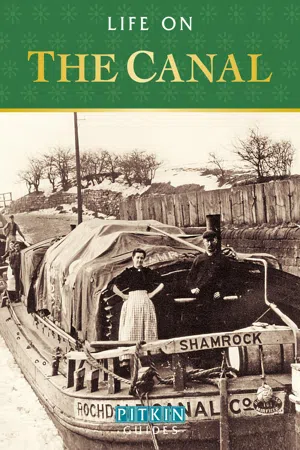
Life on the Canal
Life in a Country House:
Upstairs & Downstairs
Life on the Farm
Life in Georgian Britain
Life in a Medieval Castle
Life in Medieval England
Life in the Mill
Life in the Mine
Life in a Monastery
Life on the Railway
Life in a Roman Villa
Life in Stuart England
Life in Tudor England
Life in Tudor Palaces & Houses
Life in Victorian Britain
Life in a Victorian School
Life in a Victorian Workhouse
Life in a Wartime House 1939–1945