Heat is a branch of thermodynamics that occupies a unique position due to its involvement in the field of practice. Being linked to the management, transport and exchange of energy in thermal form, it impacts all aspects of human life and activity.
Heat transfers are, by nature, classified as conduction, convection (which inserts conduction into fluid mechanics) and radiation. The importance of these three transfer methods has resulted – justifiably – in a separate volume being afforded to each of them. This first volume is dedicated to thermal conduction, and, importantly, assumes an analytical approach to the problems presented, and recalls the fundamentals. Heat Transfer 1 combines a basic approach with a deeper understanding of the discipline and will therefore appeal to a wide audience, from technician to engineer, from doctoral student to teacher-researcher.
1 The Problem of Thermal Conduction: General Comments
1.1. The fundamental problem of thermal conduction
The fundamental problem of thermal conduction involves the determination of temperature domains and flows across particular surfaces, for a given physical situation, in one or several given environments.
The resolution of a thermal conduction problem involves:
a) for all problems, a heat equation is considered, resulting from a local heat balance;
b) for specific conditions of the problem, the conditions are constituted at the limits that are applied to the heat equation.
In the most general case, these temperature domains T are not homogeneous. They can be three-dimensional and variable over time:
In other systems, we note that T = T (r, θ, z, t) or T = T (r, θ, Φ, t).
Temperature is expressed in degrees Celsius (°C), formerly degrees centigrade, or in Kelvin (K).
We know that the temperature, expressed in Kelvin, is measured from absolute zero. The conversion rule is known as: T K = T C + 273.15.
The most general problem presented in thermal conduction is therefore extremely complex, since the heat equation has four dimensions (three in space and one in time).
Fortunately, significant simplifications are possible for many problems.
The temperature field can only depend on a spatial variable. We say that conduction is monodimensional or bidimensional.
The temperature can remain fixed at each point as time progresses.
This last remark divides the approach that we will adopt into two parts:
– stationary conductive heat transfer;
– non-stationary conductive heat transfer.
Two important categories will be examined in this chapter:
– problems of stationary conduction with a single dimension: T = T(x) or T = T(r)
– problems of non-stationary conduction with a single dimension: T = T (x,t) or T =T (r,t)
For many problems, the analytical approach is possible. This will be the case, in particular, for the stationary or non-stationary problems with a single dimension. In (most) other cases, a numerical approach is required.
1.2. Definitions
1.2.1. Temperature, isothermal surface and gradient
The temperature T is a parameter defined in all thermodynamics classes.
As of now, we can define isothermal surfaces in space. An isothermal surface is a surface on which the temperature is constant:
[1.1]
Furthermore, we will look at the important relationship between this surface and heat flow.
Let us note that in a non-stationary problem, the isothermal surface is mobile in time.
The temperature field also allows a very important vector to be defined, whose use will be explained later on: temperature gradient.
Initially, we define this vector in a Cartesian system. Later on, we will see that it is quite easy to determine its components in other systems when the symmetries in a problem make that a pertinent option.
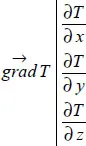
In a Cartesian system, this gradient is constructed by taking, for each of its components, the partial derivative of the temperature with respect to the relevant coordinate axis. In other words:
[1.2]
For other systems, it will be useful to refer to Appendix 2.
This mathematical operation is known to all physicists. With a minus sign, it is the derivation of a force from a potential.
We should note that in a stationary problem, this gradient is a vector attached to each point in space and fixed in time. In the case of a non-stationary problem, this gradient is a vector attached to each...
Table of contents
Cover
Table of Contents
Title Page
Copyright
Preface
Introduction
1 The Problem of Thermal Conduction: General Comments
2 The Physics of Conduction
3 Conduction in a Stationary Regime
4 Quasi-stationary Model
5 Non-stationary Conduction
6 Fin Theory: Notions and Examples
Appendices
References
Index
End User License Agreement
Trusted by 375,005 students
Access to over 1.5 million titles for a fair monthly price.
Study more efficiently using our study tools.
Frequently asked questions
Yes, you can cancel anytime from the Subscription tab in your account settings on the Perlego website. Your subscription will stay active until the end of your current billing period. Learn how to cancel your subscription
No, books cannot be downloaded as external files, such as PDFs, for use outside of Perlego. However, you can download books within the Perlego app for offline reading on mobile or tablet. Learn how to download books offline
Perlego offers two plans: Essential and Complete
Essential is ideal for learners and professionals who enjoy exploring a wide range of subjects. Access the Essential Library with 800,000+ trusted titles and best-sellers across business, personal growth, and the humanities. Includes unlimited reading time and Standard Read Aloud voice.
Complete: Perfect for advanced learners and researchers needing full, unrestricted access. Unlock 1.5M+ books across hundreds of subjects, including academic and specialized titles. The Complete Plan also includes advanced features like Premium Read Aloud and Research Assistant.
Both plans are available with monthly, semester, or annual billing cycles.
We are an online textbook subscription service, where you can get access to an entire online library for less than the price of a single book per month. With over 1.5 million books across 990+ topics, we’ve got you covered! Learn about our mission
Look out for the read-aloud symbol on your next book to see if you can listen to it. The read-aloud tool reads text aloud for you, highlighting the text as it is being read. You can pause it, speed it up and slow it down. Learn more about Read Aloud
Yes! You can use the Perlego app on both iOS and Android devices to read anytime, anywhere — even offline. Perfect for commutes or when you’re on the go. Please note we cannot support devices running on iOS 13 and Android 7 or earlier. Learn more about using the app
Yes, you can access Heat Transfer 1 by Michel Ledoux,Abdelkhalak El Hami in PDF and/or ePUB format, as well as other popular books in Technology & Engineering & Engineering General. We have over 1.5 million books available in our catalogue for you to explore.